


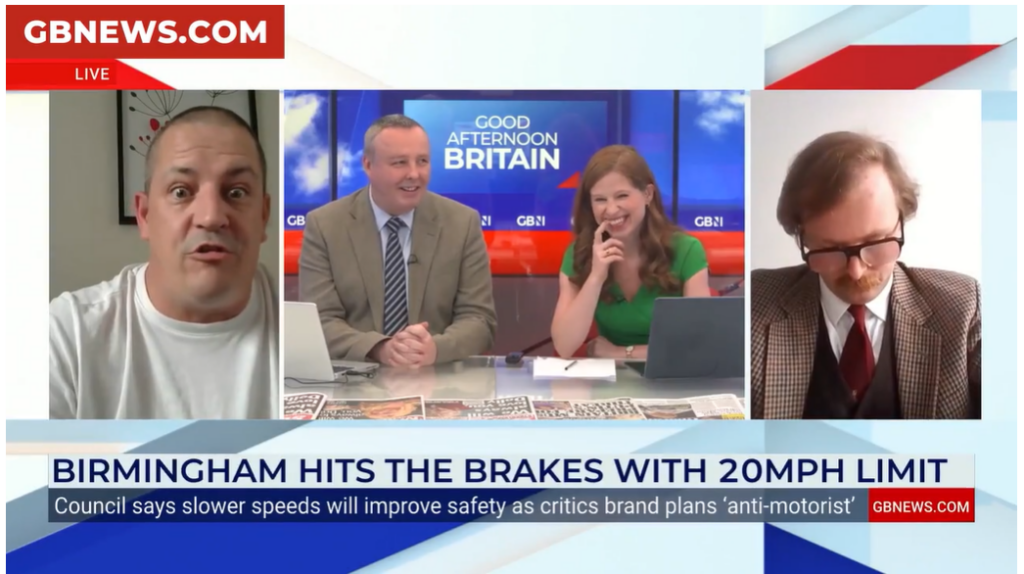

A camera cyclist once described as “Britain’s most hated” for reporting bad drivers was mocked on GB News for saying that speed limits are for “motorised vehicles” – a fact that went over the heads of the two presenters, one of whom asked if he was being serious during a debate on the planned introduction of 20mph speed limits on all non-A-class roads in Birmingham.
Dave Sherry was on the show to discuss Birmingham City Council’s plan to limit motorists to 20mph on all B, C and unclassified roads, a policy he argued would make roads safer for pedestrians and cyclists, and “make traffic flow even better”. The policy proposal – under discussion for years after Birmingham declared a road safety emergency in 2024 – was recently backed by the city’s road safety commissioner Mat MacDonald, who told BBC Radio WM: “Anyone who opposes these measures has to come up with a set of reasons, advantages, and benefits that eclipse the value of the human lives that will be saved by this.”
Before Sherry was able to debate with fellow guest Charles Amos – who would go on to claim that Birmingham’s 20mph limit would incur a net cost of £182 million due to “increased journey times” – host Mark White challenged Sherry about the behaviour of “most… or some” of his “cycling brethren” failing to obey speed limits.
When Sherry pointed out that speed limits are for motorised vehicles, White and fellow host Emily Carver erupted with laughter: “Are you really being serious”, said White, while Carver said the claim was “funny”.
‘I think it makes traffic flow even better.’
‘The costs are three times the benefits.’
Dave Sherry and Charles Amos debate the introduction of 20mph zones across Birmingham, as it’s set to become England’s first 20-mile-an-hour city, with the limit planned for almost all roads. pic.twitter.com/vej3xInaE7
— GB News (@GBNEWS) August 26, 2026
While Sherry is technically correct, because speed limits on public highways in the UK only apply to motorised vehicles (excluding compliant electric bikes, which are treated the same as standard pedal cycles in law), officers can use their discretion to charge or arrest cyclists with offences such as careless cycling, dangerous cycling, and ‘wanton or furious driving’ – naturally speed could be a factor here, even if cyclists cannot be given speeding fines specifically.
Councils can also enforce bylaws limiting pedal cyclists to certain speeds. Last year Wandsworth Council deployed officers with speed guns to fine cyclists travelling faster than 12mph on Tooting Bec Common, though it told road.cc the tactic was only being used “as a last resort for dangerous speeding and unauthorised cycling.”
Back in 2018, Bournemouth Borough Council spent £12,000 on digital signs reminding cyclists to keep to the 10mph speed limit enforced on Bournemouth’s promenade – Cycling UK said at the time that the money would have been better spent targeting “the few troublemakers, rather than vilifying all cyclists.”
Sherry – a London bus driver who also claims to be a qualified commercial drone pilot – is no stranger to media attention, and once appeared on Good Morning Britain described as “Britain’s most hated cyclist”. On the show, he claimed that he reported up to 70 drivers a week during a debate with Penny Malory, who complained that cyclists were unidentifiable and unaccountable. That appearance was off the back of Sherry’s participation in Channel 5’s controversial documentary titled ‘Cyclists: Scourge Of The Streets?’
Another thick-skinned display was needed in 2022, when Sherry was berated by a furious Jeremy Kyle about insurance, cyclists riding two abreast, and vehicle excise duty.

















52 thoughts on “Camera cyclist Dave Sherry laughed at by GB News presenters for correctly pointing out speed limits do not apply to cyclists during 20mph ‘debate’”
Odd: they laughed at Sherry, who was 100% right, but listened in silence to Charles Amos whose figures were laughable.
I wonder if he’d be of the same opinion that saving money is more important than saving lives if it was his parents or children that were next to be killed.
I feel all cyclists need to grow up on this issue. Cyclists cannot claim that 20 limits save lives, and in the same breath say they don’t apply to cyclists. I would say morally they do.
The legal position is a little greyer. Speed enforcement doesn’t work the same way, and it requires a Police Officer to make a non-endorsable charge where speed may be a factor and prosecution is very rare.
Highway Code rule 69 is quite explicit – obey all traffic signs and road markings – although of course this is simply a statement not the actual law and there are other errors in the Highway Code too (MUST stop at an advanced stop line on amber for example).
We need other road users to respect and look out for cyclists and pedestrians, and all those sharing the road following the rule book and looking out for one another is all part of this.
There is zero moral equivalency between a speeding driver and speeding cyclist. The capacity for harm and the likelihood of causing harm is so much greater for the driver, and this is bourne out in the statistics. 1,700 dead every year and 30,000 seriously injured; a tiny fraction of which can be blamed on cyclists not following rules.
Cycles are better than cars per urban mile travelled in terms of injuries contributed to, but not by as much as to justify complacently dismissing the issue. I don’t think it unreasonable for cycles to be expected to keep below 20mph in 20mph zones. That is a fair lick by any standards on a bike and considerably faster than the vast majority of other cyclists on the road.
@Ben Graham It is about energy, and to a degree momentum.
Kinetic energy is m*vv/2 so yes, a cyclist and bicycle (say 100kg) at 40kph has noticeably more energy than one at 31kph (50 times 40*40 vs 32*32) a driver and car at say 2000kg firstly has vastly more energy than the faster cyclist, and secondly the increase in energy of the car from 32 to 40kph is also a lot more significant.
One might think about frontal width and so on as well, but mostly consider the differences in energy involved.
Actually, specifying the limit in terms of energy might have a salutary effect on Range Rovers and suchlike.
@migex I’ve been guilty of this previously – that’s a simplification. E.g. not all the energy is transferred. I think it’s a reasonable proxy, but the collision dynamics are important.
There are different risks either way. Motor vehicles are wider, modern ones often with higher fronts so more danger of people going under them, cyclists quieter / often “unexpected”, some vehicles may have frontal energy absorbing measures, cyclist quite likely to be injured also etc.
I’d guess the main reason that motor vehicles are more dangerous is that it’s just much easier for drivers to reach (much) higher speeds.
Then exposure factors. Not certain but i guess cyclists may be more likely to interact with pedestrians in the UK and in more informal environments (shared use, pavement cycling). However there must be much greater exposure to motorists (given the fraction of people driving for x time).
Also the ability for drivers to see things is far worse as it’s significantly obstructed by the frame of the vehicle.
@Ben Graham wrote :
Could you tell me why this is an error? This is a genuine question as Gloucestershire police has declined to take action when drivers have crossed the ASL on red let alone amber and I am not sure I understand why.
@Bungle_52 Could you tell me why this is an error? This is a genuine question as Gloucestershire police has declined to take action when drivers have crossed the ASL on red let alone amber and I am not sure I understand why
It’s because, like many ‘I’m a cyclist myself; can’t we have more laws against cyclists?’ types, he doesn’t believe that drivers should stop for red lights at all if they don’t want to- just like Lancashire Constabulary, who agree ‘because everybody does it’
ttps://upride.cc/incident/kn13aus_knausmotorhome_doubleredlightpass/
@Bungle_52, the actual offence is failing to stop on a RED light, not an amber – if you follow the law reference it gives the less layman answer which the Highway Code attempts to simplify – usually very well.
A driver can lawfully go over the advanced stop line on an amber or green, and then have to stop at the normal line – often but not always as a result of poor planning.
In most situations I have seen a driver quite blatantly go over the advanced line on a red; to prosecute though, the Police would need the evidence that the driver went over the advanced line on a red, and most Police Services will apply a margin of some sort (as they do with most offences).
I hope that helps.
Uh, no.
@Ben Graham Thank you.
@mdavidford Wait – is that suggesting we need to take into account whether the *amber* was … established?
You have that the wrong way round, the advanced stop line is, as the name suggests, after the “normal” stop line, not before it. As for the legality of crossing the motor vehicle stop line on amber, that is only legal if the driver is already over the stop line when the light changes or is so close to it that to stop would potentially cause an accident, otherwise it is mandatory to stop, HC 175 “You MUST stop behind the white ‘Stop’ line across your side of the road unless the light is green. If the amber light appears you may go on only if you have already crossed the stop line or are so close to it that to stop might cause a collision.” Drivers can be, and sometimes (though not nearly often enough) have been, given fines and points for driving without due care and attention for deliberately accelerating when the light turned amber, even though it was not red when they went through the stop line.
@Ben Graham I have just checked the footage from my report. The driver crosses the 1st stop line 4 seconds after the light turns red. All on camera from behind the vehicle. No further action. So I assume the margin is at least 4 seconds.
@Bungle_52 The Met told me a couple of years ago when rejecting a submission that they needed a clear three seconds of red visible before they would consider it for an RLJ prosecution. I pointed out to them that this meant that at 30 mph a driver could see a light change to red from 40 metres away and still get through without sanction, or 55 m if they accelerated to 40 as most do. They just replied “them’s our rules…”
Hi Bungle,
I saw you follow-up comment. I can’t imaging there’s a tolerance of 4 seconds on camera enforced lights, seems an odd decision – an offence is committed if a vehicle starts crossing on a red, any tolerance is discretionary.
There does seem to be some odd thinking about ‘advanced stop lines’ where the rules relating to them are identical to a regular stop line, as explained correctly elsewhere in the Highway Code. It does seem a regular offence.
Where I live it doesn’t help that some of them are very faint and disappear in rain.
At best a very minor part I would suggest. Or: only when other things have been done first to allow this to work.
The power of “respect” to fix systemic safety issues and the notion that fundamentally different transport modes can all just “get along” are enduring misconceptions. I suspect this is because it fits our “folk psychology”
There is some truth to this. But it is most applicable under rather specific conditions: such as eg. the Dutch have engineered where their “sustainable safety” system suggests mixing is fine. That would be where the more vulnerable mode is numerically dominant and the harm that the faster / heavier one can do is limited by reducing their speed. *
And that others have “skin in the game” perhaps they or their family members regularly cycle.
Otherwise, as the occasional cyclist on a road with motor traffic, even at 19.5mph (a very rare speed for me) I am “in the way” for many drivers who *must* get past me. And if I filter past them when they’re stopped I’m “cheating” (don’t pay “road tax” etc).
Meanwhile, by the logic of the misconception, if people see videos online about youths in some other part of the country are tearing it up on electric motorbikes ridden illegally, apparently drivers and pedestrians would be justified in their “lack of respect” for me (whatever that means)?
Sounds like a hiding to nothing.
* There are a whole suite of infra details to cue this up plus societal “understandings” eg. everyone should be very clear about other modes being “legitimate transport” and what they and others are expected to do. That often isn’t the case in the UK…
If driving a tank on the roads required you to go no faster than 10mph would you then argue that all road users had a moral duty to go no faster than 10mph regardless of the actual risks?
Presumably, by the same logic, you think you shouldn’t cycle through a ‘No motor vehicles’ restriction, or drive anywhere with a height or width restriction, because the Highway Code demands you ‘obey all signs’, regardless of whether or not they apply to you?
@mdavidford I don’t know if this is the view of the poster but I believe those in the “vehicular cycling” camp would incline to that view.
Damn Forester. He’s the Thatcher of cycling.
The rule is incorrect by omission as it should in fact say “You must obey all applicable traffic signs”. If there are signs mandating lower speed or lane allocations for HGVs, they don’t apply to cars, for example. Speed limits do not apply to cyclists and therefore the signs also do not apply to them.
Just for interest, can you cite the last time a person in the UK was killed in a collision with a cyclist in which the cyclist riding in excess of the posted motor vehicle limit was a factor? I can’t (please don’t cite Hilda Griffiths as she stepped out in front of the cyclist when they were at a distance at which, as mentioned on here numerous times, the cyclist could not have reacted in time to miss her even if they had been riding at the motor vehicle limit or indeed considerably below it).
As for “morally they do [need to obey the speed limit]”, that’s simply nonsense. The law is there to mandate safe speeds for motor vehicles. There isn’t a speed limit law for cyclists as it isn’t necessary and there’s no moral obligation to obey a law that doesn’t exist. If you want to get into moral obligations, we all know that a pedestrian is five times more likely to be killed if hit by a car driver at 30mph than at 20mph, aren’t car drivers therefore morally obliged to drive at 20mph even in 30mph zones? Why not 10mph then? That would almost eliminate pedestrian fatalities in such areas. The law is there to create a balance between allowing efficient road user progress and safety, when a law doesn’t exist or doesn’t apply to certain road users the idea that there’s a moral obligation to follow it anyway is farcical.
@Rendel Harris yup – it’s about the big picture, balancing safety, convenience, what we can actually persuade people to do and all the other things we want from transport.
But clearly many people with no particular interest in cycling or active travel *are* open to the surface arguments about “same rules for everyone, fair’s fair” *.
Ideally in a stable system (eg. behaviour in public spaces – the roads) perception and facts should be in reasonable if imperfect alignment…
* Indeed that’s one reason why I very much doubt that the “just share the road” arguments get us very far – cyclists simply can’t follow some (unwritten) rules (keep at or near the speed limit) and others aren’t helpful – or even needed if cyclists have their own space eg. no need for traffic lights or roundabouts!
It was a road in public park and the spot where she was killed was in close proximity to warning signs to traffic of the need for caution as regards pedestrians. If they had been cycling with due caution it is much more likely that they could have stopped in time and very much less likely she would have been killed.
@Robert Hardy The lady was standing on a traffic island in the road giving every appearance of waiting for the cyclists to go by. She then, according to independent eye witnesses, for unknown reasons, stepped out in front of the rider when he was two metres away. Even at 15mph two metres takes 0.30 of a second; the baseline reaction time as employed by the guidance in the Highway Code is 0.67 seconds. To have had that amount of time to react (that’s to even start pulling the brakes) the rider would have had to be travelling at 7.5mph. The lady’s death was, sadly, caused by her own actions in stepping straight in front of a cyclist who had no chance to stop and would not have done even if he had been going at one third of his actual speed. That’s why no criminal proceedings were taken against the cyclist.
Just for your information, as you seem to think “it was a road in a public park” is somehow damning, the Outer Circle marks the outer perimeter of the park, and it is a very busy standard London road. The Daily Mail and The Evening Standard tried this “cyclists thundering through a public park” line with pictures of locations in the park where cyclists are banned, it has no validity.
@Robert Hardy As Rendel suggests, I’m not certain that any wheeled mode of transport – even at speeds well below the limit – would have avoided tragedy here.
Although the road around the *outside* of the park where IIRC this occurred (Outer Circle) isn’t “the main drag” (that would be e.g. Park Road / Marylebone Road) it is wide enough to put a question mark over “casual crossing”. And indeed there are signalised crossings…
Leaving aside “but racing cyclists!!” for now, looking at how safety might be improved here let’s see how others do this. For example: West End of the Vondelpark in Amsterdam is on a “main road” (Amstelveenseweg). (The rest are very much “streets”). What happens there where pedestrians are crossing to and from the park?
As it’s a main road (and with tramlines) there are cycle paths (in this case unidirectional). That means that everyone knows where everyone else is and what to expect.
The cycle path is really obvious, and it’s only a couple of paces wide. People expect cyclists in that section, but being narrow compared to the road lanes it’s simple to cross – so much so that no lights are used. cross. (Although unusually – presumably due to very high flows of pedestrians and cyclists – there is a *marked* crossing point).
Once you’ve negotiated the cycle lane you can then wait (again in “pedestrian space”) and concentrate on “watching for the cars” at a signalised crossing if needed (because it takes longer to cross the road part).
I think there is space in the Regents Park case for cycle paths of some kind…
I suggest that you look up “physics”, particularly the bit about the difference between a 10kg bicycle and a two-tonne tin box on wheels.
I think if “grown up” cyclists * are quibbling about ASLs we’ve very much missed the road safety point anyway. (Not to mention the wider “better transport choices” picture).
ASLs are poor-to-useless “cycling infra”, even for their design intent. If the idea is “for less confident cyclists” then a design that requires that you re-position in front of the motor traffic – waiting to accelerate – seems unhelpful. Of course they’re only designed to help when traffic is stopped, and you can reach the front in time and if vehicles aren’t already occupying them.
As we’re noting here drivers frequently ignore them – whether that be deliberate, a lack of road craft, because they were concentrating on following the vehicle in front, or because the paint has rubbed off.
* Aside: shouldn’t cycling also be safe and accessible for kids? Or should they only be allowed to do this when accompanied by sufficient qualified adults? Or be limited to parks and otherwise being driven around by their carers? Perhaps there is another way…?
Before I start arguing about whether cyclists are constrained by speed limits (it only leads to scoffing that they should be -and licensed, and insured, and number-plated, and anything else I can pull out of my cliche bag), I would:
– challenge the presenter’s assertion that he sees cyclists zooming by at over 20 mph in slow traffic – highly unlikely to be more than a rare event
– challenge the presenter’s description of being trapped in traffic, when he is the traffic he’s complaining about
– remind the presenter that, if he took to a bike, he could show other cyclists, based on his undoubted experience and knowledge, how to cycle properly – and he’d get around faster, to boot!
– in the first place and at the first opportunity, refer the researcher inviting me to the “interview” on GBeebies to the answer given in Arkell v Pressdram.
The only thing funny about this show is calling it a news channel. It is a propoganda machine for the cvnt that owns it who has huge investments in the motor and oil industry (and bent politicians). The presenters are paid to say whatever he wants them to say. I sincerely wish karma would come to them in the form of a 2 ton lump of metal travelling at over 40mph in a 20mph zone whilst they are claiming those zones are not needed.
@Muddy Ford “I sincerely wish karma would come to them in the form of a 2 ton lump of metal travelling at over 40mph”. The caring, sharing left again; violence is OK and justified as long as it’s directed against people who have a different viewpoint and perspective (SMH). All set for tomorrow’s hate march?
@RTB Do you understand what karma actually means?
@Muddy Ford
They don’t understand what ‘left’ means either.
The presenter says
“I do notice quite a few cyclists like yourself zooming by much faster than 20mph…”
A good pushback would be
“How do you know for sure they were above or much faster than 20?”
Would love to know where the figure of £182M due to “increased journey times” is from.
Given that a huge percentage of delays to drivers is being part of rush hour traffic and that AVERAGING 20mph would be unheard of, the best way to cut that be getting those who CAN cycle or use good public transport to do so.
Why is that we ‘whizz’ by at 20mph but hold traffic up doing 20mph?
I dunno, but apparently I’m incredibly annoying and entitled either way…
@cycling grandad
“Why is that we ‘whizz’ by at 20mph but hold traffic up doing 20mph?”
Schrodinger’s cyclist innit. Simultaneously too fast and too slow.
I watched this GB news section, and found it to be balanced and fair. Dave Sherry was extremely foolish to start with an opening gambit of claiming that cyclists can ignore speed limits, when we all know there are laws against careless and dangerous cycling. The interviewers were completely within their right to treat these comments with the derision they deserved.
If anyone is around from GB news and monitoring these comments, I would invite them to have a sensible cyclist like myself on the show, where I can demonstrate to their viewers that not all cyclists are militant anti-motorists, and certainly do not agree with blanket 20mph speed limits.
I would acknowledge real issues with cyclists ignoring traffic signals and routinely flouting laws, e-motorbikes, and the unfortunate culture war between cyclists and motorists, curated and promoted by the left.
P.s. Dave Sherry isn’t even close to being the “most hated” cyclist. That crown would be held by Cycling Mikey.
@jackcycles One should be informed by speed limits, not ignore them. Nevertheless, the limits per se are applied to motorised vehicles, and not to pedestrians, horses, or cyclists, and initially for the most obvious of reasons.
Luckily you’ll never be invited on. Although you probably could get on if you wrote to them to tell them that you think the ‘culture war’ between cyclists and motorists is being curated by the Left. That sounds like the sort of thing they’d love. The fact-averse, reactionary clowns.
GB News is a far-right fake news outlet run by racists, nationalists, homophobes and morons and they generally invite as guests dribbling knuckle-draggers incapable of forming a coherent sentence let alone a coherent argument, their only “virtue” being the ability to spew hatred against “the left”, the left in their view being actually the majority of decent, morally and socially responsible law-abiding citizens who don’t agree with their promotion of bile, hatred, misinformation and lies calculated to forment division, mistrust and violence to assist the interests of their billionaire, often foreign, backers.
Stone the crows though Nige, even they have some standards.
“Stone the crows though Nige, even they have some standards.”
Hence why I didn’t suggest you go on!
Rendy Vs Jack Cycles in a debate… That would be like Bambi trying to fight Godzilla 😂
So in your analogy I am the charming, caring creature that saves other animals through heroic actions and ends up as the new Prince of the Forest, whilst you are an horrific prehistoric lizard activated by pollution that blunders through civilisation smashing it in pieces by belching out yet more toxic pollution. Okay, seems fair.
I believe the accepted form for this kind of argument is “I know you are, you said you were, but what am I?”.
20 mph limits make traffic flow more smoothly. It’s a pro-car policy.
Woah. Deja vu.
Those who complain about the cost of these measures should simply Google “cost of road traffic collisions” and work out how long the ROI takes (and then add in the safety benefits)
I think ‘Ben Graham’ may well be a Lancashire Constabulary officer, because they are similarly mystified about ASLs as they are about most aspects of traffic law such as handheld mobile use, or unbroken white lines or whether a valid MOT certificate is reallynecessary when a vehicle is being driven on public roads. In practice, in Lancashire these disputes about the minutiae of crossing the SL and the ASL on amber or red are futile because the police believe you can just carry on across the junction if you were 30 yards away when the lights turned red, as I have demonstrated on here only too often
@wtjs Try Surrey!
@Surreyrider Don’t need to travel so far! This is Mini YE10 AJU- he must have thought he was already over the IVASL (Invisible Very Advanced Stop Line) and therefore, according to Lancashire Constabulary, entitled to continue over the Virtual Stop Line. Of course, there was no response from the police
GBTV is effectively Reform TV, so it was never going to be an easy ride for Dave. As for speed limits, we all have a duty to drive/ride in a safe manner.