
Will they accept that it's a highly dangerous road?
If you’re of a certain age, you may remember the ITN report on the A19.
Or, if you were out back then, maybe watching another channel or not even alive, you will be aware of it through the proliferation of archive accounts keen to share far and wide the minor embarrassment of this local councillor, whose words are fed back to him almost as he says them.
In any event, we appear to have a cycling-themed equivalent!
The London Cycling Campaign have crunched collision data and calculated the ten most dangerous junctions for cyclists in the capital. Worryingly, for the fourth year running, the most dangerous spot appears to be a junction with one of the city’s ‘protected’ Cycleways, CS7 on the Upper Tooting Road.
A quick look at the map, identifies the problem, with the lane seemingly creating a blindspot for drivers.
Whether drivers are automatically pulling up to and over the cycle lane because they can’t see oncoming traffic or they’re ignorant of the lane despite the paint isn’t clear, but the LCC are using the data to call for all-around protected junctions, as well as traffic modal filters on side streets.
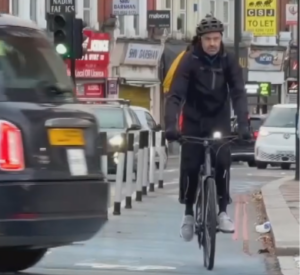
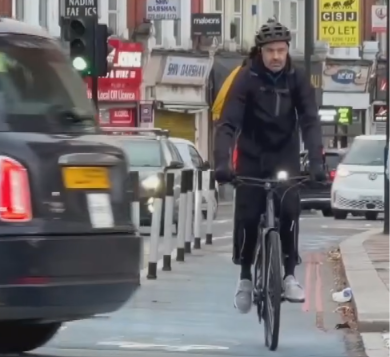
A little further along the Upper Tooting Road, the LCC’s Simon Monk is giving an interview to ITV when a driver crosses the cycle lane and causes a cyclist and son to brake very suddenly and come to a complete halt…
View this post on Instagram
“Exactly that. That right there is the danger. So we’ve got a kid on their bike with their dad, and what’s happening is these motor vehicles, these drivers here, are turning in and out, and they’re in a rush to get across to the next turning to cut across this main road.
“No one has dealt with these side roads, that’s the problem here and it’s been the problem for the fourth year in a row.”
Depressingly, the social media comments seem to suggest the cyclists using supposedly segregated cycling infrastructure are at fault:
“Bikes have brakes too! Eyes to anticipate like driver! They are able to calibrate there [sic] speed also it’s not all about right of way in [a] city like ours.”
“There should be Stop lines on the cycle lane to allow vehicles to exit the junction”
“I can’t see motorists rushing to get in and out of the junction. The cyclists are being treated as any other vehicle. If you’re trying to get out of a junction you creep into a gap in traffic and eventually get out. Cyclists need to be patient too.”
Maybe the worst comment of them all:
“Yes is dangerous! But a lot of cyclists ignore red traffic lights and zebra crossing too.”
Quite a bit of whataboutery there…
In terms of a response to the LCC’s findings, Helen Cansick, TfL’s head of Healthy Streets Investment Planning, told the BBC: “Our deepest sympathies are with everyone impacted by loss of life and injuries on London’s roads.”
She added TfL was working hard to deliver improvements at some of the capital’s “most dangerous and intimidating junctions”.
Will Norman, the city’s Walking and Cycling commissioner, also pointed towards planned upgrades at Monument Junction, and in Shoreditch and Streatham Hill. Suppose you have to start somewhere…
Winter is coming, stay seen!