


It does “not make sense to focus much police attention on cycling behaviour”, a former active travel commissioner has argued, after a new report in the Times revealed that the number of fines issued by the police to cyclists dropped to its lowest level in five years in 2025.
According to data secured through a Freedom of Information request by the newspaper, which gathered information from two-thirds of the UK’s police forces, 3,360 fixed penalty notices (FPNs) were issued to cyclists last year for offences such as cycling on the pavement or in pedestrianised zones, not having lights at night, or riding through red lights.
By comparison, in 2021 the same number of police forces issued FPNs, which normally constitute a £50 fine if paid immediately, to 6,083 cyclists. 4,339 cyclists were fined in 2024, 5,927 in 2023, and 4,674 in 2022.
The Metropolitan Police somewhat unsurprisingly topped the chart for cycling fines, handing out 1,491 FPNs in 2025, a number that fell by almost half compared to 2024, when 2,628 London cyclists were fined.
On the other hand, City of London Police are handing out more and more fines every year, with 1,123 FPNs issued to cyclists in 2025, almost double the 635 doled out in the Square Mile in 2023.
Earlier this month, City of London Police introduced a ‘sin bin’ for cycling offenders, offering them the opportunity to watch an educational road safety film from the roadside instead of paying the £50 fine.
Last September, we reported that the force was considering using Community Protection Warnings and Notices to issue stronger sanctions than £50 Fixed Penalty Notices (FPNs).
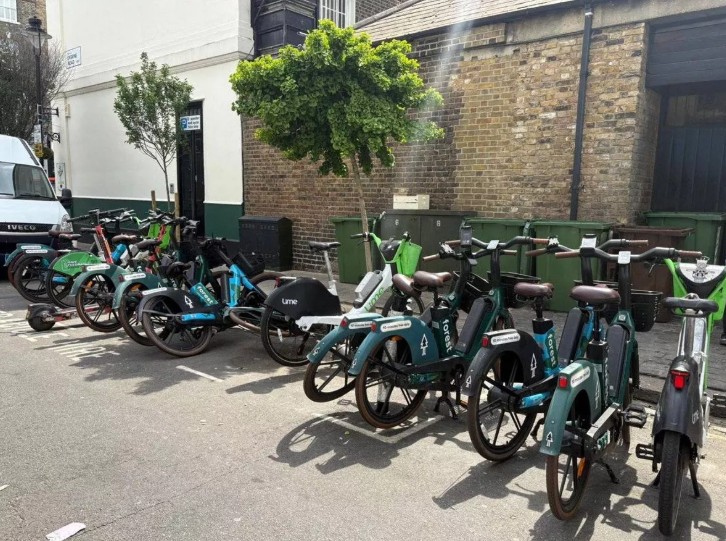
Officials reportedly expressed concern about “dangerous, anti-social, and nuisance cycling behaviours” such as red light jumping, with councillor Jacqueline Webster also suggesting promotion of a “culture of courteousness” among cyclists is needed due to the parking of dockless hire bikes.

The Times also found that, between 2021 and 2025, South Yorkshire Police and Merseyside Police were prolific when it came to cycling fines, handing out 827 and 753 FPNs during that five-year period.
However, the newspaper reported that some forces, including Durham and Northumbria, revealed that they hadn’t fined a single cyclist in the last five years, with Northumbria Police telling the Times that “we do not issue fixed penalties to cyclists” (it was not clarified whether this task was left to the area’s local authorities).
In 2025, no cycling fines were issued by police in Kent, Northamptonshire, and Lincolnshire, while Bedfordshire Police handed out four FPNs to cyclists between 2021 and 2025.
According to the data, Cambridgeshire Constabulary fined 49 cyclists over the five-year period, including five in one 12-month spell, all for failing to obey a traffic sign, the most common cause of cycling fines across the UK.
Speaking to the Times, Sarah Gayton, from the National Federation of the Blind of the UK, said the figures had left her “speechless, angry, and upset”.
“The public are at breaking point, faced with the constant daily onslaught of riders jumping red lights, riding on pavements and in pedestrian-only places and spaces,” she said.

“I have witnessed first-hand how annoyed and upset cyclists get when they are stopped for going through a red light. It is very clear to us that it appears that bad cycling has been decriminalised and giving them a green card to cycle wherever they want with no consequence.”
However, Adam Tranter, the former cycling and walking commissioner for the West Midlands, argued that cyclists, as vulnerable road users, should not be the focus of police attention when resources are limited.
“The reality is that the biggest danger to pedestrians is overwhelmingly drivers of motor vehicles. On average, more pedestrians are killed each year by cows than by cyclists,” he said.
“By comparison, in 2025 alone, 364 pedestrians were killed and 5,960 seriously injured, almost all of them hit by drivers of motor vehicles.
“In an ideal world, everyone would follow the rules of the road but with limited policing resources and competing priorities, if you want to improve road safety, it does not make sense to focus much police attention on cycling behaviour.”
As Tranter notes, according to the Department for Transport’s road casualty statistics for 2025, most pedestrians killed or injured in reported road collisions were hit by motorists.
245 of the 364 pedestrians killed last year were involved in incidents with drivers (67 per cent of all pedestrian fatalities), and overall there were 15,222 pedestrian casualties involving motorists (76 per cent of all pedestrian casualties).
By comparison, cyclists were involved in just two incidents which resulted in a pedestrian fatality in 2025 (one per cent of all pedestrian fatalities), while 718 pedestrians were injured by cyclists (four per cent of all pedestrian casualties).
In a statement, the National Police Chiefs’ Council said: “We must all take responsibility for keeping everyone safe on our roads and any behaviour which puts other road users at risk is unacceptable.
“Police forces are operationally independent and decisions around enforcement are at the discretion of local teams, taking into account a number of factors.”
This isn’t the first time the Times – which in 2012 launched its award-winning ‘Save Our Cyclists’ campaign calling for better protection for people on bikes – has gathered information from the UK’s police forces to bemoan the apparent lack of action when it comes to “law-breaking” cyclists.
Back in 2017, the newspaper published a strikingly similar article which revealed that 3,590 cyclists had been fined the previous year – down from the crackdown-associated high of 15,297 in 2013 but, interestingly, roughly the same as 2025’s total.
In April, City of London police officials urged cyclists in the capital not to “gamble” that pedestrians will move out of the way, after it was revealed that the number of people on bikes caught running red lights had doubled in the past year.
The data, covering the period from the start of April 2025 to the end of March 2026, revealed that the force’s cycle team issued 1,315 fixed penalty notices to cyclists for riding through red lights – compared to the 643 cyclists caught committing the same offence during the previous financial year.
However, that fine tally is roughly similar to the number of fixed penalty notices issued in 2023-24, when 1,229 red light-jumping cyclists were fined in the City of London.
Last year, Kensington and Chelsea Council was forced to backtrack over a fine issued to a cyclist, admitting the £100 FPN should never have been given to the rider who was using a shared-use crossing when he was stopped by an enforcement officer.
“I was cycling very slowly and she caught me by surprise. She said: ‘Please show me your ID’,” Dr Paulo Ceppi said at the time, questioning if the decision to stop him there was an “insidious, unjust tactic” to “trap” cyclists and make money.










28 thoughts on ““Bad cycling has been decriminalised” warn campaigners as Times reveals some police forces are not fining ‘law-breaking’ cyclists – but others claim “it doesn’t make sense to focus on cycling””
So what?
Law breaking drivers are not being fined either.
In fact the ones around here are even being called ‘good drivers’ by the police!
https://www.bbc.co.uk/news/articles/cvlyd1dx6139o
@saw442000 Emily Booker, from the safety partnership, explained for many drivers it’s a moment of poor judgement, so we don’t want to prosecute otherwise good drivers
Ho! Ho! For many drivers in Lancashire these moments can last a couple of years (of No MOT or Failed MOT, for instance) and the police still do nothing
@wtjs Every – and I mean EVERY – close pass is a deliberate active choice to prioritise driver convenience over the life of a another human being.
Don’t want to prosecute them? Sure. Offer them a driver improvement course, or points and a fine. You’ll find out soon enough if it’s actually a “moment” of poor judgement, because if it isn’t then they’ll be back up again.
Let them off, and you’ll never know – because every time will just be another “moment”.
@saw442000
“… we don’t want to prosecute otherwise good drivers.”
Well, if such good drivers do something that would be a straight fail on a driving test (thus proving they shouldn’t have a licence) … what then?
@mitsky I agree, how good can a driver if they don’t know the highway code or understand the law.
Also wouldn’t the money be better spent on targeting this lack of knowledge at the population as a whole rather than one person at a time.
@saw442000 Ahh yes…
In an 1hr30 commute in the rain today had 1 driver turn across the cycle lane I was in and 2 drivers look straight at me (and my bright red helmet and flashing front light) before pulling out regardless (2 forcing emergency stops; still no idea how I managed to squeeze past the driver turning across the cycle lane as I didn’t have enough time to grab the brake at all!)
I suspect these are the ‘otherwise good drivers’…
I do wonder if part of the solution would be to allow police to issue a certain amount of points with the reasoning + evidence being documented at the time; Then if the driver gets more than X points (e.g. enough for ban/suspension) the evidence is THEN reviewed in court for all of the offences as a whole rather than going to court for each offence.
Of course I suspect the issue with this is currently the main penalty for points on a driving licence is insurance costs… So you’d get massive complaints about running up insurance costs ‘without a fair trial’…
(I also think there is a lot of bad driving where 1 point should be a suitable penalty; but we seem to never issue less than 3 (so WTF have a 12 point system).
@qwerty360 I’ve been suggesting the 1 point system for years. The new AI cameras can pick up thousands of incidents in very short periods so this would really work against repeat offenders.
I suspect that what we really need is complete review of the law (which we were of course promised in 2014).
“(I also think there is a lot of bad driving where 1 point should be a suitable penalty; but we seem to never issue less than 3 (so WTF have a 12 point system).”
@Backladder I’m going to take a wild guess that this offence has not been enforced anywhere in the last five years.
But also … if there’s a designated “play street” where motor vehicles aren’t allowed, why the heck is the penalty only two points anyway!?
@qwerty360 a points system you say? You mean like the current one, where for thousands of drivers points mean… nothing, with a half-competent legal advisor, a sad story and magistrates willing to look especially sympathetically on human fallibility while driving?
@saw442000 I’m just about to take the dog out for his night time walk and fully expect to see no illegally parked cars, speeding drivers or drivers overtaking parked cars into the path of oncoming traffic.
Unfortunately, my expectations will be dashed – again.
No – 245 of the 364 pedestrians killed last year were involved in incidents with car drivers. Another 105 pedestrians were killed in incidents involving drivers of lorries, buses, motorbikes and vans.
https://www.gov.uk/government/statistics/reported-road-casualties-great-britain-final-results-2025/rrcgb-2025-vehicles-involved#casualties-in-collisions-by-vehicle-type
(Oddly enough, the numbers in “Chart 6” on that page don’t actually match the numbers in the accompanying Table RAS0601 spreadsheet. I’ve used the spreadsheet numbers but the Chart 6 numbers are very similar – presumably just minor corrections have been made.)
If the police pulled every driver over for every driving infraction, most of us wouldn’t get to the end of the street.
@Terry Hutt Thats the funny thing isn’t it. Bad driving is so utterly normalised that people don’t even realise its happening most of the time. Anyone who walks, cycles and drivers notices it. The complete lack of respect for the rules from most people but the monumental majority of the dangerous stuff is from cars.
Every single time I go out on my bike I have multiple drivers do stupid things around me. Dangerous things. Things that would be an instant fail on a test and should be getting drivers points but wouldn’t. Blind corner overtakes are absolutely standard. Like, I reckon one in 5 cars that comes up behind me when there isn’t a safe place to overtake immediately will role the dice on overtaking unsafely.
People mistake safe and good driving for convenient driving. As soon as you become inconvenient, a lot of drivers become bad and dangerous drivers. The complete lack of enforcement against bad drivers just emboldens and normalises it.
How we are talking about cyclists as the main danger on our roads despite all the stats these days is mind boggling.
@mctrials23 how? Because “others” – fuelled by the gutter press and schools not teaching critical thinking.
@Terry Hutt and, the problem with that is?
@OnYerBike: it’s strange that there are never any media articles or programs about all the killer drivers, but lots of adverts for cars.
@kingleo It’s like they’re connected in some way…
@kingleo …what you need to realise is that the roads in those adverts don’t have anybody else on them (not even other cars) so it’s only right to deduce that drivers can’t possibly collide with anybody 😉
Ah, the good old National Federation for the Blind, “The Voice of Britain’s Blind People!” with 4,553 Twitter followers and a membership that they refuse to disclose when asked, as compared to the Royal National Institute for the Blind which had 50,000+ followers before it quit Twitter and, although it doesn’t have members, directly helps more than 100,000+ blind/partially sighted people each year. NFBUK is a monomaniacal organisation with an hysterical focus on active travel (their latest posts are wailing about the pedestrianisation of Oxford Street) and little else.
@Rendel Harris I think you mean the good old National Federation for the Blind;
Whose total budget (per charities commission) when I last checked was comparable to what a local rotary club spent running social events for local blind residents…
“The figures left me speechless, angry and upset!”, said Sarah Gayton of the NFB, speaking to the Times.
Aha! Caught out in a lying exaggeration.
“The cyclist sped through the red light at the pelican crossing, mowing me down and killing me in the process. I reckon he was travelling at well over 60mph. And then to make things even worse, he streaked through the cemetery at my funeral, doing wheelies, making me turn in my grave!”, said Mrs Fruithat, FNB treasurer, speaking to the Daily Telegraph.
Well, bike theft has also been de-criminalised. So quid pro quo I guess.
@Clem Fandango And speeding, phone use while driving, drug driving, driving without insurance, MOT and/or licence…all pretty much unchallenged unless you are in an incident when doing them in which case you might sometimes get condign punishment (unless you hit a cyclist of course).
Isn’t the language being used here incorrect?
“Bad cyclist”??
Wouldn’t that be someone who is bad at cycling, rather than cycling in a dangerous manner and potentially causing harm to others?
We wouldn’t say the same about drivers.
A “bad driver” would be someone who is incapable of driving a car/vehicle without doing basic things such as stalling regularly, failing to turn adquately etc.
(The driving test is there to weed out dangerous drivers, ie those who can’t control the vehicle safely on roads with others around them.)
At the end of the day, most people can cycle on a bicycle once taught.
Those that have trouble keeping balance can use an adult sized tricycle.
I’ve seen someone who seemed to have Parkinsons using one and he was safely cycling on the road no problem.
There are various other options available for anyone else who has other physical limitations.
@mitsky as someone who pays attention to language, isn’t it that “bad cyclist” actually carries a moral tone? More like “evil cyclist”? (Obviously some people would say that’s an oxymoron).
https://www.bbc.co.uk/news/articles/c63elww8djj1o
Meanwhile life-threatening driving has been officially decriminalised in Derbyshire. Times has been strangely silent on that one. Wonder why?