


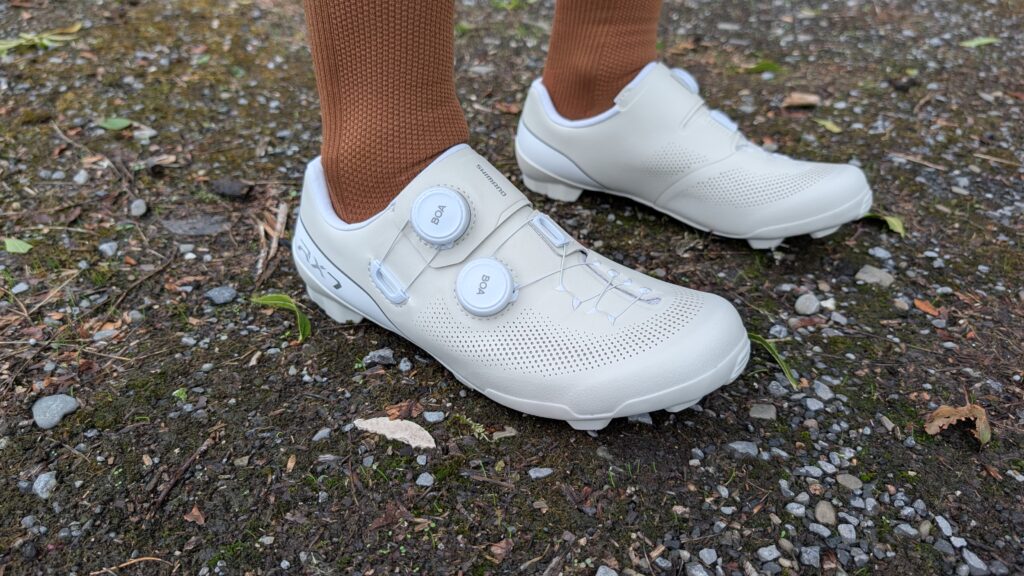

Shimano has finally introduced a fit system that caters for a wider range of riders, with the RX710 the first model to feature its new Dynalast 2.0 design. Offering more forefoot room, excellent comfort and a good balance of stiffness and walkability, they make a strong all-round gravel shoe. However, with a retail price that puts them up against some of the top shoes from rival brands, they are a harder sell on value alone.
Shimano RX710 shoes – Technical Details
The Shimano RX710 is a gravel race shoe that combines a relatively stiff, carbon-reinforced sole with Shimano’s new Dynalast 2.0 fit system and a distinctive pontoon cleat design that’s intended to improve stability on the pedals. At £270, it sits firmly in the performance category, but its most significant feature could be the one that has little to do with racing: a redesigned fit.
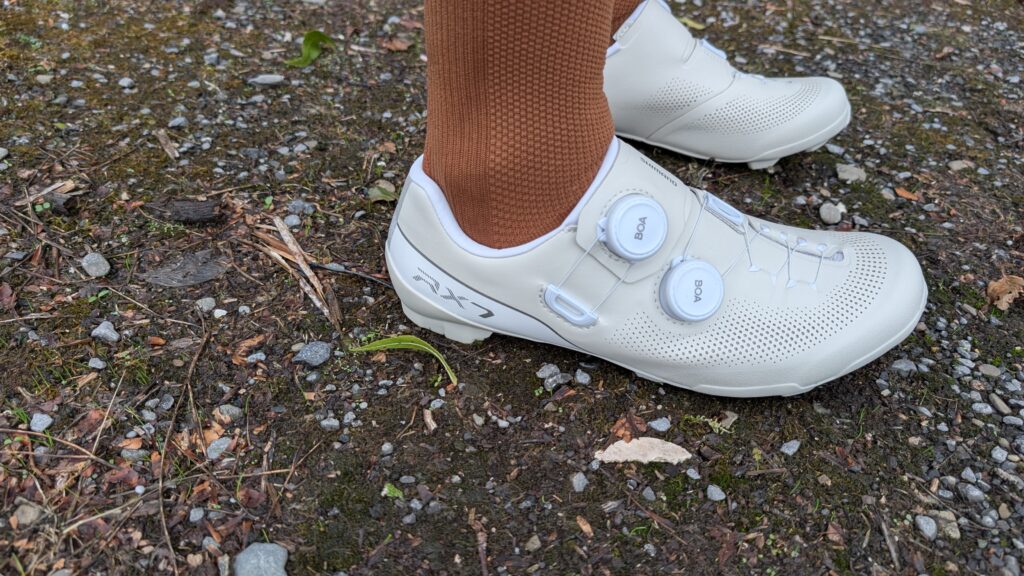
The new last provides more room around the forefoot, allowing the toes to spread more naturally. As Shimano puts it, the system is “built for more riders’ feet”. It is not simply a case of making the shoe wider, but of increasing the volume around the toes while maintaining support through the midfoot and heel. The technology has since appeared on the RC910 and RC810 road shoes, and I expect it to become more widespread across all Shimano shoe ranges.
Dynalast 2.0 shoes are offered in Narrow, Standard and Wide fits, although availability varies by market and size. At the time of testing, the UK range was more limited, with the Wide option and some half sizes unavailable. This is worth bearing in mind if you are considering the RX710, as the fit options could be just as important as choosing the correct length.
Shimano quotes a 4% increase in volume and 3mm more width for the new Standard fit compared with the previous version. The Wide fit increases volume by 7% and width by 6mm, while the Narrow fit has 2% less volume and is 1mm narrower than Standard. The Narrow option is therefore closer to the previous fit in terms of volume, while retaining the revised forefoot shape.
Personally, I have struggled to wear Shimano shoes comfortably for many years without sizing up to gain extra width. That has usually left me with shoes that are longer than necessary, so the changes here are particularly welcome.
Beyond the new fit, the RX710 is a mid-range gravel shoe that borrows several features from the flagship S-Phyre RX910. Chief among them is Shimano’s pontoon cleat system, which increases the contact area between shoe and pedal to improve stability. The replaceable blocks sit on either side of the SPD cleat and move with it, maintaining contact with the pedal as the cleat position is adjusted. The system is designed to work with Shimano’s XTR PD-M9200 and Deore XT PD-M8100 pedals, although compatibility extends to other suitable SPD pedals.
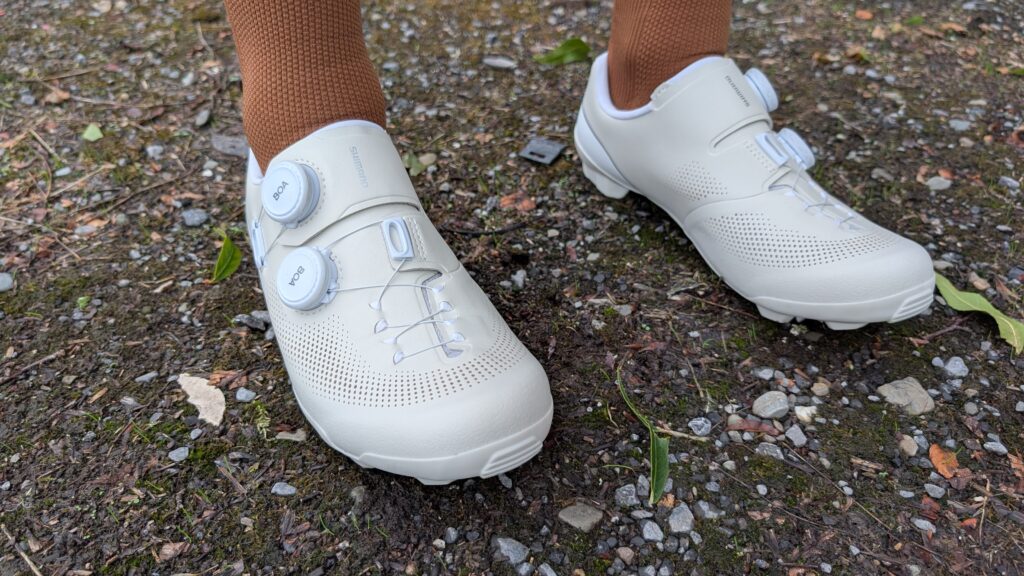
Looking at the outsole, the difference between the RX710 and Shimano’s XC mountain bike shoes is clear. The tread is minimal, with a small number of lugs and no provision for adding toe studs. That makes sense for a shoe aimed primarily at gravel riding, although it limits its appeal for riders who regularly venture into muddy terrain, cyclo-cross, or more technical terrain.
The RX710 uses two BOA L6Z dials, matching the general arrangement of the RX910 but not its higher-specification Li2 dials. The L6Z system allows incremental tightening, but loosening requires pulling the dial upwards, which releases all the tension. The superior Li2 dials on the RX910 allow finer adjustment in both directions.
The sole has a Shimano stiffness rating of 9 out of 12. These ratings are useful for comparing models within Shimano’s range, but they do not provide a meaningful direct comparison with other manufacturers. In practice, I found the RX710 far more flexible than the stiffest race-oriented shoes, such as the Lake MX333, although not to the extent that I could feel the sole moving under power.
The RX710 is available in three colour options, including the sand white on test, as well as black and navy. The size range varies depending on fit, and the Shimano website currently shows the Narrow available in EU36 to EU44; the Standard width has the broadest range, with 38 and 50 with ½ sizes between 39.5 and 46.5, while the Wide fit is available from 38 to 48 and ½ sizes between 39.5 and 46.5. This gives a huge range, and one that is only matched by specialist brands like Lake.
Shimano RX710 shoes – Performance
Given my difficulty with previous Shimano shoes, I was able to test two different sizes, with the initial EU41 and later an EU40. Typically, I fall within this range for most shoe brands and must use a 41 for shoes that have a narrower front foot area. The RX7 feels much wider, and the 41 felt longer than I was comfortable wearing. The 40 was a far more comfortable fit, although it would limit me to only using thinner summer socks. In an ideal world, a 40.5 would be the best option, although in the UK at least, the RX710 is only available in full sizes, and in either standard or narrow volume options.
To give a comparison against other shoe brands, I am a 40.5 standard for Lake in its Race Last range and a 41 in Fizik, DMT and Giro, although each of those is larger for the increased width, rather than simply in length. The size 40 shoes weighed in at 277g each, and when comparing with the pontoon and cleat as well, the total weight is 319g (638g pair).
Fitting the pontoon cleat is simple, and the shoe has been designed in conjunction with the pontoon. While it would be possible to use the shoes with other brands’ pedal systems or a version without a pontoon, I did not have the opportunity to test this.
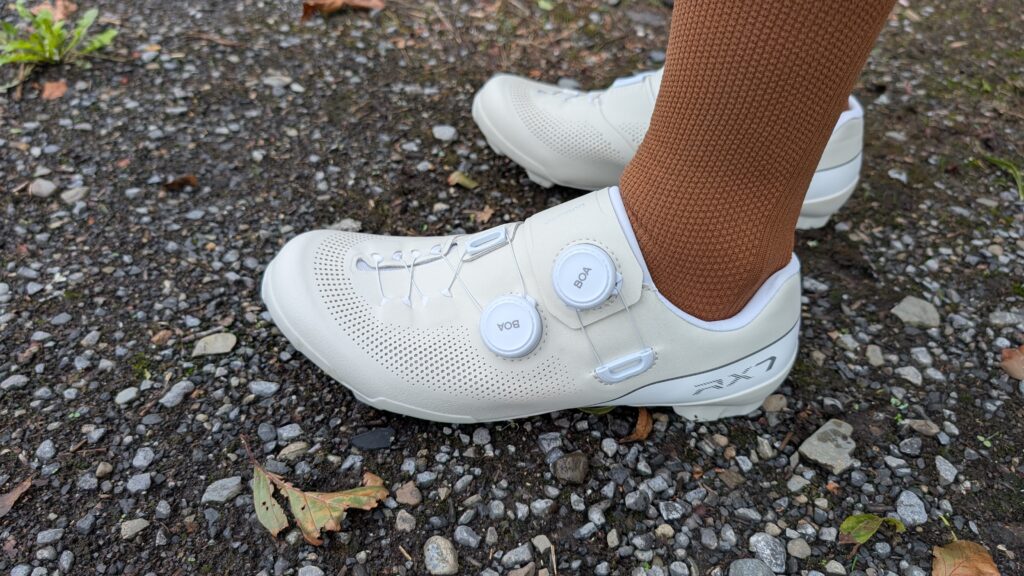
The shoes have a wide top strap that wraps over the entire foot, and this makes the shoes easy to get on and off but also gives plenty of security. The lower strap is quite close to the upper strap, and despite the Boa threads being placed reasonably low down, I didn’t feel it had the greatest effect on tightness around the toe box and forefoot area. Having Boa L6Z dials means that tightening and taking them off is easy, as you can just pop the dial upwards and it releases all the tension. Given the price, at £270, I think it would be reasonable to expect to have the top-level Boa Li2 dials. I can only assume this is done to give a bigger upgrade path to the RX9 model, which also features a stiffer sole and a carbon midsole, rather than simply a carbon-reinforced midsole. The big problem is that, for now at least, the RX9 doesn’t have the new Dynalast 2.0 last sizing.
Riding with the pontoon system on the cleats and using Shimano XTR pedals, there is a noticeable difference and a greater feeling of connection, with less movement. In theory, the float in the cleats is still there; it’s just that the shoe feels more connected to the pedal, so you feel less of it. I found the shoes harder to clip in than standard cleats, requiring an extra downward push. While this is fine for general gravel or road riding, I wouldn’t want to use the shoe and pedal combination for any MTB or cyclocross riding.
While the insole has some shaping and moulding, it is quite basic, and Shimano doesn’t provide any extra spacers to raise the insole and give more support for riders who might have a high instep, as they have on some previous shoes.
The comfort generally has been very good, and I have used them for long all-day rides and races with no discomfort at all and quickly got used to the shaping. While the white/sand colour isn’t the best option for riders who regularly ride in muddy conditions, the main areas clean up quite well, but the fabric sections tucked into the shoe make them harder to clean.
Shimano RX710 shoes – Verdict
Beyond simply the shoes, the updated Dynalast 2.0 fit system is a big step forward for Shimano, and it will ensure that more shoe models they produce will give a better fit for more people. This is assuming it is rolled out across the other ranges, although I am sure this will happen. I also hope that more size options will eventually become available in the UK, with some half sizes and the wide fit option, which should ensure that all riders and foot shapes are supported.
For the RX710 shoes, the comfort and performance are excellent, and the new pontoon cleat system is fantastic for gravel riding, or perhaps to use on road shoes and keep a dual-sided pedal and have shoes that you can walk in more easily than road shoes.
What doesn’t stack up is the price and what is offered. £270 for a second-tier shoe that lacks micro-adjust boas, a basic insole and a more flexible sole than many race-oriented options that would be more typical for shoes at this price bracket. For many, the idea of a gravel-focused shoe will seem pointless, and among many brands the differences over MTB shoes are minimal, but for the RX7, the pontoon cleat system does add a tangible difference.
Among other brands, the Lake MX30G is the gravel-focused option, and has an equally broad size range, Boa Li2 dials and a full carbon sole for £275. The MX333, upon which it is based, shares many of the same features and adds an element of custom-fit for £400, although it is a heavier shoe compared to the RX7 or RX9 models. For the same price range, the QUOC Gran Tourer XC are £240, although limited in the size options; the Bont Riot G are £209, and SIDI Physis are a little more at £300, and will change any stereotypes you might have about SIDI shoes only suiting those with narrow feet.
Shimano has delivered an improved fit system that will suit a wider range of riders, while also giving a great blend of comfort and performance to suit most gravel riders. The only issue is the price, and there are lighter, stiffer, and more versatile shoes available for the same money.
Test Report
What does the manufacturer say about this product?:
Shimano says:
Race-proven performance for riders chasing adventure, competition, and exploration
Shimano introduces the new SH-RX710 gravel shoe, a high-performance off-road shoe inspired by the S-PHYRE RX910 and designed to bring premium race technology to a broader range of riders. Whether lining up for a gravel race, exploring remote backroads, or embarking on an all-day adventure, the RX710 delivers the efficient power transfer, secure fit, and lasting comfort needed to ride further and faster across mixed terrain.
As gravel riding continues to evolve, riders are increasingly seeking equipment that performs across a wide range of experience levels. One weekend may involve chasing podiums while the next could mean exploring unfamiliar roads deep in the mountains. The RX710 was developed to meet those demands, balancing race-focused efficiency with all-day versatility.
At the heart of the RX710 is a lightweight carbon-reinforced midsole with a stiffness rating of 9 out of 12. This creates an efficient pedaling platform that helps riders maximize every watt while maintaining comfort for long days on the bike. A low stack height construction enhances the connection between rider and bike, delivering a stable and responsive feel whether accelerating on smooth gravel roads or navigating rough, technical sections.
The RX710 also features Shimano’s innovative Pontoon Cleat System, which delivers a more stable interface between shoe and pedal while simultaneously providing confident walkability off the bike. The result is a secure pedal engagement and enhanced control across changing terrain.
A lightweight synthetic leather upper balances breathability, durability, and comfort, helping riders stay comfortable during long training rides, race-day efforts, and multi-hour adventures. Dual BOA® fit system L6Z Dials allow for precise micro-adjustments and a secure fit that can be quickly tuned as conditions and riding intensities change.
From race-day attacks and weekend training rides to remote gravel adventures, the new RX710 is built to help riders push further, ride faster, and discover what lies beyond the next turn.
Tell us some more about the technical aspects of this product:
Shimano lists:
Sizing Note:
Riders who currently wear a Standard fit can expect a roomier toe box, while those who previously sized up for extra width or toe room may prefer to size down by ½ size for a more precise fit. The new SHIMANO DYNALAST 2.0 Wide fit is noticeably roomier than both the previous DYNALAST Wide and Standard fits, offering increased width and a larger toe box. Women riders and anyone who prefers a snugger, performance-oriented fit may find the Narrow option provides the best fit.
• Carbon Reinforced Midsole (Stiffness Rating 9/12): Efficient power transfer while maintaining comfort on long rides
• Seamless Midsole Structure: Reduced stack height and improved pedaling efficiency
• Pontoon Cleat System: Enhanced stability and secure pedal engagement for confident control
• Lightweight Upper Construction: Synthetic leather increases breathability, comfort, and durability
• Dual BOA® fit system L6Z Dials: Micro-Adjustable fit and secure closure on the fly
• SHIMANO DYNALAST 2.0: Updated fit platform to fit more riders
• Claimed Weight: 315 grams (size 43)
Any further comments on quality?:
Typical Shimano standard, they are clearly well made and durable materials used.
Any further comments on performance?:
At this price, I think Boa Li2 dials would be reasonable to expect.
How does the price compare to that of similar products in the market, including ones recently tested?:
They are expensive for a second-tier shoe that has a basic Boa dial and doesn’t have a full carbon sole. Lake has the MX30G for £275, and the MX333 with some custom-fit in the upper for £400. The Bont Riot G (https://road.cc/content/review/bont-riot-g-313315) are £209 and SIDI Physis (https://road.cc/offroad/content/review/shoes/sidi-physis-shoes-review-17487) are a little more at £300.
Any further comments on fit?:
Great fit and three width options available.
Any comments on sizing? Did they size up too big or too small?:
I sized down compared to previous Shimano shoes that didn’t have Dynalast 2.0
Any further comments on comfort?:
Wide size range in theory, although no ½ sizes in the UK currently, and no wide fit option, although the standard is much wider than previous Shimano models.
Any further comments on ventilation?:
It is nearly all covered in material that stops air, but also allows them to stay drier through puddles and showers, but ventilation is OK with air channels in the sole and parts of the upper.
Any further comments on water resistance?:
They are not waterproof, or even claim to be for wet weather, but they feel surprisngly good on wetter rides.
What type of closure system does the shoe use?:
Dual Boa L6Z on each shoe.
Any further comments on the closure system?:
Boa dials are fantastic, but for the price, I think it is fair to expect the shoes to be fitted with Boa Li2 dials, which have micro release and micro tension.
Any issues with durability?:
No. Despite being almost white, they cleaned up quite well. Although personally I would still avoid the white colour if you will regularly get them muddy.
How easy is the shoe to clean?:
Very easy, which you will need given the bright white colour and off-road design. There are some areas of knitted fabric that are harder to reach and clean than the basic overall upper.
Did you enjoy using the product? Yes
Would you consider buying the product?
Yes, although I would look for a 1/2 size option
Would you recommend the product to a friend?
Yes, with some caveats.
Use this box to explain your overall score
The Shimano RX710 delivers excellent comfort, an improved fit and a genuinely useful pontoon cleat system for gravel riding. However, the £270 price tag is difficult to justify given the basic insole, less refined BOA dials and relatively flexible sole compared with similarly priced alternatives. A very good shoe, but one that falls short on value for money.
About the tester
Age: 42Height: 168cmWeight: 61kg
I usually ride: Road / Gravel / MTBMy best bike is: Cannondale SystemSix (road)
I’ve been riding for: Over 20 yearsI ride: Every dayI would class myself as: Semi-pro or ex-pro
I regularly do the following types of riding: Cyclocross, Gravel riding, Indoor riding, Bikepacking, Audax, Mountain bike XC
