The Tour de France is defined by the images it conjures. The colourful blur of the peloton as it whizzes through a quaint village. The stunning landscapes that provide sport’s most vivid stadium, from spectacular high mountains to never-ending sunflower fields. The sea of passionate fans at the roadside.
The job of the cycling photographer, then, is to capture and distil these images into one singular moment, slowing down time amid all the speed, energy, and chaos of the Tour.
James Startt knows this more than most. After all, Startt is twice a winner at the World Sports Photography Awards and is currently covering and photographing his 37th Tour de France. That means he has more Tours under his belt than Mark Cavendish has stage wins at cycling’s biggest race.
This year, he’s been travelling with road.cc, following the Tour as it takes in the bustling buoyancy of Barcelona to the sandy beaches and stunning coast roads of Catalonia, and back through the majestic Pyrenees to France.
To celebrate the first ever Barcelona Grand Départ, James has picked out his favourite shots from the race’s Catalan detour, giving us some insight into the life of a Tour de France photographer.
Words and images James Startt:
Sagrada Família, Barcelona
Ever since the Tour de France announced it would start in Barcelona this year, I knew exactly where I wanted to be for stage one: beneath the Sagrada Família, the masterpiece of Catalan Modernism.
While not officially a cathedral, the Sagrada Família dominates the city’s skyline like nothing else. Conceived by Antoni Gaudí, widely regarded as the father of Catalan Modernism, it has often been described as Art Nouveau on steroids – and it’s hard to argue with that.
The idea of photographing the Tour de France riders racing beneath one of the world’s most extraordinary buildings had captured my imagination long before the race arrived. The only question was how – and from where. The team presentation offered an early preview, but it was a visual letdown. It took place beneath the church, directly into the setting sun, making for a scene that was far more challenging than inspiring.
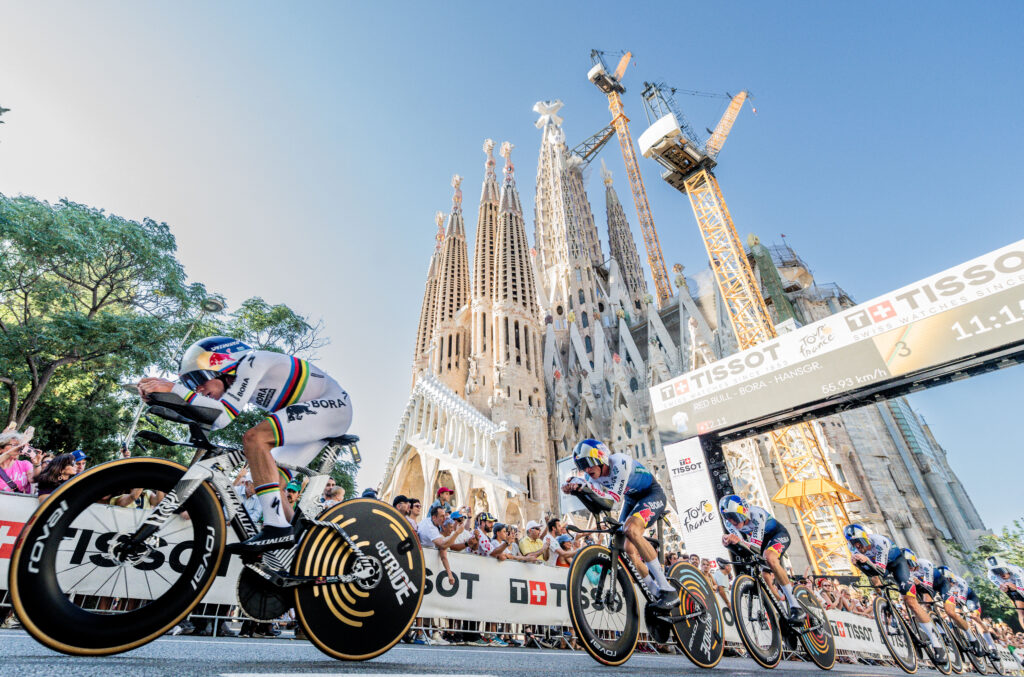
Race day, fortunately, was a different story. The course approached from the opposite direction, offering far more favourable light. I arrived more than three hours before the first team was due to pass and had the place almost entirely to myself, giving me first choice of shooting positions. It didn’t stay that way for long. Before long, photographers began filling every available space.
I managed to secure a spot almost directly beneath the church, though it wasn’t quite perfect. I could certainly have done without the construction cranes, which were still standing despite reports that the basilica had finally been completed earlier this year. The Tissot timing arch wasn’t exactly my favourite addition either. But time splits are part of the race, and, well, this was the Tour de France, not an architectural photo shoot.
Soon enough, riders rolled through on their reconnaissance laps of the team time trial course, followed by the Tour’s colourful publicity caravan. Then the countdown was over. The first team flew into view, and suddenly everything I’d spent hours preparing for was happening in a matter of seconds.
That’s often the way it goes. On days like this, it’s the planning, logistics, and patience that consume most of your time. The photography itself is over almost as soon as it begins. But standing beneath Gaudí’s masterpiece, watching the world’s greatest cyclists race past one of the world’s most iconic landmarks, made every minute worthwhile. Some photographs are about timing. Others are about place. Every now and then, you’re lucky enough to have both.
Merci Barcelona!
Preparing the shot is central to good photography. But all too often, the anticipated image doesn’t materialise as expected. Today was a case in point.
Looking at the profile for Stage two, I was certain the money shot would come on the road that snaked along the Mediterranean Sea midway through the stage. And after talking with Tour de France race director Thierry Gouvenou, I was convinced the best vantage point would be just beyond the town of Sitges.
And it was. The only problem was that my image didn’t even mildly capture the beauty of the peloton stretched out along this sinuous, rocky road.
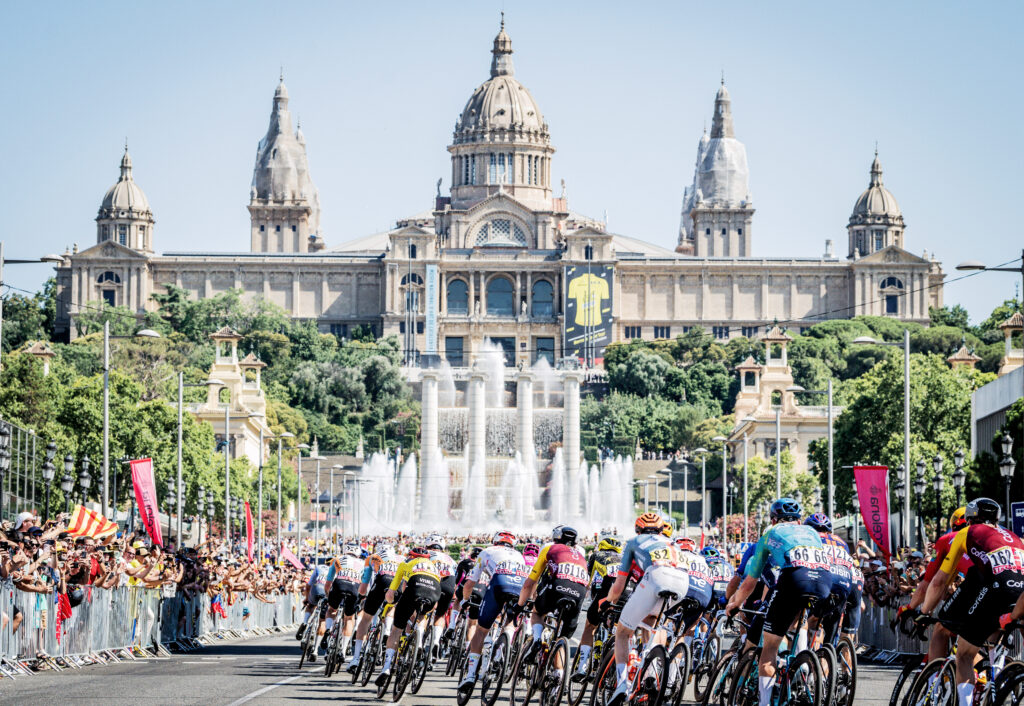
But photography also offers second chances. When I returned to Barcelona, the race route once again climbed toward the city’s magnificent Magic Fountain of Montjuïc, with the National Art Museum of Catalonia perfectly positioned behind it.
On Stage one, I had already spotted these two landmarks at the foot of the final climb. But today, with the full peloton racing toward the opening pitches of the Montjuïc climb, I knew I had to stop.
Sure, I could have positioned myself on the climb itself to focus on the race leaders, but the Tour de France is a monumental event, and for the past two days, Barcelona has provided a stunning backdrop. I knew this would be my last chance to capture it. Merci, Barcelona!
Au Revoir Catalonia
Well, this year’s much-anticipated Grand Départ is now officially a thing of the past, as the Tour de France has raced out of Catalonia and back into France. But those three Catalan days will be remembered fondly.
There was Barcelona, of course, one of the world’s great cities, and it welcomed the Tour in style, showing off its many iconic landmarks. Then there was stage two, which hugged the Mediterranean coastline for much of the day.
But perhaps Monday’s stage captured the heart and soul of Catalonia better than any other, as the Tour raced into the Pyrenees, passing through one village after another, each generously decorated in the colours of the Catalan flag. It was in this region that much of the Spanish Civil War unfolded nearly a century ago, and the people here remain known for their strong sense of identity and independence.
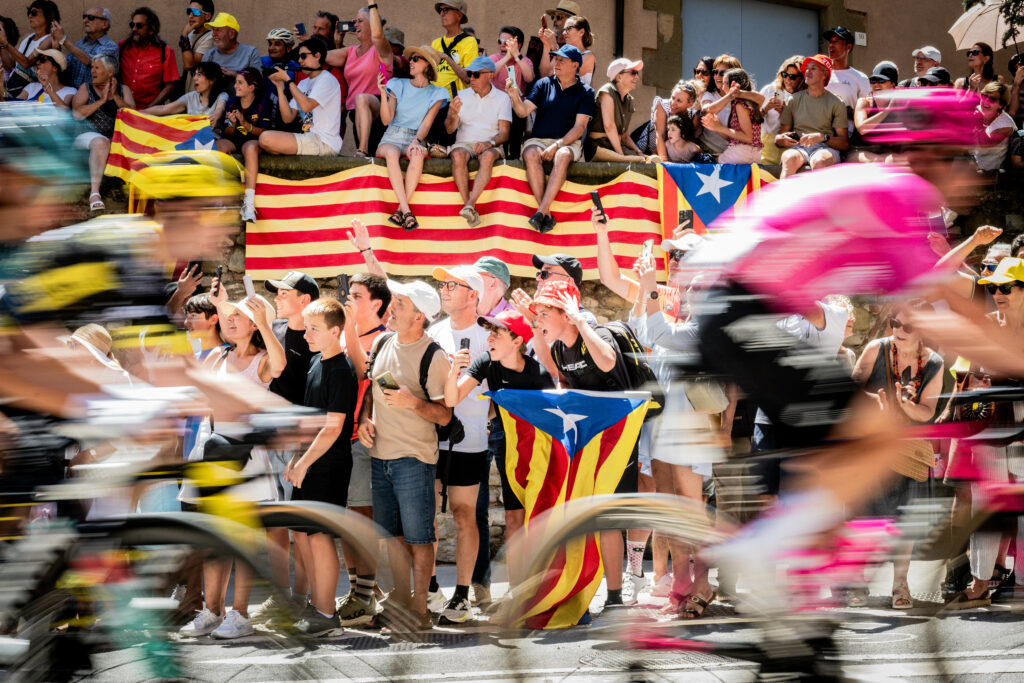
Catalonia is also a hotbed of cycling, and the people in its towns and villages were only too happy to welcome the Tour de France.
I spent much of the morning driving ahead of the race, looking for a village that best captured that spirit. It took longer than I expected, but the moment I entered the town of Vic, I sensed a special energy and knew I would make my picture there. The excitement only grew as the Tour approached and raced through the narrow streets.
And then, just like that, it was over. Au revoir, Catalonia.
Paris-based American photographer James Startt is one of the longest-serving cycling journalists in the press room, with almost four decades’ experience in the sport. He is covering his 37th Tour de France and is a two-time winner at the World Sports Photography awards. James currently serves as the creative director of luxury cycle tour operator inGamba.