


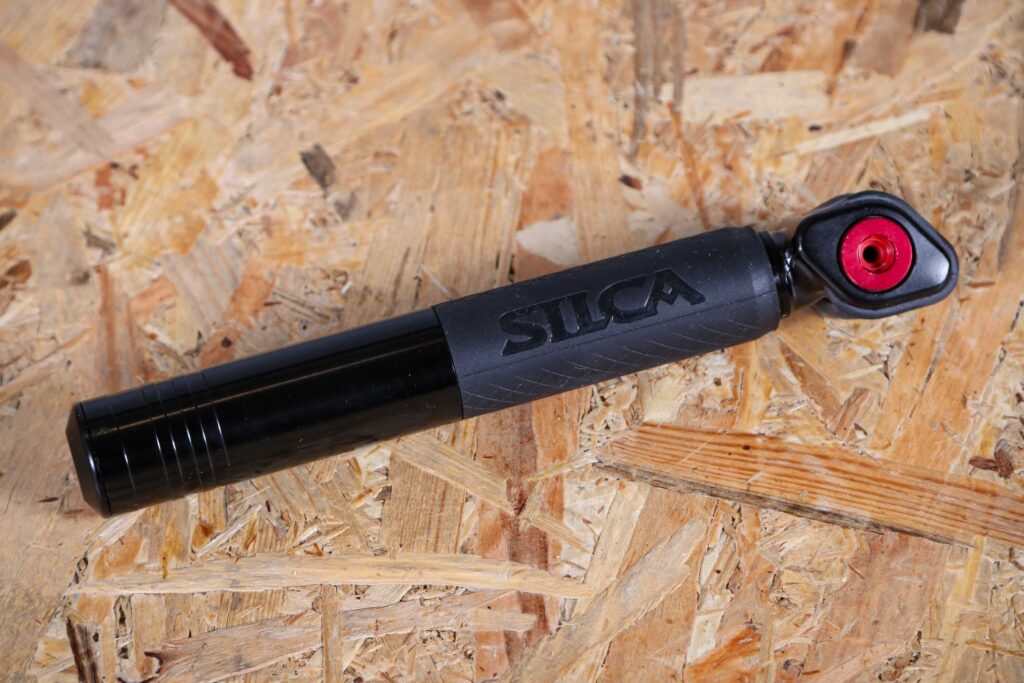

The Silca Pocket Impero II is an outrageously expensive though high-quality pump that offers a fairly decent pumping performance. While it takes a lot of strokes to get where you want, it’s capable of achieving high pressures without needing the assistance of The Hulk, and there’s very little build-up of heat either. It’s small enough to fit in the back of a jersey, although it’s a bit weighty.
If this is looking a bit pricey for you, check out our guide to the best cycling mini pumps and the best bike pumps for more options.
While it’s certainly one of the most expensive mini pumps out there (even the Lezyne Digital Pressure Drive is ‘only’ £77), the Pocket Impero II features the usual quality build and sweet aesthetics of the Silca product range. It’s also easy to service, to keep it going for a long time, and the leather gasket (100% cow, sorry vegan folks) is replaceable. It also features a two-year warranty that covers all rubber, leather and gauge parts, which is nice to have.
At 203mm (or an even 8 inches) it’s pretty compact, if not the smallest mini pump out there. For reference, it’s longer than a Lezyne Pocket Drive but shorter than a Lezyne Grip Drive HP, with greater girth than either of those pumps.
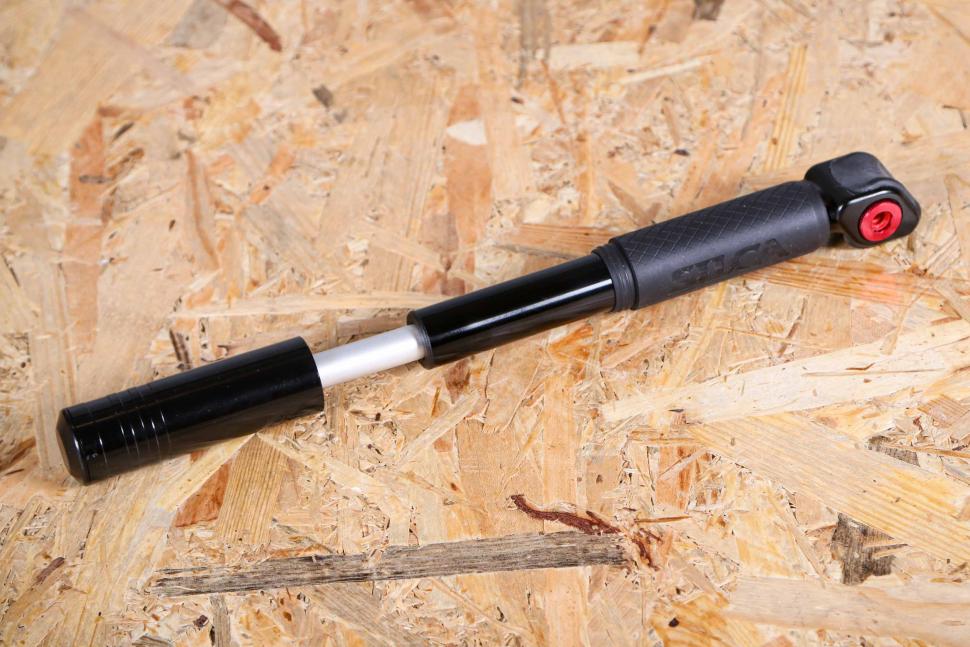
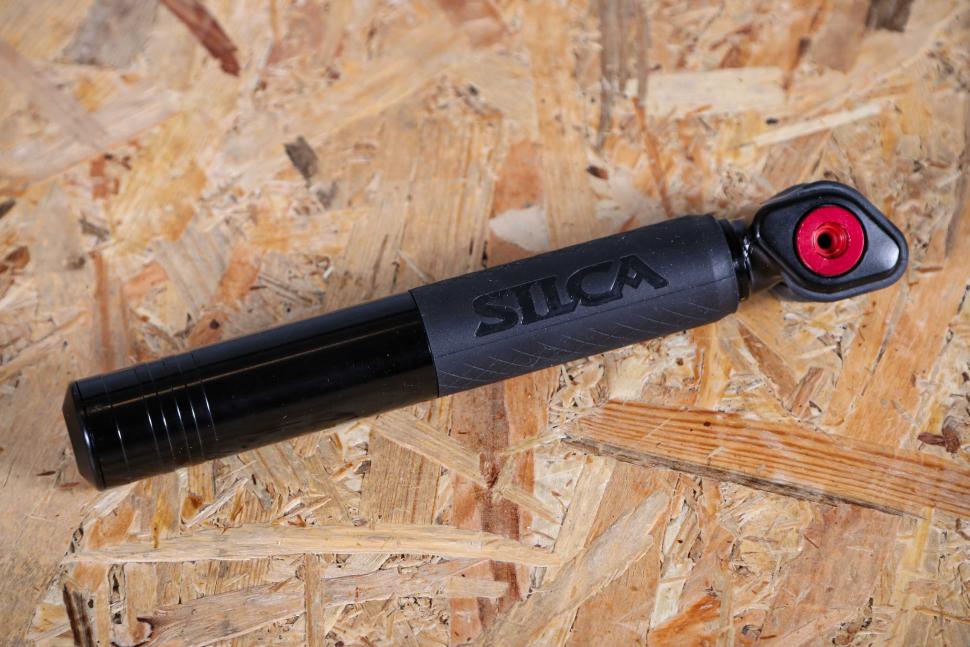
Though Silca claims a 150g weight, it actually came in at 169g on the road.cc scales, which makes it pretty heavy in its class – 55g heavier than the longer Lezyne Grip Drive HP.
When compared with the original Pocket Impero, which Silca released about seven years ago, I don’t see any obvious difference in specification, other than a few cosmetic changes. In fact, Silca has even regurgitated the old description with the new pump, so I’m pretty sure it’s just a facelift, if it was even needed.
Mind you, the new pump does look rather neat, with an all-black alloy construction (save for the piston inside). The end of the body is knurled for better grip, while the silicone sleeve has a diamond tread pattern which makes it very secure to hold. The silicone sleeve also serves as a way to hold the handle in place when it’s on the bike, though I did find it requires a bit of effort to get it in place.
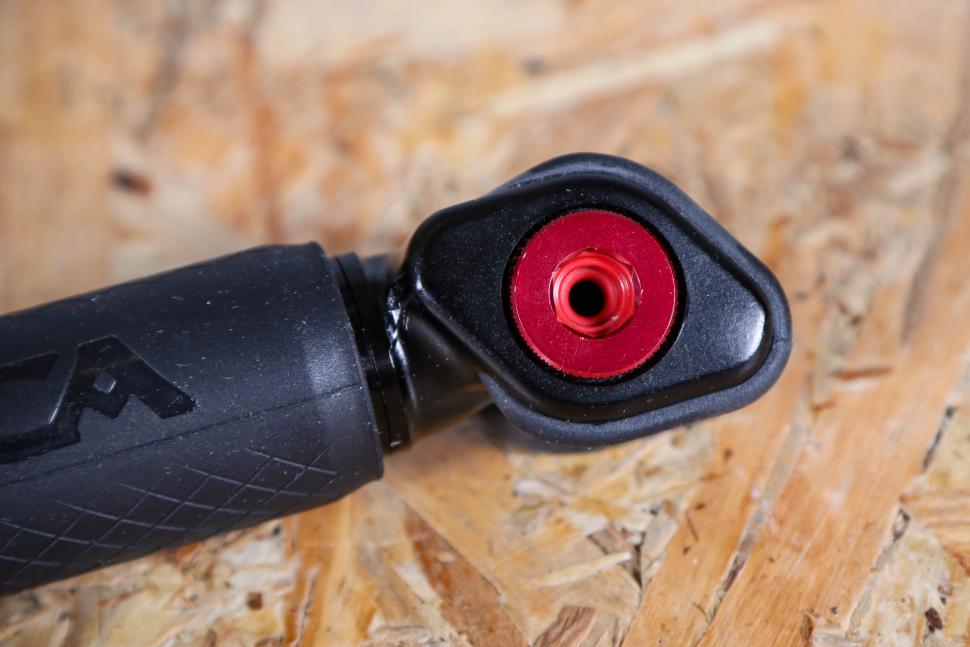
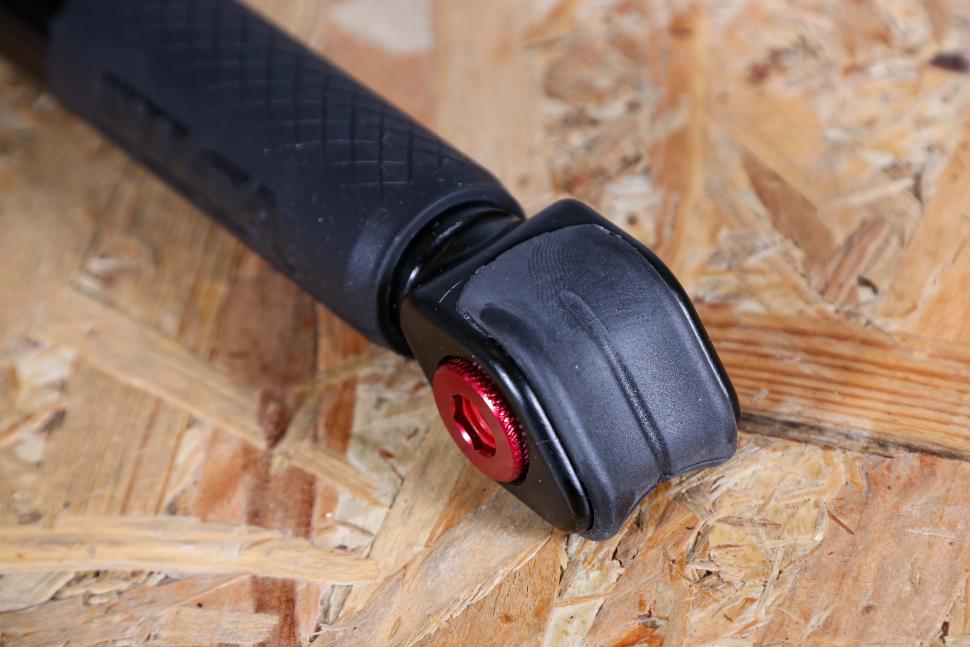
At the business end, the Pocket Impero II features a bright, anodised red pump head, which you simply slide onto the valve (Presta only) to lock it into place – no need for a manual lock, or anything like that. A silicone strip over the head of the pump gives you a bit of extra grip when you’re pumping, to keep it firmly in place.
On a 28mm road tyre, 200 strokes equated to 54psi, while 260 strokes left me with my optimal road pressure of 70psi. At the other end of the spectrum, on my Bombtrack Beyond+, with 2.8-inch plus tyres, 200 strokes delivered 15psi, which is about spot on for off-road riding.
> How to choose the best bike tyre pressure – balancing speed, comfort and grip
In isolation that seems a little disappointing in comparison to some of the other mini pumps out there, which take fewer strokes to get to a similar pressure, although that said, the Pocket Impero II requires relatively little effort for the same number of strokes. Even at 70psi on my road bike’s 28mm tyres, the going was still easy, unlike other mini pumps I’ve used. Indeed, the Pocket Impero II didn’t seem to produce much, if any, heat at all which is probably a sign that this is a very efficient mini pump.
Value and conclusion
Does that excellent build quality and high efficiency translate into a mini pump worthy of its £125 price tag? Well, probably not, but the serviceability and the warranty do help to sweeten the deal somewhat.
Still, there are similar size pumps out there that require fewer strokes to get to the same pressure. The Lezyne Grip Drive HP is longer, but it’s lighter, and Stu managed to get to 50psi in just 100 strokes. That said, I’m personally not a fan of the screw-on chuck, but it is only a fraction of the price of the Pocket Impero II at at around £30.
Similarly, Topeak’s Roadie 2Stage is only around £30, is just 162mm long and weighs only 102g, and offers decent performance with 55psi after 150 strokes on a 28mm tyre.
So, perhaps not the best performance out there, given its high price tag, but there’s no doubting that the Silca Pocket Impero II is a quality product that is easy to use and will last you a very long time.
Verdict
Effortless to use, but high on the strokes and very expensive
All the deals displayed on our review pages are pulled from a constantly updating database feed of the best affiliate deals available. The criteria for deciding on what are the best deals is who is offering the lowest, delivered price. In most cases we will be showing the very best deal available online, but sometimes you may be able to find an item cheaper. If you can please feel free to post a link in the comments box below. To find out more about affiliate links on road.cc click here.
road.cc test report
Make and model: Silca Pocket Impero II Pump
Size tested: n/a
Tell us what the product is for and who it’s aimed at. What do the manufacturers say about it? How does that compare to your own feelings about it?
Silca says, “The mini-pump to put all others to shame. The leather gasket and metal construction make this the most efficient mini-pump on the market. Save time and frustration with the Pocket Impero.”
Tell us some more about the technical aspects of the product?
Silca lists:
Alloy construction
Leather piston gasket
Slide-lock silicone sleeve
150g (169g)
8 in (203mm)
Typical Silca high-end build quality.
Easy to use lock-on pump head, and great to hold. Needs more strokes than similar mini pumps out there, but there’s very little effort in doing so.
Early days, but all good so far; should last a lifetime thanks to high-quality build and serviceability.
Certainly not the lightest mini pump out there for its size.
Great to hold, and very grippy.
Very expensive, about £95 more than similar pumps. But the ease of servicing and replacement parts mean it should last a lifetime. You get a two-year warranty too.
Tell us how the product performed overall when used for its designed purpose
The Silca Pocket Impero II is easy to use, and although it needs a high number of strokes to achieve higher pressures, it doesn’t require much effort to do so.
Tell us what you particularly liked about the product
The ease of use and lack of heat build-up.
Tell us what you particularly disliked about the product
Nothing.
How does the price compare to that of similar products in the market, including ones recently tested on road.cc?
It’s by far and away the most expensive mini pump out there, about £95 more than similar pumps such as the Lezyne Grip Drive HP, which is lighter though longer and gets to 50psi in just 100 strokes, while the Topeak Roadie 2stage is shorter, lighter and gets to 55psi in 150 strokes (both on a 28mm tyre).
Did you enjoy using the product? Yes
Would you consider buying the product? It’s a little out of my price range.
Would you recommend the product to a friend? Maybe
Use this box to explain your overall score
The Pocket Impero II is seriously expensive, which is partly justified in its build quality and serviceability, as well as its ease of use, though it does seem to take more strokes to achieve pressure than similar mini pumps, which makes it hard to recommend over others unless you really like Silca stuff.
About the tester
Age: 39
I usually ride: Condor Italia RC custom build My best bike is:
I’ve been riding for: 10-20 years I ride: A few times a week I would class myself as: Experienced
I regularly do the following types of riding: commuting, touring, club rides, sportives, mtb,

8 thoughts on “Silca Pocket Impero II Pump”
Maybe when I win the lottery.
Maybe when I win the lottery…
And if my Topeak Master blaster DX finally gives up the ghost, but after twenty odd years…
And I could always do with a Schrader…
ktache wrote:
I has a Zefal frame pump in the bike shed that serves to put a bit of air into the tyres on the wheels not currently in any bike, to stop the tyres sagging over the weeks or months they’re idle. I bought it in 1976. Sadly, it won’t fit on any of the modern frames I have, them with their queer topologies. The rubber grommet’s been renewed a time or three, of course.
Silca, eat yer heart out.
I’d spend the money on a
I’d spend the money on a (second) Topeak even after lottery – I own both the Silca and the Topeak frame pump versions, and can tell pretty much the same story as in the review and the comments: Silca is very well made etc. but the silicone grip is awful to move in order to keep the handle from rattiling, and the pump is actually very heavy to use. Whereas in the Topeak the construction is slighty more wobbly and and has more plastic, and the rubber cover around the head has broken, but it’s much lighter to use and gets to the desired psi in just as many strokes. For such a tech geek company, Silca makes surprisingly mediocre pumps at least.
Silca marketing is a queer
Silca marketing is a queer thing. Some of their accessory tech is way overpriced, even for that high quality they certainly put into various things like this pump. £250 pressure gauges! £135 for a set of allen keys!! You can find similar items of just as good a quality for far, far less. As this pump review mentions.
Yet Silca also make excellent lubes and cleaners which, although slightly more expensive than the competition, are actually far better value because they work a lot better than most of the alternatives brands and go further as less stuff does more work.
How much chain lube do they sell? Loads. How many £250 pressure gauges? I’d bet, hardly any.
There are some buyers of some of their nice tools, titanium bottle cages and the like who seem happy to pay for the cachet of the label, although personally I would want them to pay me for sticking a label-advert on my gubbins.
But were they to sell a lot of their gubbins at much reduced prices, even if still higher price for the quality than the price for rival items, they’d surely sell a lot, lot more stuff and still make a profit. And many of us would be happy owners of a very high quality thing.
I’d like a nice pressure gauge like that one they have – but for £25 not £250. That would still be 2 or 3X the price for pressure gauges made by others that are probably nearly as accurate …… . But I already have some Wiha allen keys that are very good; and cost a quarter of the price of the Silca. No fancy (and useless) box with a label on it, mind. 🙂
About 3 years ago I bought an
About 3 years ago I bought an Aldi presta/schraeder pump for about £5, I think. It’s still working well.
This one only has a two year
This one only has a two year warranty so you’re quids in already.
I dream of being rich enough
I dream of being rich enough to buy Silca stuff.
I still wouldn’t buy them, mind you.
Don’t worry about buying
Don’t worry about buying Silca stuff, there are a lot of other tools and stuff that are made by other companies that are at least just as good and most is better for less money.
Take that pump, it’s not that good of a pump, the strokes to get to 70 is around 300, anything more than that will be difficult, paying $100 for a Silca pump when a Lezyne Road Drive is better for half the price! Just get the medium size Lezyne not the small one or it could be quite the struggle to get up to 70.
I looked at the Silca torque wrench too, and went with the Lezyne because the scale read out was far superior to the Silca scale, and the Lezyne was less than half the price!
Silca has a nice fancy wood boxed ball end hex set too, it’s $125, I bought a Eklind with more tools in it, both standard and metric for $30, though it has a hard plastic holder instead of fancy wood box like I really care!
Don’t buy something just because it’s a Silca brand, why buy a $175 or more for a floor pump when Specialized Air Tool Comp pump is rated higher and yet cost just $70.
Be smart, don’t get tunnel vision because it’s Silca, and you’ll save a lot of money.
Now Silca does make Super Secret drip on wax, I just started using it so can’t say how good it is, but reviews have all said it’s the best drip on wax lube on the market and it seems to last longer then other drip on wax lubes, held up t rain better, along with having very low wear indicators on chains and gears and low friction while keeping the gears and chains clean, I’ll find out, but that could be worth buying.
Comments are closed.