



A study from Austria has analysed the role played by handlebars in injuries sustained by children when cycling, concluding that properly moulded bar ends can help reduce the number of such occurrences.
Christoph Arneitz, senior physician at the Department of Paediatric and Adolescent Surgery in Klagenfurt, was quoted in a press release from Graz University of Technology (TU Graz) as saying from that each year some 8,000 children and young people in Austria are injured in bike-related incidents each year.
Of those, some 600 casualties arise from what is described as direct contact with the handlebars, with 19 per cent of those cases resulting in hospitalisation.
Half of those injuries relate to the victim’s abdomen, including bruising or tearing of the handlebars, pancreas or spleen, says Dr Arneitz, and usually happen when the child falls onto the handlebars of their bike when it is on the ground, or when the bars turn suddenly when the rider is rear-ended in a crash.
Previously on road.cc, we have reported on one incident from the United States in which a six-year-old boy was killed when he was impaled on the exposed handlebar of his bike, which according to his father had turned 90 degrees.
> US father’s warning after six-year-old dies after being impaled by his bike’s handlebars
Another case we reported on involved a teenage cyclist in Oxford whose penis was ‘degloved’ and scrotum ripped open by his bike’s handlebars following a freak crash.
For his Master’s thesis, TU Graz Institute of Vehicle Safety postgraduate student Maximilian Schinagl used a virtual human body of a child to produce simulations of the effects of a blunt impact to the abdomen from different angles, using six bar ends made by various manufacturers as well as one with no bar end, leaving the bare metal exposed.
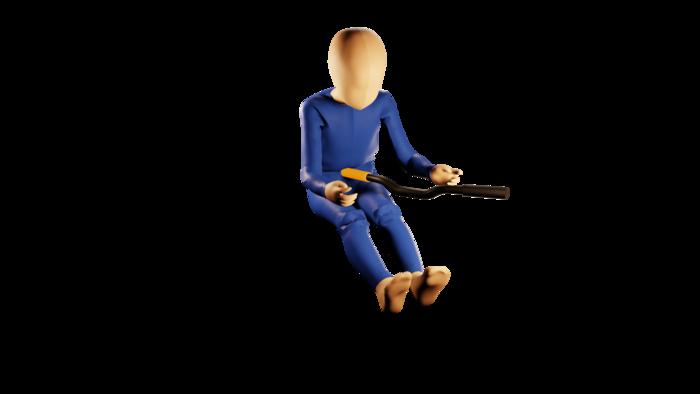
He found that the design of the bar resulted in a significant difference not only in the likelihood of the child sustaining an injury, but also its severity, with his analysis addressing issues including the force of contact, depth of penetration, and the loads to which the abdominal wall and organs were subjected.
Schinagl concluded that handlebars with widened protective caps afforded the best protection.
TU Graz has subsequently launched a follow-up project in partnership with Austria-based children’s bike brand, Woom, to further examine the relationship between bar ends and abdominal injuries in children.
The bike firm already equips its bikes with widened bar ends to reduce the risk of injury, but is aiming through the project to make them even safer.
Woom CEO Paul Fattinger said: “Cycling safety is our top priority. By working together with research institutions, we can optimise the design of bicycle components on the basis of empirical evidence.”
Nico Erlinger, from the university’s Institute of Vehicle Safety, said: “In the course of our simulations, we have seen that handlebar ends with a larger diameter can reduce the risk of injury by up to 20 per cent.
“As there have only been a few studies on injuries in this type of accident so far, there is still a lot of potential to reduce the risk with further research,” he added.
Detailed findings from the project were set out in a paper presented at the conference of the International Research Council on the Biomechanics of Injury (IRCOBI) in Cambridge last September.






9 thoughts on “Study analyses role of handlebars in children’s cycling injuries, finding widened protective caps afford best protection”
Although not necessarily
Although not necessarily children, it still amazes me how many competitive riders are surprised when commissaires refuse to let them start races with bar end plugs missing.
I actually did one race with
I actually did one race with a wine bottle cork stuck in the bars. It got a laugh from the scrutineers but they agreed it did the job and was safe. I joked I’d share a glass of red with them after the motos.
‘Half of those injuries
‘Half of those injuries relate to the victim’s abdomen, including bruising or tearing of the handlebars, pancreas or spleen’ – would these be items of the bicycle’s anatomy, or the child’s?
Once upon a time… on a
Once upon a time… on a planet far away … Suffolk !
35 years ago my son was playing on his bike in the local park .. He fell and was hit in the stomach by the end of the bars …. grips were fitted … 1 month later he’s at the Military Hospital Ely having a hernia repaired ….
Another study about the bleeding obvious …..
We don’t allow kids in our
We don’t allow kids in our BMX club to ride without bar ends. There was a fatality many years ago now at the local track where a child fell off his bike and had a severe stomach injury. It’s an open track and this wasn’t at one of our sessions as the child was riding with his dad. The track was closed for a while after until the council did a safety check and determined that the death wasn’t an issue with the track. I feel for the parent though.
We have spare bar end plugs in case someone doesn’t have one. I’ve even advised parents to pop a wine bottle cork in the end of the bars. It may look silly but it works.
This kind of injury should be
This kind of injury should be publicised as it’s so easy to prevent. I try to remember to carry around a couple of spare bar ends just in case I spot someone with damaged or missing ones.
I have a couple of sets of
I have a couple of sets of Jones’s plugs from their grips which I keep trying to remember to take into work, Hope grip doctors for the Ultimate Commuter, X-lite Disco BBs on the Good Bike, downhill originals, knurled. And blanked ends on my Ti X-lite bars on my getting to work bike, but that’s more to strengthen for the Onza cut down ends, those have been plugged with Onza’s own, that they supplied with their Porcipaws, to stop the bars cookie cutting the grips.
“including bruising or
“including bruising or tearing of the handlebars, pancreas or spleen, says Dr Arneitz”
Of all those injuries it’s without doubt bruising of the handlebars that’s the most painful and the most debilitating.
ISO standards for the
ISO standards for the smallest kid’s bikes covers bar plug inclusion and spec plus grip end size/area. Bar plugs are covered in the same way in the ISO tests for adult and larger children’s bikes. The bar plug detail was an update in the last few years but many brands were speccing them before the tests required them.