


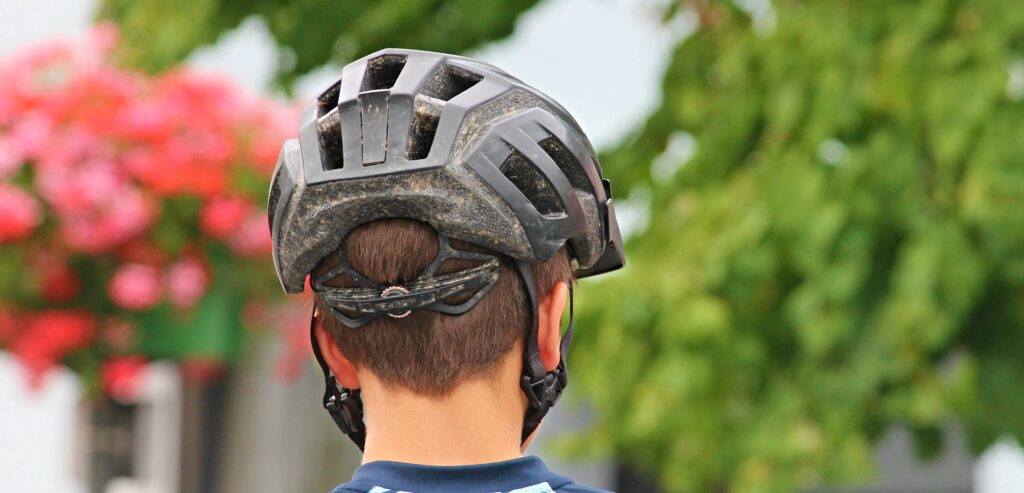

The sister of a teenage cyclist who was killed after being struck by an overtaking driver, causing him to hit his head on a kerb, has called on the government to make wearing a helmet while cycling a legal requirement, telling her school assembly that “I just wish my big brother had a helmet on” the night he died.
A road safety expert, meanwhile, has responded to the youngster’s campaign by noting that, while cycle helmets can lessen the risk of traumatic brain injury in a collision, they “alone do not prevent crashes from happening” and that safer infrastructure is key to preventing fatal collisions.
> Why is Dan Walker’s claim that a bike helmet saved his life so controversial?
15-year-old Riley Ketley was cycling with friends to the shops in the Yorkshire village of Molescroft, Beverley, on 8 April 2021 when he was struck from behind by a motorist who had allegedly “sped up” to overtake the group. Riley suffered a serious head injury in the crash and died hours later in hospital.
“There was just no saving him. He had a head injury to the front of his head and a head injury to the back. He’d hit the car the front ways and he’d hit the back of it on the kerb,” Riley’s mum VJ told the BBC today.
At the inquest which followed the teenager’s death, a friend who was cycling behind Ketley – who had been told he had been accepted into the Royal Marines earlier that day – told investigators that he had pulled out into the middle of the road, as the driver of a Honda Civic “sped up as if overtaking”, leading to the collision.
The motorist, who said he felt “absolutely terrible” about the incident, claimed that he’d moved to the right to give the youngsters as much room as hospital, the Yorkshire Post reported in 2022. He said the group had seen him and moved over to the adjacent cycle lane, when Riley pulled out.
“There was absolutely no warning at all, and I had no chance to stop and avoid a collision,” the driver told the inquest.
After extensive inquiries, the police concluded that there was insufficient evidence to charge the motorist, with a forensic collision investigator determining that there was no evidence of excessive speed and that the crash was “unavoidable”.
And this week, Riley’s younger sister Amelia, now 12, has urged all cyclists to wear helmets while riding their bikes, in order to help prevent the serious head injuries suffered by her brother.
“I just wish my big brother had a helmet on that night,” Amelia told her school assembly this week, as part of her campaign, which includes handing out helmets to classmates.
The 12-year-old, who said losing her brother at the age of nine was a traumatic experience, told the BBC that wearing a helmet while cycling should be mandatory by law, in a similar manner to using a car seatbelt.
“We want to make the people who don’t wear helmets look the stupid ones,” she said. “But people don’t wear helmets and you want them to just automatically put them on instead of people having to tell them to put them on.”
> Government shuts down mandatory cycling helmets question from Conservative MP
In December 2022, the Department for Transport insisted that the government has “no intention” to make wearing a helmet while cycling a legal requirement.
Addressing a written question from a fellow Conservative MP, the then-minister of state for the department, Jesse Norman, said the matter had been considered “at length” during the cycling and walking safety review in 2018.
Norman also added that while the Department for Transport “recommends that cyclists wear helmets”, the “safety benefits of mandating cycle helmets are likely to be outweighed by the fact that this would put some people off cycling”.
Responding to Amelia’s campaign for a helmet law, Steve Cole, the director of policy, campaigns, and public affairs at The Royal Society for the Prevention of Accidents (RoSPA), noted that other factors – such as infrastructure – are more critical to ensuring the safety of cyclists on the roads than helmets.
“While everyone has the right to choose whether they wear a helmet, the evidence shows us that they can more than halve the risk of a traumatic brain injury,” Cole said.
“However, it’s important to note that helmets alone do not prevent crashes from happening, and poor infrastructure can often be to blame for collisions.”
Cole also called on the government to “publish its long overdue road safety strategy and to invest in safe infrastructure”.



















130 thoughts on ““We want to make people who don’t wear helmets look the stupid ones”: Sister of teenage cyclist killed in collision with overtaking driver calls for mandatory cycle helmet law”
I feel for the grieving
I feel for the grieving sister, and would not hold it against her that her grief occludes dispassionately weighing the arguments. But somewhere, in a parallel universe where helmetless cycling is rigorously prosecuted, brothers are dying from heart disease and it’s just accepted.
Sriracha wrote:
Also, she’s 12! But agree with the sentiment
quiff wrote:
More than that – she’s 12 now, but the death was three years ago when she was only 9. I don’t imagine that the last three years have been full of dispassionate research – more likely the grief stricken parents not letting her out the door without a full zorb suit.
Sriracha wrote:
Australia?
And brothers, sisters, fathers, mothers … are still dying in collisions on the road. But they’re all just tragic “accidents” that no-one could reasonably do anything to prevent.
Except for the odd wrong’un who was doing twice the speed limit, whilst intoxicted, on the way to a “serious crime”. So we can call that dangerous driving, give them a reasonable fraction of the sentence for manslaughter. Or maybe a few extra years on top of whatever they’re probably due already for other crimes.
And feel reassured that most of us are doing our responsible, lawful best…
The ‘expert’ said that
The ‘expert’ said that helmets alone do not prevent crashing, I would counter that in no way do they prevent crashes and there is evidence that in fact they cause more crashes due to risk compensation by both the riders and motorists.
I am sorry that someone died, but an impact to the head at 30mph from a car is very unlikely to be mitigated by a helmet, the empahsis should be on infrastructure and training for all road users.
How can the collision have
How can the collision have been “unavoidable” were there no brakes or steering wheel in the car? this is the sort of bullshit that leads the victim’s sister to call for mandatory helmets because it leaves no other option when in reality there are many other options but nobody wants to have to slow down or allow extra time for journeys when driving!
I think I’d prefer to see
I think I’d prefer to see cars hitting and killing cyclists made illegal.
The lad suddenly moved out of
The lad suddenly moved out of ‘his’ lane. Presumably the (the court believes) the driver was not obliged to give 1.5m whilst overtaking because cyclists should be staying in their lane. The driver did not exceed 30mph and did not enter the cycle lane.
Yet the conversation is about helmets not how much better the Dutch would have designed this residential street.
If that’s a current image of
If that’s a current image of the actual place – broken white line – “advisory” cycle lane.
Meaning and effect: nothing. Total waste of cash on paint. Also note a car entirely legally parked in it*.
* Advice gone against because they’re parked facing oncoming traffic for no valid reason, and of course they have also broken the law by driving on the footway but “prove it” means this is decriminalised…
It’s the road mentioned in
It’s the road mentioned in the Yorkshire post. Although it’s a long road and we don’t know where the collision occurred I can see that it fits with what we do know.
I come from an industrial background where changes are made based on risk assessments. I would love to see a risk assessment from the local council when they came up with that dogs dinner.
Is that really a dogs dinner
Is that really a dogs dinner in terms of cycling infra?
Good point – no, it’s just
Good point – no, it’s just exactly the same as no cycling infra at all. (But plus the cost of painting the road). At the very most it might serve as “optical narrowing” in an attempt to nudge drivers to slow down a bit. It doesn’t seem to have worked here.
You’re correct sadly – councils are quite capable of delivering something much more dangerous and inconvenient for cyclists, probably for far more money.
Perhaps this campaign should
Perhaps this campaign should be added to the ‘make wearing stab vests compulsory’ campaign. This crash was entirely avoidable if the driver had not been impatient and stayed back until it was safer to overtake, or perhaps just not overtake. This poor kid might not have heard the car behind. True, a helmet ‘might’ have saved him but I seriously doubt it because a speeding car would have generated a force way in excess of what a 1″ piece of polystyrene can protect from and his head hit a kerb. He would have got serious brain damage at the least, if he had survived. What would the campaign be then? This is why it must never be made a legal requirement to wear a helmet, because it will be used to get drivers off murder. Imagine a mugger getting off murder because their victim wasn’t wearing a stab vest, and they’d also been stabbed in the neck?
“a speeding car would have
“a speeding car would have generated a force way in excess of what a 1″ piece of polystyrene can protect from and his head hit a kerb”
You know the specifics of the case, or are you just making something up? What force a “speeding car” will “generate” will be entirely dependent on the circumstances, as will the effect of an impact with a curb.
If you’d have bothered to
If you’d have bothered to read the article the kid suffered 2 impacts to his head hard enough to kill him and be picked up in an autopsy, one from the car and one from the curb. I think its fair to say that a lump of packing foam design to a standard thats protects against static drop test from head height would have made very little difference.
The lack of a helmet didnt kill him. The presence of car driver did.
john_smith wrote:
No, the amount of force a car generates is simple physics using mass and speed in the calculation.
I don’t like the divisive
I don’t like the divisive language (“stupid ones”) used by this appeal, campaign or whatever it is at this stage. This is hugely victim-blaming, and should not be coming from the family of a victim themselves.
I can only imagine how it is
I can only imagine how it is for his family and sister to deal with this.
Even if they had been educated here on road.cc it’s understandable they might reach for any “reasonable” solution.
With distance from their loss we can suggest that this is not the most effective response. And indeed a product of our attitudes around driving and transport.
Our system is always going to trade safety improvements with further reducing the convenience of active travel or making places less pleasant. Because prioritising moving (and storing…) vehicles is something which most people just assume.
I understand what you’re
I understand what you’re saying but isn’t the reasonable (and obvious) solution to reduce the the speed limit to 20mph. The evidence is that the chance of surviving a collision increases dramatically.
On a long straight road like this one you would probably also conclude the need to introduce traffic calming measures. A few chicanes should do the trick.
Here it is; slow motorists
Here it is; slow motorists down to the speed of cyclists; next thing is a call to criminalise motorists overtaking cyclists, but then your desire for road ‘calming’ would close off space for motorists to get past a slow cyclist..
grOg wrote:
I’m guessing you mean this ironically but that is in fact a) reasonable in certain environments b) practical (including “can be accepted by drivers”) and c) you can go and see this in action!
… in the Netherlands. Athough I appreciate that’s a long way from Australia! Luckily there are thousands of hours of videos you can watch.
Try Googling “fietsstraat” – Athough not all of these mean “no overtaking cyclists” (that requires separate regulation and signage). Here’s a couple:
Both slightly cautionary tales reminding us that the rules are rather the icing on the cake. The main thing is to have a very low volume of motor traffic compared to cyclists – indeed low overall.
That means the street should not be a *road* – not a through route for motor traffic. Nor provide access for lots of people driving to a destination. For those cycling should have separate space (if cyclists even need to be there – nobody’s suggesting adding cycle paths to motorways). Then it’s safe and convenient for cyclists and drivers don’t have to overtake or interact with cyclists at all. Win-win!
The UK, US and possibly Australian failing was designating most existing streets for motor traffic first and last and maintaining the same level of access and connectivity for drivers as for when people were mostly on foot…
New laws proposed by victims
New laws proposed by victims or their families are often not good ones, as they are (understandably) hyper-focused on the specifics of their case. They’re an important part of the debate, but public policy needs to be dispassionate.
AidanR wrote:
Cough, cough – Matthew Briggs – cough, cough.
brooksby wrote:
The Briggs incident is ironically an excellent example of where a pedestrian helmet would most likely have saved Mrs Briggs’ life. However, that is still victim blaming as PPE is not the first thing we should turn to and I think it’s offensive to be labelling people as “stupid” for making a decision to not wear PPE for non-dangerous activities such as walking and cycling.
Not that offensive though,
Not that offensive though, given the age of the person doing the labelling, and her circumstances.
john_smith wrote:
This is why places like the BBC try to get opinions from youngsters in distress to further their anti-cycling agenda – any criticism of the bullshit message and it can be justified due to the age of their chosen mouthpiece.
hawkinspeter wrote:
They had Matt Briggs on R4 Today this morning, the usual nonsense, including that they couldn’t get anyone from “The Cycling Lobby” to be interviewed: maybe because it doesn’t exist? Or the fact that it’s a Bank holiday weekend and they’re all taking some well deserved time off?
Quote:
Well clearly he didn’t if he hit one of them “Enough room” would generally mean that you DON’T hit someone if they suddenly move out or fall over…
This is the whole reason for
This is the whole reason for requiring 1.5 meters of clearance. Then there is the margin for error when the rider wobbles, swerves or generally does things that a cyclist does.
Going by your logic, no
Going by your logic, no motorist should pass a cyclist in case the cyclist suddenly chooses to turn in front of a motorist..
grOg wrote:
IIRC you’re in Australia and I’m sure they do things differently there.
in the UK Highway Code, you pass with at least 1.5 metre clearance and this has been explained as being so that if the cyclist in front of you suddenly falls over sideways (medical/mechanical) or has to swerve to avoid a pothole or squirrel then the motorist won’t run over their head. Seems like common sense, doesn’t it?
Nobody said anything about them suddenly turning in front of you, so that’s a bit of a straw man?
Mind you, when on a bike I’ve had a motorist suddenly turn across me without indicating or warning, very dangerous: was that what you meant?
So presumably, given the
So presumably, given the rider was riding legally, the road has been closed until it can be redesigned to prevent unavoidable fatalities?
(/sarcasm)
qwerty360 wrote:
This is exactly what should happen if we want to be serious about reducing traffic collisions – close the road/junction to large motor traffic until the incident is fully investigated. The result should always be either prosecution of the guilty party or a redesign to prevent future incidents.
I think this is law in the
I think this is law in the Netherlands
Tram lines cause bike
Tram lines cause bike accidents all the time in Melbourne, so according to you, most of inner Melbourne would be closed down to traffic and redesigned to protect cyclists from their own incompetence in coping with roads/traffic.
Why would you let a system
Why would you let a system which is constantly responsible for injuries to continue to operate?
Now – *how* you address it, that’s a different thing.
Cars and road design have become hugely safer over time. Some of that driven by sales eg. people may pay for a safer car. But while there was also lobbying from motor trade governing bodies recognised that “saving people from themselves” on the roads was to some extent a very good idea, rather than just decrying the victim’s as stupid. (They did that also of course and still do …)
The tram system there is certainly extensive!
Don’t know the history but where I stay (Edinburgh) the council and their company deliberately ignored requests, offers of free consultants etc. from experienced experts from continental Europe and did what *they* thought best. Cue hundreds of injuries and a couple of deaths (cause of one is less clear but a cyclist slipped due to rails and was run over).
Over a million in compensation and they’ve had to make some expensive and less than ideal adaptions. Causing a fair bit of disruption.
I can think of a couple of reasons – in their own interest – why they might have been a bit more proactive…
grOg wrote:
Tram lines and bikes aren’t a good mix and if tram lines are involved in fatal incidents, then there should absolutely by an investigation as to why we’re putting tyre traps in the same space that cyclists use. You may consider it “incompetence”, but why would we want to have dangerous infrastructure that is only safe for experienced cyclists to use? It’s quite possible for tourists to be wanting to cycle around a city and having roads that are known to be likely to catch them out seems an odd choice.
Is two cyclists get their
Is two cyclists get their handlebars tangled, say, and one crashes and dies, would you ask the same thing? There is no road design that will prevent “unavoidable fatalities”.
Well – does that happen often
Well – does that happen often?
Has this happened before on this road / cycle path? Has it happened before on this *type* of road / cycle path? Do certain designs of bike make this more likely? Are the rules / training making this more likely?
There are certainly road designs which prevent what were (and sometimes still are) called “unavoidable fatalities” – things like roads with centre lines, cats-eyes, street lighting, traffic lights, rumble strips, energy absorbing barriers, level crossings with gates (or avoiding having a level crossing entirely), crumple zones, airbags …
Asking the questions (“why did it happen? What could we do differently?”) is always valid. The answer may ultimately be “due to the combination of circumstances we can’t see how we’d stop it”. Or “perhaps X might stop this but it happens so rarely we’re at a point of diminishing returns trying to fix that”. The last is “politics” of course.
However in the UK the honest answer is often “it happens because we were and still are are prepared to allocate lots of tax to facilitate most adults operating cars and make it very convenient for them – but we’re not prepared to spend a fraction of that or reduce driving convenience slightly to make it safer for those not in cars”.
We know that a percentage of people are going to “make mistakes”. We know what makes that more likely. There are (relatively) low cost ways of dramatically reducing the likelihood of certain classes of “accidents”.
Don’t worry – we have the
Don’t worry – we have the Road Safety Investigation Branch for exactly this kind of enquiry! … oh, “still committed to doing this” years later.
No doubt it will swing into action seconds after the review of driving offences and penalties commences. (Still in 2018 apparently 15 people thought the government should be jollied along, so that’s something).
Maybe we cannot entirely
Maybe we cannot entirely eliminate fatalities, but that doesn’t mean we shouldn’t try (that is the goal of “Vision Zero“).
Considering your specific example, why did their handlebars get entangled? Were there potholes or street furniture or other issues that cause the cyclists to collide? Was it because the cycle lane was too narrow? Sensible countries design in “sociable” cycling: https://www.aviewfromthecyclepath.com/2016/08/mass-cycling-requires-sociable-side-by.html
They usually get tangled
They usually get tangled because the riders aren’t paying attention. It’s got nothing to do with road design and really no one’s fault.
john_smith wrote:
Doesn’t quite meet the standard of “unavoidable” though does it?
Whilst thoughts are always
Whilst thoughts are always with the loved ones of those affected in these situations…
As we know, bicycle helmets will have almost no protective capacity in higher speed impacts.
I suspect that we will soon be required to wear actual Iron Man suits or a zorb ball to avoid drivers being required to do what they should: drive safely.
The driver is saying he moved
The driver is saying he moved over to the right, to give the cyclists as much room as possible, but the victim still managed to get in front of him?
The crash was unavoidable?
Driver seems to have got away with it, but there is nothing unusual in that.
Cyclist decided to go
Cyclist decided to go straight across to a shop or the other side? There are occasions where it can be unavoidable – https://youtu.be/QCWJTvgS0mM?t=394
2 seconds earlier and could have been serious.
Best *always* to give more room to youngsters and expect erratic behaviour.
No point looking to PPE
Mark Hodson
“Helmets are so good motorcycle #KSI s are almost non existent…what do you mean don’t be so sarcastic, it’s because of x y & z ….so what you are saying is that we need to evidentially identify the reasons behind collisions & negate the danger at source…glad we got there …”
In that clip you’ve linked to
In that clip you’ve linked to, shouldn’t we all drive expecting something like that to happen every time we approach a junction? The driver looked to be going appropriately slowly so the chance of a collision was low. Plenty of other drivers ‘in a rush’, race up to blind junctions and would have hit those cyclists, and it would it have been declared ‘unavoidable’, with no charges for the driver.
It was the nearest I could
It was the nearest I could find. The point was if the driver had arrived 2 seconds earlier they would have very likely hit him or him them.
I see your point that things
I see your point that things may be ‘unavoidable’, and that clip is close. My point was our ridiculous tolerances for collisions to be declared ‘accidents’ and ‘unavoidable’.
How exactly this particular collision happened isn’t clear to me. My understanding is the cyclist pulled out abruptly and the driver drove into the back of him. I assume there isn’t any dash cam footage, and there never will be, of someone driving and overtaking cautiously and a cyclist moving so abruptly that a driver goes into the back of them.
Yes, I was just trying to
Yes, I was just trying to address the idea that things are always avoidable.
You only have to watch a few dashcam videos to see collisions are often avoidable by slowing or reading the road
As I said earlier, always give children room and expect erratic behaviour.
… and some things are more
… and some things are more avoidable than others – like motorists being run over by pedestrians and cyclists, or cars being hit by trains where there is a fully grade separated crossing.
Some of these things have in fact occurred but those are usually appropriate for “freak accident” designation (maybe more investigation needed in the train case). There are good reasons they are incredibly rare – we’ve fixed it so the usual human fallibility and error is (almost) designed out.
Making things *far less likely* in the given case would be eg. examining this street – is it actually a street or a road? Are children to be expected travelling or playing here? Would it be appropriate to “tame the cars” by blocking this as a through route, putting in “traffic calming” and dropping the expected speed to 20mph or less?
Or if this has to remain a road make it safe for the children by giving them a completely separate cycle path.
Neither suggestion is 100% proof against crashes but shown to make them much less likely.
Of course that may be too “nanny state” and spoiling people (children?) by insulating them from the consequences of their own actions. I’d just point out that this is *exactly* what we have done for people in cars over the last century…
“Rule H2 – Rule for drivers,
“Rule H2 – Rule for drivers, motorcyclists, horse drawn vehicles, horse riders and cyclists
At a junction you should give way to pedestrians crossing or waiting to cross a road into which or from which you are turning.”
Not % applicable as kids on bikes but they are using the pavement. It seems you are right drivers should approach junctions prepsred to give way to pedestrians.
I have 2 very experienced
I have 2 very experienced club mates, currently in hospital, who managed to crash without any 3rd party involvement. Admittedly one of them, because of poor road surface. The other, is unknown because the rider cant recall the accident.
In both cases their head injuries would be far worse, probably life threatening, were it not for their helmets.
Accidents come in all shapes and sizes. In many cases the helmet does its job.
The young lass is absolutely right.
bikeman01 wrote:
How is she right? Just because a helmet can help in a minority of cycle crashes, it doesn’t make sense to not be caring about dangerous driver behaviour which is the cause of far more cycle collisions and fatalities. Of course, poorly skilled drivers also hit pedestrians and other road users, so why is it only cyclists that should be getting a message to protect their head? Are pedestrians not worthy of the same level of protection?
Who is suggesting you shouldn
Who is suggesting you shouldn’t care about dangerous driving? Regarding pedestrians–they don’t usually travel at the same speeds as cyclists, and they don’t tend to tip over the way a bicycle does; but if you want to campaign for them to wear wear helmets too, who is stopping you?
john_smith wrote:
This whole article is about a sister who believes that the main lesson about a dangerous driver killing her brother is that he should have been wearing a helmet – nothing about dealing with dangerous driving.
Why should I campaign for pedestrians to wear helmets when it’s so very clear that the problem is dangerous driving and a helmet is of sod all use when 2 tonnes of speeding metal hits you.
You’re some kind of special idiot aren’t you?
Your argument could also be
Your argument could also be used against having motorcycle helmet laws and seatbelt wearing laws, but I guess you would call people idiots for advocating for complying with them..
No.
No.
grOg wrote:
Not at all as motorcycle helmets are designed to help with the increased speeds and energy involved with collisions. If motorcycle helmets were designed only for speeds of up to 12mph and static collisions similar to a 2m drop, then it would be criminally stupid to have a mandatory law for them.
Similarly, seatbelts are designed to cope with multi-vehicle collisions.
If a law is mandating PPE that is ineffective, then you have to look at the reasoning behind that law as it’s unlikely to be for safety reasons, but more likely to provide the police with a means of targetting cyclists for a bullshit reason.
grOg wrote:
I’ve just liked your post, but I suspect not for the reason you think.
The evidence for motorcycle helmet and seatbelt laws are very similar to that for bicycle helmets i.e. largely absent. Oh, I know about all the studies showing huge benefits, otherwise known as bad science, but when the reliable evidence shows that their efficacy cannot be demonstrated, I’ll stick with that.
Having gone head first into a
Having gone head first into a car that pulled out in front of me I would say wear a helmet. While stopping the driver from pulling out would have been even better a helmet at least took some of the impact. Even a tiny reduction in energy reaching your brain is a good thing. A bit of protection from a point load is also a good thing. In my case there were three impact points on the helmet one a dent in the hard shell, the second cracking of the polystyrene under the scuffed outer shell and the third broken through. I was unconscious for a while and became aware of my surroundings about 5-6 hours later.
I still wouldn’t make it mandatory to wear a helmet but guess what I will wear one every time I cycle anywhere. I won’t think less of those that don’t but I would recommend wearing them.
As for drivers they do not go out to crash. They may do rash things at times, they may not see things, they may misjudge speeds, they can be distracted, have a sneezing fit, the reasons for collisions are plentiful and they will happen. That is not to say don’t campaign to make them happen less often, quite the reverse.
JLasTSR wrote:
That right there is the big problem with the whole “helmet debate” – people ignore that the main cause of collisions is driver inattentiveness and lack of skill. This whole article is focussed on helmets and nothing about how to reduce road danger. The mainstream media loves to harp on about helmets and in this instance, the girl wants to humiliate cyclists for not wearing a helmet rather than trying to call out the bad drivers and humiliate them (or calling them stupid). What we need is a massive campaign to make bad driving as socially unacceptable as drink driving, but that’s not what the BBC is suggesting at all.
hawkinspeter wrote:
Indeed – although I’d say an even bigger issue is the focus on issues at an individual level *.
I’d say “it’s the system” – leaving aside the broader sociopolitical considerations more narrowly our public spaces are predominantly (now) set up for the movement of motor traffic and the convenience of those driving. The only way that is going to make for a safe system is by removing the vulnerable road users. Which has happened in the UK and other mass motoring countries. The problem is wherever this is “difficult” eg. space is limited because there are lots of people / competing uses of the space convenience for those not motorised is abandoned.
The UK has probably gone as far as it can in doing this without following the US route of just designing out walking and cycling entirely.
The alternative – successfully working in several places now – is a change of *goal*. Instead of simply maximising motor traffic flow / storage capacity we could aim for efficient movement of *people* with criteria that places should be really accessible to those without motor vehicles and not blighted by excessive noise / paving everything for space inefficient transport.
* That’s understandable – we’re most interested in what affects us, then ours and others with rapidly dwindling interest. That is also the tack taken by use of the legal system in road crashes – each its own unique event; looking at culpability and intent in the participants.
chrisonabike wrote:
That’s definitely true, but we have a major problem when politicians throw their weight behind keeping things car oriented. There’s also the problem of the car industry influencing both politics and media, so we end up with a zeitgeist that we have to prioritise driving above everything else.
So what you are advocating is
So what you are advocating is a real “war on motoring/motorists” rather than the pretend one that the current government is up in arms about?
Backladder wrote:
To be fair, I don’t think he’s advocating us going around and killing drivers.
Or is he?
Where’s that armoured Flying
Where’s that armoured Flying Pigeon when I need it, comrade…?
“Who is suggesting you
“Who is suggesting you shouldn’t care about dangerous driving?”
The fact that the family of a victim killed by a car driver call for cyclists to wear helmets.
Where did you fact (?)
Where did your fact (?) suggest you shouldn’t care about something?
Nothing in what you say
Nothing in what you say supports making helmets [i]compulsory[/i].
Way back in the forum you’ll
Way back in the forum you’ll find my report of a crash which I still can’t explain the cause of. I suffered a broken left clavicula, ripped right adductor and concussion leaving me unable to give my home address to the taxi driver.
There is no way in the world that I would advocate the compulsory use of helmets. How could I? I don’t always wear one.
Helmets are not designed to
Helmets are not designed to prevent brain injuries.
What do you think they’re
What do you think they’re designed for?
john_smith wrote:
IIRC it’s for mitigating the injuries caused to your head (*or to your brain, thank you john_smith!) by falling onto a flat surface from roughly head height, with no other forces involved.
*edited
Which would include brain
Which would include brain injuries.
What is it with commenters here and their childish black-and-white two-things-can’t-both-be-true-at-once I’m-right-and-you’re-wrong thinking?
No one has any right to even
No one has any right to even suggest that a person should be made to do anything to protect themselves from any danger. If that is the case then we have to stop anything that can injure someone. So lets ban step ladders, standing on chairs, or wearing worn out Crocs. Stupid idea.
john_smith wrote:
To make obscene profits for those who manufacture and sell them.
eburtthebike wrote:
Also to reduce the likelihood of payments by insurance companies if they can show that a cyclist victim wasn’t wearing a helmet or wearing it incorrectly etc.
hawkinspeter wrote:
A scenario so unlikely as to be not worth considering. AFAIK, there has been one successful case of a cyclist being found to be guilty of contributory negligence and having their compensation reduced as a result, and it was under such peculiar circumstances that it does not make case law.
Oh, the insurance companies will try to bamboozle the ignorant by pretending that the compensation will be reduced because of the lack of helmet, but they always retract if the claimant refuses to accept that, often at the doors of the court.
eburtthebike wrote:
Which was that one? I’ve never seen a case of that in the UK, though there have been several in Ireland.
Rendel Harris wrote:
I reckon he means the Irish one (I recall there just being one)
Rendel Harris wrote:
It was the one where the company was having a day out, and one of the activities was a bike race, for which helmets were provided, but one guy refused the helmet. He then rode so recklessly that he had a serious head injury which could have been mitigated by a helmet, and was found to have negligently contributed to his own injury. Can’t remember the name, but I’ll see if I can find it.
EDIT “In the case of Reynolds v Struct and Parker [2011] EW HC 63 QB a cyclist was participating in a cycling race organised by his employers and sustained a head injury. He was not wearing a cycle helmet although helmets were available to participants. The impact speed was held to be below 12mph and the court concluded that given the low speed of the impact, a cycle helmet would have reduced the severity of the head injury. The court made a deduction for contributory negligence of two thirds but that was based on the claimant’s reckless actions during the race as well as his failure to wear a cycle helmet so the apportionment of the deduction wasn’t stated by the court.”
Thanks, hadn’t heard of that
Thanks, hadn’t heard of that one. As you said, fairly unique circumstances.
bikeman01 wrote:
Do you have any evidence of that?
Do you know anyone else who has crashed in exactly the same way and suffered worse injuries because they were helmetless? Or did you just make it up?
Sounds like some kind of religion to me. Either that or marketing bullshit swallowed whole without a moment’s pause for thought (though those may be almost interchangeable).
We would be far better off if people stuck to FACTS.
Try tapping your head with a
Try tapping your head with a heavy hammer with/without a helmet and see if you are still so convinced a helmet offers no protection.
john_smith wrote:
You were looking for this:
https://cityofraleigh0drupal.blob.core.usgovcloudapi.net/drupal-prod/COR28/Hammer7thru12.pdf
(I absolutely fucking can’t believe this actually exists out there…)
marmotte27 wrote:
I have some issues with that experiment. Firstly, the hammer is too small so is only demonstrating the range that cycle helmets are effective – it would be instructive to also do the same experiment and have a burly hammer wielder swing a big sledgehammer as hard as they can and see if the helmet is still protective. (I suspect that the helmet would make little difference unless it manages to deflect the sledgehammer).
The other issue is that having a static piece of wood doesn’t capture the nature of moving collisions and certainly doesn’t capture the nature of brain injuries with the brain “sloshing” against the inside of the skull due to the head suddenly stopping or changing direction. Maybe throwing raw eggs at a wall would be more accurate as you could examine whether the yolk is broken afterwards, though we’d need to find some really tiny helmets or use ostrich eggs.
Absolutely agree. I’m
Absolutely agree. I’m dumbfounded anyone actually thought up bullshit like that.
marmotte27 wrote:
Try tapping your head with a heavy hammer with/without a helmet and see if you are still so convinced a helmet offers no protection.
— marmotte27 You were looking for this: https://cityofraleigh0drupal.blob.core.usgovcloudapi.net/drupal-prod/COR28/Hammer7thru12.pdf (I absolutely fucking can’t believe this actually exists out there…)— john_smithThe definition of bad science, and utterly typical of the “evidence” used to promote helmets.
john_smith wrote:
Try getting hit by 2 tonnes of metal moving at speed and tell me that half an inch of polystyrene (with holes cut in it) will make any real difference to the outcome.
It is staggering, in fact I find it truly DISGUSTING, that a child FUCKING DIES and the answer for so many wags is that a flimsy little hat would have stopped it happening.
It’s a fucking insult to 15 year old Riley Ketley and every other dead cyclist. All the bullshitting “helmet saved my life” people and the “you’re stupid if you don’t wear one” fuckwits should hang their heads in shame. You are part of the problem.
By all means wear a helmet if you wish, that’s 100% fine with me. I wear one sometimes. But the victim-blaming drivel that spews forth every single time this topic comes up is absolutely off the scale in its hypocrisy.
Done the hammer experiment
Done the hammer experiment yet? How did it work out for you?
Tried engaging with logic yet
Tried engaging with logic yet? If so, seems not to have worked out for you.
There was no “logic” in his
There was no “logic” in his post and no evidence of any understanding of physics or cycling–just a lot of swearing. Why would I want to “engage” with that?
“There was no “logic” in his
“There was no “logic” in his post and no evidence”
It was there and in the many other posts in this and countless similar threads on the matter, if you can read. Yet you helmet zealots relentlessly come out with the same utter bollocks like your hammer “experiment”, no one wonder one ends up swearing. It’s the equivalent of the 50th close pass in a week.
Then kindly explain the
Then kindly explain the logical argument above that shows a helmet cannot provide any protection, or whatever it is you are trying to demonstrate.
john_smith wrote:
I don’t believe that is marmotte27’s stance and if so, you’re making a strawman argument.
My stance is that cycle helmets provide meaningless protection in severe multi-vehicle collisions and it’s not worth discussing them in that context, but instead we should focus on why the collision occurred and the steps to prevent similar incidents, whether that’s separated infrastructure, road design or driver training/punishments.
Consider an experiment involving a finger, a hammer and a few mm of protective foam. A light tap with a hammer on your finger will likely hurt and with the protective foam, it’ll hurt less. However a really hard smash with the hammer is going to do a lot of damage with or without the foam. Technically, the foam will have provided some protection, but likely too small to measure.
john_smith wrote:
What you consider as logic isn’t it actually. Mark Treasure (see below) explains that very well, so I don’t have to repeat it here, probably a lot less clearly.
Helmet zealots are never about the actual security of cyclists. They’re about any or all of the following:
– deluding themselves that, wearing a helmet, they or people they care about are actually safe
– gaslighting others, even loved ones, into feeling safe because of a helmet
– deflecting responsibility and culpability for the dangers they pose as motorists to others
– avoiding efforts to change their own transport choices and behaviour on the roads
– avoiding efforts to see, think about and understand the real risks in our transport system and wider society
– avoiding efforts to see, think about and understand the vested interests at work to skew our perception of those real risks
– avoiding efforts to actually speak out about and do something about those real risks and the people who try to distract from them or hide them
I’m not what you think you
I’m not what you think you mean by “what you consider as logic”, since I haven’t anywhere specified what I “consider as logic”. Your entire comment is based on prejudice and assumption and has nothing to do with anything I have written. It is valueless.
“I’m not what you think you
“I’m not what you think you mean by “what you consider as logic”, since I haven’t anywhere specified what I “consider as logic””
“Try tapping your head with a heavy hammer with/without a helmet and see if you are still so convinced a helmet offers no protection.”
* waves *
* waves *
Go have the same collision that I had – without wearing a helmet – and we’ll compare brain injuries.
I’ll wait.
Why weren’t you wearing full
Why weren’t you wearing full body armour, please? It could have protected you from some of your other life-changing injuries.
P.S.: I’ve already posted this on here before, but maybe this time someone will actually read it:
marmotte27 wrote:
Thanks for posting, I read it! Excellent article, should be compulsory reading for anyone demanding a helmet law, along with the whole population studies from Australia.
to me the phrase “gave as
to me the phrase “gave as much space as possible” is problematic. Drivers do not give space to cyclists they are overtaking, they take it from them.
“as much space as possible” also suggests he was closer than he should have been, but something prevented being further away. So of course he absolutely could have left the cyclist with more room, by not overtaking at that moment.
Of course lifting the right foot off the loud pedal and not overtaking NOW, is an anethema to many drivers, and the fact this was not challenged in the court suggests the legal system have bought into the concept as well.
Here in BC, helmets are
Here in BC, helmets are mandatory for cyclists, and it doesn’t seem to be much of an issue for riders. This law is apparently somewhat loosly enforced, but it is rare to see cyclists without lids. I haven’t seen a child riding without a helmet for ages. I suppose that shops and stores selling helmets are happy.
Ken in BC wrote:
Which is the only detectable benefit from mandatory helmets. Personally, I don’t think profit is sufficient reason for laws.
This is what was left of my
This is what was left of my bike after being hit in 2018. Impact speed was around 60mph as both myself and the car were doing 30mph each.
I suffered life changing injuries in that collision, which have left me needing a stick to walk, and some cognitive impairment following the TBI I received.
I do not owe my life to the helmet I was wearing – I owe my life to the paramedic that gave me CPR every time I needed it and got me stabilised while reinforcements arrived.
I do, however, owe the *quality* of life I have to the remains of my helmet.
The helmet is likely to have reduced the amount of damage my brain received from colliding with the windscreen/roof joint and then – after flying several meters [I’m told, I was out of it by then] – the ground.
I still got a TBi … but less of one had I not have been wearing the helmet.*
I do, however, support freedom of choice for adults who are old enough to accept the risks involved … after all, those risks might not come from a car; a squirrel/ cat / dog /small child could run out in front of you at any time and your head could hit the floor.
Next thing you know, your eating dinner through a straw, or can’t remember your kids names.. but it’s your choice to make, and I fully support your right to make that choice.
* some of you don’t like people like me recounting our history.
They call it ‘anecdotal’ or ‘unscientific’.
However … none of these people have taken up my suggestion of repeating my collision themselves, but sans helmet.
Make of that what you will.
Sadly, helmets are not
Sadly, helmets are not designed to stop brain injuries.
If you have that much faith
If you have that much faith that a helmet offers as little protection as not wearing one … feel free to replicate the collision that happened to me.
And when you’ve done so, get your carer to let us know the results.
Oldfatgit wrote:
Even if the helmet did nothing, the tester is still going to need a stick to walk, its not a good offer, plus its not fair on the bike!
On the other hand though …
On the other hand though …
Because the damage caused by the TBI is likely to have been reduced, at least I *can* walk – albeit with a stick *.
There’s every chance that had I not have been wearing a helmet, I might never have walked – or indeed do anything for myself – again.
And yeah, it’s really not fair on the bike …
* the walking issue is physical from having my patella smashed in to 4 peices and then put back together with pins and wires, so it’s now significantly larger, uneven and doesn’t fit in the groove. Being able to walk as well as I can took 12 months of intensive physio twice a week and a very understanding employer.
So why don’t you wear a
So why don’t you wear a helmet when you are a pedestrian? – about 1000 people a year in the UK are killed falling down stairs and some more when they trip over and hit their heads on the ground.
Interesting reasoning. We
Interesting reasoning. We could extend it to show that Formula 1 drivers should also ditch their helmets, since far fewer than 1,000 die from head injuries each year.
If you don’t see the
If you don’t see the differences between F1, Moto GP, ridIng a motor cycle on the roads, mountain biking, road cycling for sport, leisure or utility cycling, walking and going about one’s daily life, no one can help you I’m afraid.
Why are you so damned rude?
Why are you so damned rude? What is your problem exactly?
Helmet zealots’ lack of logic
Helmet zealots’ lack of logic and knowledge, as evidenced by your post I responded to, exasperate me I’m afraid.
Oldfatgit wrote:
I do, however, owe the *quality* of life I have to the remains of my helmet. The helmet is likely to have reduced the amount of damage my brain received from colliding with the windscreen/roof joint and then – after flying several meters [I’m told, I was out of it by then] – the ground. I still got a TBi … but less of one had I not have been wearing the helmet.*
* some of you don’t like people like me recounting our history. They call it ‘anecdotal’ or ‘unscientific’. However … none of these people have taken up my suggestion of repeating my collision themselves, but sans helmet. Make of that what you will.— OldfatgitBicycle helmets are rated to protect up to 12mph, and since the energy of a collision increases with the square of the speed, at 60mph your helmet is effectively useless.
Inviting people to repeat your damaging experience and then being surprised that they don’t take it up is absurd, and your history is unscientific and anecdotal.
And yet …
And yet …
Here I am.
With a smaller TBI than I would have had, had I not been wearing a helmet.
Please feel free to explain why that would be.
Oldfatgit wrote:
How can you possibly know that, though?
I don’t doubt that a helmet is always going to provide some level of protection, but it may well be too small to measure in horrible crashes like your one. Did someone assign actual figures to the with and without helmet scenarios and on what basis where those figures arrived at?
(And I totally agree with ktache and am happy to see you on here even if I don’t agree with your helmet statements)
Thank you hawkinspeter … I
Thank you hawkinspeter … I’m happy to be here too, and back on a bike.
Given the extent of the rest of my injuries (15 broken bones, punctured lung, and some other soft tissue damage), as well as the TBI, I would suggest that the helmet has done what it was supposed to do.
That the TBI was so small given the rest of the trauma suffered can only really be accountable by two factors:
Luck
Protection
I am not a neuophysoclogist – in fact I probably can’t even spell it correctly – and much of what I’ve read about TBIs, how they are formed, reduction and prevention, goes further over my head than a transatlantic flight at cruising altitude.
I do not fall in to the blind exclamation of “helmet saved my life. Every one should wear one” camp … and I hope that was clear in my comment.
What I do find rather interesting though, is that the deniers will absolutely not put themselves in the position of proving that the helmet had no place in the reduction of the TBI, by placing themselves in the same circumstances.
If the belief that the helmet had no impact on the size and severity of the TBI, then there should be problem with showing the courage of their conviction.
In the meantime, I’m quite happy to say that the size of the TBI was reduced *because I’ve been there*. I’ve got the physical scars, and the cognitive impairment.
I’m also happy to say that adults should be free to choose if they wish to wear a helmet or not… as long as they understand the risks associated with both sides of the fence.
We get hung up on the risks posed by faster, heavier moving motor vehicles, and the ‘useless above 12mph’ thing gets thrown around like confetti … but we forget that not all riders do over 12mph, and that not all accidents happen at speed or involve a motor vehicle.
How may of us have suffered the embarrassment of forgetting to unclip at a traffic light … an easy example of a low speed incident that could easily turn in to someone’s head hitting the floor or a kerb stone.
Quote:
Sorry, but that’s the opposite of what makes sense. A helmet denier would not be happy to be involved in a collision with or without a helmet. A helmet advocate, on the other hand, should be prepared to have a collision whilst wearing a helmet, though of course no-one is going to want to be involved in a collision anyway, so it’s not really a sensible argument either way round.
Cycle helmets do have their uses (my one has protected me from a few “owies” involving low hanging branches), but again, the problem is that the discussion of helmets and their effects, distracts from sensible discussion of reducing traffic danger and implementing ideas that have been shown to work in other countries.
The BBC is especially problematic as they’ll promote (or manufacture) any story that involves focussing on cyclists wearing helmets and won’t give the same attention to measures that prevent dangerous driving.
Personally I wear a cycle helmet when cycling, but I recognise that promoting helmet wearing is counter-productive. If we look to other countries that have taken cycling seriously and improved safety, they don’t focus on helmets because they’re not even in the top ten things that make cycling safer.
I’ve been in plenty of
I’ve been in plenty of crashes, including one memorable one in which I fell 50m down a cliff (admittedly ski-ing, not cycling, but still serious). In the majority, I was not wearing a helmet. Slipped on ice while wearing one, and ended up with 3 slipped discs requiring years of treatment. My risk assessments are as valid as yours, and I choose mostly not to wear one. Anecdotes aren’t data, but they do inform personal opinion, yes? That’s all they can inform.
High Probability Fantasist
High Probability Fantasist Alert
And even if the story true,
And even if the story true, it is irrelevant, since no one is asserting that a lid will prevent slipped discs or stop you falling down mountains.
john_smith wrote:
Perhaps not, but the most famous helmet research (TRT 1989) showed that helmets not only prevented head injuries, they also prevented injuries to the arms, legs and all other parts of the body.
Clearly nothing to do with the fact that the helmet wearing children were riding in the park with their parents, unlike the unhelmeted kids who were riding on the road on their own.
No, it was the helmets.
“and since the energy of a
“and since the energy of a collision increases with the square of the speed, at 60mph your helmet is effectively useless”
That is a pretty meaningless assertion, since every crash is different. What happens to your skull and brain after a collision is not determined solely by the speed at which you or someone else is travelling.
Let’s just ignore the fact
Let’s just ignore the fact that cars are killing cyclists.
SteveBr wrote:
DRIVERS. Drivers are killing cyclists.
I for one am pleased that
I for one am very pleased that Oldfatgit survived his awful crash, has recovered enough to get back on a bicycle and hope he can recover more
Thumbs-up.
Thumbs-up.
Saw on a window sticker of a disability-adapted car, asking for consideration from other road users: “We’re not an exclusive club – you could join at any time…”
Thank you ktache, much
Thank you ktache, much appreciated.