


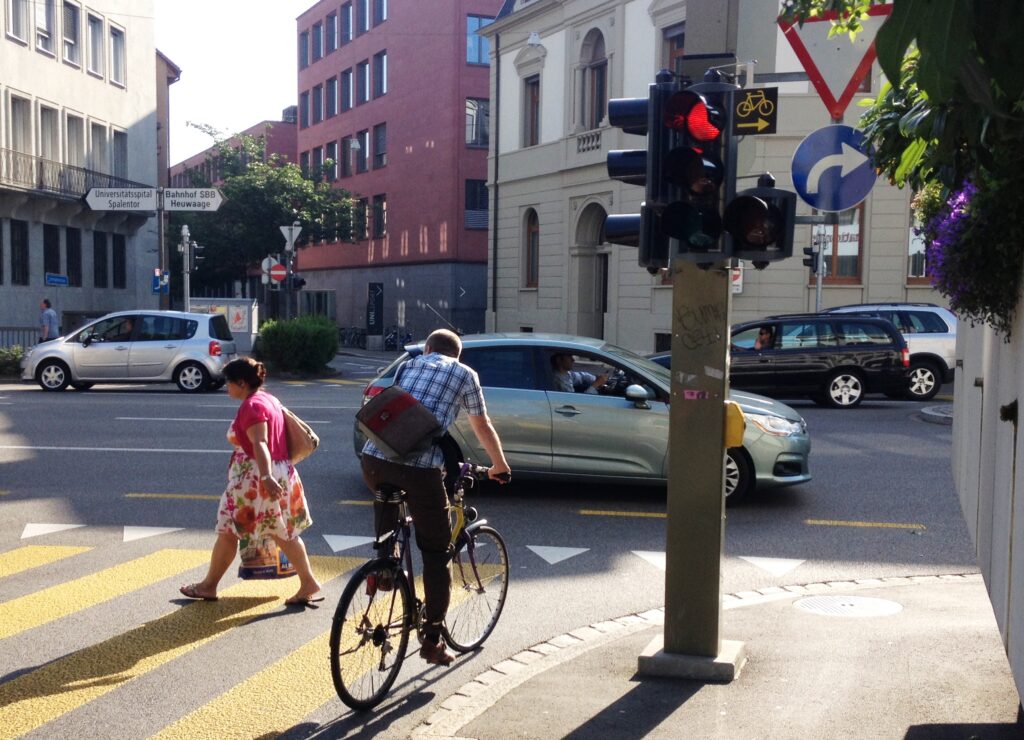

Leading cycling campaigners in Scotland have been discussing the potential road safety implications of allowing cyclists to ride through red lights.
Speaking to Scotland on Sunday figures from campaign groups such as Bike for Good, Cycling Scotland and Spokes shared differing opinions on the matter, with disagreements over whether such changes were necessary and what safety improvements they would have.
As per the Highway Code, informed by the Road Traffic Act 1988 section 36, cyclists ‘must obey all traffic signs and traffic light signals’ and ‘must not cross the stop line when the traffic lights are red’.
This differs from road laws in other parts of the world, notably in some parts of the United States and France where cyclists are permitted to proceed at red lights in certain circumstances, something Gregory Kinsman-Chauvet of Bike for Good believes should be implemented closer to home.
“After reading various studies proving that removing the obligation for cyclists to stop at red lights increased safety, I decided to test it myself,” he told the Scotsman’s Sunday sister paper, arguing a change of road rules could allow those on bicycles to travel through red lights at specially marked junctions after giving way to pedestrians.

“In Paris and Lyon last summer I had the opportunity to experience this and quickly felt much safer on the road. At junctions motorists knew they had to prioritise cyclists and were more cautious — it’s time to change mindsets.”
However, not everyone agrees, Cycling Scotland’s cycling safety manager Simon Bradshaw suggested Scotland’s road laws are too different to France’s to be compared and questioned if such action should even be a priority.
“There are many actions needed to improve safety for people cycling and we don’t believe that permitting people to cycle through red lights is one of them,” he said.
“Red lights — and green figures — ensure people can cross roads more safely and confidently. Scotland also has very different rules of the road to France, making it complex to replicate. The recent updates to the Highway Code, if followed, make our roads safer for everyone.”
Likewise, Ian Maxwell of the Lothian cycling campaign group Spokes, told the Sunday newspaper he does not believe the matter is “necessary”.

“I would like to see all motorists respecting advance stop lines before we try this approach,” he explained.
“There is also the question of why this particular priority is necessary. Cycling is already a fast and reliable way of getting through city centres, even if you have to wait at a few red lights.”
Just last year Colorado approved a bill to let cyclists ride through red lights with the aim of cutting collision numbers by reducing interactions at junctions between drivers and people on bikes.
The rule change does still require riders to briefly stop at red lights to give way to any vehicles or pedestrians before continuing on their way.
Elsewhere, in Paris, since 2015 cyclists are permitted to travel straight or make right turns through reds when at specially signed junctions, a law change that followed a successful pilot scheme.
> Cyclists in Paris allowed to ignore red traffic lights
“They [red lights] were installed so that car drivers would let pedestrians cross the road, to regulate the flow of traffic and to moderate the speed,” Christine Lambert of the campaign group Mieux Se Déplacer à Bicyclette (MDB) said at the time.
“But bicycles don’t go fast and don’t make any noise. It’s idiotic to stop for nothing. You waste energy and it slows you down. The best safety assets for cyclists are your eyes and your brain.”
Coverage of cyclists and red lights here in the UK is often a divisive topic, with headlines such as ‘Red light Rats!’ appearing in the Mail on Sunday after the paper accused 26 “rogue cyclists” of jumping lights outside Buckingham Palace.
The story of last August led to accusations of the article being “manufactured” and “dehumanising” after it was discovered the road was closed to motor traffic and police officers had urged bicycle riders to continue through the lights.
Earlier this month a Deliveroo food delivery cyclist based in Edinburgh spoke out about the pressures of the job and said the struggle to make ends meet leads many couriers to break traffic laws, such as jumping red lights.
“I do not have any issue with laws, and as a recreational club cyclist, I feel some obligation to not give cyclists a bad name and fuel anti-cyclist attitudes held by many motorists. Riding for Deliveroo, I have the opposite mindset,” he said.
“If every road law was to be followed, it could easily add five minutes to a delivery, which would cut my income by 20 per cent.
“My normal ‘Roo’ daytime income averages £10-12 per hour. To reduce that by 20 per cent is therefore not realistic. Most Roo cyclists will, like me, not follow all road laws.”
What do you think? Should cyclists be allowed to ride through red lights in certain circumstances? Would a change in the rules improve road safety for everyone? Is a change even necessary?










126 thoughts on “Should cyclists be allowed to ride through red lights? Campaigners split on safety benefits”
I don’t think there should be
I don’t think there should be a change. There are a core set of rules in the Highway Code that apply to all road users. Behaviour at junctions is one – and a vitally important one. There are enough road users that struggle with the current rules – complicating them won’t help.
It could also create resentment of cyclists if they’re considered “special”. Cyclists certainly don’t need any more resentment against them just now.
A big factor in road safety is the level of compliance with the rules. Historically the UK has done well, but in recent years, the injury accidents from vulnerable road users has been creeping up. Compliance with the rules, whatever they are, by all road users, matters. I say sort out the compliance, not the rules. And that means more enforcement.
danhopgood wrote:
I’m not sure that junctions apply here – the rules for using junctions are already different for pedestrians and motor vehicles. In fact, I suspect that very few rules apply to all road users – the code is very clearly sub-divided by different users. I suppose you could make the case if you exclude pedestrians from being road users, but that just becomes a fiction
the little onion wrote:
Sorry, almost every driver I know hates cyclists with a passion, and if we were given the ok to go through red lights in certain circumstances, that situation is only going to get worse. And if a cyclist went through a red under these new rules, and caused an accident…
You simply cannot explain to drivers that there are different rules, they just do not get it, or don’t want to get it.
Daveyraveygravey wrote:
In that case, it’s best to completely discount their uninformed opinions and let the adults get on with implementing the best solutions, especially those that have shown benefits in other countries. If a segment of the population are willfully ignorant then there is no benefit in trying to appease them anyway.
What you said! Different
What you said! Different modes are different. The fact that in the UK we’re unclear about this just means we need to be clearer!
Examples: cyclists are not pedestrians so don’t lump them together (especially not on crap infra – being exactly the same narrow footway space). Cycles are legally “vehicles” but are not the same as “motor vehicles” and are already subject to different rules (restricted from motorways etc.)
I’m against on this one, I’m
I’m against on this one, I’m afraid. There’s already enough conflict and resentment from drivers and pedestrians about supposedly “entitled” cyclists, rightly or wrongly this would inevitably make it worse and increase levels of aggression against cyclists. Additionally, I just don’t think it’s that necessary; in a 20 km commute across London I encounter approximately forty sets of traffic lights and I always stop when they are on red, yet my Strava shows that my total travel time is only ever five minutes greater than my moving time (generally around 55 minutes total, 50 minutes moving). I would far rather see a campaign to install cameras ensuring that every driver deliberately blocking an ASZ gets fined and pointed and also a campaign to have cyclist early release lights installed at every junction. We are lucky enough to have quite a few of these around our neighbourhood and they make a far bigger contribution to cyclist safety at junctions than being allowed to run red lights will ever do.
Rendel Harris wrote:
I don’t think it’s valid to consider the opinions of uninformed people complaining about entitled cyclists when they typically have next to no knowledge of the highway code or the dangers present on the roads. If you try to appease them, we’ll just end up with tabards, number plates, taxation and licences whilst the police would just use them as an excuse to target minority groups. What we need to do is evaluate traffic in terms of road danger and not whatever crap the Daily Fail prints to rile up the aged.
hawkinspeter wrote:
I do agree with you, but unfortunately, the fact is that “the crap the Daily Fail prints to rile up the aged” has a real impact on how cyclists are treated on the roads. Remember the HC updates when 90% of the info on it to reach the public was through the lense of anti-cyclist bile spewed by the gutter-press? I noticed a pretty significant uptick in abuse I got on the roads while that was in the news cycle.
I’m dreading the above story being picked up by the usual MSM suspects…
hawkinspeter wrote:
I totally agree that it shouldn’t be necessary, but unfortunately in the real world I fear it is. There’s a difference between resisting the imposition of stupid unnecessary regulations such as the ones you mention and giving cyclists exemption from the laws they currently have to follow. In an ideal world a new law could be introduced, carefully explained and people would accept it; in the imperfect world in which we live, it would, I fear, simply raise aggression levels toward cyclists. Simply from a pragmatic point of view I don’t believe the resentment and extra aggression towards cyclists such a measure would create is worth the marginal benefits it would prvide.
Rendel Harris wrote:
Sorry, but I just don’t think that unlawful aggression should be used as a reason for not making improvements. Throughout history there’s many examples of minorities being subject to aggression (some of it illegal, but all of it immoral), but not wishing to change the status quo because of it is flawed logic – the laws often need to be changed to reduce that aggression. Imagine if the gay-bashing of the 70s/80s etc had the effect of not introducing anti-discrimination laws – how would that have helped matters?
We’re not talking about
We’re not talking about antidiscrimination laws though, are we, we’re talking about giving cyclists an exemption from traffic law that all other road users must follow. If anything we would be introducing a new layer of discrimination in our favour and that inevitably causes resentment.
Rendel Harris wrote:
My point is that some motorists discriminate against cyclists and that leads to unlawful behaviour on the roads that injures and kills cyclists. Now, this discussion isn’t about making their discrimination illegal (although I’d consider a case could be made for that), but about different modes of transport and increasing safety for the more vulnerable. I fail to see why people cling to “one rule for everyone” when there’s already different rules for buses, taxis, cyclists, pedestrians etc.
With segregated cycle infrastructure, there’s a clear discrimination against motor vehicles with a stated purpose of increasing safety for vulnerable traffic and by copying Paris and other places, we’d be attempting the same thing by modifying the red light rules. Your argument could equally apply to scrapping all LTNs and cycle infrastructure and I think it’s unhelpful to think in terms of appealing to the biggest contributors to road danger when we need to be increasing modal share of cycling/scootering etc.
Rendel Harris wrote:
That’s simply not true – pedestrians are road users and don’t have to stop at red lights. It also overlooks the numerous othe ways in which the law treats different road users differently (e.g. speed limits; insurance/tax/licence requirements etc.)
In some ways, I think that is actually key to this discussion. The law, and society, largely treat cyclists as “car-lite” – i.e. bikes and cars are both “carriages” in the eyes of the law. Whilst the earliest road traffic laws referring to carriages actually predate the motor vehicle, that term has stuck and the law has been extensively (re)written around the motor vehicle, with the humble bicycle caught up in this definition (with some additional bits of law tacked on for motor vehicles specifically). (Incidentally, having bicycles classified as “carriages” was actually considered a win by cycling campaigners at the time, because it gave cyclists the legal right to freely use public carriageways.)
I would argue that bicycles are better considered “pedestrian-plus”. In pretty much all regards (e.g. weight, size, power, speed, vulnerability, situational awareness etc.), a cyclist has more in common with a pedestrian than a car.
And there are plenty of car-free spaces where pedestrians and cyclists mix comfortably with no traffic signals – from my own experience the best examples would be Cambridge’s various green spaces (Jesus Green, Midsummer Common, Parker’s Piece etc.) which are key routes for both cyclists and pedestrians and yet very safe and largely incident free (not 100% incident free, but if you browse Crash Map or similar it is striking how few incidents occur compared to the nearby roads open to motor traffic).
In that light, any change should not be viewed as “giving cyclists an exemption from traffic law [as it applies to carriages]” but rather “bringing cycists into line with existing traffic law [as it applies to pedestrians]”.
This would definitely be a
This would definitely be a good thing to introduce for cyclists as we’ve had to put up with motor-centric designs of roads, junctions and traffic lights for too long. Anyone who cycles recognises that there’s some junctions where it’s safe to turn left for bikes when there’s not enough room for cars to make the same turn.
I don’t think it’s worth considering the attitudes of anti-cyclist motorists as they seldom have an understanding of the highway code as it is. If people are concerned that it introduces asymmetry into road traffic, then they should appreciate that there’s already a huge difference in vulnerability between drivers and cyclists. It seems reasonable to provide those most vulnerable with the opportunity to avoid some of the danger posed by motorised vehicles, and not having to start moving at the same time as drivers when the lights turn green is one instance where it’s safer to go through on red.
There’s a pelican crossing
There’s a pelican crossing near me that you can wait for ages after you press the button. Quite often I press the button, cross when a gap in traffic appears and then be 20 yards further on before I hear the beeps. The crossing has good sight lines, but I suspect that regarless iit was still deemed too dangerous to be a zebra crossing largely because of poor driving and lack of confidence in drivers ability to see pedestrians. If I’m cycling along there in good light, I can see the pedestrian has crossed, I can see that there are no other pedestians are in the vacinity why would I want to stop and wait at a red light that was put in because there are lots of drivers that can’t be trusted to observe a zebra crossing?
Going off on a tangent a bit,
Going off on a tangent a bit, but the long wait when you press the button at a pelican crossing isn’t because it is a pelican crossing, it is because it has a long wait. The solution is simple, do away with the wait.
It is nonsensical that pedestrians wishing to cross at a pelican or puffin crossing (or cyclists at a toucan crossing) should have to wait some arbitrary period of time. Sure, there are some junctions where it might be necessary to tie the timings in with other signals – however, for the most part, it keeps those wishing to cross waiting for no reason. It delays the the time when road users will need to stop, but it will still hold up some road users, for the same amount of time, it just delays the inevitable and changes which particularly road users are delayed. The only purpose I can see, is to allow parents to catchup with their children who are running or scooting ahead of them next to a busy road (and that has its own problems).
I’ve come to the conclusion that the primary purpose of the wait is to penalise those who wish to use the crossings (and perhaps to disincentivise use of the crossings).
The delay is to allow the
The delay is to allow the pressee to look up from their phone, realise it’s clear and cross anyway, all before the lights turn to red…..
If it is selected clearly
If it is selected clearly marked junctions only then I see no problem with this – not sure it will increase conflict as the motorists who are anti-cyclist already think we all sail through red lights on a regular basis!
And the minority of bad cyclists will continue to sail through red lights in front of cross traffic even if marked up as a “no-cycling-on-red”
I bolded the above – as unlike New world or re-built europe we have many narrow roads – I only see this working for left turn or straight at light controlled T-junctions where the road is wide enough for cyclists to turn/proceed with little to no impact on any flowing traffic, obviously same could be achieved with dedicated turn/straight cycle lanes – but the latter would be more costly to implement than a few small rectangular signs added to the existing traffic light.
Im mostly agnostic to it –
Im mostly agnostic to it – tending to slightly against. I think the benefits are marginal and I’d rather see the funding used for more ASL’s to reduce cyclist/motorist interactions rather than increasing the chance of Pedestrian-Cyclst interactions.
I dont think its solving the anything near the most pressing problem for cyclists.
Secret_squirrel wrote:
I don’t see why it would need special funding – I’d be all for a rule change to decriminalise cyclists crossing through a red light without any need for changed signs or road markings. The idea would be for cyclists to make their own choice as to whether it’s safer to wait for the green or to proceed when they consider it safe (and obviously no pedestrians trying to cross).
I’d agree about it not being the most pressing problem as the lack of road policing makes it easy to just go through reds when appropriate and of course the lack of road policing is probably cyclists’ most pressing problem due to some drivers having the skillset of a squirrel playing chess.
hawkinspeter wrote:
It just needs the rule to be ‘treat a red light as a Stop sign’.
hawkinspeter wrote:
I was specifically commenting on the article – not some other theoretical proposal.
I’d be dead against this change with no indication to pedestrians that they are somehow approaching a junction that has different expecatations on them.
Even if we went with your model there’d need to be a massive PR campaign which would cost money.
Saying this could be done for free is both naive and dangerous imo.
Secret_squirrel wrote:
I’d assume that any update in rules would be along the lines of cyclists treating the red-light as an uncontrolled junction – i.e give way to cars on the road you’d be crossing and crossing pedestrians (if the light was directing pedestrians too). So in theory, there wouldn’t be any different expectations on the pedestrians as the cyclists should be givig way to them too.
Secret_squirrel wrote:
I don’t see why there would need to be different expectations from pedestrians as they would have priority and can cross as usual. I suppose the benefit of specially marked junctions would be to roll out the change incrementally, but I think the better option is to just change the law. A PR campaign would hardly be needed as plenty of “news” papers/sites would pick up on it with their usual anti-cyclist bias.
I believe (haven’t looked it up) that the U.S. states that introduced the red-light-as-stop-sign laws didn’t require changing junctions or a massive PR campaign. I think Paris may have changed some signs, but I think that was after making the law change.
So far the evidence is that it isn’t dangerous.
hawkinspeter wrote:
So when, inevitably, a cyclist legally going through a red light is hit and killed by a driver legally proceeding through a green light, who is going to be to blame? I simply don’t see the need for this to be introduced, surely it is simply common sense that the safest way to get opposing streams of traffic – all traffic – through a junction is for lights to hold traffic going N-S whilst the traffic from E-W goes through and vice versa. That, coupled with advanced stop zones and early release lights for cyclists, is surely the optimal way of avoiding conflict. Telling cyclists that they can ride through red lights at their own discretion is to my mind simply adding an extra layer of danger and confusion with no safety advantage, merely an insignificant time saving.
Rendel Harris wrote:
If you make it so a red light for a cyclist is in effect the same as a give way sign, then you have the precedent there.
I’m not sure where I stand on this issue, but that specific question seems pretty easy to answer.
Rendel Harris wrote:
The cyclist. Because, if we’re assuming that this is going to work like cyclists treating red lights like a normal “give-way” junction, they’d still have to actually give-way. So in your scenario, the cyclist has pulled out in front of a car without looking/giving way.
They’d be “legally” going through a red light in terms of there not being a specific crime for it, but they’d still be in the wrong in the same way a car would be if they pulled out from a side-street infront of another car.
Rendel Harris wrote:
In your cyclist/driver/red light scenario, the blame would by default be with the cyclist for not checking that it was safe to proceed (providing that the driver didn’t suddenly accelerate or swerve to hit the cyclist).
You may believe that to be the safest way, but the evidence shows that allowing cyclists to treat red lights as STOP signs results in greater safety for cyclists. It may well be counterintuitive to you, but reality doesn’t have to abide by anyone’s rules.
Here’s a study into the Idaho law and its effects on cyclist safety: https://denver.streetsblog.org/wp-content/uploads/sites/14/2018/02/idaho-law-jasonmeggs-2010version-2.pdf
I disagree. Pretty sure a
I disagree. Pretty sure a green light means “proceed with caution”…not “pedal to the metal” (been a little while since my last driving test). So irrespective, the driver at the wheel of a 2T death machine not looking at what’s in front of them is at fault.
KDee wrote:
Yeah – I was envisioning a typical incident as being a driver continuing at a steady speed and a cyclist coming from the side and causing them to hit the brakes or change course to avoid a collision (or not as the case may be). The traffic going through an established green should have priority and cyclists/scooters going through the red should be only going when there’s a suitable space.
Good point…the “he/she came
Good point…the “he/she came out of nowhere” defence.
I see plenty of RLJ’ing by cyclists here in NL, but it’s really part of the culture and most drivers seem to be expecting it and are ready to give them a good blast of the horn. However, we also have the ability to turn right at a junction on a red light on the bike (most of the time) which really makes sense (as long as we also give way to peds that may be crossing on a green). The weird thing, and it’s really in the detail, is that to do that we often have to pass waiting cyclists on their left and hope they don’t get a green light at the worst possible time. I have seen a few bike lanes with a right turn filter lane, but they seem to be fairly rare.
This would be a positive
This would be a positive change and I’m all for it. It seems to work well in France: https://youtu.be/yIcj9rIWgA8
I think it would improve safety overall. If drivers are expecting cyclists to be crossing the junction when their light is green, then I think they will approach with more care and a lower speed.
Ideally, I would prefer a combined phase where pedestrians and cyclists can negotiate the junction without any moving motorised traffic. But that’s a costly change and will take a long time to implement. Letting cyclists treat a red light as a give-way at some junctions is a sensible solution to quickly improve the safety and convenience of cycling.
On the only occasion I have
On the only occasion I have been knocked off my bike by a car, I was waiting at a red light and the driver anticipated the green and went right into the back of me (when the light was still yellow). Back wheel wrecked and a few cuts and bruises were, fortunately, the only damage.
As a result of that collision, I make no apologies for occasionally skipping through a red where I judge there is a danger of that happening (Audi TT drivers revving up behind me being a good example) and if the police stop me and give me ticket I consider that a price worth paying for not ending up under someone’s front bumper.
I have also noticed an increasing tendencey for drivers to go when the cyclist specific light goes green at the junction near my house, rather than waiting for theirs. I assume their attitude is “if it clear for cyclists to set off, then it is obviously clear for me to as well”.
Anything we can do to ease that interaction is fine in my books.
Jetmans Dad wrote:
Waiting for the light to actually turn green before moving away is always a pretty risky proposition…
I have had to dive out of the
I have had to dive out of the way when stopping as amber turns to red to avoid being rear ended by ambler gamblers.
Woud that involve going
Woud that involve going through an established red light? 😉
Personally, I lean towards
Personally, I lean towards thinking that some kind of change would be good, although not sure what this would look like exactly in terms of which junctions/lights are covered and what requirements remain.
The arguments for are convenience and safety. Convenience isn’t just about the time spent stopped, it’s also the effort required to stop and start. And whilst you might think “convenience” is not a strong argument, I would reiterate the point that making cycling more convenient is an important part of getting more people cycling – which I think has numerous benefits for road safety and public health.
Safety – it’s well established that allowing cyclists precedence over motor vehicles is a good thing – it’s why we have ASLs and even early release lights for cyclists in some instances. But IMHO those current features are insufficient, even when not abused – a couple of meters/a couple of seconds ahead just isn’t enough to clear the junction. Going through on a “red” can be much more effective in getting space away from motor vehicles.
I would also point out there are numerous cases where going through on a red would have zero potential for conflict due to bike-specific facilities not being taken into consideration when designing the lights – for example when turning onto a dedicated cycle track or onto a contra-flow cycle lane.
As for the cons, the main concerns seem to be:
Potential for cyclists to hit pedestrians. I think this risk is low, and in any case I certainly expect any change to the law would still require cyclists to give way to pedestrians. The sort of reckless cyclist that might endanger pedestrians is probably the sort of reckless cyclist that isn’t stopping for the red light anyway. And while by and large I think pedestrians and cyclists should be segregated, I also think that cyclists and pedestrians can mix much more safely and cordially than when motor vehicles are involved. If pedestrians and cyclists can successfully negotiate “shared” paths and other shared spaces, I don’t see that a crossing is much worse.
Potential for cyclists to be hit by drivers. Obviously this would depend on exactly how the law is changed, but in general I think the risk is low. As above, I assume any change would require cyclists to give way to motor vehicles proceeding through a green light. Cyclists do not want to be hit by a car, and most would only proceed when safe to do so. Again, the sort of cyclist who proceeds recklessly into the path of a car is the sort that would probably jump the red light anyway.
Finally, there’s the “optics”. On principle, I object to the idea that we should base any laws around the ill-informed mouthing-off of bigots. There’s also an argument that given all cyclists supposedly already jump red lights, if the law permitted cyclists to do so that would actually be one less thing for them to complain about.
One more thing – the debate becomes moot if there was actually good, segregated infrastructure where lights/junctions/crossings are actually designed around what is safe and convenient for cyclists, rather than for motor vehicles.
“There is also the question
“There is also the question of why this particular priority is necessary. Cycling is already a fast and reliable way of getting through city centres, even if you have to wait at a few red lights.”
This is exactly the problem with a non-cyclist’s* way of thinking. It’s quite often not about speed at all.
*Or, alternatively, a segment-hunter’s
Bucks Cycle Cammer wrote:
It’s about momentum as much as anything else. That at least is recognized in the USA regulations.
Also worth pointing out that
Also worth pointing out that in pretty much everywhere that this or similar rules exist – including those for motor vehicles – the rule is stop first, then proceed if clear. In other words, you treat the red light like a stop sign.
Bmblbzzz wrote:
And having to clip in again…
I’m pretty mixed about this
I’m pretty mixed about this one. In some ways it will be good, especially on junctions that are notorious for their safety or those junctions that are on a hill. In general I think it may only serve to increase the antipathy that some motorists already have. As an aside. I’ve noticed an increase in motorists of late to block access to the ASL by pulling into the nearside. It doesn’t really bother me that much as I filter to the offside or will just wait behind. Part of me feels that we could see a greater increase in this behaviour.
I’m torn on this one. There
I’m torn on this one. There are definite safety benefits to it on roads with clear visibility, and I must say that personally, one of the situations that makes me feel the most vulnerable is sitting at a red light with a queue of cars behind me – knowing that as soon as the light goes green, I’m going to have 4-5 of them race forward and try to squeeze me through the road furniture on the other side of the junction. There are quite a few non “smart” lights near me that are just on timers where it would usually be perfectly safe for me to roll through and re-establish my position on the road well before the drivers behind have a chance to grind me into a traffic island. I also think it would make a lot of left-turns safer. I also (though it’s been a long time since I’ve done any reading on it) seem to recall the Idaho stop resulting in a fairly significant drop in cyclist KSIs – though US roads, driving attitudes and rules are quite different, so you couldn’t automatically assume the same would be true here.
On the other hand – there’s already so much animosity and misinformation towards cyclists already due to constant crap in the media. If this was ever even proposed, let alone enacted, I can’t imagine a reality where the right-wing gutter press wouldn’t make it their mission to turn the roads into open-season for cyclists. Remember when the Government updated the highway code but decided against any public information or publicity of any sort and just left it up to the Telegraph and the Daily Mail to run with the “cyclists are taking over at YOUR expense” line? Did anyone else notice a massive uptick in abuse on the roads for the period until the news cycle rolled onto something else. I sure as fuck did.
Gosh – here’s a talking point
Gosh – here’s a talking point and a half, so many angles here. Short – I’m with the Spokes-person – it’s not the big issue. What is? Reducing the number of motor vehicles on the roads, keeping them to the existing rules, making more dedicated space for each of cycling and walking – and taming motor vehicles where these modes interact, as they always will … the list goes on.
Our whole approach in the UK for road transport changes seems to be to focus on a detail and worry it to death, or try to “fix” one part in isolation. I think that is part of why our system is less than ideal. More of the same won’t change things.
However, if we are only talking about lights here are a few thoughts:
Cyclists jumping red lights “solo” can run into problems because of motorists. Cyclists and motorists jump red lights for different reasons. Motorists (cars or motorbikes) who run red lights are often accellerating through at the end of a green light cycle or “anticipating” the start of a cycle with a quick getaway.
Advanced green lights for cyclists exist in the UK [1] [2] but are not common currently. It’s quite likely that “trigger-happy” motorists may mistake these for their own green. Although this should improve over time this is an imperfect solution. It relies on cyclists filtering to the front / may require an ASL – and this is commonly blocked by motor vehicles. Unfortunately this is also sometimes used instead of more expensive / “controversial” but better infra / network works…
On Critical Mass rides if lights change while the stream of cyclists are passing the rule is that everyone continue to ride on through the red light. (That’s not a goal BTW – it’s actually for ride safety). This is safe as cyclists are travelling at about 6 – 8 mph and in a continuous stream (several abreast!) plus there will be “blockers” martialling the junction. So it’s very obvious to others that they can’t get through. It can of course result in anger – including from pedestrians.
If delivery companies – using any mode – are tacitly incentivising dangerous behaviour that needs recognising and tackling. That is a separate issue.
There is an existing proven way to improve things for cyclists with minimal infra changes (lights and controllers). This is the “all ways green” / “simultaneous green” / “scramble” light cycle. This is scalable to many junction designs / sizes and can even work in conjunction with pedestrians crossing simply because cyclists can clear a junction quite quickly.
Motorists (cars or motorbikes
Motorists (cars or motorbikes) who run red lights are often accellerating through at the end of a green light cycle
Of course, what this means to these drivers is ‘I was only accelerating to go through on the green!!’- and everybody does it!
So how long are the apologists going to allow them, because all times are at the end of a green light cycle?
https://upride.cc/incident/t90jdt_audiwithcaravan_rljatspeed/
And if they decide that shouldn’t be allowed, how about this 32 tonner at speed?
https://upride.cc/incident/pk68zfl_32tonnetipper_redlightcross/
Left turn seems ok to me as
Left turn seems ok to me as long as it is clear that it is give way to peds and they always get priority.
Be interested to hear what leadensky(ies) thinks.
Most reasonable people
Most reasonable people recognise that most bike RLJs are not a danger to anyone else and jumping the red light can in some cases can be the safest option. That said, I personally don’t like it and some RLJs are just arseholes.
Any changes would be expensive, require a lot of communication and would be put to a public resistant to change.
I’d propose a slightly different approach. Change guidelines to say that unless someone has been harmed or property damaged through cycling RLJ, no penalty will be enforced. However if harm ensues or property damaged, maximum penalty enforced.
JustTryingToGetFromAtoB wrote
I’m feeling like I’ve hijacked my own account today, but I’m going to have to disagree on that one as well! I agree that RLJs are not often a direct danger to anyone else in terms of the likelihood of colliding with them and the severity of injury if they do, but riding in London I frequently see motor vehicles and/or other cyclists having to take evasive action to avoid RLJs, action which could easily cause incidents with oncoming traffic, pedestrians et cetera.
From previous discussions on
From previous discussions on this it seems that there is a “thing” with this in London. Is this just “concentration” e.g. small area with sufficient cyclists so that the x% who jump lights are actually “lots”)? Is it “demographics” where the cyclists there are more likely to take risks (e.g. more riders are young / Londoners are somehow more pushy / there’s an excess of bicycle messengers / food delivery services)? Is it that there is enough ‘adequate’ cycle infra for there to be a noticable number of cyclists? Is the infra itself contributing (maybe excessively long waits tempting people)?
Tbf most RLJs I see seem to
Tbf most RLJs I see seem to be people who have no idea about the HC so may not be representative of a legal RLJ.
Ashley Neal wants to disagree
Ashley Neal wants to disagree! (His first post on the Picardy Place Leith Street / York Place collision). His point (I think) is “it’s not just ‘only a danger to themselves’ – there is an effect on a driver who hits them, the family of that driver, their own family…”
I think we should talk about that. However I suspect he would emphasise a certain aspect (personal responsibility / enforcement) whereas I see this as a more systemic issue. I’d say we’re setting vulnerable road users up to fail – or at best forcing them to choose safety OR convenience in a way we simply don’t with the dominant mode (driving). We’re also obscuring the seriousness of the choice you make each time you decide to drive.
I’m also still interested in getting to the bottom of the figures repeatedly brought up by some posters here. These apparently suggested pedestrians are at an elevated risk of being in a collision where cyclists were “involved” at crossings (relative to other vehicles). This clearly needs much more detail however as to what is actually being recorded and why this might be the case.
chrisonatrike wrote:
Those figures (assuming you are referring to the infamous TfL table, the bottom of which a certain person likes to cut off) are a nonsense, because all they did was record all vehicles involved in an incident, whether or not they actually came into contact with a pedestrian. If an out-of-control motorist hit a cyclist and then span into a pedestrian, that was recorded as a pedestrian collision/injury/fatality involving a cyclist with no record of circumstance or fault. I’ve looked reasonably hard for any evidence that pedestrians are at greater risk on crossings from cyclists than from motor vehicles and haven’t been able to find anything; I’m pretty sure that if there was a study or evidence that showed that it would be being quoted at us ad nauseam by the motor lobby.
Rendel Harris wrote:
Don’t worry, Martin73 will be able to share the outputs of his various Freedom of Information requests, which for some reason known only to him, are restricted. It’s going to be a big story. But he can’t share it yet. Probably because it doesn’t exist. Probably.
chrisonatrike wrote:
Does the table you’re referring to specifically talk about crossings? I thought is was just general traffic in London – which is why it shows the numbers it does. Cars, vans, and HGVs should only come into conflict with pedestrians at crossings, or when the pedestrian is crossing the road. On the other hand, cycle infra (by-and-large) either exists in or adjacent to (but often not separated from) pedestrian spaces. A car could spend 2-5% of its journey in “conflict” with pedestrians, but a cyclist could spend 50-70% of their journey in “conflict” with pedestrians (if they used as much provided infra as they could).
Combine this with other context (pedestrians are 23% more likely to be to blame in these collisions according to TfL stats, and the extremely loose definition of the word “involved”) and the table in question actually paints cyclists in a rather good light.
However, a certain poster likes to conveniently “forget” to include this context so that he can make dubious claims like “cyclists are more of a danger to pedestrians than HGVs are”.
Funnily enough, DfT stats show this claim to be utter, utter bullshit:
I agree that the poster you
I agree that the poster you mentioned was – politely – overselling their pitch. I’d suggest that DfT stat summary you’ve got there unfortunately doesn’t tell us much more. You could possibly suggest uncontroversial takes like “cars are by far the dominant mode”, “motorbikes go faster than bikes so are more dangerous” and “big vehicles like lorries and buses kill more than they injure because of their mass and catching people under their wheels / superstructure”
Indeed if you simply adjusted corrected for the proportion of traffic you could argue that cars, vans and lorries were less dangerous than cycles per unit of traffic! I think this was as reported in the PACTS data summary. However this doesn’t help much if you were actually interested in understanding what was going on and reducing harm of course, rather than just hunting for some reason to shout a cyclists…
I think there were some other figures mentioned by rich_cb (?) and others (?) some time back specifically about junctions / lights. Although possibly it was another view of the same data set? No one’s appeared waving these triumphantly so like Rendel I’m tempted to believe this provided neither further insight nor ammunition against mass cycling.
I went looking for some data
I went looking for some data on this subject and found:-
https://www.whatdotheyknow.com/request/306163/response/754931/attach/html/4/FOI%201737%201516%20ped%20casualties%20injured%20by%20a%20vehicle%20disobeying%20an%20ATS%202005%202014.pdf.html
(there is a link at the top right of the page to a PDF version which is formatted better)
Comparing the data with the number of times I see people in all sorts of vehicles jumping red lights it is not the problem we think it is and we should concentrate safety efforts elsewhere.
vehicles jumping red lights
vehicles jumping red lights it is not the problem we think it is and we should concentrate safety efforts elsewhere
The idea that only those moving traffic offences which can be proved to have resulted in collisions, injuries and death are worthy of consideration, and the rest should be shrugged off as ‘everybody does it’ is a counsel of despair and a call to anarchy! To start with, it leads to ‘if you survived a close pass it wasn’t worth talking about’- this is essentially the case at the moment, and the reason why the count of NMotD is nudging 850 with no improvement so far
With the massive reductions
With the massive reductions in traffic police since the introduction of “speed cameras” we should concentrate these scarce resources where they will do the most good.
For me it is a clear yes,
For me it is a clear yes, cyclists should be allowed to ride through red lights.
It seems weird to me that an 80kg human is allowed to cross vertically a road and an 80kg pedestrian and 10kg of metal and plastic cannot legally do it.
Of course it cannot be done anywhere and under any circumstances just like walking, but it is good that it is finally being discussed.
because when your 90kg combo
because when your 90kg combo hits a human at no more than 5mph, Newtons second law of motion kicks in, and the force hitting most likely the humans shoulder is over half a tonne for a fraction of a second.
And I can assure you that hurts.
It is not that bad, it is
It is not that bad, it is still better than being hit a 100kg 10mph runner. Even if you get hit by a car at 5mph you will probably not be hurt. The problem is that motor vehicles will reach much greater speeds, incomparable to human powered motion.
So cycling speeds are not really great, especially compared to motor vehicles. The sweet spot in bicycle commuting is going slow and as uninterrupted as you can get, you will not sweat and not get tired. That is why the Dutch love it, they have excellent infrastructure, cycle on rusty bikes with normal clothes and still are happy, good looking, fast and safe.
Inertia should be considered
Both motor vehicles and cyclists can quickly exceed jogging speeds even from a standing start… and certainly motorists passing reds tend to be going fast or even accelerating!
Inertia should also be considered. A runner hitting you will likely fall. So will a cyclist but they may be airborne / land more awkwardly – so maybe worse outcome for them.
Part of the added danger of motor vehicles is that due to their greater mass when they hit you they won’t be brought to a stop. If a much more massive and/or higher- clearance vehicle hits you – and you aren’t thrown to the side – they will be on top of you…
Agree with the comments on Dutch cycling speed but note that how they manage interactions between modes is *utterly* different from UK. I doubt “just let cyclists through red” would be acceptable as good “sustainable safety” practice. For more on their designs see “unbundling / unravelling modes”, smart traffic lights, junction design etc. (You can find all these at bicycledutch – there’s a “Themes” section or just search).
My shoulder would disagree
My shoulder would disagree with you on how much that hurts.
And bringing motor vehicle forces into it is just whataboutery on this point, the discussion is about letting cyclists go through red lights, and doing that pedestrians will be put at risk because we already see those cyclists willing to take risks through red lights do not treat them as stop and only go if it’s safe, they carry on through “uninterrupted” because they dont like stopping and this change would simply give them free licence to do it, and the consequences be damned.
Totally undestand you, when a
Totally undestand you, when a motorcycle going the wrong way hit me on a pedestrian crossing, I admit I wasn’t that kind and I may have used some of my grocery as projectiles against the hasty rider. And I had pain quite a few days.
Nevertheless it is a light injury, I had nastier injuries me just walking alone, playing basketball, or working. I bet that health effects from exhaust fumes from passenger cars driving around, will have compromised much more my health in an irreversible way.
So if we could promote cycling commuting by evaluating again red lights for cyclists, it makes sense to me. There are big health gains for many when even a few people cycle to commute.
Awavey wrote:
One of the worst wrist breaks I ever saw on the rugby field was when a prop forward, jogging at not much above walking pace to get back into position, tripped over a supine teammate and fell awkwardly on the hand he had put out to break his fall (admittedly there was a lot of weight going through it); very ugly compound fracture that required surgery. Young children, pregnant women and the elderly are of course far more vulnerable to bumps and falls at any speed. No legislation or cyclist behaviour should be based on the idea that “if there is a collision it’s only going to be a little bump”.
What’s this nonsense about
What’s this nonsense about Scotland hzving very different rules of the road to France?
I’ve driven ridden bikes in both countries, they’re pretty much the same in the areas that would be affected by the Idaho stop.
I notice that the article and
I notice that the article and those quoted all seem to be Scotland-based. Is this proposed as a UK-wide change or is it limited to Scotland? (A quick search suggests transport policy is devolved but I’ll stand corrected if it’s not).
Intuitively, I’d support such a change but agree it’s probably not the most pressing issue.
The question I’d ask is; who does it benefit?
To that end, it brings to mind a very old blog post (by ‘magnatom’) which (iirc) argued that ASLs ‘promoted’ in less confident or inexperienced cyclists a mindset that because an ASL was there, that’s where they should be, regardless of any present dangers to get to it. Could we make a similar argument here?
I think this article is
I think this article is Scotland-focused because it started out with a comment by a Glasgow-based charity (Bike for Good) and was picked up by a Scottish newspaper. And, as you say, transport policy is devolved so I suspect it would need to go through legislation separately in Scotland and rUK.
But all the arguments apply equally across the UK and it is something that has been mooted before, especially in regards to London:
https://www.cyclinguk.org/blog/duncandollimore/turn-left-red-running-red-lights
https://www.bikeradar.com/news/let-cyclists-run-red-lights-says-pressure-group/
26 “rogue cyclists”
26 “rogue cyclists”
In the context of red lights and particularly as they’d just been discussing the French situation, it was inevitable to misread this.
Is road.cc owned by Shell now
Is road.cc owned by Shell now as well?
Seen some ludicrous articles recently, really show us all up in my opinion.
What this is proposing is based on too many “if x then do x” which is stupid. Red is stop. Green is go. No interpretations, simple, elegant even.
Consider this;
Should pedestrians cross where ever they want?
inb4; “THEY ALREADY DO” hows that been working?
So embarrassing.
Except there is more to Green
Except there is more to Green is Go.
There is always If Clear and Proceed with Caution.
If I viewed life with your level of simplicity I’d have been dead long ago and many times over when attempting to cross the road.
Don’t forget folks
Don’t forget folks accellerating through the junction because they were already hooning and the red was not yet “established”… and the driver behind them doing follow-my-leader!
Still, I think given things are already confusing for some road users making them even simpler is the way to go. They could start with removing any “hardship” dodges for driving offenses, ditch the “mandatory cycle lane parking” exemptions, then move on to making the speed limit, you know, a limit…
And emergency vehicles going
And emergency vehicles going through on red with caution.
Life seems to be getting somewhat complicated, doesn’t it?
LeedsLegs wrote:
The only embarassment here is when someone’s been so brainwashed by carbrain and populism that they think everything is simple. It’s not. Advanced stop lines for cyclists must blow your mind!
Unless you are a London
Unless you are a London cyclist*
Green means go, amber means GO, red means GO GO GO! Zebra cossing Goooooo!!
*not all cyclists, just an exasperated p**s take from experience being one of few who do stop at lights and for pedestrians in London.
Coincidentally, I just saw
Coincidentally, I just saw this on Facebook.
The Idaho Stop works very
The Idaho Stop works very well, in my experience, here in the US. It seems that Gregory Kinsman-Chauvet has not really experienced this in action since the Idaho Stop does not require specially marked junctions and does not ‘prioritise cyclists’.
Jumping red lights whilst
Jumping red lights whilst very temptingly is just daft. If it’s a matter of cyclist versus motor vehicle there is only going to be one winner and it ain’t going to be the person on the bicycle. Your family will be more thankful that you’ve come home safely than they would be that you’re top of the leader board.
jaymack wrote:
What a stupid thing to say.
The entire point of cyclists treating red lights as stop signs is that it leads to better safety. I don’t know why you think that a cyclist v motor vehicle collision needs to be clarified when there’s less chance of that happening if you allow cyclists to go through the junction when they choose rather than forcing them to go at the same time as those motor vehicles that you think are winners.
What’s a leader board got to do with this discussion?
You may never been hit by one
You may never been hit by one of our fellow cyclist jumping a red light desperately trying to get a good segment time. I have and it really, really hurt, the cyclist was bashed up badly too, a bag caught in his front wheel really did have the effect my O’level physics suggested it would. I’ve also been in the position of trying to comfort a dying motorcyclist that really all was well, not to move and await an ambulance ‘cos he’d taken the chance of nipping through a light that had just changed. It’s not really an experience that leaves you. I’d love to say that it’s always ‘two wheels good’, but trying to gain those few moments aren’t worth the risk be they simply to get to work, to the station or home. If another cyclist wishes to take the risk then it’s up to them but it may be more than their life that is changed
jaymack wrote:
There’s also plenty of times that cyclists have been killed by vehicles as they both move off from the green light together. The entire point of trying to amend road rules is to improve safety and initiatives like the Idaho Stop have improved safety for cyclists over in the U.S. so it seems perfectly logical and desirable to see whether we can take advantage of the same rule changes.
Just because you’ve seem some idiots on the road doesn’t mean that road laws are perfect and nothing needs to be done – what we want to do is move towards Vision Zero to reduce traffic fatalities to zero. I don’t understand why you seek to oppose that.
hawkinspeter wrote:
Indeed there have been, but I do think that’s a better argument for early release lights for cyclists that allow them across a junction whilst all other traffic is held (we have quite a few in my neighbourhood and they work brilliantly) rather than allowing cyclists through a red light and across an active lane.
Rendel Harris wrote:
We’ve got some early release lights here in Bristol and they do seem a good idea although I don’t know if they delay motor traffic by a small amount or whether they use the gap in timing between the different directions. They’re better than nothing, but I think the decriminalisation of cyclist RLJing would achieve the same or better results with a zero cost outlay (depending on whether it’s just decriminalisation or changing all the junctions).
The junction at The Triangle (Clifton, Bristol) has just one lane of merging/active traffic, so going straight ahead can almost always be performed safely (note the early release light): https://goo.gl/maps/BECd1irX3yR6n97u5
I can see how the Idaho stop
I can see how the Idaho stop can work on basic crossroads or T-junctions, I would have less faith in it at highly complex junctions. Below is one of my local junctions (Camberwell Green) that I cross three or four times a day from various directions: as you can see, there are up to six lanes of traffic from each direction, further complicated by special rules for buses etc, it’s not an environment into which it’s safe in any way for a cyclist to go through on red, indeed I’ve seen several cycllists hit or be hit by cars there doing just that. Since they introduced early release lights for cyclists, 95% obey them (I think people don’t mind waiting a little if they know they’ll get a safe release in return) and there are virtually no incidents except those caused by the local hoppers whipping through on 30mph scooters.
Rendel Harris wrote:
I agree – complex junctions can have vehicles moving from unexpected directions so it can be safer to wait for a green light. It does however raise the question of why the junction needs to be so complicated and whether it could be redesigned, but that’s a much tougher problem than making ordinary junctions safer for cyclists.
I hate cycling thru that
I hate cycling thru that junction tho I often do on the way to Peckham BMX track.
It’s a horrible junction from
It’s a horrible junction from pretty much any direction.
Just out of shot, 100m or so up the road coming in from the left, is a lights-controlled pedestrian crossing which illustrates why cyclists and red lights are such a hot-button topic and why I’m not convinced leaving red lights to cyclists’ judgement is currently wise. It’s heavily used, and is right outside the leisure centre so is often used by small children and their parents. A majority, and usually a large majority, of cyclists will breeze through it on red regardless of whether people are crossing. The lights are clearly visible from both directions, and it’s not people sneaking through a light that isn’t yet “established”.
It’s one I cross several times a week, often with a small child, and it drives me fucking mental to see cyclists endangering people with that selfishness. For what it’s worth, I think I’ve seen a motor vehicle run those lights perhaps three times in ten years: I went very vocally fucking mental at them because it is of course even more dangerous.
hawkinspeter wrote:
Ah, I remember when there were all those wands there to mark out extra footway and a cycle lane…
The early release lights are, IMO, generally a good idea – they give cyclists an opportunity to start moving and establish themselves in the lane before the motorists look up from their phones and put their foot to the floor.
Only downsides are (1) food delivery motorcyclists/scooterists, who think a bicycle ASL is for them, and (2) the rare attentive motorist who sees a green light and their hindbrain tells them to hit the accelerator before the rest of their brain realises that its the bicycle early release light…
Wonder what happened to those
Wonder what happened to those wands, brooksby?
I really don’t think this is a big issue – a more useful one would be that junctions are not convenient for anyone except motor vehicles and many don’t even feel safe. (Here’s how to fix that – different routes, no juction at all, not stopping at junctions and roundabouts [Dutch-style, UK style] ).
I’d slightly favour “early release” / “advanced cycle release” lights over “cyclists treat red as a stop sign” Again I think this in the “marginal gains” category and certainly won’t encourage more cycling. Having seen how late and how fast motor vehicles can come through junctions* I’d probably stick to the lights anyway. I suspect it won’t decrease the amount of casual abuse directed at people cycling either.
I suppose the counter-argument is that such a change clearly says to cyclists “fix light issues (e.g. not being detected) yourself – but it’s on you to look out for yourself and it’s strictly ‘proceed with caution’ at all junctions”.
If fiddling with lights a more convenient solution for cycling might be to add a “cycle scramble” / all-ways green phase.
* And that’s absolutely fine of course because it was not safe to stop, the speed they were going, or the red was not “established”…
Rendel Harris wrote:
Indeed there have been, but I do think that’s a better argument for early release lights for cyclists that allow them across a junction whilst all other traffic is held (we have quite a few in my neighbourhood and they work brilliantly) rather than allowing cyclists through a red light and across an active lane.— hawkinspeter
But that would delay motorists by many thousands of milliseconds, no amount of road safety is worth that!
Rendel Harris wrote:
Indeed there have been, but I do think that’s a better argument for early release lights for cyclists that allow them across a junction whilst all other traffic is held (we have quite a few in my neighbourhood and they work brilliantly) rather than allowing cyclists through a red light and across an active lane.— hawkinspeter
As long as the red ligt is treated as a stop (and give way) rather than just ignored there should be no issue crossing an active lane.
This law would save addressing all the junctions controlled by sensors which simply do not detect cyclists, which can be an issue outside of peak times.
Rendel Harris wrote:
Indeed there have been, but I do think that’s a better argument for early release lights for cyclists that allow them across a junction whilst all other traffic is held (we have quite a few in my neighbourhood and they work brilliantly) rather than allowing cyclists through a red light and across an active lane.— hawkinspeter
This is just the beginning for adequate facilities for bikes. In London, we have a crucial lack of adequate lanes more or less everywhere, except for a few main roads, but at each junction, there are issues. But yes, most of the time, it would be nice to have the release lights so that we can cross also safely before the fast cars arrive. For that we need to be able to get to the bike SAS and also fine non cyclists that are there properly.
This is also where I have to say that the Scotland advocate is clearly out of line and needs to be replaced. I would also fault here RoadCC for not explaining the new signals that are available in france and that are the subject of this discussion (also, a side note, to promote cycling, you need to promote soft speed changes as well, and that where the Scotland advocate is failing utterly, as they clearly don’t understand how to promote cycling, please get another one that KNOWS what the science is).
These signals are not for any type of crossing. They are only acceptable if they don’t cross another car flow coming in, and they are yield the way, always. So they are a complement to the release lights, not a replacement because the lights are mandatory for crossing, yield the way is only for non crossings (and they are still not adequately understood by everyone in Paris, to be fair).
Typically where it would make sense in London is around Regent’s Park, counter clock wise. It would be far better to have also a dedicated lane for everyone, and this signal to yield the way on all red lights. This would fluidify the traffic. The fact that it’s used for cyclists to break some speed record is a problem though and the same speed limit that applies to cars should be enforced there at the same time. BUT, if on top we change the facilities there and make it even one way only for cars, we could have a bidirectional lane that is safe for everyone AND a lane where these kind of signals could be tested.
London is clearly way behind most European capitals and need to up its game, get more data on cyclists behaviors and how to promote, through facilities, better, safer cycling. But if even the advocates don’t know what they are talking about, we first need to change them for people that get to the information and the data.
Rendel Harris wrote:
Indeed there have been, but I do think that’s a better argument for early release lights for cyclists that allow them across a junction whilst all other traffic is held (we have quite a few in my neighbourhood and they work brilliantly) rather than allowing cyclists through a red light and across an active lane.— hawkinspeter
Just that adding early relase lights to every traffic light junction is a significant cost and so will never happen, allowing the Idaho stop requires a change to the highway code (and proably also the law, so maybe those early release lights might be quicker after all)
hawkinspeter wrote:
There’s also plenty of times that cyclists have been killed by vehicles as they both move off from the green light together. The entire point of trying to amend road rules is to improve safety and initiatives like the Idaho Stop have improved safety for cyclists over in the U.S. so it seems perfectly logical and desirable to see whether we can take advantage of the same rule changes.
Just because you’ve seem some idiots on the road doesn’t mean that road laws are perfect and nothing needs to be done – what we want to do is move towards Vision Zero to reduce traffic fatalities to zero. I don’t understand why you seek to oppose that.— jaymack
Had a muppet nearly do me in this morning doing exactly that. I’m in front at the red light, muppet stayed on my back wheel through the junction… on crappy road surface and despite the right turn we were heading into being chocka… the arsehole had no where to go but decided to drive like a dick for shits and giggles. It would have been safer for me to ahead before the light turned but I don’t jump red lights*
*actually I have jumped that red light a couple of times, 4:30am, no other soul around and the sensor doesn’t pick up my bike so doesn’t turn green for me.
I don’t seek the opposite I’m
I don’t seek the opposite I’m just not an advocate for jumping lights for the reasons I’ve outlined. I’d be in favour of designated lights for cyclist rather than rule changes ‘cos I just don’t trust the pillocks behind the wheel. They don’t seem to understand anything new fangled like the recent Highway code changes
jaymack wrote:
Rendel has also brought up the early release lights for cyclists/scooters and although I think they’re a good idea, I’m not sure if they go far enough and of course there’s expense involved in changing junctions. It’d be interesting to see if they provide more or less benefit than just decriminalising RLJing.
I’m a bit leery of just
I’m a bit leery of just saying “suggest cyclists ignore (some) red lights”. This is mostly because the UK is at such a motorcentric point. That has consequences such as “motorist aren’t looking for anything but other motorists”, “it’s a war on the roads – between drivers (and good luck to anyone else)” etc.
On the other hand it’s a “quick win” and “cheap intervention”. However that in itself should indicate caution – UK has repeatedly gone for “cheap and quick” and many of these measures have actually put people off (because they’re not joined up / actually make things feel less safe).
Some countries (Thailand one I’ve seen) have a more “traffic rules by negotiation” method in practice but a) this seems to rely on congestion to ensure slow motorists b) few motorists are arguing with elephants and c) I think they have a pretty unenviable safety record anyway.
Early release lights can help – again with the caveat of UK motornormativity. That means that the numbers of motorists who see these and take them as their own green may not be small and that situation will persist for a long time.
chrisonatrike wrote:
It’s not about ignoring them, but treating them as a stop-and-give-way sign instead.
I understand – but I suspect
I understand – but I suspect we’re at a toxic “stable point” now. There are very few non-motorised road users in most places (couple of % of cyclists basically). Though people don’t realise it all public space is completely set up for driving. So the idea of “using the same space but not obeying the rules” will further trigger our “cheating” or “othering” psychological features.
I think the “happy with understanding another mode with different requirements” thing only really kicks in when there are lots of that mode. So it needs cyclists about. Plus either you occasionally cycling on the road yourself, or friends / family that do. I’d also help to see cyclists using special dedicated spaces around the place and that being just fine. (Contrast UK’s “we made the pavement a cycle-path as well” and other conflict-creating stuff).
Note that most drivers aren’t jealous about pedestrians “filtering” past on the pavement while they’re sat somewhere even when those pedestrians then cross the road – using the “car infra”.
Anyway this is all moot because I bet about zero people would be tempted out of their cars by “current road infra but with some relaxed rules at junctions”. I doubt that will make things that much better for many existing cyclists! I’d probably not change how I rode much due to self-preservation and knowledge of the unhelpful junction designs and wild drivers about…
I don’t think we’re at a
I don’t think we’re at a “stable point” at all.
There’s some competing forces at play
I don’t think traffic will look the same in 10 years time, but which way it goes is difficult to predict. I could add electric vehicles to the above list, but I think they’re mainly a marketing distraction and not feasible until battery tech moves away from lithium.
Interesting summary!
Interesting summary! Competing visions of the future on display here: rich_cb’s optimistic “autonomous tech” for the win (plus “demographic changes” – which I’m sure is true), Martin73’s bitter “tragedy of the commons”, maybe some kind of critter-cal mass revolution…?
By “stable point” I mean
By “stable point” I mean there are a lot of forces resisting much change from our current motoring-based transport system. In fact I think we’ll tolerate worse congestion, more expense and certainly more death and pollution, and the current direction of travel is overall still “more cars”. For congestion, even if some quit driving I suspect this then creates space and more fill it.
I just don’t see driving as a habit suddenly disappearing unless the fuel runs out. But cultures do suddenly collapse, so…
Optimistically – cycling for example has the advantage of being distributed, low-resource requirements, individual, super-efficient. It still hasn’t become extinct in the UK (though tiny). So like mammals existing as mouse-sized creatures until the dinos died out it can always pop up to fill some gaps. It might also “drift in” to the transport mix by being used for some journeys even as we still rely on cars.
I’m going to settle for “the future will look quite like now, but less so the further we get from the present”. That should have me covered – barring asteriods, nuclear / biological war or some technological singularity.
I think traffic and
I think traffic and congestion will be worse in ten years time.
ktache wrote:
That certainly seems to be the direction we’re heading in.
chrisonatrike wrote:
I think that is because they don’t see the same pedestrians filtering past them at every set of lights for several miles.
There’s something to that.
There’s something to that. However I’ve received abuse and missiles when the relationship hasn’t even been that long. Of course there are idiots everywhere and I could have been collecting on behalf of another. Nevertheless I was still collecting.
Your point on momentum is spot on though – efficiency when steadily moving is cycling’s killer selling point. Read somewhere that making a casual cyclist stop is energetically equivalent to adding another hundred metres to the journey – that adds up fast in the UK!
… however I think there are much better / safer ways to resolve that (separate infra, allowing cyclist to take short cuts motorists can’t, smarter lights…). Albeit these have to be done one- by- one in the UK and each may be a battle.
hawkinspeter wrote:
From memory of when I used to commute through a relatively small town, my incentive for red light jumping was conservation of momentum, once I’ve actually stopped then I might as well wait a few seconds for the green light. It may be different in London and other large cities, I havent ridden enough in the city recently to know.
Although “Vision zero” is
Although “Vision zero” is much better than the current approach (maximum throughput of motor vehicles consistent with safety) an aside: this often comes over as more “slogan” than plan. I appreciate there are various versions of “Vision zero” and I have tried to understand the detail where it’s actually given (not always).
That’s why I keep pointing to the Dutch “sustainable safety” model. There is a clear goal which is a positive goal (“safe and efficient movement of people“) rather than just “no deaths”. The latter suggests fixing what’s already there, the former a whole new direction.
The overall goal in the “sustainable safety” model is served by a set of principles and applying those leads to the design detail and rules. Finally one of the principles is a requirement for a feedback process. So issues (crashes, problems with rules etc.) aren’t just viewed through the “someone – an isolated wrong ‘un – done wrong / it was just one of those things” lenses we have here. Applying a more “systems-based” approach to issues can lead to recognition of less-than helpful designs, or prompt more training or rule changes.
chrisonatrike wrote:
That’s a much better approach, but I’m concerned that the UK is more interested in copying the U.S. than Europe.
One aspect of allowing RLJing by cyclists/scooters is that it reinforces the idea that different vehicles should have different restrictions according to weight/speed/momentum etc. so maybe we can get past the tired old theme of “if you use the road you have to abide by all the same rules as everyone else”.
jaymack wrote:
I bet the families of all the cyclists killed by left turning HGVs just after the lights changed are glad they blindly followed the rules.
Obviously no one is suggesting cyclists ride through red lights as if they are invisible, I fail to see how waiting at a junction with no other traffic around waiting for the signal to change adds anything to safety, compared to stopping, looking and then proceeding if clear. so talk of bike v car is just a straw man really. I assume you are capable of using UK roads and manage to safely negotiate junctions with stop signs or give way signs without coming into collision with motor vehicles.
I assume you are capable of
I assume you are capable of using UK roads and manage to safely negotiate junctions with stop signs or give way signs without coming into collision with motor vehicles
Well, lots of us aren’t when we’re on the main road and a driver pulls out from the side road right in front of us in broad daylight without looking, and kills us- and PC B*****d essentially blames the cyclist for not wearing a helmet or hi-viz, and excuses the driver.
On the subject of early
On the subject of early release lights, a random thing some other cyclist do that irritates me…
Some cyclists roll past the stop line, so they can’t see the early release lights, just the main lights. Which then means they don’t move off when the early release lights change, and just get in the way. Rolling past the line seems worse that pointless (in general, and specifically in these circumstances).
Minor rant over.
Agreed, especially when they
Agreed, especially when they have the nerve to then look offended and sometimes even remonstrate (“Did I ask for your help mate?”) if you call out, “It’s green now” to encourage them to get moving.
Yes let them ride right
Yes let them ride right through but only when Theres a bus or articulated lorry coming this would reduce the numbers of crazies on bikes and make the roads safer
Wheelywheelygood wrote:
Mods (if any): we are all accustomed to there being a fairly, ahem, tolerant approach to trolls around this neck of the woods, but even by the usual relaxed standards prevailing here someone calling for, and apparently relishing the idea of, cyclists being killed, even if it is in jest, must be a bit too much to be allowed to stand? You report too often on tragic real life cases of cyclists being killed to regard this sort of thing as acceptable, surely?
Mods (if any): we are all
Mods (if any): we are all accustomed to there being a fairly, ahem, tolerant approach to trolls around this neck of the woods
Agreed- the fantasist nutter in question is indeed advocating policies designed to result in increased numbers of cyclist KSIs. He ought to be banished.
I must admit in my more
I must admit in my more cynical moments to have doubted whether you are a wheelchair user. But then I brush the idea clean out of my mind and realise you would have to be one really sick individual to come on here pretending to be disabled. Shame on me.
Wheelywheelygood wrote:
Rod Liddle – is that you?
Clearly you believe in the
(Noting this whole new conversation seems to be due to thread resurrection by a bot / revenant – appropriate…)
Clearly you believe in the “safety in numbers” hypothesis and are trying to boost the number of wheelchair users, yes?
No we should obey the highway
No we should obey the highway code, keep the red but why not have a purple light for bikes to go just after the red and just before the amber green for vehicles..??
Or just this?
Or just this?
mdavidford wrote:
We’ve got some traffic lights here in Bristol that have a special cycle green light that lets cyclists go earlier.
It seems expensive to alter all existing traffic lights, so I’d be in favour of a law change so that traffic lights are treated as “Give Way” for cyclists.
hawkinspeter wrote:
AFAICS it lets DeliverUberFoodWhoosh drivers on motorbikes to go earlier, too. Just like the ASL boxes are apparently for them, too
brooksby wrote:
You’ve got ASL boxes where the paint hasn’t worn off, or that aren’t already full of cars and vans??
hawkinspeter wrote:
You could just apply a template over the existing green light masking it so it just showed a cycle. Red, orange, green for cycles only. In fact that would improve things a lot…
w jones wrote:
or let cyclists go on red and amber?
But if the question is shoudl the highway code be changed to allow cyclists to proceed with care on red lights (stop, look and go if clear), then simply saying “obey the highway code is ignoring the question”
Benefits – cyclists starting ahead of traffic is safer. Remove risk of cyclists killed by left turning HGVs. I’m sure the number of cyclist KSIs caused by setting off and then being squashed by an HGV far exceed the number of KSIs caused by cyclists jumping reds. All those sensor controlled lights to not need to be fixed to detect bicycles.