


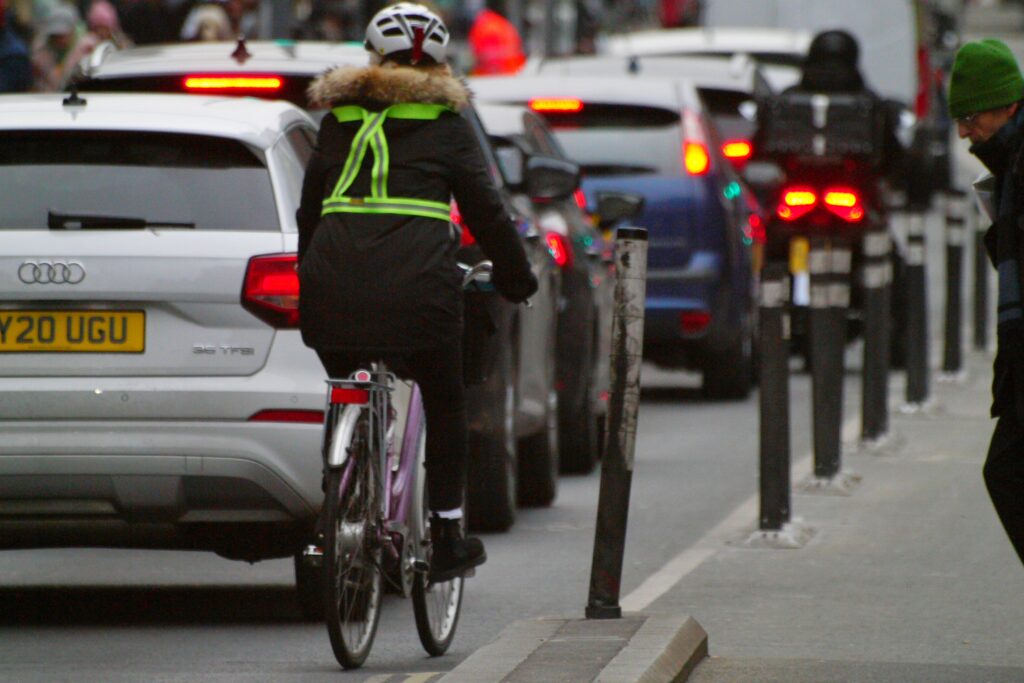

During the winter months, police forces, politicians, and road safety organisations regularly advise cyclists and pedestrians to ‘be safe, be seen’ by wearing reflective clothing when out on the roads. But, according to an alarming new study conducted by a vehicle safety organisation, hi-vis gear could in fact make cyclists invisible to some car brands’ automated emergency braking systems.
The research, carried out by the US-based Insurance Institute for Highway Safety (IIHS), even found that the crash prevention system employed in a Honda CR-V failed to recognise or slow down even a fraction for pedestrians wearing reflective clothing, while the braking system deployed in a Mazda CX-5 failed to stop for a mannequin wearing clothes with reflective strips.
According to the IIHS, past research has shown that automatic emergency braking (AEB) systems reduce the rate of pedestrian crashes of all severities by 27 per cent. However, on dark roads at night, their effect becomes negligible.
The institute’s new study sought out to test the effects of “conspicuous clothing” and increased road lighting at night on the performance of AEB systems installed in three 2023 car models, a Honda CR-V, Mazda CX-5, and Subaru Forester.
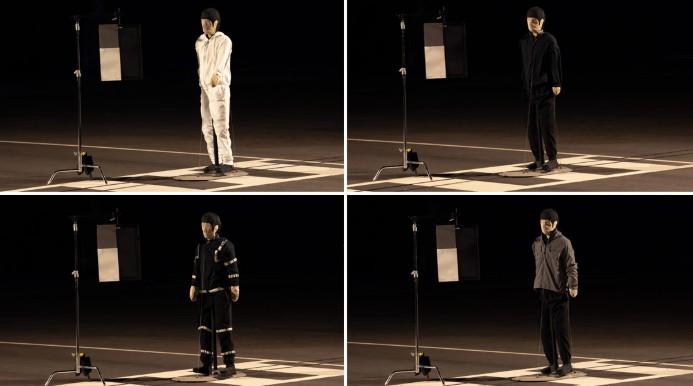
Researchers conducted multiple trials with an adult-sized dummy wearing a range of different clothes: a black jumper and trousers (top right in the above image), a highly reflective jacket with black trousers (bottom right), a black jumper and trousers with reflective strips attached to the dummy’s limbs and joints (bottom left), and a white jumper and trousers (top left).
The tests were run at 25mph in three conditions: with no road lighting, with 10 lux of illumination, and with 20 lux of illumination (recommended by the US government) on the pavement, with the dummy crossing the road in front of the vehicle in all scenarios.
During every test, regardless of the lighting conditions, both the Honda CR-V and the Mazda CX-5 hit the dummy wearing the reflective strips without slowing down at all.
Meanwhile, the Honda also hit the dummy wearing the reflective jacket without slowing every time, in every type of lighting condition.
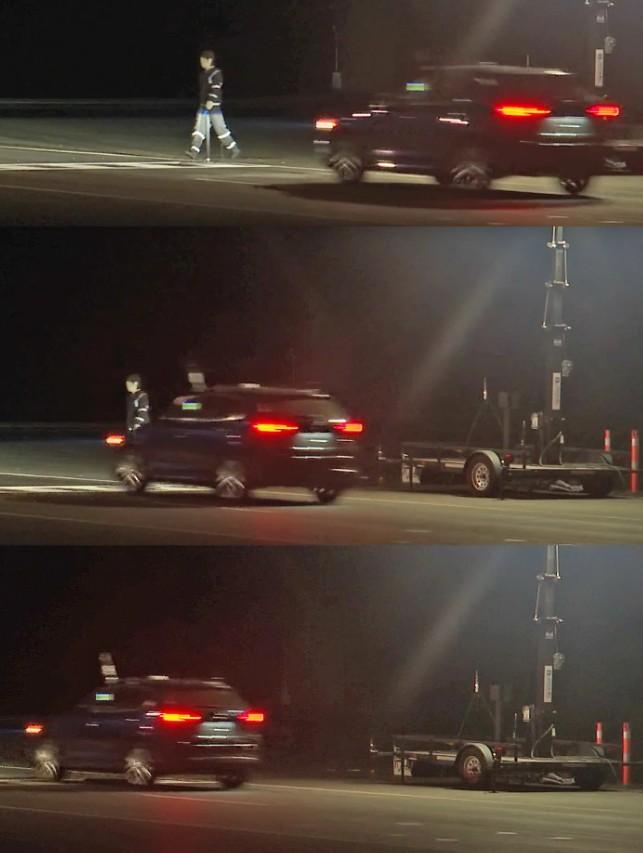
The unfortunate outcome for the dummy wearing reflective stripes
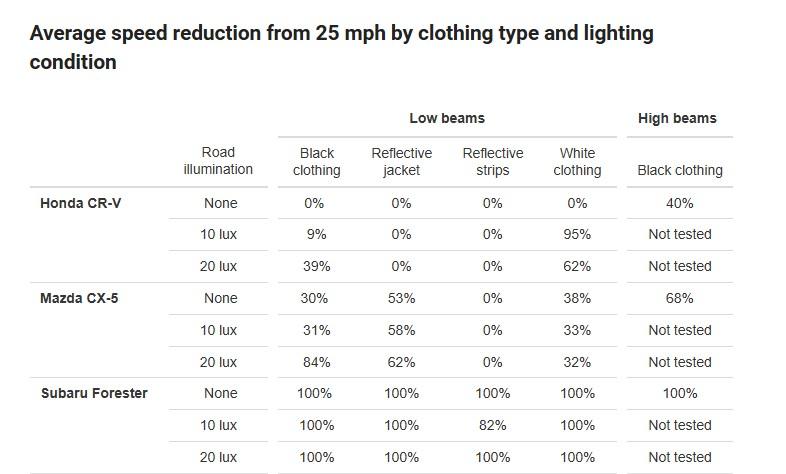
Interestingly, the Honda performed better when the dummy was wearing black or white clothing. For the dummy wearing black clothes it slowed slightly with 10 lux of illumination, and by 39 per cent with 20 lux. It almost came to a complete stop for white clothes and 10 lux of lighting, and slowed by 62 per cent in 20 lux.
The Mazda, meanwhile, slowed by roughly half in all types of lighting for the dummy in the reflective jacket, and by around a third in most types of lighting when confronted with both black and white clothing – though its AEB system performed best for black clothing in 20 lux of illumination, slowing by 84 per cent.
More encouragingly, the Subaru Forester came to a complete stop and avoided a collision in every single test bar one – where it slowed by only 82 per cent when heading towards the dummy wearing reflective strips in 10 lux of illumination.
“The placement and motion of reflective strips on the joints and limbs of pants and jackets allows drivers to quickly recognise the pattern of movement as a person,” the study’s author, David Kidd, a senior research scientist at IIHS, said after publishing the results.
“Unfortunately, the moving strips didn’t have the same effect for the pedestrian AEB systems we tested and probably confounded their sensors.”
According to Kidd, it’s not clear why the Honda and Mazda systems struggled with the reflective strips or how many other systems might have trouble identifying pedestrians and cyclists wearing this type of clothing, a lapse he described as a “concern” considering the rhetoric around wearing hi-vis clothing.
“It certainly was surprising that those two vehicles didn’t respond at all when the pedestrian was wearing those reflective strips on the joints and limbs,” he said. “That’s a configuration that you have emergency personnel as well as construction workers use to become very visible to drivers at night.
“The Forester responded without any problems, so it can be done. Hopefully bringing these results to light motivates manufacturers to improve the technology so that it can respond to pedestrians no matter what they’re wearing.
“This technology, automatic emergency braking, is amazing and it does prevent crashes, but it’s still nascent technology that’s not going to respond to everything.”

> Mandatory hi-vis for cyclists a “timely proposal” coming up to Christmas, say councillors
“These results suggest that some automakers need to tweak their pedestrian automatic emergency braking systems,” IIHS President David Harkey added.
“It’s untenable that the clothes that pedestrians, cyclists, and roadway workers wear to be safe may make them harder for crash avoidance technology to recognise.
“This is a worrisome blind spot. To make good on their potential, pedestrian detection systems have to work with the other commonly used safety measures.”
In response to the researchers’ findings, Maza spokesperson Tamara Mlynarczyk said: “Roadway safety for everyone, including those in and around our vehicles, is a top priority for Mazda.
“Our engineers are continuously working to improve Mazda’s crash avoidance systems and are already using these latest IIHS results to further assist us in this work, with special consideration for nighttime pedestrian scenarios.”
Meanwhile, Honda said in a statement: “Continuous improvement is a core part of the company’s vehicle development process, and we will closely analyse the results of IIHS’ recent non-standard pedestrian AEB testing in an effort to enhance future model performance.”
> Police ask pedestrians to wear hi-vis following spate of road deaths in Scotland
As noted above, campaigns advising cyclists and pedestrians to wear hi-vis, reflective clothing are a common sight in the UK, but have sometimes come in for criticism from those who claim they place the onus for road safety on the most vulnerable users.
In February 2023, Police Scotland found itself at the centre of a “victim blaming” row after a chief inspector urged pedestrians to wear “reflective or fluorescent” clothing after six people walking were killed after being hit by other road users in the space of just 13 days.
Ch Insp Lorraine Napier argued that in light of the incidents, officers should encourage all road users to keep safe, first asking pedestrians to stay visible.
“Pedestrians are considered vulnerable road users and, in winter, particularly when it is dark, pedestrians should wear reflective or fluorescent clothing,” she said.
“I would also urge pedestrians to be mindful of their surroundings and to ensure they are not putting themselves at risk.”







41 thoughts on “Cyclists’ hi-vis clothing invisible to some car brands’ automated emergency braking systems, shocking crash prevention study finds”
Obviously they based their
Obviously they based their algorithms on the average driver.
Indicative of how poor our
Indicative of how poor our legislators are at responding in a timely manner to safety concerns.
Such as the use of distracting screen filling driving aids such as sat nav or even more distracting touch screen for all controls or how high powered electric bike and electric scooters are still freely available to buy despite being illegal to use.
The solution must be
The solution must be electronically tagging cyclists! Then they could be detected remotely. Make it easy to identify them when they commit offenses – and you could check their speeds and make them stick to limits (they could be shocked if they go too fast?)
In fact you could make them pay cycle tax – which could also fund the scheme or just compensate drivers for the inconvenience of driving around them…
Safer for everyone! What’s not to like?
I would wear one if it
I would wear one if it guaranteed geofencing ie that no car would be able to come within 1.5m of me.
That might reduce close
That might reduce close-passes! Unfortunately in the UK that might result in more aggro at junctions and lights as drivers “stuck” because their vehicle won’t overtake get out and lay into you for not pulling over to let them by. Also we know that some cars follow ballistic trajectories [1] [2] which “smart cars” ought to fix but may well not…
This is reminiscent of the
This is reminiscent of the infamous case study of soap dispensers in public toilets, that activated when white people put their hands underneath, but didn’t work for black people, because testing was done by all-white staff. Maybe car manufacturers should diversify their self-driving tech development teams to include some cyclists.
All cyclists must wear a
All cyclists must wear a transmitter to broadcast their presence.
It’s the only way to be sure.
Hirsute wrote:
Funnily enough, I’ve just been having an argument on the other website I waste time on with someone who is pretty much suggesting that.
There was an article on here
There was an article on here some time ago along those lines. Can’t find it but here is something similar.
Or we could train drivers to look, concentrate, focus and be aware of hazards. Instead we provide increasing distractions and more awkward to use touchscreens and mobile sofas.
Will it have two settings? I
Will it have two settings? I think “Stun” will not be good enough.
youd kind of want to see an
youd kind of want to see an atypical cyclist as a test, as in someone actually sat on a bike, before just drawing conclusions solely based on a static dummy representing a pedestrian.could they not afford a bike to crash into repeatedly ?
after all you could say these tests prove those cars would hit bollards with reflective details, or barriers, concrete blocks, maybe even other cars.
So what actually do the tests really prove ?
Q, So what actually do the
Q, So what actually do the tests really prove ?
A, That the technology is not as good as the manufacturers would have you believe.
Safety wrote:
Cos that never happens, does it…?
(Remind me, weren’t we supposed to have had completely self driving cars all over British roads by now?)
We have the collision system
We have the collision system on our Nissan. It does work extremely well, whilst driving along a country lane once, a jogger ran out of a track onto the lane without looking. The car stopped quicker than I could react, if we hadn’t had our seatbelts on we would have been catapulted through the windscreen.
stonojnr wrote:
That dazzle camouflage works? (Although I think we possibly knew that already.)
Quote:
FTFY
I don’t understand the issue.
I don’t understand the issue. Do they assume people drive with their eyes closed to have to rely on the front collision assist? I have that system on my car and switch it off before each journey. I was trained to keep my eyes on the road when driving to recognise potential hazards in time and adjust the speed down accordingly during my driving course.
I don’t get the “in winter, in the dark” either. Do they drive with their front lights turned off? My car came with 2 no. front lights and when they are on I can see what’s in front of the car perfectly well. Cyclists and pedestrians wearing dark clothes, which seems to be a national sport in this country. In fact last night when I was driving back home, I spotted a hedgehog crossing the street in front of my car early enough to check if it was safe to stop and did so to avoid killing it. And I wear correction lenses.
People seem to be trained not
People seem to be trained not to use their eyes and blame others.
Well done for stopping and not running the hedgehog over. During the months when hedgehogs are active, it is heartbreaking to see so many run over. There must be some sickos driving who run them over on purpose, they are not fast and they are not small either. It begs the question, would these people run over a house brick in the road?
Apparently someone did a
Apparently someone did a study on this…
Actually I should probably scare-quote “study” … it was Mark Rober’s amusing test with rubber animals – but apparently more people in the US in “light trucks” like running animals over. For UK folks – that’s “SUV-type vehicles”, not truck drivers. (Summarised in NotJustBikes long-form dissection of this “scam on humanity”).
Of course you don’t rely on
Of course you don’t rely on the system, it’s there as a backup. Not everyone is the perfect driver you claim to be. So yes, it is alarming when these systems don’t work properly, because in the real world this will result in more people dying.
whosatthewheel wrote:
The tests were done with full beam on when there was no lighting, and dips when there was (that’s not particularly obvious from the article, but it is mentioned in the table of results shown).
The point was presumably to test in conditions that the systems might not have been previously trained/tested in (i.e. Not on a sunny California day).
whosatthewheel wrote:
Why? It doesn’t stop you driving and breaking normally, it’s a backup for if things go wrong. Like a seatbelt.
Actually, it does. It can be
Actually, it does. It can be activated by small branches & (possibly, there seems no other reason) a particular roadside sign. Incidentally, it doesn’t work in snow. Imagine your seatbelt tensioner or airbag going off, just in case.
The point of these systems is
The point of these systems is to protect against drivers who are too confident in their own skill, believing they would never fail, and that they would always be able to “recognise potential hazards in time”… A degree of over-confidence that leads to even turning the system off is on a different level, though…
There’s a whiff of Martin73
There’s a whiff of Martin73 about that post from whosatthewheel.
The problem with these
The problem with these systems, assisted breaking, traction control, etc) is they allow the incompetent (“too confident”) driver to carry on without correcting their faults. At some point the system will be unable to compensate. The end result is the same, although the “system” will probably allow you to crash at a greater speed.
ChrisA, I would disagree.
ChrisA, I would disagree. Coming to an emergency stop with screeching tires, perhaps (lightly) hitting the obstacle, is probably not what even incompetent drivers will want to get used to. The same applies for traction control – starting of with (initial) tire slip on a wet or frozen node is not so cool that people will want to get used to… I rather think that these systems can help drivers to remain vigilant – a little like an inbuilt, niggling driving instructor, repeating “mind your distance”, “control the acceleration” in an annyoing tone. — This is, if people don’t turn the systems off (where possible), believing the system was too alarmist for the great, wonderful driver…
I think you have a higher
I think you have a higher opinion of your fellow drivers than I do. I would suggest that whilst a small percentage are downright dangerous and probably a similar percentage are very good, the majority view a car as a means to get from A to B, and view driving aids, mechanical malfunctions and third parties as things best ignored.
So far as screeching to a halt. My wife’s car has only done that once, at low speed in reverse – a very small branch, not quite in the way. It has, however, buzzed & flashed on numerous occasions, never for any good reason (ie a obstacle in the way) when I have been driving it.
Is this another story about
Is this another story about AI assimilating human bias and prejudice from its data set?
I take it these cars are
I take it these cars are going to be urgently recalled?
I hope the inattentive driver
I hope the inattentive driver is in a Suburu when I’m crossing the road.
It makes you think that, if
It makes you think that, if the very basics of “stopping for a human” at 25 mph has glaring gaps in its technology.
I wonder where that leaves those wonderful self driving cars, that seem to have had most of their testing done on the wide streets of the USA, where few pedestrians will venture on the road other than at defined road junctions / traffic light.
Pedal those squares wrote:
A woman who had been crossing a road got severly injured by a self-driving Cruise taxi in SF. The car had “seen” her and activated emergency braking, but by the time it stopped she had been under the car, at which point the sensor no longer “saw” her so… the car drove off dragging her underneath. There is a good video on the subject of autonomous cars on Youtube, on the “Not Just Bikes” channel, called “How Self-Driving Cars will Destroy Cities (and what to do about it)”.
Well, Elon might set these
Well, Elon might just set these cars to “cruise-missile-mode” when Donald calls for it…
Surely, from the car
Surely, from the car manufacturer’s point of view, they are over complicating things here. As an owner of a car with this system you want the system to just recognise that there is something in the way, not recognise what that something is?
I would want the system to work whether it is a runner, cyclist, bollard, lamppost, another car, gate, etc…
NickSprink wrote:
Unfortunately then you end up with systems that emergency stop for an empty plastic grocery bag blowing across the road.
andystow wrote:
We can’t have that can we. Much better to risk killing vulnerable road users. Less damage to the cars.
With crap engineering like
With crap engineering like this (looking at you, Honda) who needs road user enemies?
Ch Insp Lorraine Napier wrote
Pedestrians are considered vulnerable road users and, in winter, particularly when it is dark, pedestrians should wear reflective or fluorescent clothing.
I would also urge pedestrians to be mindful of their surroundings and to ensure they are not putting themselves at risk.— Ch Insp Lorraine Napier
Just a gentle reminder that pedestrians should (to summarise Rule 3), “Help [themselves] to be seen”.
However:
Drivers must drive with due care and attention. Which includes making sure that at any point along the way it is still safe to proceed. Pedestrians are not invisible, but they can be harder to spot at night and in poor conditions. Which means you should use lights and speed as appropriate (without dazzling others) to be sure that the way ahead is clear. For context, fallen trees are also hard to spot in the dark round a bend. And if you hit one of those, you will come a valiant second place in the ensuing kinetic contest.
So oifficers should encourage all road users to keep safe, first asking pedestrians to stay visible demanding and enforcing drivers to remain vigilant and alert to the circumstances at all times.
Meanwhile…
I have had conversations with engineering-focused people who are more than happy to declare that automated cars will be much better at maintaining a careful watch. But they remain only as good as the programming and sensors.
As the article shows, we’re not there yet.
The cyclist will still be
The cyclist will still be blamed.
so will I be able to see the
so will I be able to see the colour of a car in the dark until I see its lights?