



A council has insisted that its controversial town centre cycling ban — which locals say has seen officers “target” old and slow cyclists after an 82-year-old man was fined for riding a bicycle in a prohibited area — will not result in disabled people using mobility aids receiving a fixed penalty notice. However, a campaign group has called for clearer signage that specifically states that people who use standard cycles as mobility aids are permitted to ride in the town centre, which they say will both reassure disabled cyclists and help reduce the risk of confrontation between pedestrians and people on bikes.
The council’s clarification comes after Wheels for Wellbeing, a campaign group for disabled people who cycle, criticised a councillor’s “just get off an walk” advice to cyclists who do not want to become the latest people to be fined under Grimsby town centre’s Public Space Protection Order (PSPO) prohibiting cycling in pedestrian areas.
Wheels for Wellbeing said the attitude “only works for people who can” walk their bikes and called upon North East Lincolnshire Council to accept a more inclusive approach, rather than preventing disabled people access to their local amenities.
However, the council replied to a road.cc request for comment by insisting that the PSPO does not prevent disabled cyclists riding into town.
“The PSPO applies to cycling in the pedestrian area. This clearly does not prohibit the use of mobility aids and therefore we wouldn’t issue a fixed penalty notice to a person with a disability who is using a mobility aid,” a council spokesperson said.
Since the PSPO’s introduction in 2019, the council’s enforcement officers have handed out £100 fixed penalty notices to more than 1,000 cyclists who ignored the no cycling signs, with headlines made after a woman was recently ordered to pay a fine of £660 and more than £400 worth of costs after refusing to pay the original ticket.
Back in October, a local pensioner made headlines too, telling the council to “stick it up your a***”, after being fined for cycling through the town centre. As outrage about the situation spread, the council’s officers were accused of targeting “old and slow” cyclists while ignoring youths “racing up and down”.
“This restricts where we can go and reduces our independence”
However, campaign group Wheels for Wellbeing is keen to point out councillor Ron Shepherd’s advice that cyclists can “just get off and walk” if they do not want a fine is not that simple for disabled people, and while the local authority has addressed the issue of disabled cyclists potentially being fined, questions may still remain about the elderly who may also rely on cycling for transport.
“Cycling is a hugely important way for disabled people and older people to get around independently, including for those of us who can’t walk at all or can only walk short distances,” a spokesperson for the campaign group said.
Saying it’s “easy to avoid a fine[…]just get off your bike and walk” only works for people who can. #Disabled ppl often use cycles as mobility aids. For #Equality, Disabled ppl #cycling should be permitted (while slow & careful). #MyCycleMyMoblityAid. https://t.co/tiE4pMsPgR
— Wheels for Wellbeing (@Wheels4Well) August 24, 2023
“At Wheels for Wellbeing, we’ve been really heartened to see reporting of so many Grimsby residents expressing their support and understanding for older and disabled people cycling slowly and considerately in pedestrianised areas. This kind of acceptance can make the difference between a disabled person becoming isolated at home, or being able to go where they want and need to be.
“If you can’t walk without pain or risk to your health, it’s not as simple as ‘just get off your bike and walk’.
> road.cc Podcast: Kate Ball of Wheels for Wellbeing outlines the barriers disabled cyclists face
“Other places around the UK are taking a different, more inclusive approach in line with our My Cycle, My Mobility Aid campaign. In this campaign, we’re calling for disabled people to be permitted to cycle at walking speed in pedestrian spaces, just as we already use mobility scooters, wheelchairs etc.”
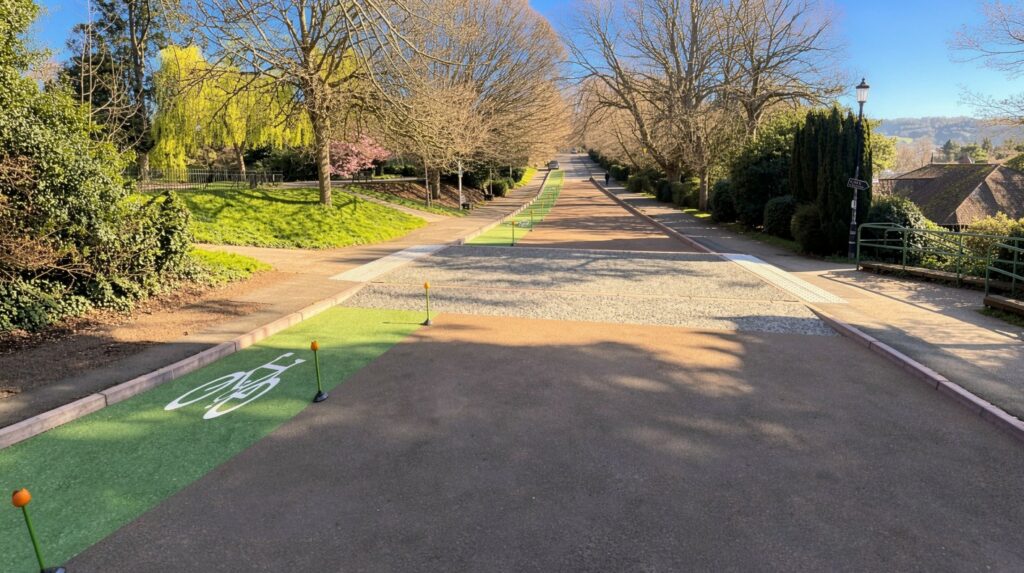
The group also highlights how signage, like the ones seen below in Wandsworth in London, show how all route users can be informed of such a policy.

Wheels for Wellbeing continued: “We’d like to invite councillor Shepherd to talk with us about how a simple change to how the Grimsby PSPO is worded and enforced could welcome more disabled and older people into Grimsby’s shopping centre, increasing spending and helping local businesses to thrive.”
Following a day of action alongside Humberside Police, seven cyclists were fined earlier this month, cllr Shepherd saying: “It’s easy to avoid a fine for cycling in the town centre. Just get off your bike and walk along the relatively short stretch of pavement. I’m grateful to everyone who does so and I ask that others do the same.”
The council’s website document informing the public of the PSPO does not explicitly mention that disabled people using mobility aids are exempt, only that “the validity of the Order can be challenged on two grounds: that the Council did not have the power to make the Order or to include particular prohibitions or requirements; or that proper process had not been followed as prescribed by the Act.”
And Wheels for Wellbeing believes that official clarification concerning the exact nature of the PSPO, as well as clearer, reworded signage in the town centre (like the one in Wandsworth), would reassure disabled cyclists in Grimsby that they will not be fined, as well as reducing the risk of confrontation between pedestrians and people who use standard cycles as mobility aids.
Responding to the council’s insistence that disabled cyclists are permitted to ride in the town centre, the Wheels for Wellbeing spokesperson told road.cc: “We are glad that Grimsby Council do not want to fine disabled people using mobility aids. But it would be really helpful if they could clarify that their PSPO specifically recognises that many disabled people use a cycle as a mobility aid and they would not be fined for doing so.
“Wheels for Wellbeing surveys consistently find that most disabled people who use a cycle as a mobility aid ride a standard, non-adapted, two-wheeled bicycle. Most of us are not visibly disabled when riding, including people who can’t walk at all unaided and those who experience severe pain or risk to health from walking more than very short distances.
The spokesperson continued: “To support disabled people using cycles as mobility aids, we ask Grimsby Council to alter their signage to make clear that cycles as mobility aids are permitted. For example, changing the signs to read ‘Cyclists dismount unless a mobility aid’ would reassure disabled people that they are allowed to ride within the town centre (safely and slowly at walking pace) and would reduce the risk of members of the public confronting disabled cyclists.
“Training for staff involved in enforcing the PSPO is also crucial. Many people don’t realise that disabled people cycle and often ride non-adapted bicycles. All organisations and individuals are welcome to read and use our simple training guide on supporting disabled cyclists in pedestrian spaces, which assumes that signage will state that riding cycles which are mobility aids is permitted.”






















22 thoughts on “Campaigners call for clearer signage to reduce “risk of confrontation” with pedestrians, after council insists disabled cyclists won’t be fined under controversial town centre cycling ban”
Quote:
But if its not dangerous or antisocial for disabled people to cycle at walking speed in pedestrian spaces then why can’t anyone cycle at walking speed in pedestrian spaces…?
If your cycling at walking
If your cycling at walking speed why not just walk
Because not all of us that
Because not all of us that ride a bike – myself included – can physically walk very far.
Not all bikes have two wheels and are vertical. Hand bikes are still bikes and are not legally recognised as a mobility aid (AFAIK)
It’s a slightly grey area
It’s a slightly grey area that a lot of us are trying to make less grey. Personally I’d like it done without the overhead of some blue-badge-like scheme – really we need certain local Councils to come into the 21C (Grimsby, Mansfield etc).
If these issues are of interest, Wheels for Wellbeing runs a “Disabled Cyclists Activist Network”, which is a forum for swapping news and campaigns and experience.
If you are interested, put in a query via the contact form on their website, or contact @tandemkate on Twitter.
The essence of the story;
“If your cycling at walking speed why not just walk”
The essence of the story; some folk simply cannot walk because they are disabled. What I don’t think the article fully covers is some disabilities are hidden; folk may look fit and healthy on a bike and its not till you force them to stop and get off that the disabillity becomes aparrent.
Wheelywheelygood wrote:
Cycling shoes aren’t great for walking and can be quite slippy on wet surfaces, so I’d rather cycle at walking pace. You also take up less room if it’s a very busy area.
Cycling shoes aren’t great
Cycling shoes aren’t great for walking
Unless you’ve stayed with SPD! Very useful for pushing the bike and trailer out of Settle on the Way of the Roses
wtjs wrote:
I use SPDs and whilst they’re much better than SPD-SLs, they can still be slippery on smooth surfaces.
I used SPD’s with my
I used SPD’s with my commuting bike and whilst they are certainly better than road shoes/cleats for walking, they are still not ideal on some surfaces. For me it isnt helped that my right cleat has to be shimmed by 2mm to prevent knee pain, exposing that more to the floor/ground!
Do you realise how ablist
Do you realise how ablist your comment is?
I sat on a jury a couple of weeks ago. The court was a pleasant 35 minute walk away so most days that’s how I got there. The last couple of days my EDS was flaring and it was uncomfortable to put weight on my feet. So I cycled instead.
Consider also that getting on and off a bike is the time of highest risk of falling off. That’s for abled people. Add disability into the mix and it gets even more risky.
Beryl wrote:
To be fair I don’t think they meant that to apply to disabled cyclists but to Brooksby’s suggestion (with which I agree) that everyone could be allowed to ride at walking pace. They weren’t saying (I’m fairly sure) that disabled riders should get off and walk.
Rendel Harris wrote:
To be fair I don’t think they meant that to apply to disabled cyclists but to Brooksby’s suggestion (with which I agree) that everyone could be allowed to ride at walking pace. They weren’t saying (I’m fairly sure) that disabled riders should get off and walk.— Beryl
For clarity:
It just seemed odd to me that, when pushed, the council is more than happy to allow ‘disabled’ riders to ride on their bikes through there at walking speed using them as a mobility aid (although, as others have pointed out, it rather leaves the definition and interpretation of ‘disabled’ and ‘mobility aid’ down to those environmental enforcement paramilitary types who guard our city centres…).
A ‘non-disabled’ person riding a bike at walking speed is taking up the same amount of room, riding at the same speed, so I wondered how come that is definitely dangerous and antisocial…
AIUI the context is that a
It just seemed odd to me that, when pushed, the council is more than happy to allow ‘disabled’ riders to ride on their bikes through there at walking speed using them as a mobility aid (although, as others have pointed out, it rather leaves the definition and interpretation of ‘disabled’ and ‘mobility aid’ down to those environmental enforcement paramilitary types who guard our city centres…).
A ‘non-disabled’ person riding a bike at walking speed is taking up the same amount of room, riding at the same speed, so I wondered how come that is definitely dangerous and antisocial…
AIUI the context is that a disabled person using a bike as a mobility aid is legally a pedestrian (ignoring grey areas around what is a mobility aid), with a right to equal access to services provided by the Council under the Equality Act 2010, and the Council as a service provider has various legal duties.
Footpaths, access to town centres etc are services under EA 2010.
For a small charity, I think that W4W are doing a fabulsous job engaging at organisational level. Three of the current things that they have been involved with have been the “cycles allowed as a mobility aid” option on Wandsworth Bridge (success), trying to persuade Hammersmith & Fulham to have a sensible PSPO (not success), and working with CycleHoop on acessible cycle hangars for non-standard cycles (ongoing) – it’s more than we tend to imagine including eg ability to open with low forces that can be applied by weaker-than-usual muscles.
One that is bubbling under are the large number of Green Flag Parks that simply exclude many mobility aids such as tricycles and large mobility scooters (access barriers, again). In my area two out of seven GreenFlag parks are entirely surrounded by access barriers, apart form vehicular entrances; the rest all have some blocks.
I try and work from an accessible/active travel view in my local campaigning, as there are many benefits for all modes of active travel, one of which is that mobility aid access can be legally enforced. And ‘standard cyclists’ usually benefit.
I agree there can be a tension between “solutions for disabled cyclists” and “solutions for standard cyclists”. That is the opposite of the tension when Cycle Campaigns supprt not-fully-accessible cycling facilities which are beneficial to most but not all.
But imo there’s a far stronger case in working across walking, cycling and wheeling needs. Wales have all their standards for active travel in a single document, for example.
On your particular question, imo the ‘social model’ (not ‘medical model’) of disability would require the Council to reassess their philosophy to be properly inclusive of all members of society, rather than provide “an exception” for “disabled people”. But we are dealing with Captain Mainwaring of North Lincs.
HTH
Wheelywheelygood wrote:
If you walk at cycling speed why not just cycle?
(It’s more efficient, less strain on the joints etc…)
I rode through Newbury town
I rode through Newbury town centre the other day, it was quite busy with pedestrians, but totally fine if you take it slow. Looking at streetview, it seems that they changed the signage sometime around 2018 to allow cycles.
edit: just occurred to me that they’ve always allowed cycles, the prohibition is for motor vehicles. I guess they added the ‘& cycle zone’ bit just to make it clearer that cycling is allowed.
Yes – it’s the kneejerk
Yes – it’s the kneejerk attitude of the Council, run by Captain Mainwaring, that is the dominant problem.
But OTOH Wheels4Wellbeiog are a specialist group, and the broader campaign is one more for all of us.
HoarseMann wrote:
I’d welcome the “& cycle zone” clarification – I understand why pedestrians might challenge you in an area under the first type of sign.
Exactly!
Exactly!
Personally I don’t have a
Personally I don’t have a problem with that. Considerate cycling should be permitted anywhere.
Can I ask you to follow this
Can I ask you to follow this one up further, Dan, and ask Grimsby Council how their enforcement officers distinguish between “disabled” and “able-bodied” cyclists, and what training they have received?
This statement looks like pure ignorance, since many disabilities are not visible. I see in the quote the Council do not even acknowledge that cycles can be mobility aids – they talk about “cycling” being banned, and “mobility aids” being permitted.
“The PSPO applies to cycling in the pedestrian area. This clearly does not prohibit the use of mobility aids and therefore we wouldn’t issue a fixed penalty notice to a person with a disability who is using a mobility aid,” a council spokesperson said.”
Disabled cyclists report via the Wheels4Wellbeing annual survey that one of the biggest issues is harrassment by “officers”. Recently their national officer was instructed to get off her bike and walk in a London station when she actually had her wheelchair strapped to the bike.
https://wheelsforwellbeing.org.uk/wp-content/uploads/2022/05/Disability-and-Cycling-Report-of-2021-national-survey-results.pdf
Cyclist with invisible
Cyclist with invisible disabilities here (EDS and MS), came here to say exactly what you have said so well. I’ve had police ask me to get off my bike twice outside Finsbury Park station – where there are actually bike lights on the crossings on either side of the station so it looks like cycling is permitted there. Both times I was cycling at a walking speed and well away from people.
I raised a similar issue when
I raised a similar issue when neighbouring North Lincolnshire Council asked for local feedback on a ban affecting Brigg Town centre and it was dismissed out of hand. I even quoted national active travel guidelines but these Tories only care about car users