


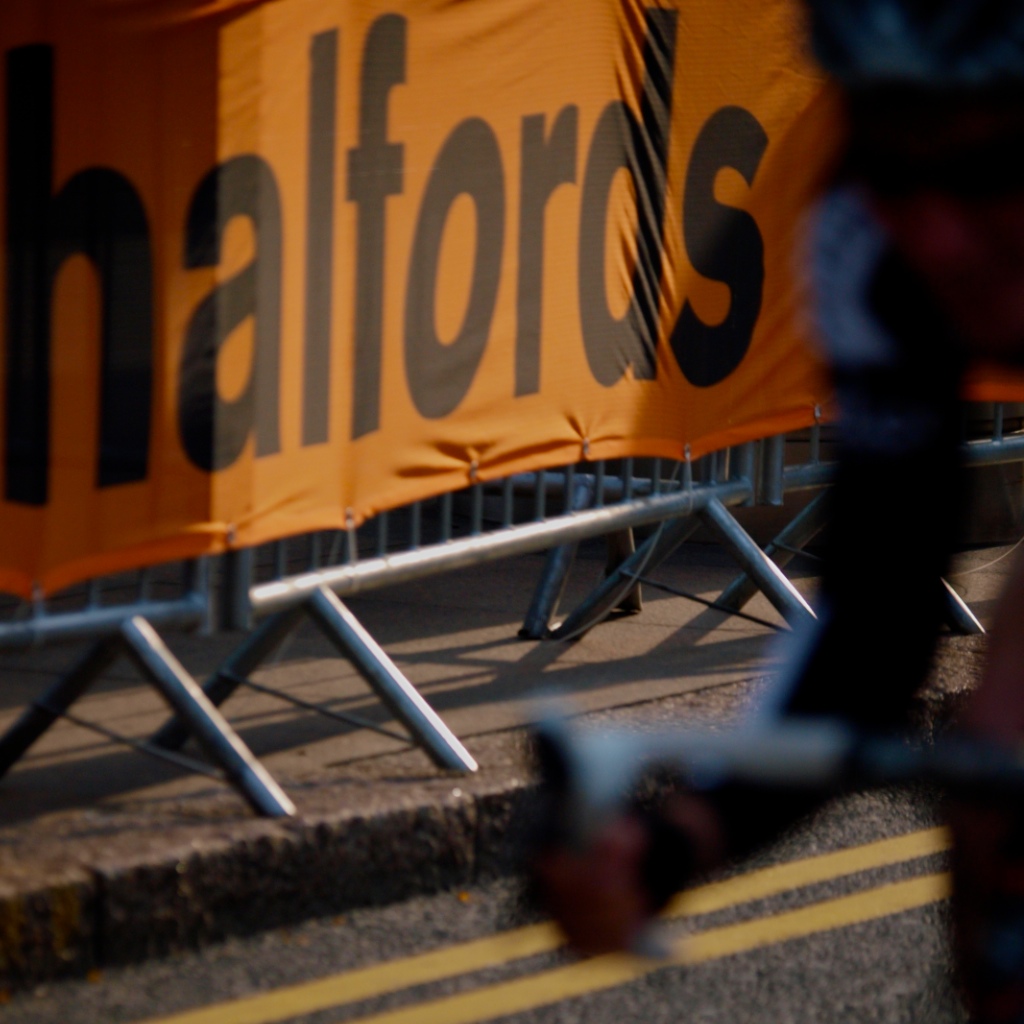

Halfords, Britain’s biggest retailer of bikes and cycling accessories, has revealed that the success of Bradley Wiggins in the Tour de France and the country’s Olympic and Paralympic cyclists in London this summer helped fuel a 14.7 per cent rise in sales in its cycling division in the second quarter of its 2012/13 financial year.
The strong performance in the 13 weeks ended 28 September come after a 9.6 per cent drop in the first three months of the financial year, which the company attributed at the time to unseasonal weather conditions.
Chairman Dennis Millard said of the figures published today: “Our trading stance together with the actions we took to capitalise on a successful summer of sport and improved weather meant we delivered a stronger Retail top line in the period, recovering some of the ground lost in the Spring.
“Our second-half planning assumptions, however, remain cautious given the prevailing pressures on the consumer as we approach the important winter and Christmas trading periods.”
Prior to the current financial year, Halfords combined cycling and what it now terms “travel solutions” into a single “leisure” category. Now that those two categories have been split, for the first time we are able to get a true picture of the scale of its cycling business, which in the 2012 financial year achieved sales of £222.1 million, 29.5 per cent of the group total.
In an investor presentation published on its website today, Halfords says that it sees an opportunity to build further share of the buoyant cycling market, details of its cycling division accompanied by the strapline ‘Best cycle shop in town’ – perhaps more an aspiration rather than a statement of fact.
The company adds in the presentation that it controls 14 per cent of the bicycle market, with total market value put at around £615 million, and 5 per cent of what it calls the ‘cycle repair’ market – maintenance, presumably – which is valued at around £85 million.
The big gap between the two figures suggests that while many people may be happy to buy a bike at Halfords, they’re going elsewhere for maintenance, as well as perhaps reflecting the fact that compared to many independents, it perhaps attracts higher proportions of more casual cyclists who ride less frequently and whose bicycles need less maintenance.








10 thoughts on “Halfords enjoys Olympic bike boom, reveals size of cycling division’s sales and market share”
tsk, bloody halfords …
tsk, bloody halfords …
“Cycle repair” is probably
“Cycle repair” is probably right in Halfords case, they take the bike back only when something breaks.
You only buy a bike from
You only buy a bike from Halfords once.
localsurfer wrote:You only
I think that depends on what your local Halfords is like. I’m lucky because mine has excellent staff who really know what they are talking about. I’ve bought my last 3 bikes from there and always take them back there for a service.
maboyctu wrote:localsurfer
THIS.
They sell great bikes, but the customer experience is far too mixed, ime. (Varying from enthusiastic & knowledgable to disinterested & unreliable). Having seen a Boardman assembled without a bearing cover on the headset (end result, knackered headset after one year) I’d always check a Halfords bike over after purchase, unless I knew the branch was ok.
When potato face Jeremy
When potato face Jeremy Clarkson and lying scrote Jan Etherington get a biek things might change.
Don’t knock it ..
I brought
Don’t knock it ..
I brought my first “recent” bike (a MTB) from Argos 8 years back, having not ridden since my BMX days in the Mid 80’s …. I became hooked and have now built up 3 bikes to my own spec ..
So long as peeps are taking to riding, thats gotta be a good thing ..
There were those that scoffed and laughed at me 4 and 5 years back for cycling … I spent the Spring and Summer months this year advising some of them what to buy at certain pricepoints as they’re now slowly coming around to the idea ..
Sorry, 4 bikes …
Sorry, 4 bikes …
As ever, more people on bikes
As ever, more people on bikes = a good thing.
Though I agree on the variability factor. My local branch certainly doesn’t seem to have staff who know anything about bikes (my rule of thumb is generally ‘do the staff know less than I do’ – as I don’t know very much about the mechanical side of things). A shame, as some of their bikes look pretty good, certainly a big step up from the Tesco bouncy-bouncy BSOs
However, remember that a lot of Halfords employees will just get put on the cycling till without necessarily knowing much about bikes. It’s not necessarily their fault; they don’t get paid much either plus often have to work crappy hours and deal with morally-fraudulent conditions such as zero-hour contracts.
I’ve had good and bad
I’ve had good and bad experiences @ Halfords. Bought my Boardman from Redhill (set-up good), had it serviced in Farnham (bad) took it back and had it re-serviced in Farnham (good). I’d expect enthusiasm/proficiency to vary with scope i.e. 1. LBS 2. National bike specialist like Evans 3. National generalist like Halfords. Now it’s out of warranty I’m going to ask my LBS to do anything I can’t myself but I would not be put off buying another bike from Halfords.