


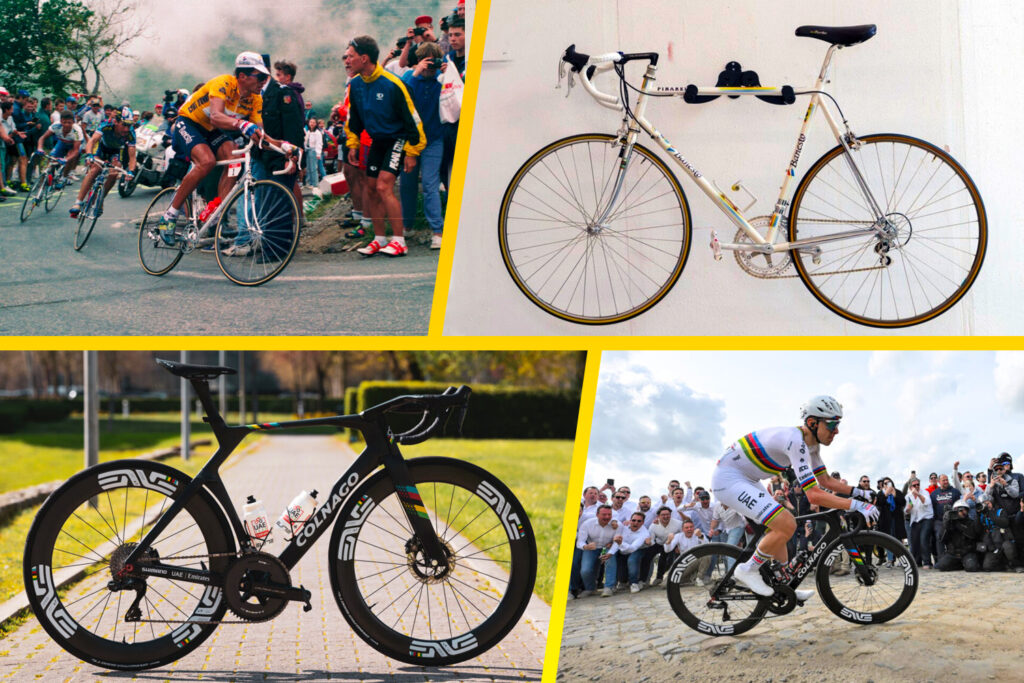

Tadej Pogacar could seal his position as a five-time Tour de France winner on Alpe d’Huez later this month, so we thought it would be interesting to compare his bike to one ridden by Miguel Indurain when he tackled Alpe d’Huez in 1994 on the way to the fourth of his five wins.
Stage 19 of this year’s Tour de France is 128km from Gap to Alpe d’Huez, while Stage 20 – on the race’s penultimate day – will see the riders cover 170km, taking in Croix de Fer, Télégraphe, Galibier and Sarenne, before again finishing on Alpe d’Huez. Most people expect Pogacar to come out on top, but this is bike racing; anything can happen.
Spain’s Miguel Indurain is one of just four riders to have won the Tour de France five times – along with Jacques Anquetil, Eddy Merckx and Bernard Hinault – and the only one to do it five times on the spin, when riding for Banesto from 1991 to 1995. He wore the Tour de France yellow jersey for 60 days during his career.
Famously, Indurain was an absolute monster on the bike, with freakish physiology: a 7.8-litre lung capacity, an 88ml/kg/min VO2 max, and a 28 bpm resting heart rate.
A fabulous time trial rider but considered by many at the time to be too large and heavy (1.86m, 76kg) to be a serious contender in the mountains, he won the Tour de France in 1991 as an outsider before taking the Tour-Giro double in 1992 and 1993, so he was going for his fourth consecutive Tour de France victory in 1994.
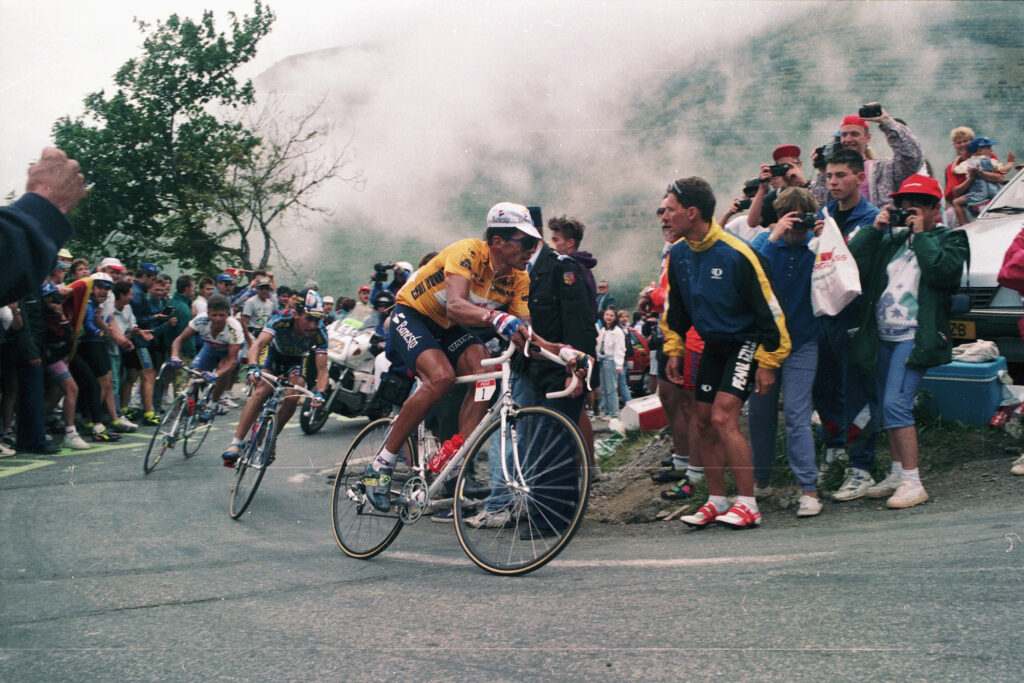
That year’s race saw an Alpe d’Huez finish too – on the 224.5km Stage 16. Indurain had already been in the yellow jersey for a week and held a chunky lead of 7:56 minutes over France’s Richard Virenque. In order to ensure the overall victory, he needed to make sure he didn’t lose much time in the Alps to his GC rivals – and we know, of course, that he didn’t.
Although he finished 12th on Alpe d’Huez, nearly eight minutes down on stage winner Roberto Conti and a couple of minutes behind Marco Pantani – who went on to finish third in GC – Indurain lost only 35 seconds to Virenque.
There were a couple more mountain stages plus a mountain TT to come, but Indurain looked in control.
Miguel Indurain’s 1994 Pinarello
We’re here to talk about the bike rather than the race, though. We actually had a look at Indurain’s 1994 Pinarello three years ago when it was put up for auction.
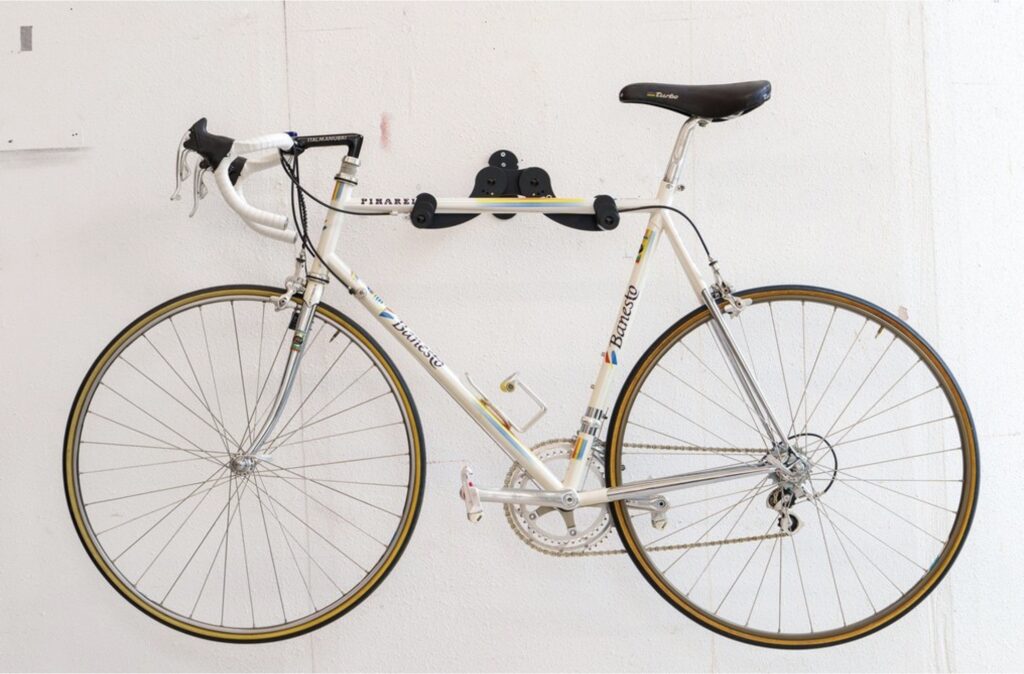
The previous owner said, “The bike is INTACT, like new and never used by anyone except Miguel Indurain himself. All elements of the bike are original. Everything works perfectly.”
Although Jacques Anquetil had ridden an aluminium frame in the Tour as far back as the 1960s and Greg Lemond and Bernard Hinault had ridden Look bikes with carbon-fibre tubes bonded to aluminium lugs in 1986, Miguel Indurain was the last man to win the Tour de France on a steel bike.
Branded as a Pinarello, his 1994 bike was made by the late Italian framebuilder Dario Pegoretti, perhaps the most revered steel framebuilder in recent history.
Those Dedacciai and Oria tubes are incredibly skinny compared with the carbon-fibre structures we see in the Tour de France today, or even compared with most aluminium frame tubes. The slender appearance is further accentuated by the fact that Indurain required a 59cm frame.
Naturally, for a bike of this era, it is equipped with rim brakes and mechanical gears – the cabling running under the handlebar tape and then externally, unlike today, when even a hint of exposed brake hose seems to be intolerable at the top end.
Speaking of the groupset components, Indurain’s bike was fitted with 8-speed Campagnolo Record. Although he had used traditional down tube shifters and non-indexed friction shifters earlier in his career, he was using Campag ErgoPower integrated brake-lever shifting in 1994.
We can’t say for sure if they’re fitted to this bike, but Indurain was known to ride 180mm cranks (listed in Campagnolo catalogues but often requiring a special order) because he liked the leverage the longer cranks provided to push large gears (when he broke the Hour Record in 1994, he used 190mm cranks). Most pros are on much shorter options these days, and 175mm is the longest that Campagnolo offers in its Super Record 13 groupset.
Although threadless systems began to appear in the early 1990s, Indurain’s bike is equipped with a slim-legged fork with a threaded steerer tube connected to a quill stem. Indurain used a 130mm stem.
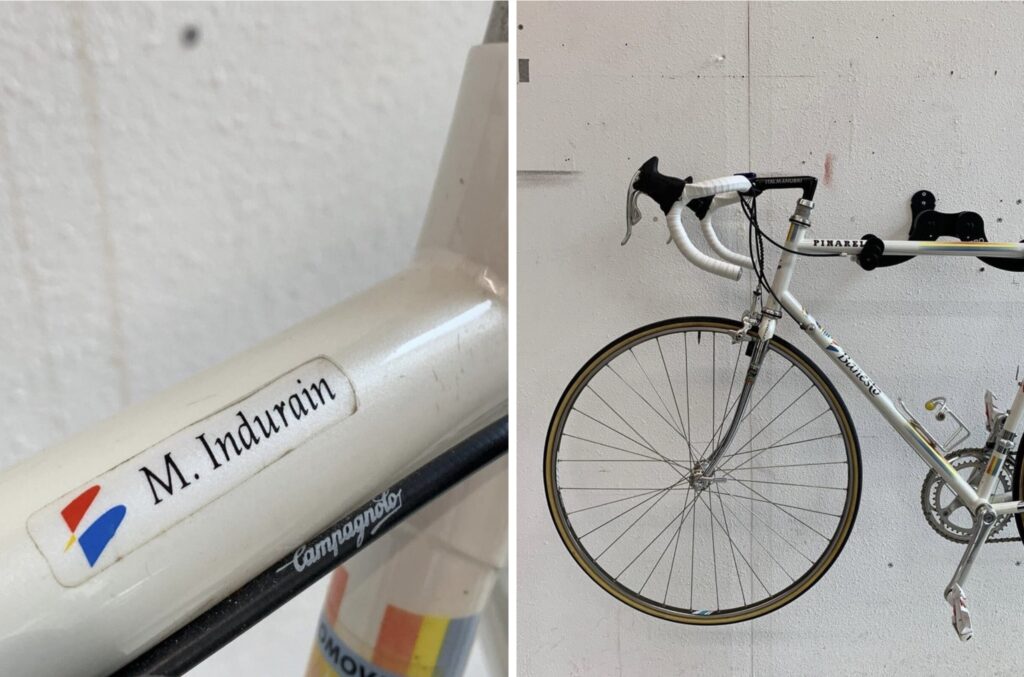
Wheels? They’re Campagnolo Sigma rims (made from 7075 Alloy – T6), and they’re built up with 32 spokes front and rear. Although some brands and pro teams were experimenting with aerodynamic wheels with fewer spokes during this period, for the majority of road stages, riders still used conventional hand-built wheels with around 32 spokes because they were reliable, repairable, and strong enough for mountain stages and rough roads. Vittoria tubular tyres – just 20 to 22mm wide – were glued to the rims.
Naturally, those wheels were held in place by quick-release skewers, as invented by Tullio Campagnolo way back in 1927. Through axles on road bikes were decades away.
Clipless pedals were invented even earlier, although Look began producing the first widely used design in 1984, and most Tour riders had switched from traditional toe clips and straps by the late 1980s. Indurain used Time Equipe clipless pedals.
As for the saddle, Indurain used a Selle Italia Turbo like fellow Tour de France winners Bernard Hinault, Greg Lemond and Laurent Fignon before him. Many riders had switched to lighter saddles like the Selle Italia Flite by 1994. Indurain might occasionally have used the Selle Italia Turbomatic, but he stayed pretty loyal to the 300g+ Turbo through his years of dominance. If it ain’t broke…
We don’t have a reliable weight for Miguel Indurain’s 1994 Tour de France bike but it is variously estimated to have been in the region of 9-10.2kg. You’ll know that the minimum bike weight for UCI-sanctioned racing has been 6.8kg since 2000, with most bikes hitting the scales within a few hundred grams of that figure.
Oh, one other thing: although Indurain routinely wore aero helmets for time trials, he rode bareheaded or wearing just a cap during standard road stages. The UCI made helmets compulsory during races in 2003, but allowed riders to discard them during final climbs of at least 5km, before that exception was eliminated in 2005.
Pogacar’s Colnago Y1Rs
On to 2026, and Tadej Pogacar could join the ranks of the five-time Tour de France winners – the most prestigious club in all of cycling.
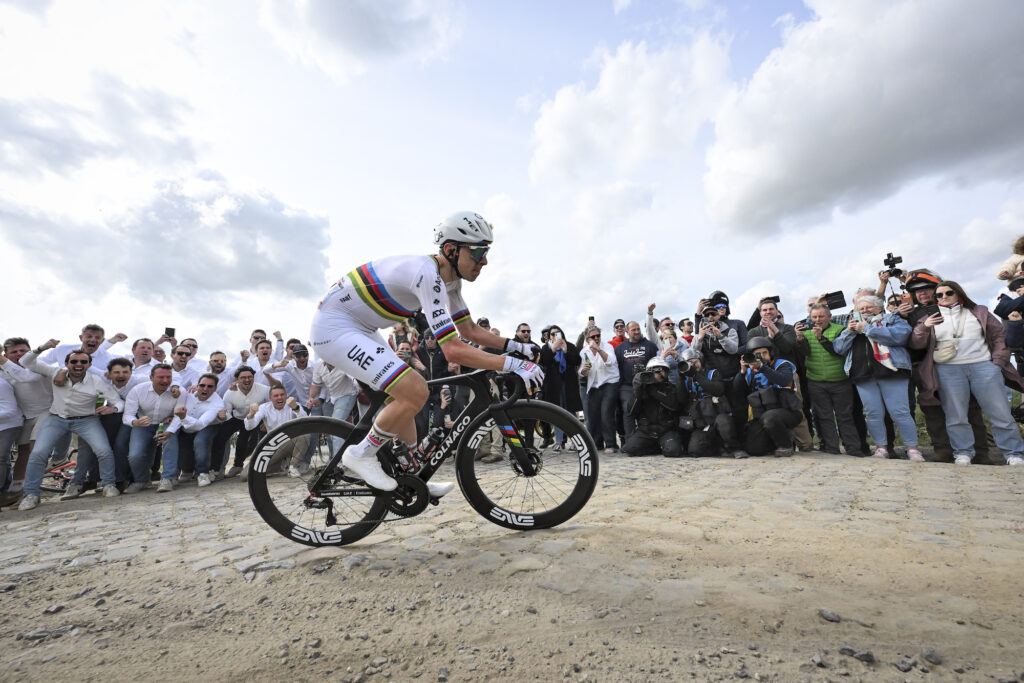
Pogacar has the option of riding the Colnago V5Rs, but he favours the V1Rs and is likely to ride this model throughout the 2026 race.
Colnago launched the Y1Rs towards the end of 2024 and it’s all about aerodynamics. As mentioned above, the UCI introduced the 6.8kg minimum bike weight limit in 2000, so there’s not a whole lot of point chasing weight improvements beyond that; it’s far more worthwhile going for an aerodynamic advantage.
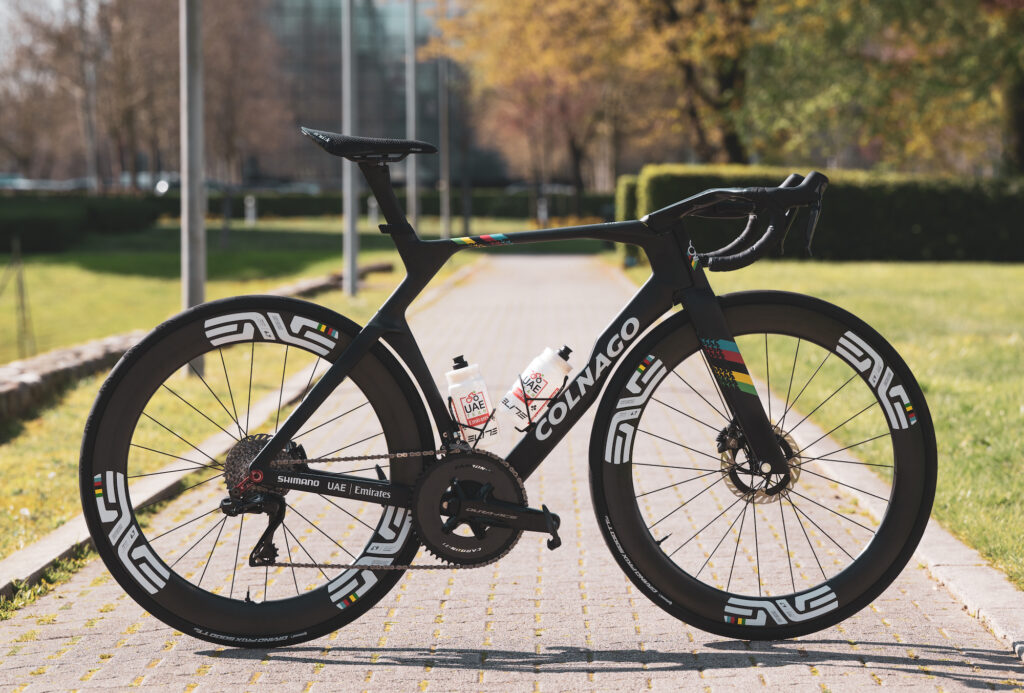
The Y1Rs frameset is 242g heavier than Colnago’s V4Rs, but the Italian brand says it saves 20 watts on its stablemate at 50km/h (31mph).
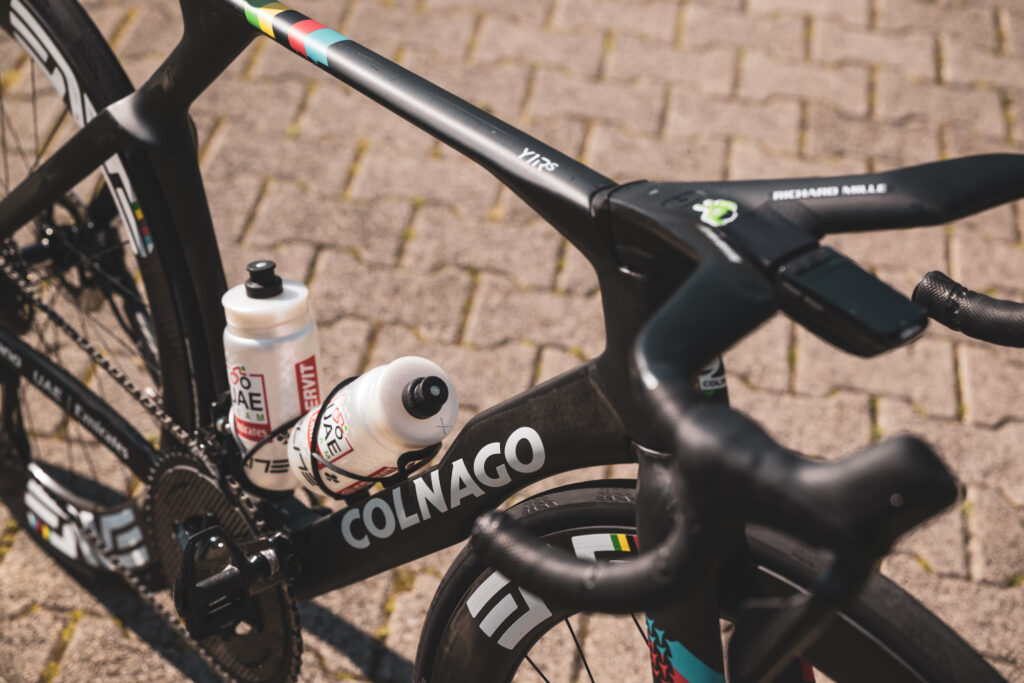
The most noticeable feature is the back end of the frame, where the shortened seat tube meets the extended seatstays.
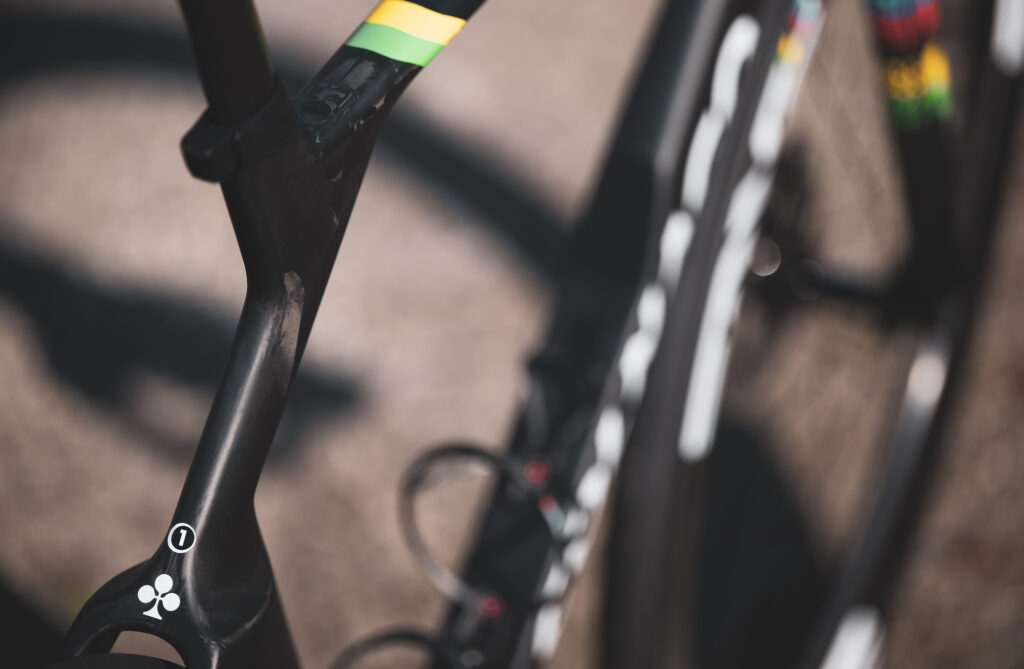
Colnago says that what it calls its Defy shape, enabled by new UCI standards, means the seat tube can “follow the shape of the rear wheel and thus be aerodynamically more effective in an area where the cyclist’s turbulent pedalling flows arrive”.
The seatpost has to be cut before being positioned. Once inserted, there is space for further adjustment of just 1.5cm.
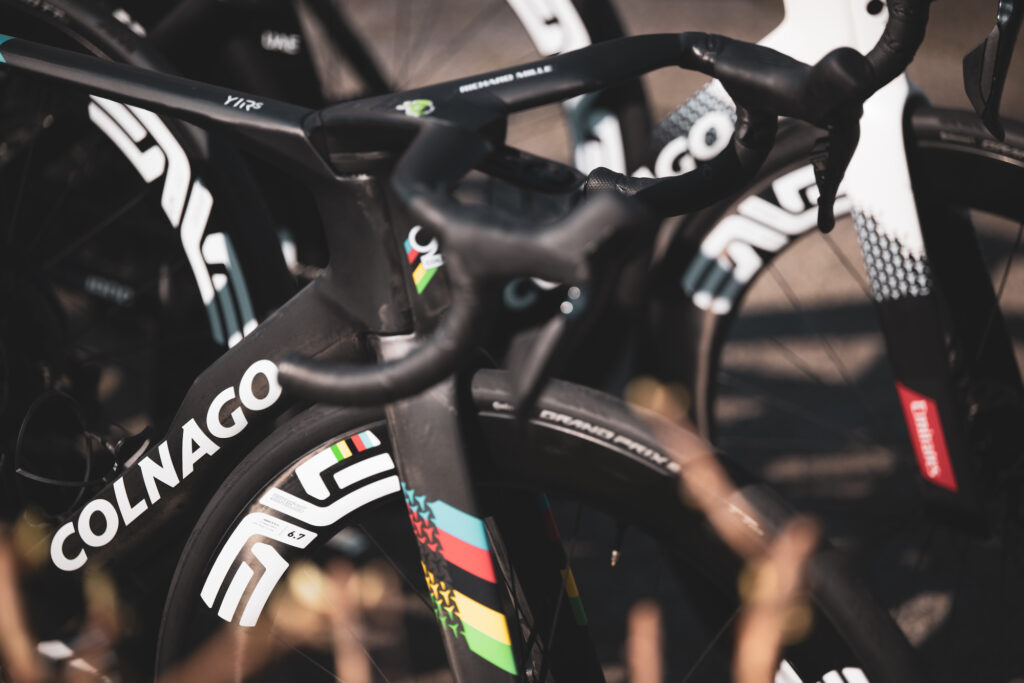
The CC.Y1 WYND shape integrated handlebar is designed to be aerodynamically efficient too. Of course, unlike Indurain’s ITM handlebar/stem from 1994, it’s carbon fibre.
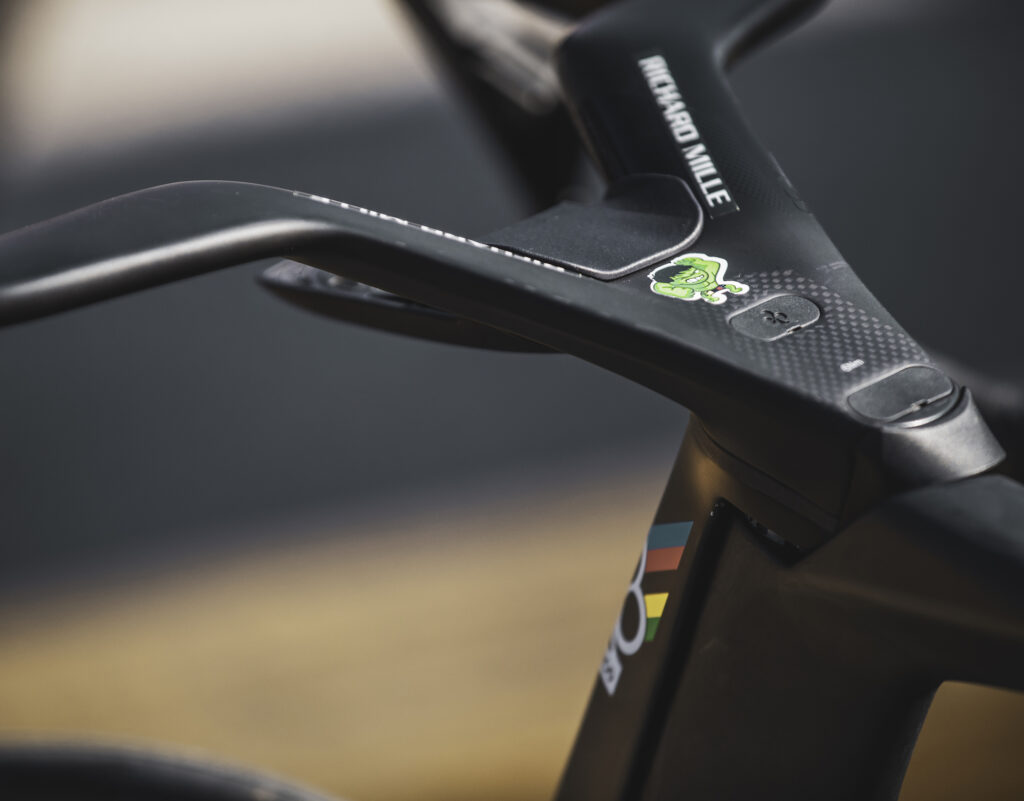
The aim of the ‘gull wing’ Y-shaped structure is to reduce the frontal area and allow for cleaner airflow over the main body of the bike.
With the Y1Rs, Colnago has taken advantage of changes to UCI rules governing frame design. When it started developing its Y1Rs aero road bike in 2021, the UCI had just communicated upcoming revisions to its regulations. For a long time, the UCI had a 3:1 rule governing bike design. The rule limited the ratio of a bike tube’s height (or depth) to its width at a maximum of 3:1. That rule was scrapped and bike designers can now go with an 8:1 profile.
Filippo Galli, lead engineer on Colnago’s Y1Rs told us, “None of the tubes of Y1Rs is 80mm long and 10mm wide since using such extreme profiles would mean increasing the final weight to guarantee the proper lateral stiffness, but almost all of them exceed the former 3:1 rule.
“In particular, it wouldn’t have been possible to realise such a thin frontal area, which significantly affects the aerodynamics of the whole bike, without penalising the stiffness of the whole front end (which is crucial in sprinting).”
The position of the seatpost on the Y1Rs is unusual, too. It is fixed in place at the point where the top tube and extended seatstays meet. Again, this is now permissible thanks to changes to changes to UCI regulations.
“Such a design wouldn’t have been possible before since the seatpost had to be aligned with the seat tube, or at least a straight line should have been drawn along these two elements,” Filippo Galli told us.
> Why the aero road bike is making a comeback
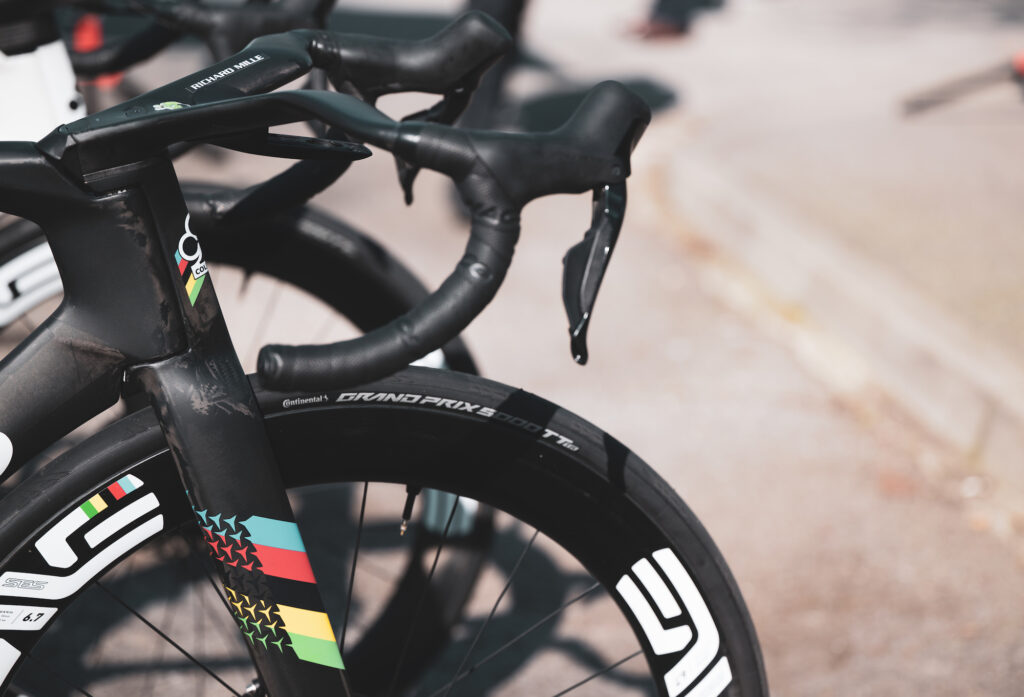
The tube profiles, the bayonet-style fork with deep legs, bottle cages integrated into the down tube… in fact, most design decisions made in the development of the Y1Rs were aimed at aerodynamic efficiency.
Tadej Pogacar won the mountain time trial in the 2025 Tour de France on a stripped-back Colnago Y1Rs and he rode a slightly modified version of that bike elsewhere in the race too. This version was in raw carbon with what Colnago called “a paper-thin clearcoat” to save a little weight.
Unlike the stripped-down build used for the time trial, this version came in a full road race configuration with bottle cages, handlebar tape, and 28mm tyres. It also had a 160mm front brake disc, whereas Pogačar used a 140mm rotor in the mountain time trial to shave grams. This is the bike that Pogacar has been racing on in 2026 too.
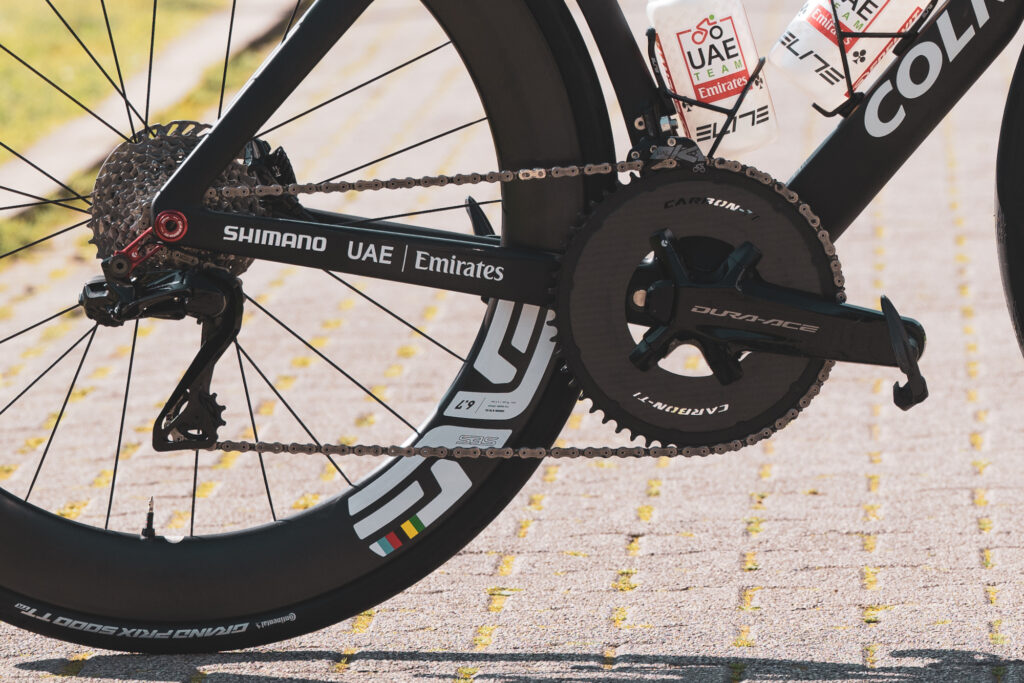
Pogacar uses a Shimano Dura-Ace R9200 groupset with 165mm cranks and additional sprinter buttons on the drops. He uses a Dura-Ace power meter, moving it from frame to frame to make sure the data is consistent.
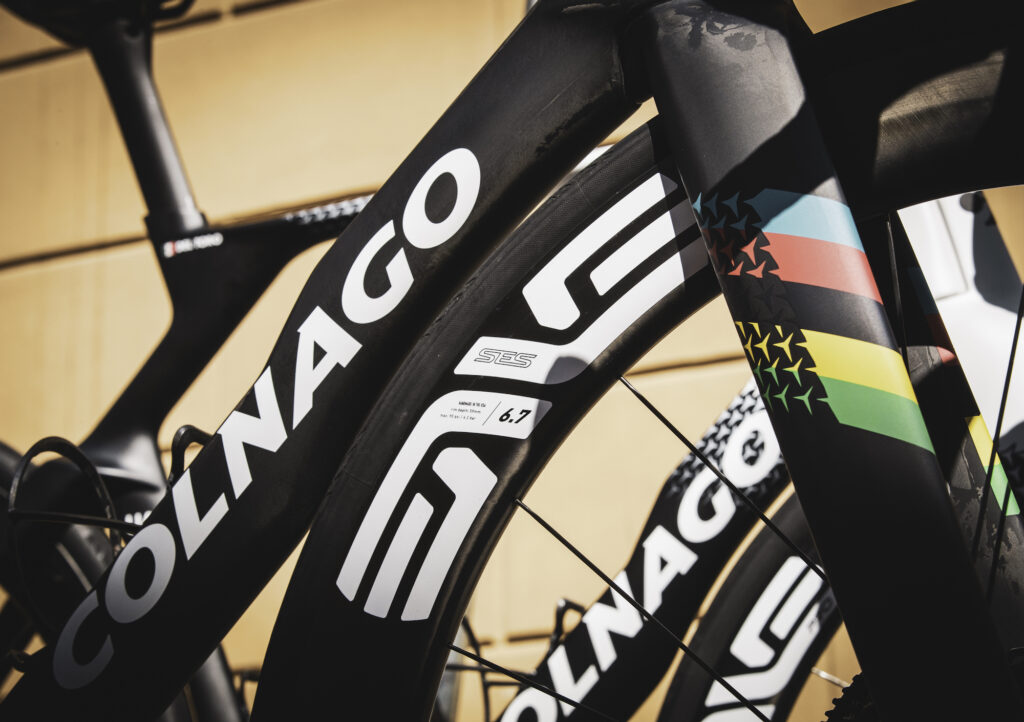
The 55/38T chainrings are from Carbon-Ti, while the wheels pictured here are Enve SES 6.7 – Pogacar frequently uses shallower Enve SES 4.5 Pro – fitted with Continental GP5000 TT TR 28mm tyres.
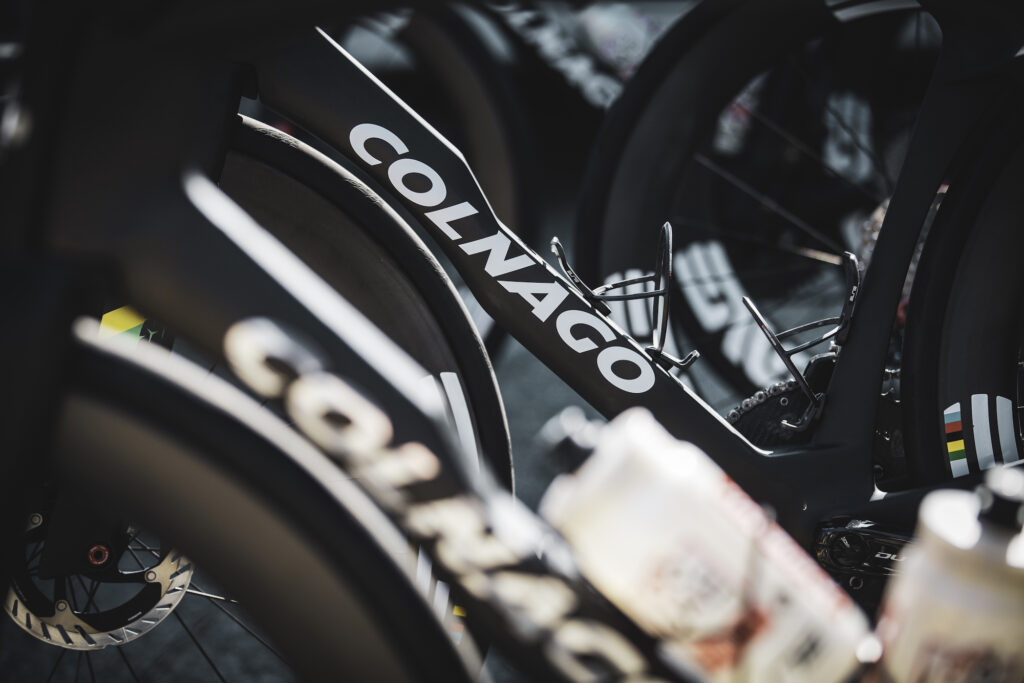
The bottle cages are Elite Leggero Carbon and the saddle is a custom Fizik Tempo Argo with 3D-printed variable density.
The bottom bracket is from Bikone, and titanium bolts replace steel wherever possible.
Colnago says that a Y1Rs in a typical UAE race build is around 7.2–7.5 kg, compared with a typical V5Rs build that’s around the UCI’s 6.8kg minimum weight. The Y1Rs that Pogacar used in last year’s mountain time trial was a claimed 6.9 kg.









1 thought on “Tadej Pogačar’s Colnago Y1Rs vs Miguel Indurain’s 1994 Pinarello: How Tour-winning bikes have changed in 32 years”
Here’s a photo I took on Alpe d’Huez at TdF 1991. L to R: Gianni Bugno, Miguel Indurain, Luc Leblanc. They would finish the stage in that order, Bugno winning. Yes, colour film was available in 1991 but that day I chose to use black and white knowing that many years hence it would look epic.