


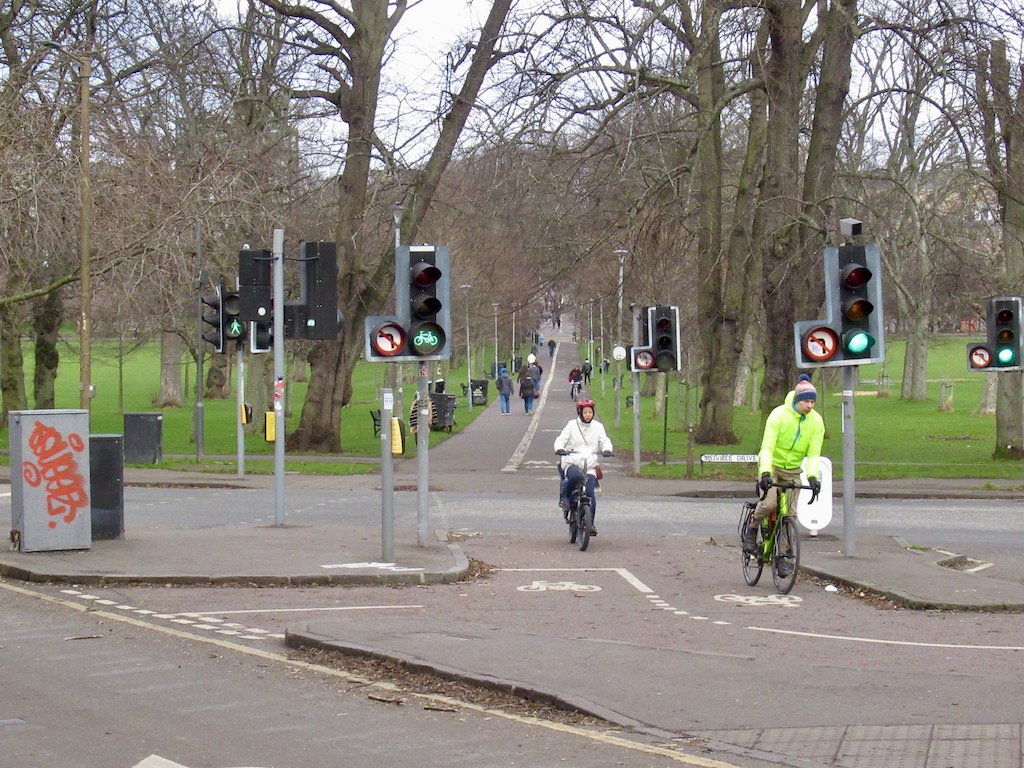

A leading Edinburgh architect has claimed the city’s active travel policy is prioritising “greedy” cyclists over pedestrians, adding that he feels guilty over the space he gets cycling across the city compared to walkers.
Malcolm Fraser, who said he cycles “most days”, told a meeting of Living Streets Edinburgh that, when riding along Middle Meadow Walk in the city, he felt that “I’m one bike and there’s hundreds of people who don’t have enough space, and I feel really guilty,” as reported by The Scotsman.
Elsewhere in the city, he described seeing, “mums with pushchairs having to go in single file because they have got much less width [than cyclists], and that’s the wrong way round. I worry that we’ve been greedy.”
Living Streets Edinburgh is an active travel charity that campaigns for pro-pedestrian policies. Among their policy objectives is to see “walking given the top priority over other forms of travel in all council transport and planning policies.” Charity convenor David Hunter later told the meeting the council’s active travel plans “don’t reflect the importance of walking, supposedly top of the sustainable travel hierarchy.”
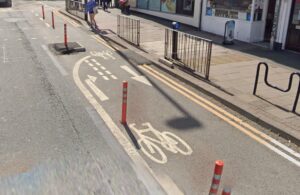
Fraser, whose firm’s designs include the Scottish Poetry Library and the Scottish Storytelling Centre on the Royal Mile, also addressed the Leith Walk cycle lane, which has been a recurring topic of conversation for road.cc users on both live blogs and forums. First installed in 2022, the lane was modified the following year to reduce the sharp-angled chicanes and zig-zags. However, the lanes have remained controversial for being frequently blocked by vehicles.

> Zig-zag corners on “moronic” Edinburgh cycleway to be replaced to improve cycle safety
Fraser is among those unhappy with the lanes, telling the meeting, “Leith Walk has the most dangerous and complex cycle lanes I know, jiggling in and out on the pavement. It bamboozles pedestrians and cyclists alike, raises costs, puts cyclists off from using it and sits very poorly with the simplicity of the urban townscape.”
In response to Fraser and Living Streets’ criticisms, co-founder of active travel association Spokes Lothian Dave du Feu told the ‘paper that Leith Walk’s design “leaves a lot to be desired.”

“However, the perception of danger to pedestrians is very different to the official data which shows pedestrian casualties there have fallen astonishingly since the road was remodelled, from an average of over ten a year to less than two.”
Du Feu added, “Malcolm Fraser is right that space for walking in many parts of the city is inadequate. But additional space should be taken from car traffic, not from another vulnerable category, people cycling.”
Active travel has become a political battleground in the city in recent months, following claims by opposition councillors that the council is covering up statistics showing the number of people cycling either once or five days a week has decreased compared to 2023.
In response, Edinburgh Council’s cabinet member for transport said, “I’m a big fan of statistics. We need to understand why there has been a dip and we need to know whether it is a dip or a trend.
“I do want to encourage more people out of their cars and cycling is an important element of that. If the data and the evidence is telling you something different, you have to adjust.”















25 thoughts on “Cyclists are “greedy” for taking up more space than pedestrians, claims leading architect who feels “guilty” when riding bike”
Motor-heads are the champions of false equivalence.
Mr Fraser would seem a perfect paraphrase of the old cartoon about the millionaire with a thousand cookies telling the working man with one cookie to watch out or the immigrants will steal his cookie…incidentally, in this age of obesity I often see pedestrians far wider than me and the bike, not to mention people with pushchairs twice as wide or more, they don’t feel guilty about the amount of space they’re taking from me, or so I surmise from the way they wander into the bike lane whenever it suits them…
There is basically no cycling infrastructure in Edinburgh that is not either a shared footpath or shared with motor vehicles. Cyclists are subservient in both cases. On shared use paths this is by legislation and common sense. On the road it is because most cycle lanes in residential areas are parking spaces, bus lanes have busses in them and the lanes segregated by wands peppered with give ways to cars every few feet. And people still park in them. Pretty much the only exception is that side of the extremely wide path through the meadows, for a few hundred yards. The total width of the paved region is probably wide enough to land a light aircraft, there is absolutely no restriction to pedestrians and pedestrians completely ignore the cycle markings on one side anyway.
Given the colossal amount of space given over to motor vehicles in the city, which are predominantly single occupancy, and the fact it is illegal to cycle on all of the pavements dedicated formpedestrians, I going to put this guy’s comments in the “idiotic” category.
While I agree with much of this (particularly on the “needs better demarcation / separation)” some notes on the specifics of Edinburgh:
There are in fact sections of actual “separate *cycle* path” (where there is also a pedestrian footway): Leith Walk, parts of the CCWEL * (Melville Street, Portobello Road to the east of Jock’s Lodge, and notably from Roseburn to Haymarket, the latter getting “near Dutch”) etc.
Unfortunately while these are workable the main issue is these are all fragments. (The width and junctions wouldn’t pass Dutch approval either but are less problematic at current cycling levels – eg still very low).
Then: the former railways-turned-paths are *mostly* very workable for cycling because at “normal use levels” in my experience the “faster mode dominates” – eg. the few pedestrians cede to cyclists.
Yes, aggro types, gangs of yoof and dog walkers can be exceptions, and this doesn’t mean I can just blat along without consideration. I mean I can make good progress *including* sometimes slowing right down a few times on the journey, just not all the time.
This accords with experience in other “shared spaces”. The exception is when there’s an event on or it’s a really nice holiday day – at which point the numerically dominant mode (pedestrians) control the flow. (Part of the reason I rarely cycle on the Water Of Leith path).
I’ve just been visiting Bristol and the contrast is interesting – while the traffic volumes seem much greater and there are real “narrow streets” they actually seem to be trying. Yes it’s very variable and “rough and ready” but they’re building infra and making *routes*.
* City Centre West East Link
Perhaps the answer is “you can’t get there from here” and “do more with less”? As in maybe the effort to actually *network* (even with planters / making some roads one-way and even if picking a limited area to start) wins? Again Bristol has less in favour of cycling (lots of sharp gradients, narrow spaces, serious car- sickness) and I found some of the infra clearly questionable – but I saw far more people cycling there, including the 8-80 (well, maybe 12 – 60s…) – unaccompanied kids cycling to get places seem rare in Edinburgh (apart from previously noted scrotters on the paths).
Edinburgh is making new infra (Leith Connections) which is good… But still not Dutch *and* it’s doing it a glacial place.
AND we’re still building in nominally “walkable and cycleable” new estates which are in fact just car-dependent places with some window dressing – they’re not connected (aside from still being poorly done in detail).
@chrisonabike Edinburgh and Bristol both strike me as cities where cycling is popular DESPITE the geography and lack of infra.
I grew up in Edinburgh, but having lived and worked in York, Cambridge and now Glasgow I’m always surprised how many people cycle despite the hills and lack of adequate infrastructure.
My daughter lived in Bristol for a few years and it struck me that cycling there was part of the counter-culture, and – again – popular despite (incredibly steep) hills and an almost total absence of cycling infrastructure.
Glasgow has started from a much lower base than York, Edinburgh, Cambridge or Bristol but Glasgow City Council are determined to press ahead with a network and some of the infra they’ve built is really very good and doing a great job of encouraging cycling. Unfortunately, some is a great deal less good and the scale of the proposed network has been cut considerably.
@IanGlasgow it seems that geography – like weather – isn’t necessarily a major barrier to cycling.
“Culture” is a thing, but I’m not sure it’s always so important for change.
Counter examples: there’s growing amounts of cycling in some decidedly hilly places in Switzerland and Norway – and both have winter. Seville has summer heat and I’m not aware it had much cycling culture before a cycle *network* was built. There’s cycling now…
I do think there are two key parts to increasing cycling modal share (which isn’t a goal itself for most people but I think inevitably emerges as part of the answer to “we need nicer places, more resilient urban transport” etc.)
One part is that “mixing with lots of (fast) motor traffic” is a complete blocker for many people (and unpleasant for all). The other part is that cycling a journey has to be not just attractive but also attractive relative to driving it.
In Bristol’s case I wonder if it’s partly that the convenience of parking and driving in the centre have been lowered (because some relatively “narrow streets” and lots of other drivers, leading to congestion / competition)?
They have also done a lot of work on making *networks* of routes, some on completely separate infra (they’re building new even now). Even if the quality of the cycle infra overall is very variable.
* Edinburgh has hills – indeed a mini mountain – but very many “journeys” are on flattish or only gradually sloping routes. Bristol’s gradients are noticeably sharper and there just seem to be more ups and downs on any route I took (excepting the former railway path).
I can’t think of anywhere I have seen cyclists getting more space than pedestrians unless we count the fact that twats in cars like to park blocking pavements as a matter of course around me.
I would also suggest that if you want people to travel around an area effectively instead of using a car, cycling is the best way to do it. I wouldn’t walk 2-3 miles to get somewhere but I would happily cycle it because it would take me about 1/4 of the time or less.
Cry me a river architect guy
This whole, seemingly endless, discussion is all caused by the abject failure to police dangerous driving motorists. Cyclists would mostly ride on the road (where they are legally entitled to ride), if it were safe to do so. …victim blaming and gaslighting of cyclists should also be illegal, whether it’s a self serving architect, city councillor or idiot driver. I’m over it.
[Citation needed]
For several reasons. If you amend that to “*existing keen cyclists* would mostly ride on the road…” that might be better but I’d still question it.
For one – the statistics say it *is* “safe” – we could all ride for several lifetimes before our chances of being killed were “significant”.
What it isn’t is “safe-feeling” (because few of us base our behaviour on analysis of stats). And that isn’t changed much by policing. It’s the fact that most humans aren’t happy mixing it with (lots of) fast- moving motor vehicles (increasing with the relative speed difference / size / noise of those vehicles).
What has been found in many places is the key blockers to remove / attractive factors to increase are reducing traffic volumes and speeds sufficiently wherever cyclists will mix with motor vehicles, and to keep cyclists moving (even if relatively slowly) in a “legible” direct route.
To a first approximation both the safety AND attractiveness are simply “fewer interactions with motor vehicles”.
I don’t disagree that the current lack of seriousness around road policing is really unhelpful though, and something that could be addressed in addition.
@GravelIsNothingNew Right from the beginning of motoring speed limits were introduced because motorists couldn’t be trusted to drive responsibly.
Recently even lower speed limits i.e. 20 mph have been introduced for the same reason.
But motorists still protest and give stupid reasons that have nothing to do with safety: “Cars are less efficient at lower speeds” or “My car wasn’t designed to do 20 mph” etc. And they don’t seem to realise they are the root cause of “all” the extra facilities being built for cyclists and pedestrians
@GravelIsNothingNew
Reporting poor driving in Scotland is much more difficult than in England.
I’ve done it three times in more than a decade. It involves making a statement at a police station or arranging for them to visit you at home to take a statement.
Then the chances of action being taken are almost nil.
Apparently Scots law prevents them acting on an online report and an uploaded video and there appears to be no interest among Holyrood MSPs in changing that.
Lol. At least he doesn’t feel guilty for very long as that path is so short.
I don’t know Edinburgh, but presumably Mr Fraser’s claims that cyclists are given more space than pedestrians apply to those relatively few pieces of dedicated / shared infrastructure – i.e. where a shared path or segregated cycle path exists, he notices that pedestrians seem to have the worse deal. But doesn’t that overlook that many urban roads have pavements (admittedly, not always wide, good quality or free from parked cars), but not cycle facilities?
@quiff as an Edinburgh resident I can confidently say he’s speaking without moving his lips in one sense:
– while as I noted in a separate comment there *is* now some real separated cycle infra, all the examples i can think of have *at least as much space* for pedestrians.
The rest of the “cycle infra” is essentially similar to the situation in the rest of the UK: eg. bus lanes*, cycle lanes and shared use paths (eg. “build” infra by sticking up a sign).
Edinburgh is one of the places with a moderately extensive network of former railways which have been converted to “shared use” paths (completely motor traffic few). However though shared they are not narrow by UK standards. And this is all effectively a “free extra” for all non- motorised users, not like the “sign a cycle path” where pedestrians do lose space.
I think this all comes from the “popular understanding” of cycling in which ultimately cyclists are the “other”. They don’t fit “motor vehicle” or “pedestrian” (including wheelchairs on the very rare occasions people think about that).
Thus “cyclists are cheating” in multiple ways! They shouldn’t get their own space as “there aren’t enough” of them. And “they can just use the road / path”.
But being able to *choose* “on the road” or “on the footway” (shared use path) is clearly unfair – nobody else gets to do that!
BUT of course even if they did pick just one of road OR pedestrian space it’s still not fair anyway because they’re “too slow” for the road (don’t pay “road tax” etc…) and “far too fast” for pedestrians…
* Though some existing cyclists may appreciate them when there are few buses, buses and bikes are a very poor mix for several reasons.
Nice one, Malcolm(!)
Now do motorists.
In reality, I dont think many cyclists actually cry out for all this cycling focussed infrastructure. Local governments may install it and cyclists will mostly use it but I see very few actual cyclists demanding it.
Most would happily ride on the roads and be treated with respect by drivers. Most cycle paths are built to fulfil a quota of active travel budget. Cyclists and cycling groups are often ignored in the decision making process, so its not us its you pal that are the problem designing crappy infrastructure very few cyclists actually wanted to begin with.
@Smoggysteve That may well apply to a lot of cyclists. But what about people who don’t already cycle? They frequently report feeling unsafe – the infrastructure is intended for them (though admittedly it doesn’t always pass muster).
@quiff The point im raising is, much of this is symptomatic of a transport infrastructure thats overwhelmed with the weight of traffic using it. Maybe people would feel safer if the vehicles were fewer and not as oversized as modern cars have become. 30 years ago this wasn’t so much of an issue. But there are more cars than ever, driving standards have eroded and the roads are crumbling through underinvestment. all while these poorly planned and built without cycling groups input.
I will use Harrogate town centre as a great example. The council never once spoke to any of the many cycling groups in the area, the plan was a total shambles and inconvenience to all. You have some great cycle routes in the area. the Beryl Burton route being a top example but the town centre is an SUV heavy clusterf***. I never cycled anywhere near the town centre due to this. Everywhere else around the town – brilliant roads in nearly all directions.
There are so many examples of utterly bonkers cycling infrastructure. Some so poorly designed it actively dissuades cyclists from using it which then draws the wrath of drivers who then complain its not being used. All the while the majority of cyclist will say, treat me with respect and dont endager me and we can all use the roads. But its getting harder and harder to do that with the current trends in car design and ailing stadards
I take a different view.
‘Vehicular cycling’ gets you modal share of 2%, whereas proper joined-up cycle facilities can result in 30%+.
Most infrastructure projects are to provide for utility cycling – short trips in town – not leisure cycling in the countryside.
The original designs for Harrogate Station Gateway (funded 2019) were excellent.
Since then North Yorkshire Council has (a) failed to build anything at all and (b) diluted the cycling elements of the scheme to the point that they are disappointing and do not provide a useful route.
@Smoggysteve “Most would happily ride on the roads and be treated with respect by drivers”. But people aren’t – and as far as I can see they won’t be. Not until there is a lot less driving and it’s slower around cyclists, and far more people driving have “skin in the game” eg. they sometimes cycle and their friends and family do also.
That’s what leads to the model – which is perhaps most advanced in NL – where cycling, walking and driving are all seen as separate normal transport modes. Their needs, vulnerabilities and any dangers to others are considered. And *that* leads to “mix / share when possible, separate when necessary”. But “possible” is “where your 10-year old would be safe to cycle unsupervised” – so very few motor vehicles, going slow!
And AFAICS everybody – even “existing cyclists” – is happy with the result. (I dunno about a few pro cyclists – but don’t they tend to have training camps in different counties anyway?)
cyclists tend to be slimmer than people who are waddl.. walking.
Wait til he finds out about vehicles…
If there’s been a decline in the number of cyclists regularly cycling in Edinburgh, I wonder how much relates to the state of the roads. I had to dodge a sizeable pothole on a downhill section yesterday and was thankful that there wasn’t a car trying to overtake me at the same time.