


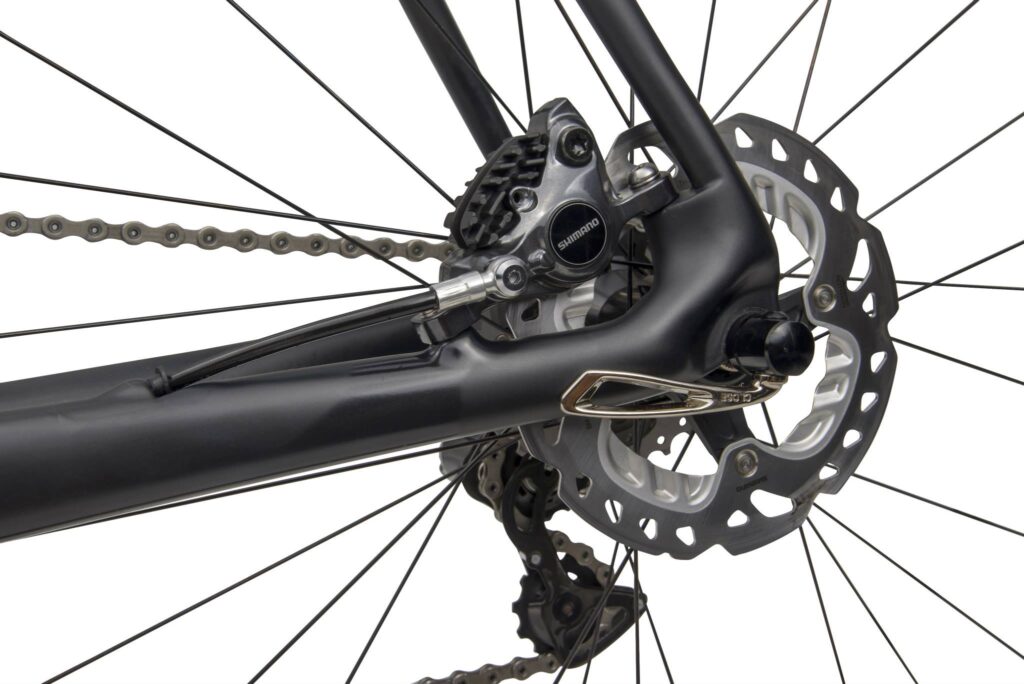

Disc brakes will be introduced in professional road racing in 2017, according to a source involved in discussions between the UCI, cycle sport’s world governing body, and the bike industry regarding race equipment. The UCI has also opened discussions with the bike industry concerning the possibility of amending the 6.8kg minimum bike weight rule and the ‘3:1’ rule that applies to the frame, fork, handlebar, stem and seatpost.
The UCI is currently reviewing many of the rules regarding race equipment in consultation with committees from the World Federation of the Sporting Goods Industry (WFSGI), a body that includes many of the biggest players in the bike industry.
The WFSGI’s Bicycle Committee is essentially the voice of the bike industry as far as the UCI and International Olympic Committee (IOC) are concerned. The Bicycle Committee comprises three sub-committees: the Wheel Committee, the Saddle Committee, and the Technical Committee that includes a Disc Brake Working Group.

Our source told us unequivocally that after consultations with the WFSGI’s Technical Committee, the UCI will allow the use of disc brakes in the pro peloton the season after next. An official announcement will be made very soon, certainly within the next month.
We reported last year that Jeroen Snijders Blok of the WFSGI had said that he expected disc brakes to appear in the pro peloton in 2016, but it now looks like it’ll be the following year.
At a WFSGI public meeting at Taipei Cycle last week, Snijders Blok refused to give any indication of the timescale for the introduction of disc brakes but he did confirm that an announcement was imminent, the timing of that announcement to be agreed with the UCI.
Snijders Blok also indicated that the introduction would be wholesale rather than staggered with some disc brakes permitted in some road races but not in others.
“There will be a fixed date, said Snijders Blok. “As of this date disc brakes will be allowed in road racing. Period.
“With the UCI, we are aiming for a level playing field for all manufacturers so they have as much time as possible for the introduction of disc brakes.”

Yves Mori, the WFSGI’s Communication and Bicycle Manager, said, “We have had a lot of meetings with the UCI over the past year and many conference calls within the industry, and we have provided the technical requirements documentation to the UCI addressing all technical issues. They brought forward requests regarding the heat of a road disc brake, for example, which may be an issue. We have answered all of these questions from the UCI.
“Then they asked for an overview of the status of the Pro Tour teams, where they all stand and whether tests have already been done or not.
“We collected a lot of information and shared this with the UCI, and we also made a proposal on the introduction procedure. I think we can say that we are very close to an agreement on the introduction timing and the introduction mode and that will be communicated together with the UCI very soon.”
“The UCI have said that they will start the process of approving frames that use disc brakes as soon as it is announced. They have said that they have no fears that this will be an issue for the introduction into pro racing.
“Companies need some time to adjust their products for a rule change and this is always taken into consideration in discussions between the WFSGI and the UCI.”
That’s a further indication that 2016 is too soon for the introduction.
Yves Mori also announced that the UCI has indicated that other key equipment regulations are now up for discussion, including the best known: the 6.8kg minimum bike weight for UCI-approved races.
Referring to a recent meeting between the WFSGI and the UCI, Mori said, “The UCI threw into the room the topics of the possible removal of the 3:1 regulation [where the length of the cross section of frame tubes and various other bike elements must not exceed three times the width – Ed] plus the removal of the 6.8kg weight limit. They asked for the opinions of the industry.
“We promised to collect information from all of our members and to give a statement at a later stage. Just that you know topics that UCI are thinking about but the work has not been started yet.”
Snijders Blok added, “What we see here with the soon announcement of disc brakes, the 3:1 regulation, the 6.8kg weight limitation, with changes on saddles [the UCI has asked for a report from the WFSGI concerning the current saddle regulations – Ed], the UCI has became a completely different organisation when it comes to innovation and when it comes to co-operation with the bicycle industry.”


















117 thoughts on “Disc brakes to be permitted in peloton in 2017”
Finally.
Finally.
Was chatting about this the
Was chatting about this the other day, would be great if they had no frame rules, within reason, and see what they could come up with.
Skynet wrote:Was chatting
define “reason”? “reason” is rules. Has to be. “no rules”? they’d be racing velomobiles.
Within reason as in not a
Within reason as in not a recumbent for example but aero, tube diameters, profiles, wheel size would be fine. Would just be interesting to see what they could come up with.
Maybe that will quiet the
Maybe that will quiet the nay-sayers 🙂
Quote:Maybe that will quiet
I’m rather more hopeful it will quiet all those who see disc brakes as the salvation of cycling…
…until the ‘next big thing’ comes along for them to obsess about, of course.
Ah, Campag must have their
Ah, Campag must have their system ready then…………..
bendertherobot wrote:
Ah,
=D>
Yes please!
Having recently hauled my
Having recently hauled my mountain bike out of the garage for its annual winter run-around, I have to say I’m all for it.
=D>
Don’t mind disc brakes coming
Don’t mind disc brakes coming in, but please restrict weight and aero. Last thing I want is for cycling to turn into F1, and all about the equipment and how well you wiggle around the rules. 🙁
Hopefully wider adoption of
Hopefully wider adoption of disc-break frames and wheels will lower the price.
Finally! the disc brakes work
Finally! the disc brakes work on road bikes, really well, especially in our climate in the UK with lots of humid / wet riding days.
hampstead_bandit
What’s that got to do with racing?
Nick T wrote:hampstead_bandit
😀
There’s no racing in rain?
Nick T wrote:hampstead_bandit
😀
There’s no racing in rain?
Previously the disc brakes in
Previously the disc brakes in the peloton was contingent upon some trial runs first, Paris-Roubaix was generally quoted as an example.
It will be interesting what
It will be interesting what this does to the sale of high end race bikes. If I was buying I’d seriously think about waiting.
I wonder how long before the rules on weight and tube shape go through? Race bikes could look utterly different in 3 years.
nopants wrote:
It will be
It may have some impact but I would guess not a huge one. Most people buy what they need when they need it.
Although a big fan of road disc brakes myself, I *just* built a new best bike with rim brakes, deliberately, for three reasons: aesthetics, weight savings, and I’m only ever going to ride it on dry roads in good weather anyway. B-)
HANG ON
.
Does this mean the
HANG ON
.
Does this mean the uci are moving forward and kinda letting bikes develop into the modern century instead of the glory days (as Pat mcQuaid would have called the 1850’s :)) ) and actually allowing innovation…. :O :O
.
I for one welcome the changes and hopefully a lower weight limit, I mean bikes are pretty much as developed as they can be at this point, need to shuffle things up a bit.
Well I’m not buying a new
Well I’m not buying a new bike anytime soon – I’m stocked up now, with mechanical discs on my ‘cross bike only. I’m happy with my rim brakes, especially when I can swap them about between bikes. Just don’t ask me to stop in the wet…
I really don’t understand why
I really don’t understand why this is a big deal.
If you want a disc braked road bike, you can have one. You can have it now, you could have had it at anytime in the last two years.
If you want a bike lighter than the UCI minimum, you can have one. You can have it now, you could have had it at anytime in the past…4-5-6 years.
The UCI run the racing bit of the sport, they don’t govern what anyone who doesn’t race gets up to, so why the big deal?
Cycling has changed an enormous amount; it used to be about what you did rather than what you bought…
crikey wrote:I really don’t
I suspect a significant part of the issue is people buying bikes who don’t race but think they might want the option of occasionally entering a race on their bike in the next few years. This is a pressure for non-racers to buy race-legal bikes.
Does anyone have an idea when British Cycling is likely to allow discs in ametuer races? Same time as the UCI?
I wonder how far Sky will
I wonder how far Sky will take frame development with their “marginal gains” philosophy?
Main concern would be safety.
Main concern would be safety. I don’t see how you can safely have a mixed peloton of disc and rim brakes all riding to the limit of their technology so surely it must be everyone in or everyone out. Two immediate problems:
1. Stopping distances are significantly different between the two and propensity for crashes increases substantially.
2. Those with discs will be able to brake much later than those with rim brakes again increasing the probability of crashes.
Dread to think how that would be amplified and compounded on descents.
RTB wrote:Main concern would
don’t remember the same hand-wringing when people started adopting carbon rims, a long time before they were any good at all for stopping in the wet. or when dual-pivot callipers were introduced. or when people were allowed to use campag delta brakes, which didn’t work at all 😉
…and yet I have ridden with
…and yet I have ridden with at least two large groups of riders this year who had a mix of discs and rim brakes.
No one died.
The whole debate has been over done; it’s just a different way of slowing down, a bit better in the wet, still dependent on the big meaty blob on the saddle and the two skinny bits of rubber on the road.
crikey wrote:…and yet I
Spot on!
For pros (on tubs, closed roads and experienced riders all around) I can only think of it being an advantage in the wet.
Although it will probably also be advantageous if you’re in the bike industry.
Future’s secured for another 15 years of teasing out incremental advances to the frenzied market place… here we go again.
Wake me up when we can finally buy some genetically engineered leg muscles to replace the crap that most of us were born with. Now that’s what I call an advance!
Mmmm… that last sentence does sound a bit dodgey doesn’t it?!
On my ride on Sunday I had
On my ride on Sunday I had this discussion with a group I was riding with and no one was going to get discs. Of course the industry needs to sell them …
Especially when for the road there is really no benefit.
ianrobo wrote:On my ride on
whereas on my ride on sunday two out of four of us had discs and were loving them, especially on steep and twisty mendip descents.
Dave Atkinson wrote:ianrobo
whereas on my ride on sunday two out of four of us had discs and were loving them, especially on steep and twisty mendip descents.— ianrobo
However have you not seen the benefit of them with out having to stump up the cash to see what they’re like first?
It’s not like we’re all industry journo’s will an opportunity to see what the benefits are on a test bike, it involves parting with a serious sum of cash. Surely you must understand peoples skepticism on having to get a new frame/wheels/50% of a gruppo to see these benefits some of the industry keeps going on about.
glynr36 wrote:It’s not like
..but you don’t have to go and buy them. You can if you want to, but rim brakes are still fine and haven’t stopped working, and as discs become more common we should all get more choice and hopefully more affordable choices at that. You could even go and test ride them should you wish..
Controversially, people could actually trust at least some of the increasingly large section of the cycling press, and others, that is reviewing them favourably instead of sticking to the “I don’t see the benefit so it can’t exist” frame of mind – the cycling industry has money and influence but I highly doubt it’s subverting everyone…
glynr36 wrote:However have
Mmm, like they’ve never become the dominant type of brake on any other bike, eh ?
There’s a reason they’re ubiquitous on mtbs, they work consistently, crap weather or not (not to mention mud).
glynr36 wrote:Dave Atkinson
whereas on my ride on sunday two out of four of us had discs and were loving them, especially on steep and twisty mendip descents.— Dave Atkinson
However have you not seen the benefit of them with out having to stump up the cash to see what they’re like first?
It’s not like we’re all industry journo’s will an opportunity to see what the benefits are on a test bike, it involves parting with a serious sum of cash. Surely you must understand peoples skepticism on having to get a new frame/wheels/50% of a gruppo to see these benefits some of the industry keeps going on about.— ianrobo
so you think it’s impossible for me to make any kind of value judgement without spending my own money? you probably shouldn’t waste your time reading the cycling press if you think that’s the case. because they’re always going to send us the bikes for free.
bottom line: very few people (read: no-one) will be doing what you describe. but lots of people will be buying a new bike, because we like buying new bikes, don’t we. that’s the point at which you’d decide to go down the disc route, if you think it’s for you. the last bike i bought was the tripster atr that i tested, which has discs. but the next bike i’ll buy is quite likely to be a genesis flyer, which doesn’t. rim brakes aren’t dead, and no-one’s saying they are.
ianrobo wrote:Especially when
Strange that so many reviews i’ve read reckon there are – perhaps they’re all on the take from the ‘industry [that] needs to sell them’ ?
Oh and personal experience of hydraulic disc and rim on the road of course – I know which i’d like to have even though the rim brakes are pretty useful in the dry (Ultegra 6800). Aesthetically i’m not always a fan of discs but they do work rather well…
Quote:think they might want
…Ummmm, no.
People might want to think they are riding a race bike, but not many people ‘occasionally’ enter a road race because it’s hard and requires a considerable amount of training and commitment.
It is very much a personal
It is very much a personal view of course. Just like I love electronic gears and others think they are a waste.
Inevitable the peloton would get them and likely that of course all the teams will adapt to them.
Interesting to see about the weight limit, sensible to bring down the weight really.
Truth is that cycling is one
Truth is that cycling is one of the few sports where spectators can essentially have the same tech as the people they admire and watch.
F1 fans don’t watch a race then get into their F1 car to drive home the scenic route in…
Rim brakes are ok.
Disc brakes are better.
Carbon is the go-to frame material now but there’s still a place for steel, alluminium and ti.
Choice.
We all have it, the pro’s don’t- well, at the moment.
It’ll make the sport, in terms of watching racing, much more progressive and go to a whole new level, which can surely only be a good thing.
They don’t still hit the ball in golf with a length of stick.
They don’t kick a pigs bladder in football.
They don’t race F1 in 1.5L engined cars.
Time and technology moves on…
Or are you all still using toe clips and straps out there…?
Hula Boy – you’re right they
Hula Boy – you’re right they don’t race F1 in 1.5L cars but 1.6L so you were close.
FIA TECHNICAL REGULATIONS
ARTICLE 5 : POWER UNIT 5.1 Engine specification :
5.1.2 Engine cubic capacity must be 1600cc (+0/-10cc).
I do remember my first race
I do remember my first race on dual pivot brakes; the ability to brake later seemed a great wonder at the time, then it was made abundantly clear that it had absolutely no advantage at all in the real world.
crikey wrote:I do remember my
the ability to do the same braking more predictably with less effort makes those twisty mendip descents more fun, i’ll tell you that. i’m going to call that an advantage 🙂
Disc brakes is easy – wait to
Disc brakes is easy – wait to the argument about through-axles vs QRs – particularly 10mm vs 12mm vs 15mm vs 20mm 👿
monty dog wrote:Disc brakes
I believe monty has hit the nail on the head. This will be where the UCI are focusing their energy once they get over the “shall we” of disc brakes. Whatever format is chosen (and only one will be able to be chosen for wheel support reasons) it will make the other format’s bystanders….
….unless we see some devil incarnate where 2017 is QR wheels and 2020 becomes 12mm ~X( (wouldn’t the industry love that! – they get to sell disc brake bikes twice)
Although the same could be
Although the same could be said for BBs where there are still many variations and no standard.
I just laughed that there’s a saddle ‘committee’. Oh to be a fly on the wall at THEIR meetings.
Cable or hydraulic?
Cable or hydraulic?
preetty chuffed about this,
preetty chuffed about this, while it is possible now to biy a bike with disc brakes, the options for replacement wheels are not there yet. Now disc brakes will become dominant I expect a lot more choice in disc compatible wheels.
discs are fundamentally a lot easier to replace when worn than rims are. The also work better in the wet, and are less susceptible to damage from grit and gravel.
I see no upside to rim brakes, other than aesthetics. Form should follow function, but the traditionalists are all about style over substance.
Having conducted a scientific
Having conducted a scientific (not really) review of crashes during races, it is difficult to identify (m)any instances were shorter braking distances would have changed the outcome.
There seem to be two main causes of racing crashes:
1- high speed pile up. There is no distance for stopping, whatever the brake set up. Riders are often ejected over their bars.
2- tyres lose grip. Dusty roundabout, wet descent, take your pick but it’s lack of grip, not lack of stopping power. Perhaps a leap in tyre technology or wings to create downforce would help, not better brakes.
I’m sure there are some instances were slightly slower stopping distances or improved modulation would help but if you are barrelling along at 40kph 20cm from the rear wheel of the chap in front there is no way of stopping a bike and keeping the rider seated if disaster strikes.
Given the effort that has been going into producing aero bikes, it’s hard to see the pro teams strapping two dinner plates to their hubs. It must cost a minute over 40km so a rider with discs is going to find a breakaway hampered. If the UCI reduces the minimum weight of bikes, we may even see some teams jettisoning weight from their brakes and going for a more spindly caliper, especially for mountain stages.
I agreed with you Scrufftie
I agreed with you Scrufftie until I got to your final paragraph.
I see the aero advantage eventually being with disc brakes: rim design will no longer be hampered by needing to include a section with parallel faces to allow for braking and I think the toroidal cross section of aero wheels is likely to improve over what is currently available.
Weight might also drop as there will be no need to allow for a safety margin in the wearing surface.
Those ‘dinner plates’ may have some slight aero effect in a crosswind but head on they are pretty much neutral: also they are in the wheel centre so have less affect on handling than a similar area at the rim.
Disc calipers will probably also be designed with more aero consideration.
I don’t see why a ‘spindly’ caliper (do you mean rim or disc?) would be adopted for the mountain stages: for the pros even most days ending at a summit have some technical descending before the finish where a manufacturer would not want to expose itself to risk of litigation, before you even consider the risks involved in selling ‘spindly’ calipers on the open (MAMIL) market…
What’s the lightest road disc
What’s the lightest road disc build we’ve seen so far? There’s that S-Works Tarmac that comes in at 6.9 for the top line £8k spec – If they drop the weight limit significantly and give teams the option of brakes, it’ll be curious to see who chooses what.
Nick T wrote:What’s the
Not sure, but a high end, off the shelf, Storck Aernario Disc is quoted as 6.3kg.
Indeed, especially interested in how the neutral service vehicle setup is going to work if there’s a split usage in the peloton. I’d hazard a guess that weight itself won’t make a big difference * but aerodynamics, as mentioned previously, might in the right situation.. but that’s all that it is, a guess.
* Unless the limit is reduced to silly numbers and, even then, i’m not so sure.
Dave: This article is about
Dave: This article is about UCI rules. Do we really need another rehash of the benefits of discs v rims for commuters and MAMILs in the UK? 🙂
Racers can race with any kinds of brakes, just as long as they have similar ones to other racers available to them. Anyone who doubts this needs to have a go on an old racer (weak, flexy calipers, with bad compounds – terrible braking).
In some situations disc brakes will be worse for racing. Mountain stages, time trials, breakaways. Discs weigh more, have a larger winded area (especially in cross-winds) and tend to rub more. Races are rarely won on descents, and even then, discs aren’t going to make a significant difference to descending times over rim calipers.
That said, give the pros the choice – no skin off my nose.
What I would hate to see is an aero or weight arms race. Minimise the influence of tech R&D expenditure on racing, please! Obree was cool cause he did it on a shoe-string, from his kitchen and was a one-off, but I’d be turned off cycling if performance became about equipment to any degree.
Tech obsessed MAMILs (and I am one) will ruin this sport, if they get their way.
The bike industry is of course salivating over free rules. They just want to be able to continually change stuff, so their marketing departments can tell you this year’s bike has more Fluxatory Compliance, or better shifting, or x% more aero (there must be some combination of equipment out there where the claimed %age aero improvements mean the bicycle should be sucked along by a self-created draft of air, no pedalling needed!). Of course, they are already free to do this now – nothing stops them selling you a non-UCI-approved machine, but for someone reason many MAMILs insist on UCI-approval, despite overwhelmingly not racing themselves (living the dream I guess)!
On another topic: I was chatting to someone high in engineering at a major equipment maker. They think the (MTB borrowed) 135mm standard for rear-disc hubs on road bikes doesn’t make sense. It leads to clearance issues on short-chainstay, race-geometry bikes. They think a road-specific standard would make more sense.
So, watch out when you’re buying road 135mm-rear discs. That might not last long as a “standard”.
Paul J wrote:
On another
Which is a problem with the Disc Tarmac I mentioned – they’ve offset the hub to fit everything into a 10mm too short chainstay and you’re locked into buying Specialized’s own wheels for ever. They’ll be loving the prospect I’m sure, but anyone who buys one has lost their damn mind.
Paul J wrote:Dave: This
what, miss an opportunity? 😉
pedalingparamedic: Equipment
pedalingparamedic: Equipment has to become available for general sale to be used in UCI approved races. So not-for-sale, too dangerous for the public, team issue, mountain-climb-special brakes would be ruled illegal (once the “not for sale” bit became clear).
I for one can’t wait. I’m
I for one can’t wait. I’m relatively new to road bikes, but can fall back on decades of mountain biking/motocross and motorbike experience.
I remember the same issues with motorbikes going from drums to disc, all the made up horror stories and nay slayers (usually older and stubborn guys) saying locking up the front wheel caused more cases etc etc. Here we are 30 yrs later and now all motorbikes have 300 mm plus twin discs on the front and no one morn the drum brake.
Mountain bikers were the same in the late 90, too much power for the mud etc etc. People will be crashing everywhere, head stocks will crack, too much weight. Then what happened in reality is that they worked brilliant, all mtbs even xc bikes have discs now and rim design moved on. They are lighter stronger and I can’t remember the last person to ask for a V-Brake or qr instead of discs or bolt through.
IMO roadies are now going through the same situation. In 5 yrs time all bikes will have the same standard road disc with tubeless tyres and bolt through. The reason we have not seen it yet is that shimano have not released it yet!
One the rims don’t have pads pressing on them, rim design will move on and get lighter and the wheels will get better as weight at the rim is the worst place on a wheel imo.
I’m installing tubeless this afternoon on as soon as shimano release the std and it is accepted I will be getting a bike with it!
gazman428 wrote:
One the rims
They won’t, though. That bead holding your tyre onto the rim is the limiting factor, not the brake track.
My main concern, one that I’ll need to see proven beyond doubt before I buy, is how they’ll tackle brake fade on the lighter and lighter rotors the road industry will demand. Heavy rotors aren’t really an issue on the other examples mentioned – but if a long descent can generate enough heat on a rim to burst tyres as was the case in Oman recently, I don’t feel too optimistic about discs right now.
Nick T wrote:gazman428
But their will be no need for a brake track. Look at mtb rims, they have a small surface for the bead to hook into then form the shape of the rim.
Without a deep braking/rim track it will be a far lighter rim
Quote:
But their will be no
What makes you think that? I have 25y old Campy Omega rims that have no machined brake track.
Road rims are not a$$ heavy MTB rims. It’s been done already… They are already light as possible and shedding the brake track will offer only a few grams at the expense of integrity.
gazman428 wrote:Nick T
But their will be no need for a brake track. Look at mtb rims, they have a small surface for the bead to hook into then form the shape of the rim.
Without a deep braking/rim track it will be a far lighter rim— gazman428
Tubular rims are lighter rims because there is no need to withstand the outward force of the clincher tyre against the rim. They are significantly lighter even when they have a brake track. Disc brakes require cross spokes and that mean more spokes and more nipples at the rim. Even MTB rims have not significantly decreased in weight after the decades they have been using discs.
gazman428 wrote:I for one
Well said.
I can’t stand those nah sayers because a few years later you won’t hear them anymore and you ask yourself why so many have no vision and simply ignorant.
I have the Shimano hydro disc for over half a year now and I can’t be happier and I would never go back to caliper again.
After disc is sorted we need something that can keep the chain maintenance free from all the dirt and no need to clean it but to lube.
About time, many including me
About time, many including me are holding off buying a new bike. If I buy a disk road bike I cant race it.
I also thing quick release will be fine for disc brakes and will be the standard. There is no need for thru axles. Maybe in cyclocross but in road there is no need.
Giants Defy disc bikes are using quick release axles, giant generally have massive clout in the industry so many will follow them. For that reason I would not buy a specialized they have a complicated proprietary standard. I hope in road the industry keeps it simple not like what is happening in the mtb side of things with about 5 different thru axle standards for a rear wheel its a joke.
roadie.ronan wrote:I hope in
Why would they keep it simple? The business people at the manufacturers are *salivating* over the chance to “segment” the market by having lots of different standards. The manufacturers DONT WANT ONE STANDARD. The more standards there are, the more opportunities there are to sell you more products.
E.g., if there was one standard, you might buy one set of race wheels and one set of training wheels for your road bikes. Or you might carry your old set of wheels over when you buy a new bike. With multiple standards, the more standards there are, the more likely it is that you will need to buy *multiple* wheels for your different bikes. This means more money for the vendors.
The more “standards” there are, the more sales opportunities for the vendors. They *love* this.
The only downside is creating the standard takes upfront investment, as can getting other vendors to adopt and ship significant amounts to make the costs worth it. That’s been the only check on things.
Look at bottom brackets and the explosion of press-fit bearing standards. (Hilariously, there is now that new bottom-bracket which fits into press-fit cups, but screws the 2 sides together through the bottom bracket, to address the squeaking issues).
Paul J wrote:
Why would they
yes I agree, I think though possibly with road racing and how common/important the replacement of wheels is. I’m hoping they just stick with a quick release. Again Giant are using this and have stated there is no need for anything else.
I don’t buy specialized purely because of all their weird little standards. Their bikes are already expensive. I am mainly a mountain biker and they always have some non standard fitting like shocks to the bike or whatever and then when you want to get a part you cant get in touch with them. For this reason I think my next road bike will be Giant.
Discs have been allowed in
Discs have been allowed in cyclocross for a couple of years now but in the big races you’ll only see 1 or 2 of the top riders on discs. It will be interesting to see the level of take up on the road.
thegibdog wrote:Discs have
The UK-based Hope ‘cross team were running discs in 2011 and the riders I spoke to wouldn’t want go back to canti brakes.
At the top level Giant’s CX riders are all on disc and among the others Helen Wyman is a disc convert (2013 interview). One reason that discs are not universal is because many of the eperienced CX riders are so accustomed to cantis that they are reluctant to change.
I think Dave was just demonstrating the comparative reactions. Many new models are being sold with discs now and they’re hardly any more expensive than the rim-braked version.
Looking at the sheer number of upgrade threads on here there are lots of people with plenty of money to burn on components to save 300g or trying to keep up with the Joneses.
Same applies to deep section wheels.
You’re following the wrong sport. Tech is at the heart of it because the manufacturers sponsor teams. Why? Because it sells. I am not enamoured with the tech ‘arms race’ but as long as we can still get 7/8/9 speed parts and rim-braked wheels cheaply I’m happy for others to have whatever they can afford.
Re. the 6.8kg limit – I’m not the least bit fussed about the weight limit. It won’t change the racing, it’s purely about marketing.
Pure scaremongering bullshit. While 135mm hubs can be bought, like those on many MTBs and ‘cross bikes, then 135mm wheels can be built.
thegibdog wrote:Discs have
In UK and Europe perhaps – try looking at the US races.
fukawitribe wrote:thegibdog
of the top 16 riders at the CX worlds, six used discs, including the men’s and women’s elite winners
http://www.cxmagazine.com/podium-ride-tech-analysis-2015-tabor-world-cyclocross-disc-di2-cx1/3
Dave Atkinson
of the top 16 riders at the CX worlds, six used discs, including the men’s and women’s elite winners
http://www.cxmagazine.com/podium-ride-tech-analysis-2015-tabor-world-cyclocross-disc-di2-cx1/3— thegibdog
So 10 didn’t?
mrmo wrote:Dave Atkinson
of the top 16 riders at the CX worlds, six used discs, including the men’s and women’s elite winners
http://www.cxmagazine.com/podium-ride-tech-analysis-2015-tabor-world-cyclocross-disc-di2-cx1/3— fukawitribe
So 10 didn’t?— thegibdog
So 3-6 times as many as posited by thegibdog. From
http://www.bicycling.com/cyclocross/powers-and-compton-keep-national-cyclocross-winning-streaks-alive
Interesting from Powers, pragmatic too.
mrmo wrote:Dave Atkinson
of the top 16 riders at the CX worlds, six used discs, including the men’s and women’s elite winners
http://www.cxmagazine.com/podium-ride-tech-analysis-2015-tabor-world-cyclocross-disc-di2-cx1/3— fukawitribe
So 10 didn’t?— thegibdog
yup, 10 didn’t. that’s for the top four riders in each category, i don’t know what the overall splits were, probably a lesser percentage of discs overall
My advice would be to stay
My advice would be to stay away from a bike with disc breaks. If there is a slight lateral movement in the wheel, the brakes will rub against the wheel. This causes a lot of rolling resistance, the slightest twist in the wheel rim or expansion of the metal will cause problems.
I have a mountain bike with hydraulic discs and it causes me no end of problems.
millskid wrote:My advice
Totally agree – if the discs are broken, they need to be replaced immediately.
Really? I have 2 mountain bikes and a touring bike with hydraulic discs and I have no problems at all. Mine haven’t even needed bleeding, other than at installation – they get fluid replacements about once every 2 years, or thereabouts, and new pads when needed (varies depending on how often and in what conditions they’re running). My road bike has cable-operated calipers – they need tweaking more regularly, but no more than cable-operated rim-brakes did. There is some rub on these, but they’re single-piston, so that’s not so surprising.
Hey ho – YMMV. Don’t really understand why disc brakes, more than any other type of component, seem to divide folk into massively happy and absolutely dead-set-against (often without any actual experience of them).
For me, if they’re badly set-up and maintained, they as much of a PitA as badly-setup/maintained rim brakes. Well set-up and installed hydraulic disc brakes are a maintainer’s dream – they need almost no input – and are reliable, consistent and controllable in all conditions. They’re (obviously) tolerant of less-than-perfectly-true rims, and rim life is no longer limited by how thick the braking surfaces are. Overheating is a possible issue for road bikes on long descents – rear-brake-dragging is common for stabilisation, and that’s a lot of heat to dissipate from a 140mm rotor. I’ve never had the “slight lateral movement in the wheel” issue, but then I maintain my bikes.
I’m not certain how much advantage there will be for racers, who have maintenance teams, unlimited rims and new brake pads whenever they need them. More consistent and controllable braking is the only real advantage as far as they’re concerned…
millskid wrote:My advice
That is boll@cks, the disc is mounted on the hub. The wheel can buckle to hell and it won’t affect the braking. It would need the bearing s or spindle to bend and that could happen to a rim wheel just as easily. But since it a rare occurrence and probably only happens on poorly maintained bikes.
Unless your wheel runs
Unless your wheel runs perfectly true through the brake it will rub against the pad (i.e when putting the wheel back on after a flat, if the wheel is not aligned perfectly you will have problems). There is no room for error.
I have Avid Juicy Hydraulic Disc Breaks, trust me they rub. You can ride through the friction obviously, however, that is not the point. My bike is not poorly maintained by the way. A good test is to free spin your back wheel by hand and you will notice even the slightest rubbing. Its good to compare it against a bike without disc brakes.
Go and buy a very expensive road bike with disc breaks and when they start to rub after a bump, or loose nut don’t moan about it.
Disc brakes are amazing when working well, I just don’t think they are worth the hassle.
millskid wrote:Unless your
Eh ? Your disc is attached to your hub. Your calliper is attached to your fork. Which one of those knows you’ve had a flat ? You’d have to have a fairly fucked alignment to cause an issue.
millskid wrote:Unless your
I have shimano xt disc brakes, they never rub, no servicing for years. I’ve had more issues with caliper brakes where the calipers close from both sides, but open up more to one side.
Any misalignment will be more pronounced at the rim than at the brake disc, so if it would rub with disc brakes it will rub on the rim with rim brakes. Really if you push the wheel fully into the grooves it will be aligned sufficiently not to rub on discs.
wycombewheeler wrote:Any
True enough. But…
…isn’t the clearance for rim brakes greater than that for disc brakes? I don’t have disc brakes so I don’t know for myself.
millskid wrote:Unless your
Thats tosh!
As stated before, If they’re set up well you shouldnt get this.
Ive used HOPE on my MTB since the late 90’s and discs on my road bike and have never had this on either. If you are then maybe try a better brand, there’s lots out there!
As for losing bolts and rubbing by going over bumps??? In all my years of XC MTB racing Ive never had this and there’s been some very bumpy courses along the way. Stating this with regards discs on road bikes is total bobbins. ….jeez, what kind of roads are you riding???!! 😀
I’m just worried that with
I’m just worried that with the metal on the discs combined with the peloton’s speed we will see the sun’s rays reflected in an infinite feedback loop between bikes resulting in a high-speed-micro-solar-explosion that will leave lots of children parentless.
Having ridden my road bike
Having ridden my road bike with v-brakes quite a bit with others who have caliper brakes I can say that in grippy (dry) conditions you can out brake by a couple of bike lengths without loosing traction — this gives you quite an advantage in technical descents.
Also from mountain biking the better (and more consistently) you can brake, the faster you can ride in technical descents/singletrack. However on a MTB you have a lot more traction and more warning when you start to loose traction.
Ive ridden my 29er with discs and tubs and I was pretty careful not to apply more brake than the tyres could cope with (pretty difficult to judge though)
I’ll wait 3 years to see
I’ll wait 3 years to see what’s become standard before deciding whether to change. I prefer the look of caliper brakes to be honest ( so much so I won’t buy Super Record until Campag realise black brakes look crap) and after buying mini disc and then mini video I’m just glad Sony aren’t making disc brakes…
Switched to discs for X this
Switched to discs for X this year and would never go back to cantis on basis of performance . Don’t look nice though so understand why people don’t like them.
Lot of top X riders carry on with cantis as have to replace all your wheels and interchange ability is a real issue with discs . Suspect this will be an issue that limits take up for road racing as can’t just wack any wheel in
@CXR94Di2
yeah its balls.
@CXR94Di2
yeah its balls. I’ve been using disc brakes on mountain bikes since 1995, and no complaints here. Disc brakes were as much of a game-changer for MTB as the introduction of the suspension fork, and later the full-suspension frame.
I have ridden mountain bikes with disc brakes all over the World including multiple vacations in Whistler Bike Park, Canada which is one of the most punishing tests of brake equipment.
@Millskid
if you are having issues with the disc brakes on your MTB, find a decent mechanic to sort it out.
Apart from cleaning the brakes, and changing pads once worn, they require little maintenance.
Most problems are due to poor setup, or a defect in a specific brake.
Disc brakes on road bikes?
I’ve been riding a 2015 Giant Defy Advanced Pro 1 with Shimano hydraulic discs since last year. No interest in ever riding a caliper brake road bike ever again, they are that good, especially in our wet climate.
Descending on discs gives much more control meaning you can go quicker, more safely. I come from a mountain bike back ground specifically downhill and freeride (at a professional level) and am not shy going down hills:
” My main concern, one that
” My main concern, one that I’ll need to see proven beyond doubt before I buy, is how they’ll tackle brake fade on the lighter and lighter rotors the road industry will demand. Heavy rotors aren’t really an issue on the other examples mentioned – but if a long descent can generate enough heat on a rim to burst tyres as was the case in Oman recently, I don’t feel too optimistic about discs right now. ” –
Trust me – not a problem with 140mm Shimano IceTech rotors. I built a Specialized Roubaix last fall, with HED Ardennes + wheels, Di2, and Shimano hydraulic disc brakes. Took it on it’s first ride – the Unknown Coast in Northern California, with extremely steep descents of thousands of feet. Would have scared the crap out of me on rim brakes. Actually did scare the crap out of me, but the brakes worked absolutely fine. If you ride in the mountains like we do in Northern California, hydraulic disc brakes make perfect sense.
And my rotors never rub – not
And my rotors never rub – not sprinting out of the saddle, not ever. Just FYI.
ICraig P wrote:And my rotors
🙁 I
I’ve been riding bb7s for the last 7000 miles. I weigh 200# and descend like a beast. I beat the shut out of my ride, Salsa Ti Warbird.
Although my brakes are cable actuated I have them so dialed in it’s as if I can feel the road in my hands when braking.
Confidence inspiring, akin to squeezing a we’ll tuned trigger if I have to adjust my line through an apex…
Utterly reliable through all conditions.
Only noise I get from my disc
Only noise I get from my disc brakes is a tiny tinkle from the Shimano Ice-Tech cooling fins on the brake pads, but no rotor rub – if the rotors were rubbing something has gone very wrong with either the brake or the wheel axle!
WANT!
WANT!
hampstead_bandit wrote:Only
Want!
My comment was merely
My comment was merely relating to what I noticed when watching the Superprestige & World Cup races this winter. I was expecting to see more disc brakes on show but usually there was only one or two of the frontrunners (i.e. the ones that were getting air time) running discs. I suppose it’s only a matter of time until the vast majority switch to discs, but my point was that it’s not been a rapid changeover. And brakes are used more regularly and more heavily in CX than they are in road races.
I have a mtb with through
I have a mtb with through axles. Absolutely no alignment issues. I have road bike with quick release again no issues dropping the wheel back into the mounts. Disc brakes have a a small pull back on the pads just like motorcycle car brakes.
My mtb has seen 3 winters and one set of pads, no other servicing has been required. They are no issues with disc brakes.
Quote:I have Avid Juicy
Juicys will, yes.
No offence, but you’re commenting on disc brake technology from the position of someone whose only experience of it is using a set of brakes so criminally shit that SRAM has completely re-designed them and dropped the Avid name from the range to try to exorcise the shitness demons.
Use something other than Juicys, like the rest of us have been for about 5 years. B-)
BigDummy wrote:Quote:I have
haha, well said. =))
gareth2510 wrote:BigDummy
haha, well said. =))
And this is one of the reasons i will never buy SRAM…. strangely Rockshox forks are ok though?????
So for all those people
So for all those people saying they don’t get brake rub, I take it you’ve never had to retrue a brake disk. This happens to me from time to time, it’s easily fixed with an adjustable spanner but a nuisance nonetheless. I tend to get it from the bike racks at work as they interfere with disks when parked.
I personally like disks, but don’t like the fact the manufacturers will likely stick a couple of hundred £ premium on disk equipped frames.
http://i2.wp.com/www.flowzone
http://i2.wp.com/www.flowzone.ch/wp-content/uploads/2013/11/DSC_0054.jpg?resize=700%2C500
thought i would dig this photo out again.
Discs make a lot of sense in bad weather, in mud, etc, they are not a panacea, if the road surface is covered in shit, you are going to have traction issues.
Discs do ping and do make more noise than calipers, particularly if you get some contamination and end up with a pair of banshees, you can get away with a bit of oil on rims and cleaning, discs and a bit of oil, tends to result in a pair of trashed pads.
For those commenting on weight saving, light mtb rims weighed c400grams before discs and still weigh c400grams. Think of it like this, Mavic GEL280’s how many rims can you buy now that are lighter? do you really think you can make a aluminium structure any lighter if you remove the braking surfaces. (Carbon is a different question)
You will have people whinging and there will be the constant, bleed your brakes comments.
Are they a game changer, in my opinion no, on an mtb the increased clearance was for me the major selling point.
My next road bike will have discs, why? Because the market has decided that discs are the way forward, so no point fighting the facts. Same reason that there is no point buying a 26″ wheel mtb anymore. Why buy technology on its way out and where spares will be an issue in the near future.
mrmo wrote:Why buy technology
Rim brake spares are going to be an issue in the near future? Seriously?
mrmo wrote:For those
Modern rims are usually wider, that material has shifted from a thicker sidewall.
The other thing is that the modern rim profiles are also optimised for strength, using the same material from the sidewall.
And I can’t recall rims as light as Stan’s are when I still used v-brakes, except as very high end racing rims. With a life expectancy of… not much.
Stan’s Alpine are 330 grams in 25″, and the Crest are 340 grams. The light 29er rims today weigh the same 400-450 grams or so that 26″ rims did 12-15 years ago… and those were the light ones. Larger hoops weigh more.
jacknorell wrote:
Modern rims
Mavic m230 were 380grams and used eyelets? and that was 20 years ago. You mention that rims are wider, so the metal has been relocated.
http://weightweenies.starbike.com/listings/components.php?type=rims
if you look rim weights have actually been fairly static with the odd stupidly light one.
mrmo wrote:jacknorell
Mavic m230 were 380grams and used eyelets? and that was 20 years ago. You mention that rims are wider, so the metal has been relocated.
http://weightweenies.starbike.com/listings/components.php?type=rims
if you look rim weights have actually been fairly static with the odd stupidly light one.— jacknorell
Sure, some were stupid light back then.
Average rims are about the same weight now. But we don’t hear the phrase ‘wheel taco’ very often anymore… as they’re much stronger at the same weight or even lighter.
The Stan’s rims are pretty solid, and the 400 gram ones are all-trail ones.
Anyway, the point (not necessarily directed at you) is that rims have got better as in wider and stronger at same weight. And lighter ones are now reliable.
We’ll see the same with road rims as discs become commonplace.
Someone made the argument that removing the brake track wouldn’t lighten or strengthen rims, and that’s just poppycock. The flat pressure-tolerant horizontal surface isn’t very helpful for the lateral structural strength needed for a rim.
.
.
jacknorell wrote:
Someone
Yeah, because a pair of track rims save a good kilo compared to road rims don’t they.
I’d just like to keep
I’d just like to keep repeating disque braix, dysc braykz, dizk breacs, dissk braiks until someone explodes.
disc breaks is something you
disc breaks is something you get at greek weddings not on bicycles!
My concerns are
Impact of
My concerns are
Impact of having a mix of caliper and disc brakes in a group, especially technical cornering – it does not sounds like a good pairing whether in pro or local amateur races.
Danger of injury from discs in a crash, again specifically within the peleton.
brakes out performing the wheel/tyre
More pressure on us mortals to upgrade and the hassle of doing so – frames, wheels, all obsolete.
I’m in no hurry to switch my road bike
Simmo72 wrote:My concerns
Simmo72 wrote:
Danger of
What a bunch of hen-clucking. Might as well get rid of chainrings, after all, they do have teeth.
BRAKES, the word is BRAKES.
BRAKES, the word is BRAKES. It really isn’t difficult.
As noted a number of posts
As noted a number of posts above, if you want disc brakes, you can have them. If you don’t want them, you don’t have to have them.
Cyclists are like the bastard sons of train spotters and golfers.
Hydraulic disc brakes for
Hydraulic disc brakes for road bikes have been around for 40-50 some odd years. Now figure out why has it taken so long for them to be adopted for racing? Some of you already know the answer. The rest never will. 😉
I can already lock up both
I can already lock up both wheels on my slick tyres easily enough if I jam on the brakes at high speed. Where is the advantage of carrying extra weight for more braking power? All you do is move the limit to the tyre rather. I would have to go to heavier tread tyres, with more rolling road friction, and between the weight and the friction, surely I must be giving up more than I can save by braking later into a few corners? Are the heat dispersing characteristics really worth it?
Mountain biking, discs make sense.
Cyclocross, discs make sense.
Commuting, discs can make sense depending on weather and tyres.
Road racing in summer, I am not really seeing the point.
kevinmorice wrote:I can
Locking brakes, oh goody, that’s an on/off switch
a) modulation
b) even in summer it chucks it down
If you go and cycle some of
If you go and cycle some of the very severe hills in Exmoor or over the Strines or any place that contains lots of short sharp hills, disc breaks are better on a road bike. In traffic disc brakes are better, on longer gentle descents disc brakes work better. In wet or dry discs are better, sometimes they squeal in the wet, so what? they still work better!
I have new Campag Veloce on one bike and avid BB5s on another, I know which I would rather have on all my bikes if I had too pick!
Quote:Yeah, because a pair of
Your sarcasm is wasted – track wheels are built for stiffness and aerodynamics, weight is very much a lesser issue in the controlled environment of a velodrome.
Removing the brake track from road (or CX,/MTB etc) wheels is a massive boost to performance, you can build the wheel stiffer, more aerodynamic, stronger, lighter, wider…
All without the constraints and fragility of a parallel machined rim.
It’s not solely about weight.
crazy-legs wrote:
Your
I must have missed the memo about stiffness and aerodynamics not being relevant on the road.
Many high end wheels don’t have parallel rims any more, and whether they’ve been machined or not isn’t really relevant – machining just takes the finish off the alloy surface of some rims and even that’s mostly cosmetic. you effectively “machine” yourself them by squeezing your brakes on.
Shallow, lightweight wheels will still need to be box shaped to hold the tyre in place. Deep, aero rims will still be as wide as the tyre to control air flow. I don’t know what super duper rim shapes you’re imagining will be possible with mega, stronger yet use less material brake track-less rims, but I bet they defy the laws of physics.
crazy-legs wrote:Quote:Yeah,
You have just contradicted your own argument there. You say track wheels are built to be stiff and aerodynamic and are heavy despite having no brake track. Next you propose that removing the brake track is going to result in stiffer more aerodynamic wheels that are also lighter.
Furthermore if removing a parallel rim could do all this why has is not been done with track wheels already. That controlled environment would be a perfect place to perfect the rim profile.
I can already lock up both
far too true and it is possible with disks too but is a harder to do – feel and consistency is so much better – I went to disks on my cx stylee aka drop bar hybrid when I noticed that on some hills I got to higher speeds on my disk braked MTB simply because I knew that i could scrub the speed safely when I wanted to
as said above this is a proposed change in rules for the pro-peleton – it won’t be compulsory
Another commercial move to
Another commercial move to get more dosh out of cyclists, should be some real bargains on future near redundant road models with traditional brakes. Just go with whatever you are comfortable with.