


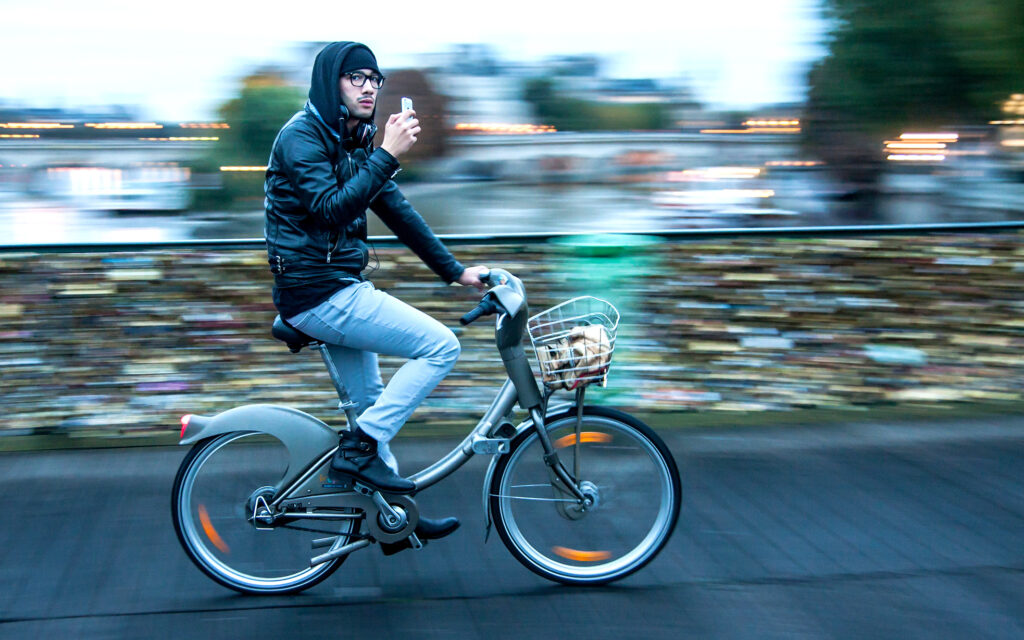

New plans from the France's National Council for Road Safety (CNSR) mean good news and bad news for French cyclists who break the law: fines for offences such as jumping red lights will be reduced, but the CNSR wants ot see them handed down far more often.
According to news site The Local, French cyclists are rarely fined for breaking the road rules.
But after a trial crackdown in Strasbourg was followed by a reduction in crashes involving cyclists, the CNSR plans to change that.
Cyclists in Strasbourg have been fined €48 for riding in the wrong direction instead of the €90 the offence would cost them elsewhere in France.
Crashes involving cyclists went down 37 percent within a year; 833 fines have issued since 2012.
Cycling deaths in France rose six percent to 147 in 2013.
On Monday the CNSR recommended that the National Assembly “extend the principle of lower fines adapted to cyclists to urban zones”.
Jean-Baptiste Mathieu, the mayor of Strasbourg, said that it made no sense to fine cyclists €90.
"It is almost the cost of a bike," he said. "Reducing the fine to €45 is much fairer, and therefore a more realistic threat of punishment. It is a form of prevention."
But French cycling bodies are not impressed. Jean Chaumien, president of a local club said: "We must stop picking on cycling. €45 is still too much, as if cyclists are the worst danger, the biggest criminals in the city!"
Geneviève Laferrère, president of the French federation of bicycle users told Le Parisien: "Cyclists pose less danger to others and we have never seen a bike killing a motorist."
The CNSR acknowledged that it is "often difficult for law enforcement to monitor spreading deviant behaviour”. In order “to promote a more systematic application of sanctions” the CNSR suggested an “awareness campaign to encourage better respect of the rules”.













17 thoughts on “France plans crackdown on cyclists breaking traffic laws”
> French cyclists are rarely
> French cyclists are rarely fined for breaking the road rules.
If the police catch you they will fine you, don’t worry about that. There are just not that many police around chasing either bad drivers or delinquent cyclists.
All the “crackdowns” probably do is reduce the number of people who bother cycling. With 400,000 bikes being nicked in France last year (up 25%) as if we don’t have enough to worry about.
I would’ve thought that
I would’ve thought that cyclists jumping lights and riding in the wrong direction would increase the likelihood that they’d have an accident, and therefore steps to reduce bad road behaviour should be applauded.
But I’ve no doubt that the cyclists-can-do-no-wrong-it’s-all-those-evil-motorists brigade will find reason to disagree.
truffy wrote:I would’ve
Was going to dig up the oft-quoted research contradicting what you “would’ve thought” but don’t want to be in a brigade so won’t bother.
truffy wrote:I would’ve
I’d like to see the published data that makes you believe that. Got a link?
There’s an argument that
There’s an argument that traffic lights could be relaxed even for car drivers such as right turn on red (as in the USA) or lights switching to flashing amber off peak (as in Germany) or even just getting rid of a lot of them: 4 way stops (USA, Switzerland) or mini roundabouts.
Indeed I think the Dutch example is that making the road environment slightly less controlled improves road safety:
http://www.spiegel.de/international/spiegel/controlled-chaos-european-cities-do-away-with-traffic-signs-a-448747.html
rather than turning everyone into highway nazis.
vadido wrote:Indeed I think
An interesting article, but quite old now (2006). Unfortunately, it conflates two different things: reducing regulation and signs, and shared space. While Shared Space may go together with the former, the former does not have to go together with the latter, and in the Netherlands the shared space experiment is mostly regarded as having been a failure, with users of all sorts avoiding those areas and disabled users excluded entirely. See: http://www.aviewfromthecyclepath.com/search?q=shared+space
Please, dig it up. I’d be
Please, dig it up. I’d be very interested to read it as it sounds as though it goes against every single law of probability.
All this talk of fines and
All this talk of fines and the like I think is missing the point. The biggest punishment I think you can dole out to a commuting cyclist is delaying them while you lecture them!
Hold them up for long enough, often enough, and they’ll soon decide it’s better to lose half a minute than ten being lectured!
French driving has changed
French driving has changed beyond recognition in the last decade. A combination of lots of unmarked cameras and huge fines has ended speeding.
One bad thing is that drivers have started givng less space to cyclists. Still better than here though.
It is hard to see how lower fines for cyclists will reduce cycling misdemeanours though!
Perhaps smaller fines will
Perhaps smaller fines will negate the ‘can’t pay won’t’ argument.
Is the premise here not that
Is the premise here not that the French are moving from a “you don’t fine them often, but when you do you fine them hard” to a “fine little, fine often” concept?
Clearly if you have a (hypothetical) 1 in 10000 chance of being fined €90 in the “old” system versus a 1 in 100 chance of being fined €45 the dynamics of the “game” have changed – whilst the penalty is smaller, the chances of paying it are considerably higher.
That all supposes that the
That all supposes that the reason the police haven’t been fining cyclists is out of sympathy for them, and that with lower fines, they will do their jobs better. That doesn’t seem very plausible, does it?
Unless the reduction in fines moves the jurisdiction from the gendarmerie to the local police or even lower, which wasn’t mentioned in the article.
Man of Lard wrote:Clearly if
The chances of paying it are only considerably higher if you break the law and ride like a plonker.
davenportmb wrote:The chances
Well yes – but if you’re acting like a dick and the chance of being caught is not infinitesimal then someone with a functioning brain is likely to modify their behaviour. For those without the wherewithal to work that out for themselves, the €45 is just an [i]aide-memoire[/i]
They should also crack down
They should also crack down on those people who put padlocks on the Pont des Arts. Look at the state of it!
Are there continental traffic
Are there continental traffic laws we should know about? In Belgium cyclists can ride the ‘wrong way’ on one way streets and also appear to be exempt from stopping at red lights when turning right.
French cyclists have priority riding across the road where the cycle path crosses and also have priority on roundabouts, at least they ride as though they do.
Cyclists can behave
Cyclists can behave dangerously just like any other road user. The difference between motorists and cyclists is that the latter mostly only endanger themselves. But if the fines have reduced cyclist crashes, that is a good thing, isn’t it?
Or is it? Have crashes reduced because of better behaviour or because more people are put off cycling at all? So far, we only have the short-term results in. What will the mid and long-term effect be? Will cycling decline? Will motorists become less tolerant of ‘deviant’ cyclist behaviour? (Remember that many cyclists are youths and children who may behave unpredictably and irresponsibly, which drivers must take into account.)
This video, Understanding cyclist disobedience in Amsterdam puts the other point of view. “Ultimately, a system of punishment decreases the likelihood of fostering a strong cycling culture.”