


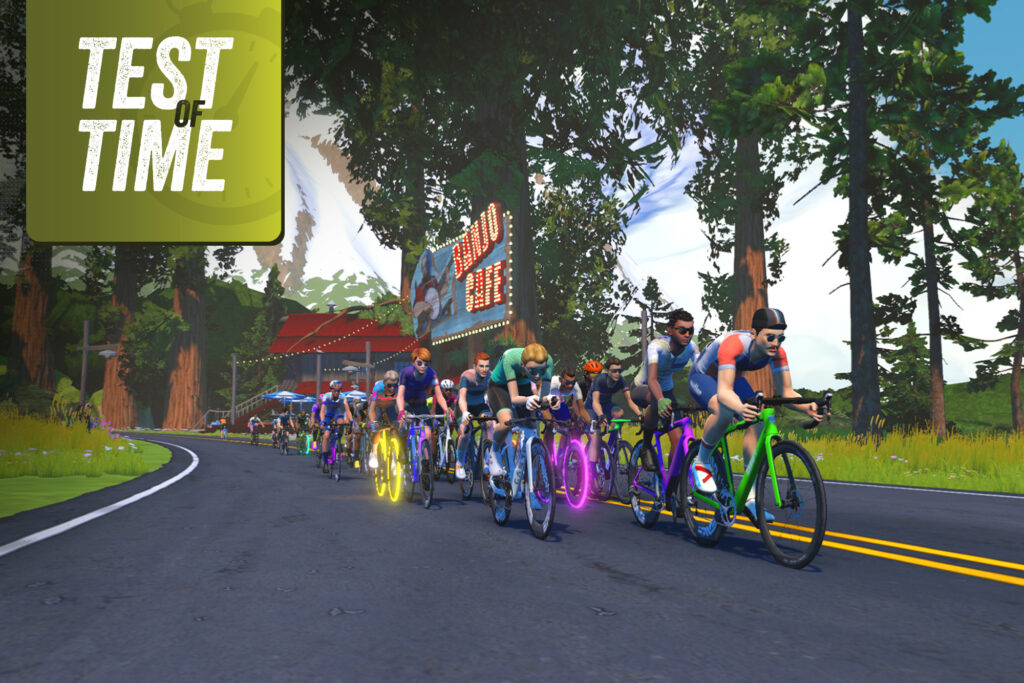

Reviews are great (especially road.cc ones), but things move fast in cycling, and you can only review a product based on the information and technology available at the time. Introducing Test of Time, a new format where members of the road.cc team will be revisiting things they reviewed years ago – or have continued to use for a lengthy period – to assess whether it’s stood the test of time.
We’re starting with Zwift, the indoor training platform that was a real breakthrough when it was first launched, but has faced increasing competition from rivals over the years. Is it still the top virtual training dog?
Zwift is the biggest multiplayer online training portal. It offers a big range of riding, training and racing options and continues to have a huge following. I’ve ridden halfway round the world on it in the past ten years and there have been lots of changes, but at its core the proposition remains the same: indoor riding is more fun if you’re doing it with other folks. Zwift does that really well.
Zwift has been around almost long enough for it to be a surly teenager, clumping around the house and not emptying its pockets when it puts its trousers in the wash. We first reported on the platform back in October 2014, and it’s fair to say it was a revelation back then.
> Your complete guide to indoor training
It’s hard looking back now to appreciate just how revolutionary it was. It’s interesting to read the comments from that launch article which are broadly positive and can see the potential in the platform, with a couple of “it’ll never catch on!” ones in there for good measure. Spoiler: it did catch on.
Giving up the ghosts

At the start, the Zwift online map was one loop, Jarvis Island, and you could ride round it either way, so there were effectively two routes. If you’re old enough to remember the origins then you’ll remember that much of the traffic was translucent blue ghost riders, who were there to give the appearance of the world being full and to give you someone to ride with/chase when there weren’t actual people to half-wheel.
It didn’t take long though: a year later Zwift was quietly turning off the ghosts because the organic growth of the platform meant that you were never alone any more. By the time I logged my own first ride, on 1 June 2015, not only was it well-populated by real people, but also the map had been expanded.
Watopia, the first Zwift world, launched in April 2015 and at first was a single 9.1km loop that’s still there as the Hilly Route. The progression from there has been huge. Now there are over 130km of roads in Watopia, including the Jarvis Island loop which was re-integrated a year or two back, and now it’s only one of 12 different worlds. It’s still the biggest, and some are tiny – Crit City has just 2km of roads – but there are loads of choices now, and we’ve moved away from the weird system where Zwift would decide what worlds you could ride on and would publish a calendar, meaning you had to hack a config file on your PC to go anywhere else.
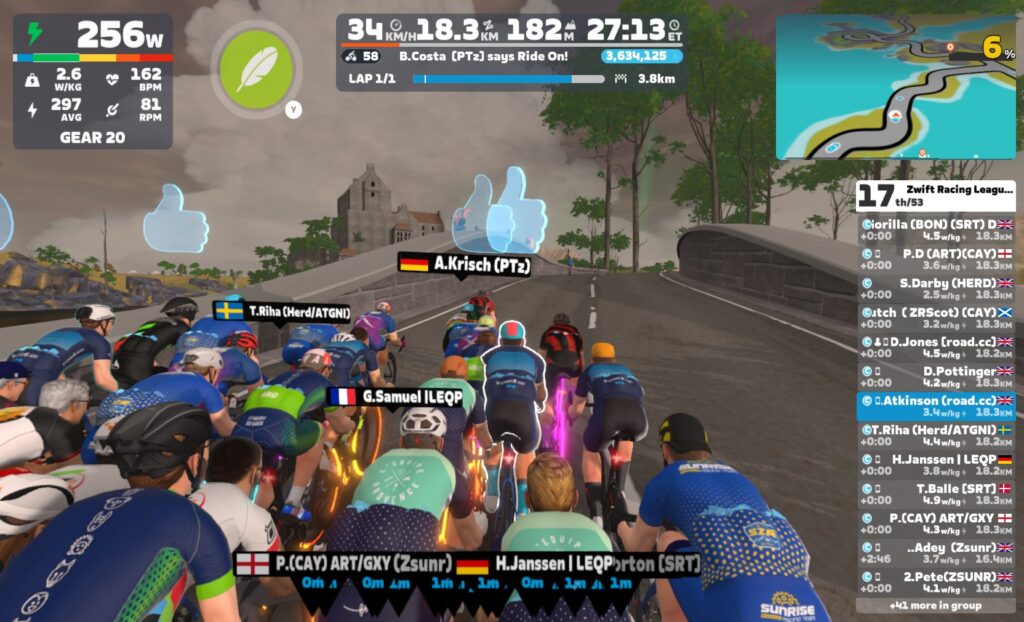
I think it’s fair to say that the engine of the game looks broadly similar to how it did when it launched – it’s recognisably the same product – but loads of things have changed in that time. You get more information on screen, and now you can customise it, and even turn it off if you just want to channel your inner Julian Alaphilippe and ride round without any data. There’s a companion app you can run on your smartphone too, which gives you easier access to game controls, messaging, events and more. The number of different bikes you can buy, and kits you can wear, has increased enormously. There are more ongoing challenges to keep you coming back, including things like the climb portals which move away from a realistic world render into something much more fanciful.
Development continues, with new features each season, and although there are always plenty of people moaning about stuff that never gets fixed, I think the reality is that the company does interact with the community it created, and does want to make the experience better.
For better or for worse?
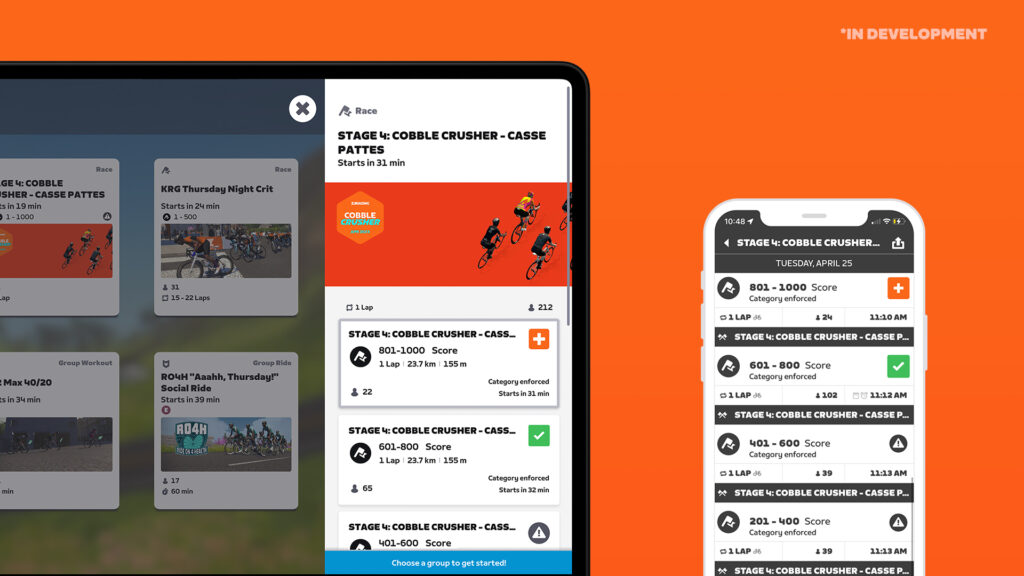
However, not all the changes that Zwift has made over the years are, in my opinion, improvements. Take the categorisation of racing: that’s one that I think has been – and continues to be – a bit of a mess.
Back in the day, you got your letter, and you raced in the races for your letter. You were categorised based solely on your W/kg at FTP, and if you were at the top of a category, it was pretty easy to sandbag in races by tailoring your effort to win, but also to stay below the numbers that would bump you up a level. Zwift tried to fix this with Racing Score, which is opaque and far less intuitive. The logic, I think, is mostly fine – you score and move up or down based on results, not just on what your W/kg numbers are – but it could have just been hidden behind the existing categories that are simple and clear. Even now, two years after it launched, both systems co-exist. It’s racing score for racing, and categories for other stuff, unless it’s a time trial, in which case that’s a race but it’s categories again. It’s more complicated than it needs to be.
Other racing changes have been much more successful. People were racing on Zwift basically from the get-go, even though there was no actual functionality for racing. If you wanted to race then you’d agree to meet at a point on a map with your buddies, and then… well, you’d race. Now there’s a whole ecosystem: lots of different races, organised both by Zwift and the community, across multiple genres, on all sorts of terrain, over any distance.
Chances are if you turn on the app and you want to race, you’ll be able to find something to suit. Even team time trials – which for a long time were grass-roots-run with some esoteric rules to get around the fact that the platform wasn’t set up for them – are now covered, with a fully automated conveyor-belt start system. There are dedicated maps for crit racing, huge global racing events, and even televised racing, with a studio setup, racers in a line, and a stripped-down UI.
From the virtual to the physical

At its outset, Zwift was just a world you could ride around, and the company’s own data suggests that a huge number of people still use it like that. But it didn’t take long for workouts to be added, and that functionality was launched when the game went from being a free beta to a paid platform in 2015. At first it was just a handful, and some of them – Jon’s Mix, for example, created by co-founder Jon Mayfield – are still available to ride. Nowadays 60% of Zwifters complete a workout at least monthly, and there’s a huge catalogue, to the point where it’s started to get a bit ungainly and is probably due a rationalisation. There are plenty of training plans and pathways through the workout library, but it’s currently not as intuitive as some other platforms.
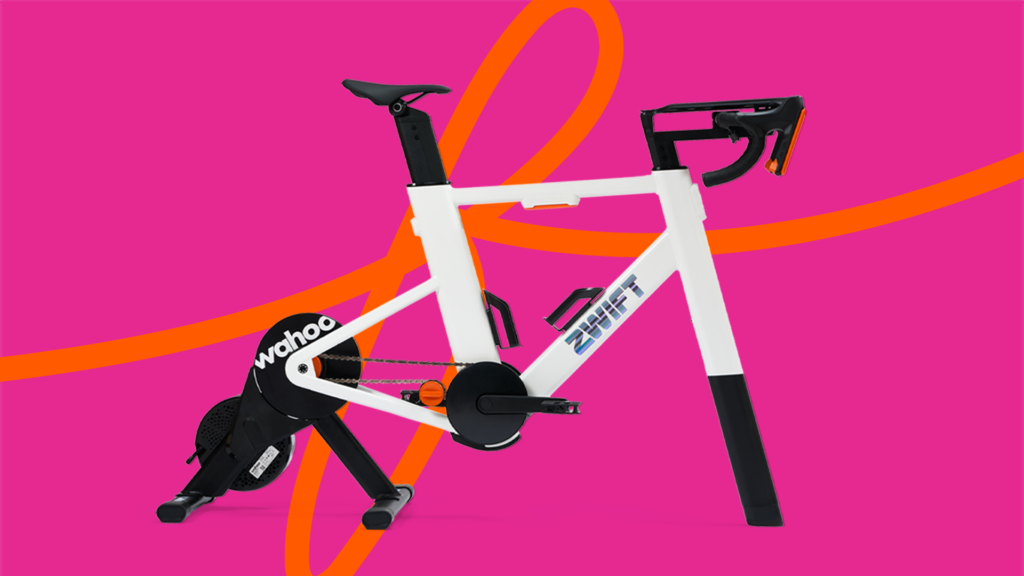
One of the biggest changes is on the hardware side. Back when Zwift launched, a direct drive smart trainer would set you back a grand, and there were only a handful to choose from. These days you can get a genuinely good smart trainer for less than a third of that, so the barrier to entry for full smart training has come right down.
As well as that, Zwift has been active in the hardware sphere in its own right, pushing hard for users to adopt the Zwift Cog and Click, which replaces physical gears with virtual ones. I’m a bit conflicted on this. On one hand, it makes compatibility issues a thing of the past and simplifies the onboarding process. It also allows for much cheaper dedicated setups like Zwift’s own Zwift Ride bike, and the new Jetblack Victory frame which save you from running your good bike into the ground over winter. On the other hand, the feel of virtual gears – at least on the less expensive trainers – is never as good. The shifting is proprietary to Zwift, too, which narrows your choices if you want to move away from the platform.
So… has Zwift stood the test of time?
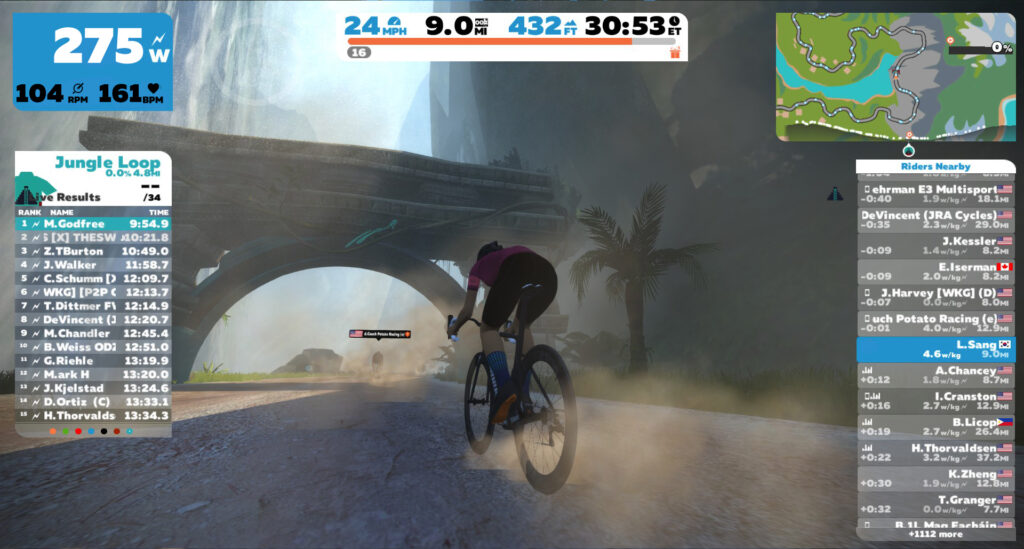
At £17.99 a month in the UK, Zwift represents a significant outlay, and the price has seen some fairly hefty increases in the last few years. If you’re committed to riding, training and racing indoors, though, I still think it’s a good investment; and at least Zwift is reasonable enough to accept that it’s a winter-only gig for many people, because you can start and stop your subscription as you want. You do get a discount for paying yearly, but it amounts to ten months at the monthly rate, which is realistically more time than most people are going to want to spend in the shed.
Of course, there are cheaper options: MyWhoosh, still burning through its UAE government money, is completely free, and because of that its user base is growing. Until recently Rouvy was an obvious competitor, but both now live under the same roof after Zwift bought it out – presumably joint subscriptions will be coming soon. TrainingPeaks Virtual, another very similar platform that launched as IndieVelo, costs a comparable amount to Zwift but comes as part of a fully-featured training environment that includes off-the-bike content too. More workout-based platforms like TrainerRoad and Wahoo aren’t as interactive, but are really good for structure.
So there are plenty of other options, and Zwift doesn’t have as much of the space to itself as it once did. But if you want to ride indoors, and you want a platform that makes that fun and accessible, Zwift is still a solid choice.
What else should we revisit for a super long-term test report? Chuck some suggestions at us for the next instalment of Test of Time in the comments















11 thoughts on “Over a decade since it revolutionised indoor training, has Zwift stood the test of time?”
I’ve had Zwift for over 7 and a half years and think it’s brilliant.
It makes turbo riding enjoyable. There are lots of races and events to enter, or lots of different paced group rides to join if you don’t fancy riding alone. I really like the idea of riding alongside people from all corners of the world.
Zwift keeps adding more routes and events, so there is always something new to try and you have the long term goal of progressing up the levels (I just reached level 98 this week!).
On average I ride on Zwift once a week over the summer and 2 – 3 times a week over the winter.
Zwift and my Wahoo turbo are probably the best cycling investments I have made after my bikes.
@Mr Blackbird Its amazing for keeping fit in the cold, dark months in the UK. I stopped using it when the price went up simply because it didn’t offer me good value for money any more. I have probably ridden indoors on the trainer about 4-5 times since march this year because the weather has been so bloody consistently good for cycling. I have a training peaks subscription that does more stuff for me and includes a “zwift like” platform so thats replaced it.
I quite enjoyed the Zwift races but perhaps not enough to pay for another cycling related subscription.
I would have been more interested in keeping it if there was a better pricing structure to reflect my desire to have it available over the summer but not paying full price.
Last time I was on there, during the Tour, it was still doing this, has it changed since then? Watopia plus two guest worlds. Admittedly one can ride where one chooses for workouts, but otherwise, as far as I know, the choice is still restricted. It’s one of the features (no I don’t want a choice between boring Richmond and boring Yorkshire), along with the XP point restrictions (if I’m paying the same as everyone else, I want to be allowed to ride the Alpe d’Huez like everyone else) that stops me having a permanent Zwift account rather than only subscribing during periods of illness and/or bad weather. It’s a shame because I feel it’s undoubtedly the best platform for leisure riders (serious racers probably prefer TrainerRoad or similar) who actually want something interesting to look at whilst training.
@Rendel Harris You can also use the companion app nowadays to add a route to a todo list and then it shows up on the main screen of zwift for you to select and ride.
I thought it was as you described with Wattopia plus two other worlds each day. But seeing thawed’ s comment, I will give that a try. Good tip!
TBH I ride on the Watopia Tempus Fugit route at least once per week, because being flat it is perfect for interval training, being easy to control your power output – I tend to use my own interval sessions rather than the ones on Zwift.
In the winter I usually ride a time trial each week, or if I want to render myself incapable of doing much for the rest of the day, a criterium! The only problem with the crits, is you can get a huge range of ability within your power category and if there is a small field you can get dropped. The long Sunday morning rides are a good way of building up base fitness.
I used Zwift until the price went up a few years ago and switched to MyWhoosh. There are 3 in my houshold that use the same turbo, if there was a family subscription I might consider it but paying for 3 separate accounts is out of the question when only one at a time is using it.
@ChasP The price increase wasn’t particularly egregious if you consider that they hadn’t raised it in a very long time but the lack of a family plan was certainly something they should have addressed.
Yes. Surprised they haven’t introduced some sort of family subscription rate.
They do have group rates… on the Rouvy side, but those pre-date the acquisition.
A simple keyword search would be a great improvement for the iPad/IOS version to help finding workouts.
Never tried Zwift even free trial.
Not sure I ever want to.
I’ve been on sufferfest, now disappointingly part of wahoo
My 5 minute power is so far ahead of my ftp.
I could really never move away