Ahooga may not be a familiar name even to keen e-bike watchers – in the UK at least. The Belgian brand specialises in folding bikes – electric and non-electric. The premium Ahooga E-Max Alfine model targets the train-transportable electric folder market and represents a distinctive but very effective take on the genre. Interestingly too, it’s a bike that has many original design elements aimed at improving practicality and performance in an area where it has often proven tricky for manufacturers to reconcile the conflicting needs of foldability, lightness and effective electric assistance.
What’s so interesting about the design? Typically folders with 20in wheels fold in the middle of the ‘mainframe’, but Ahooga has its own design – though it’s clear it has been broadly inspired by design elements of other class-leading designs, most notably Brompton.
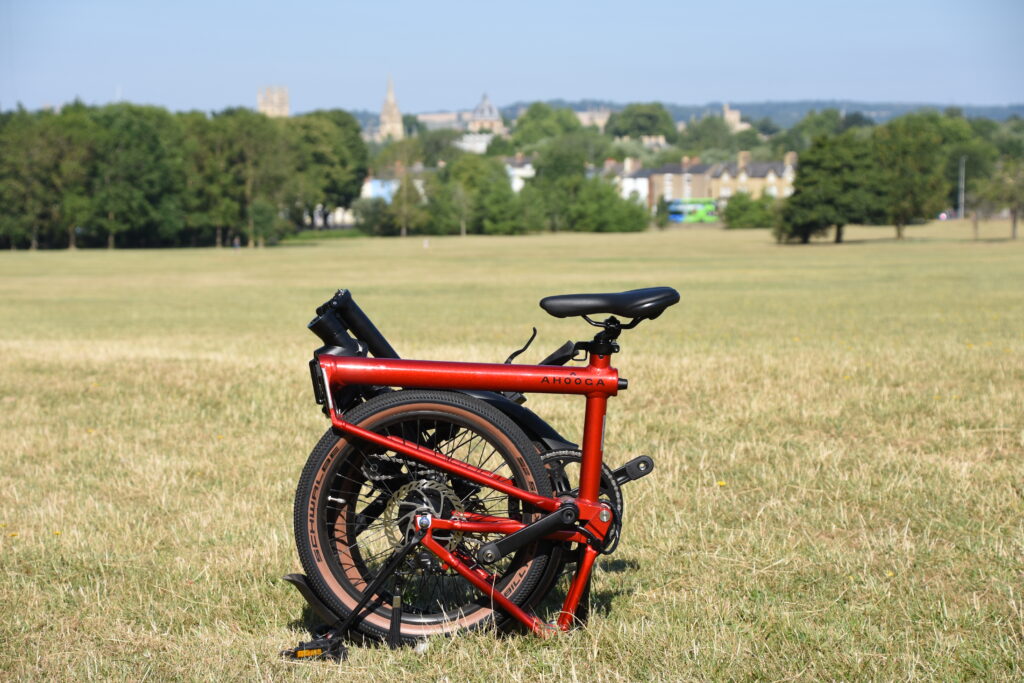
In a nod to the Brompton design, the Ahooga is a tri-fold (folding at the rear triangle and near the headset) which has the advantage of there not being a hinge in the middle of the mainframe, as is typically seen on fold-in-two designs.
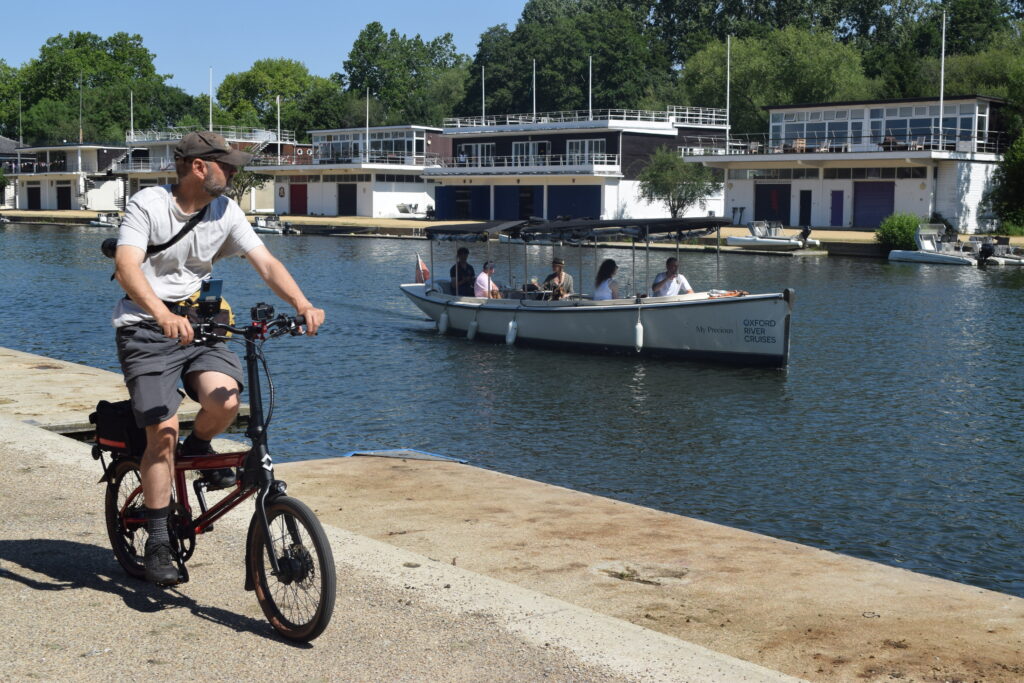
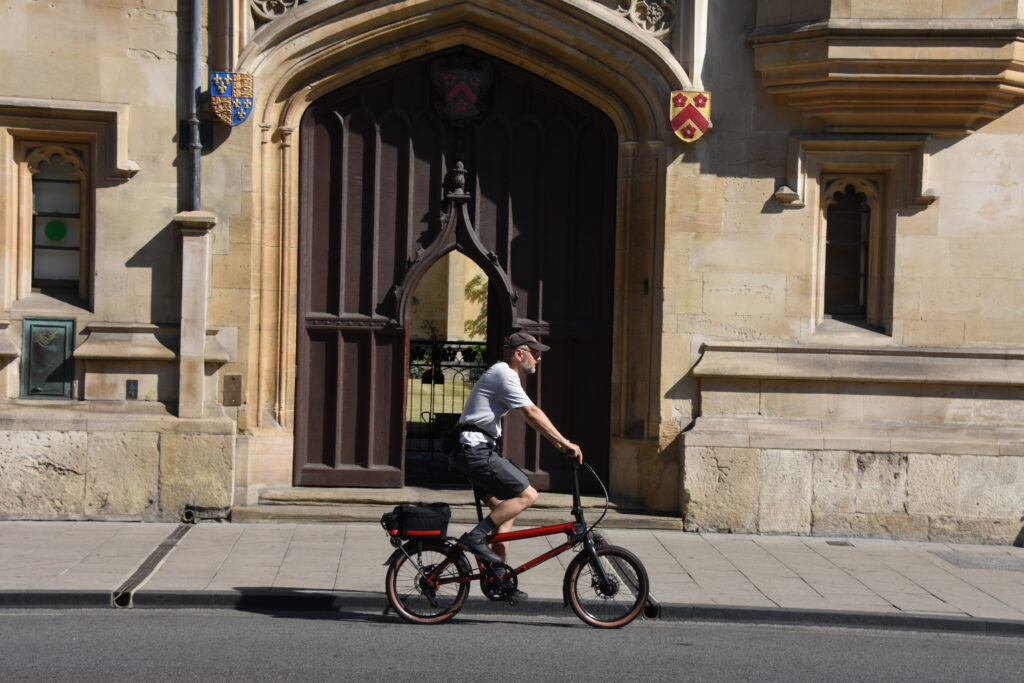
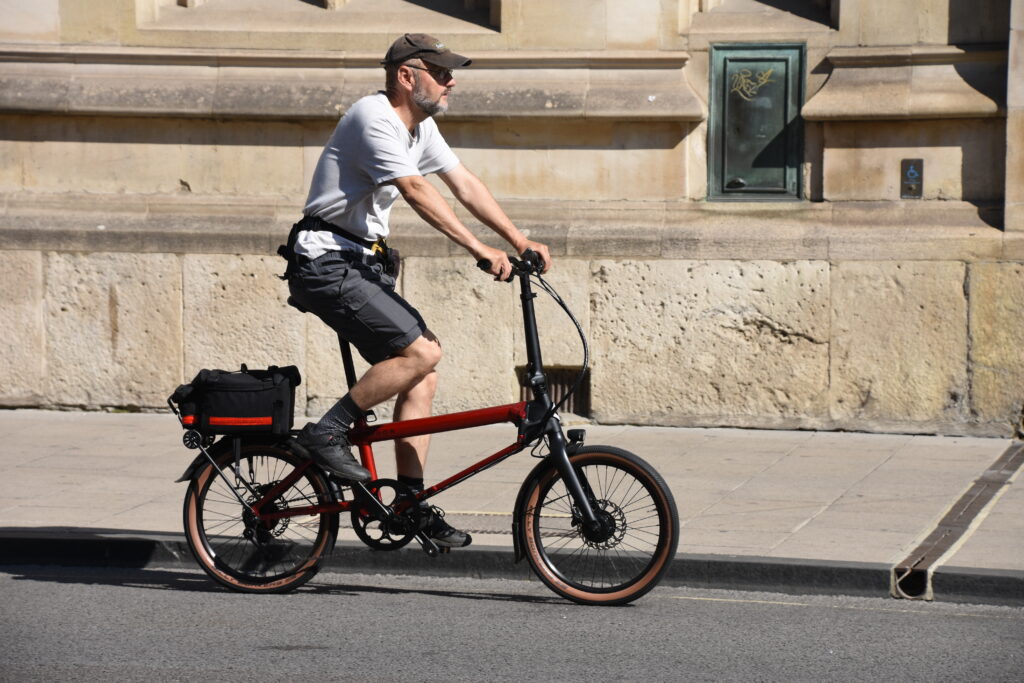
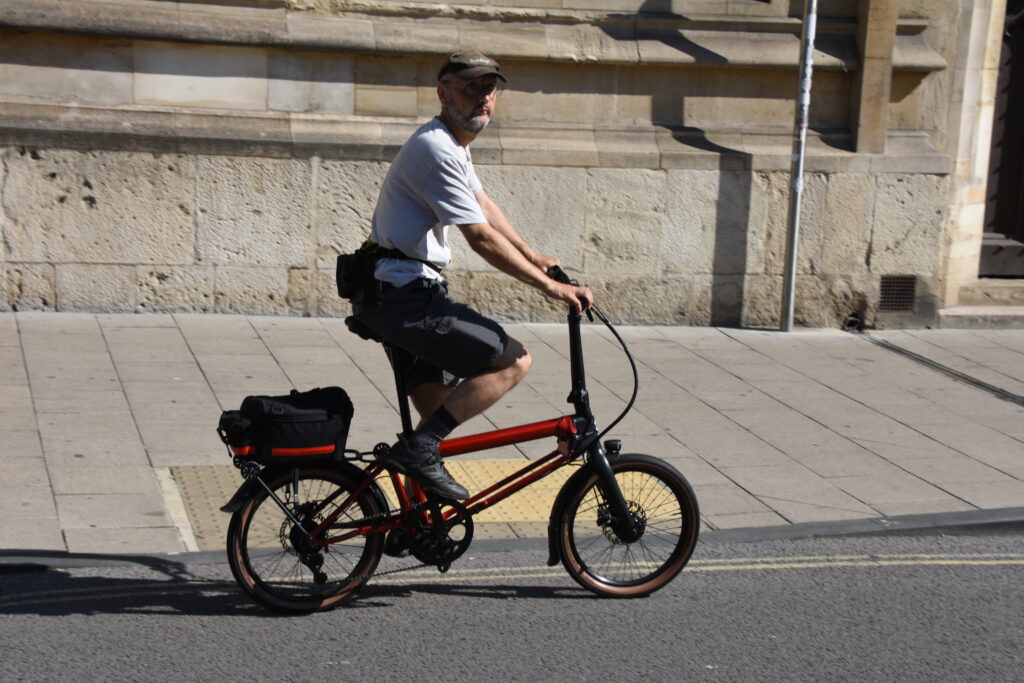
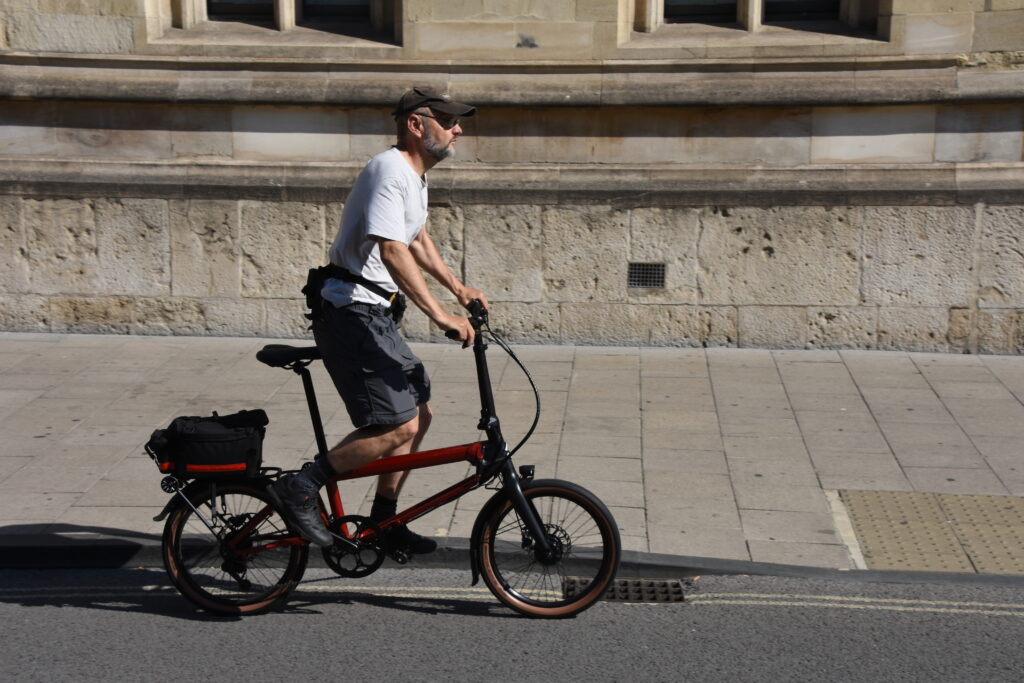
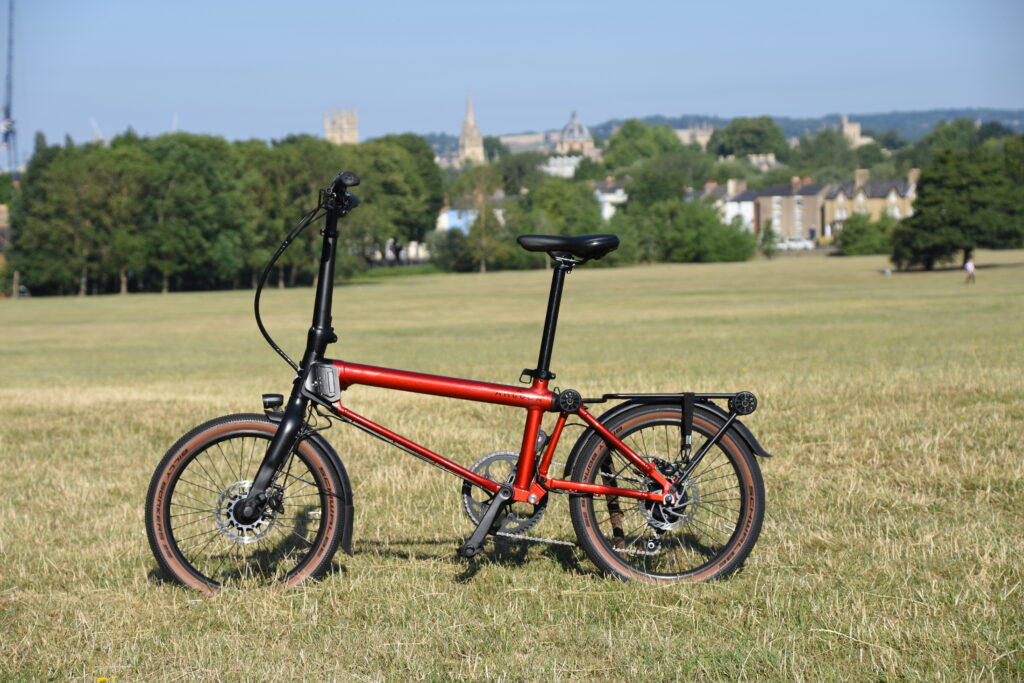
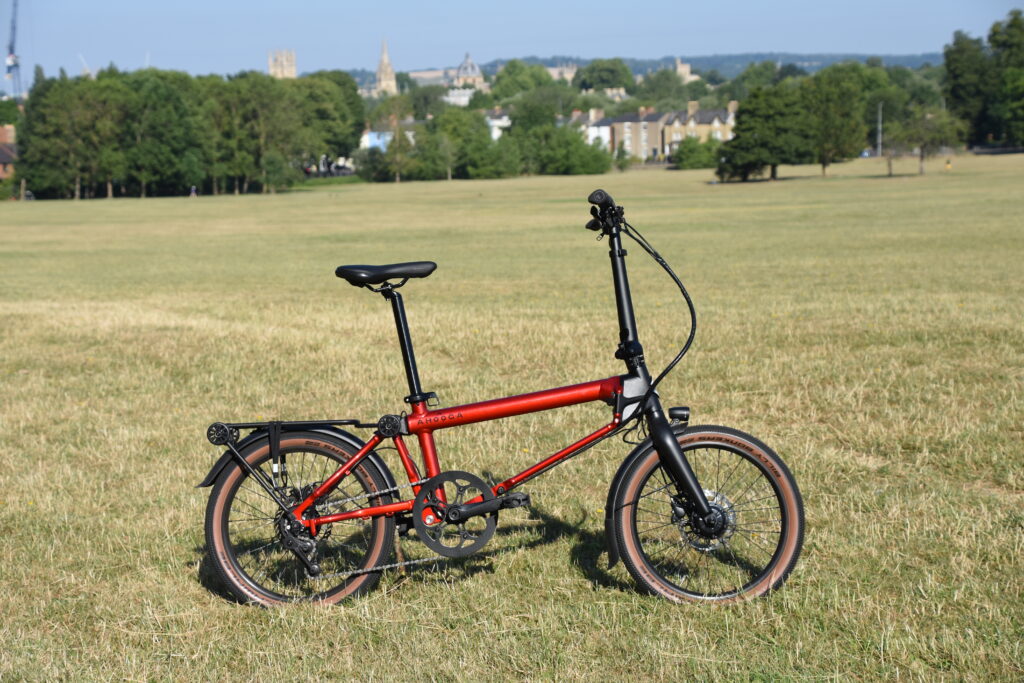
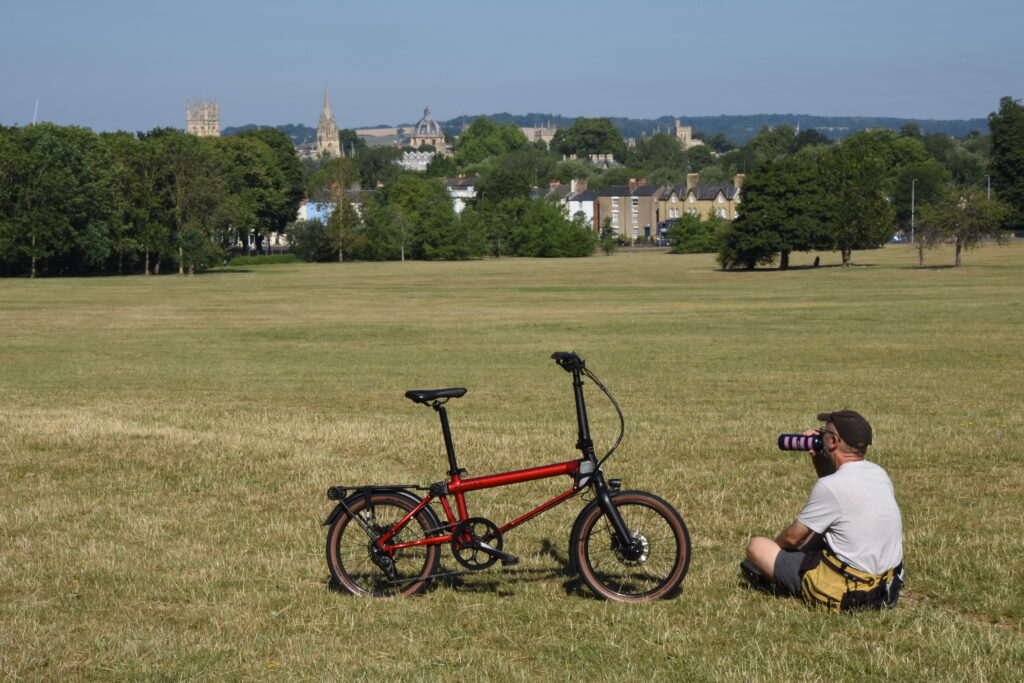
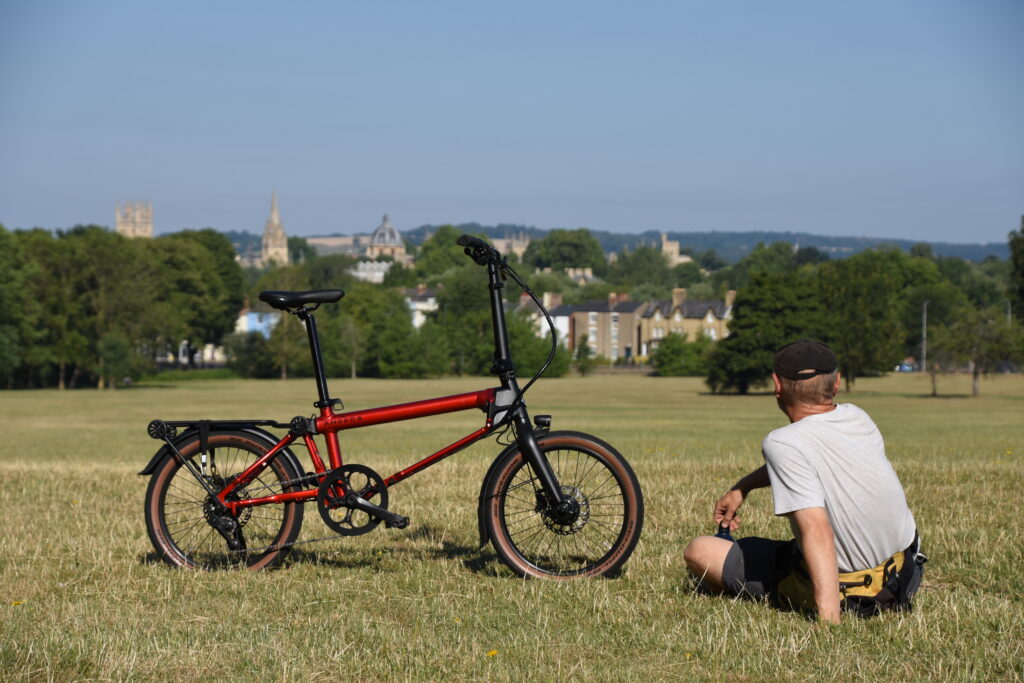
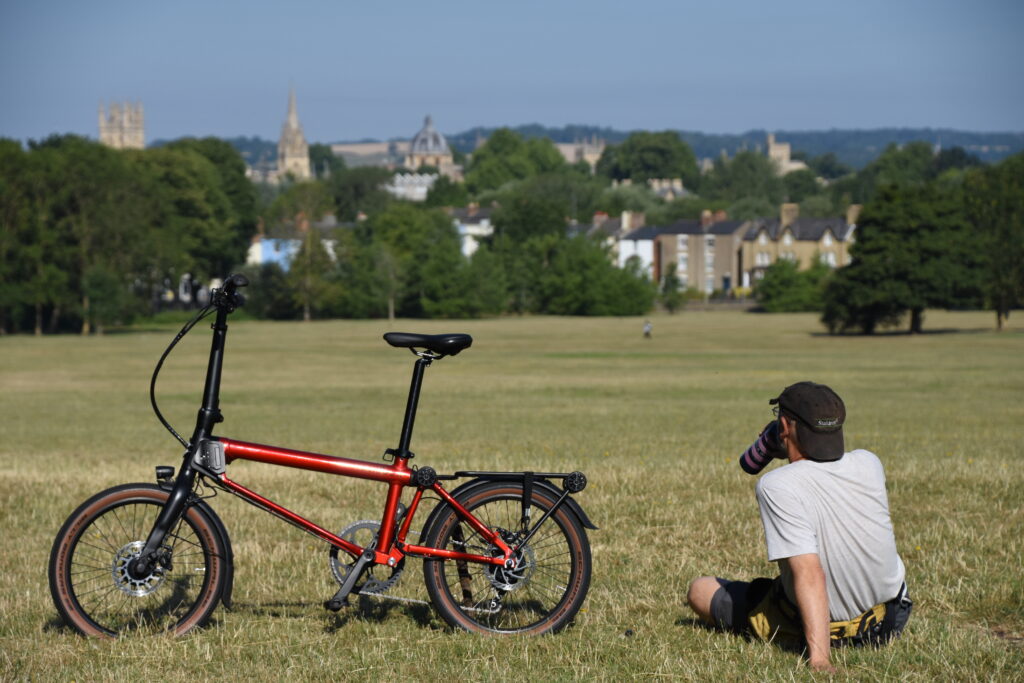
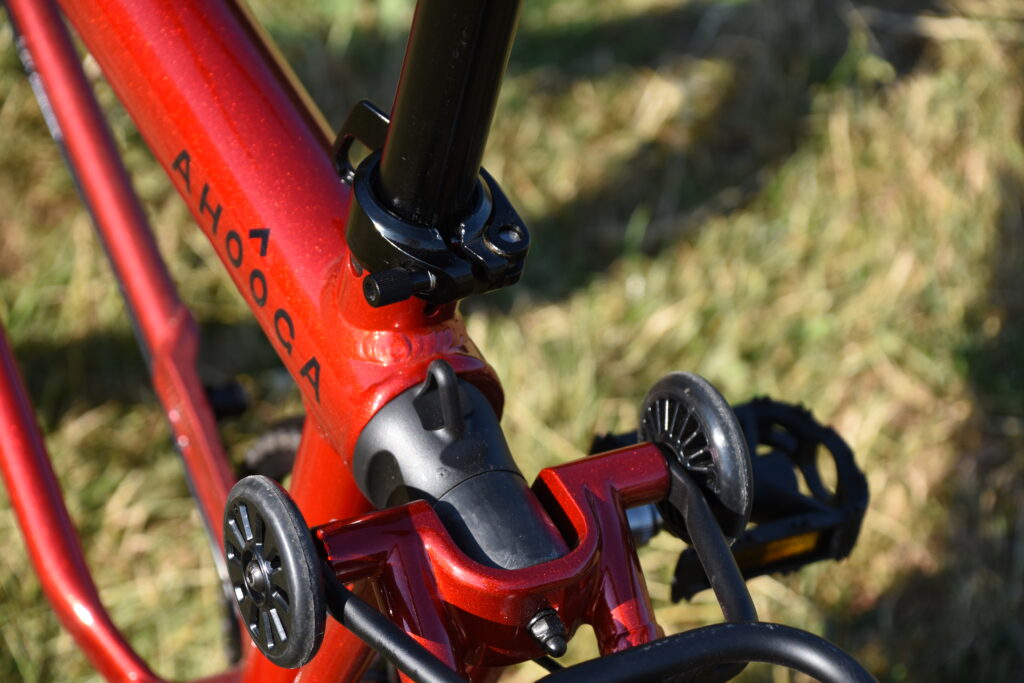
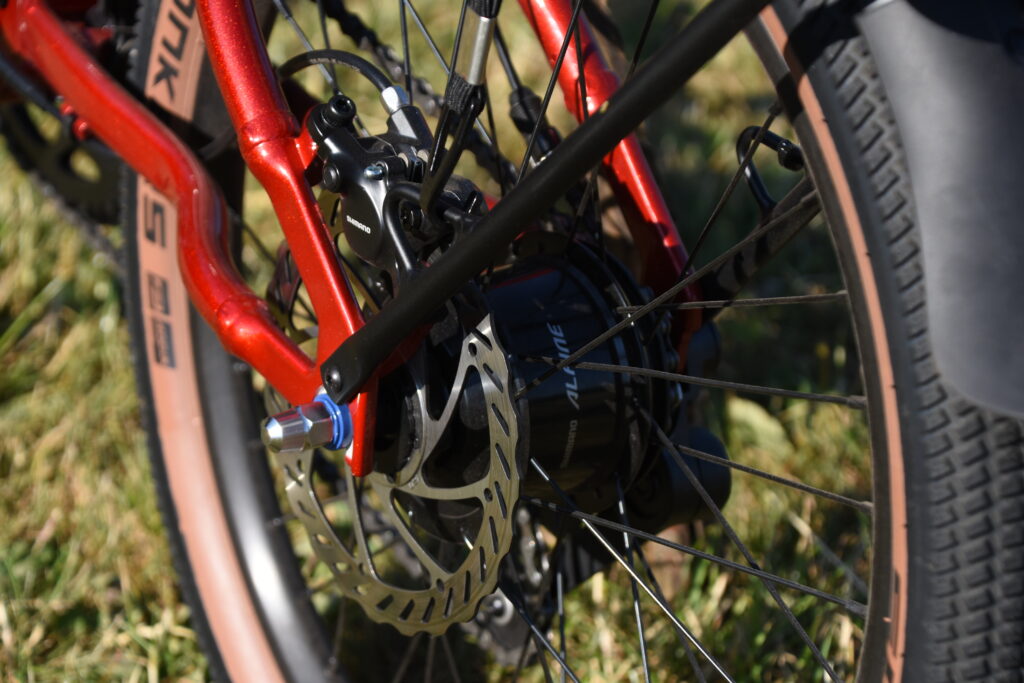
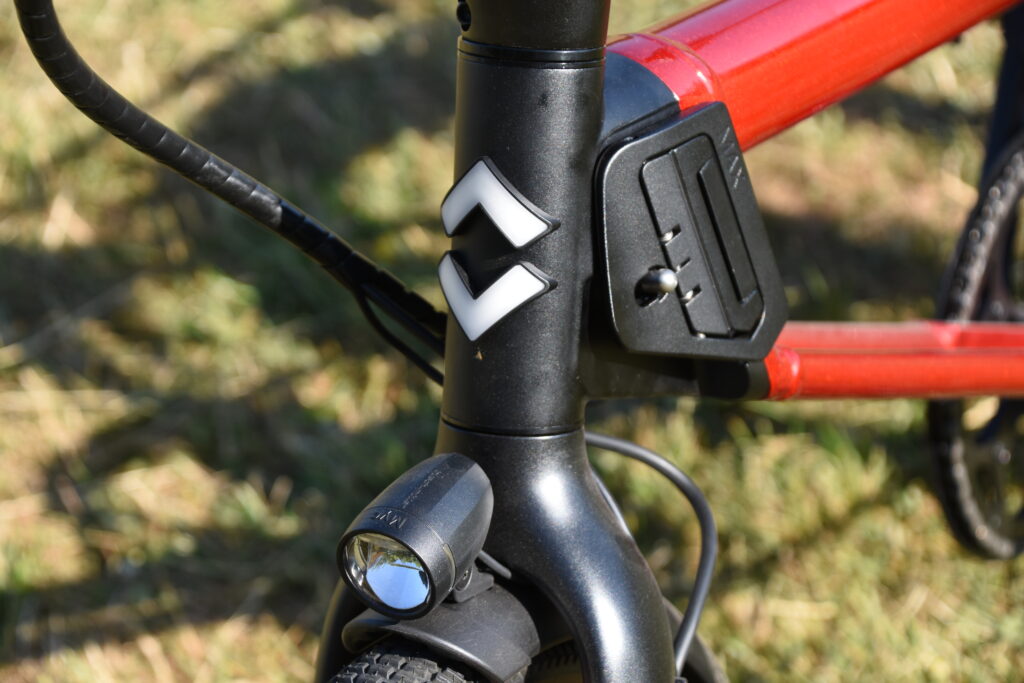
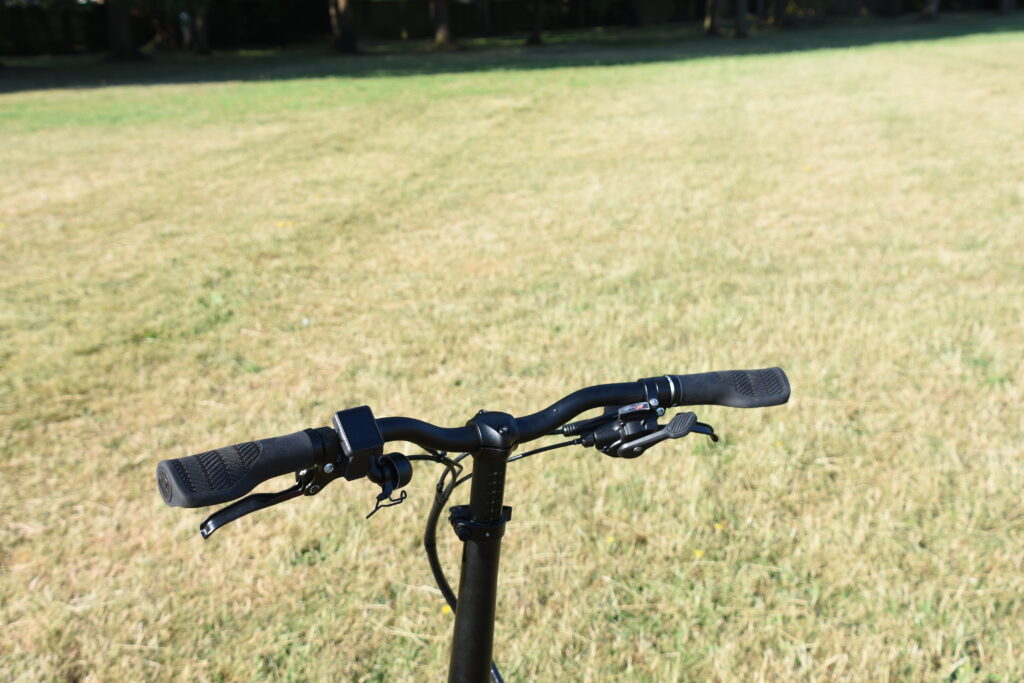
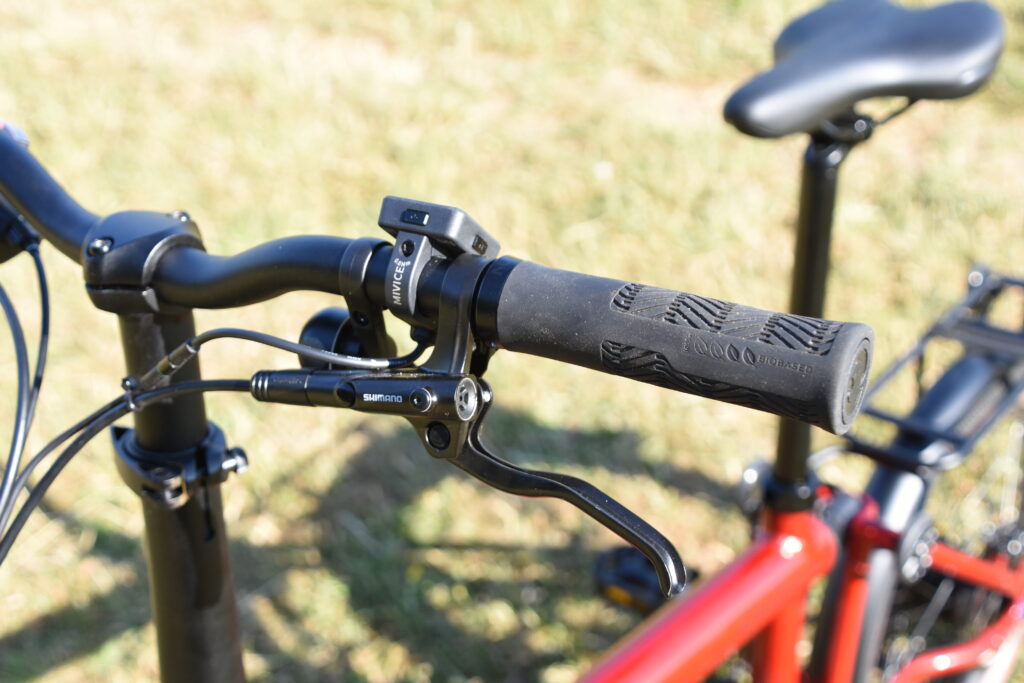
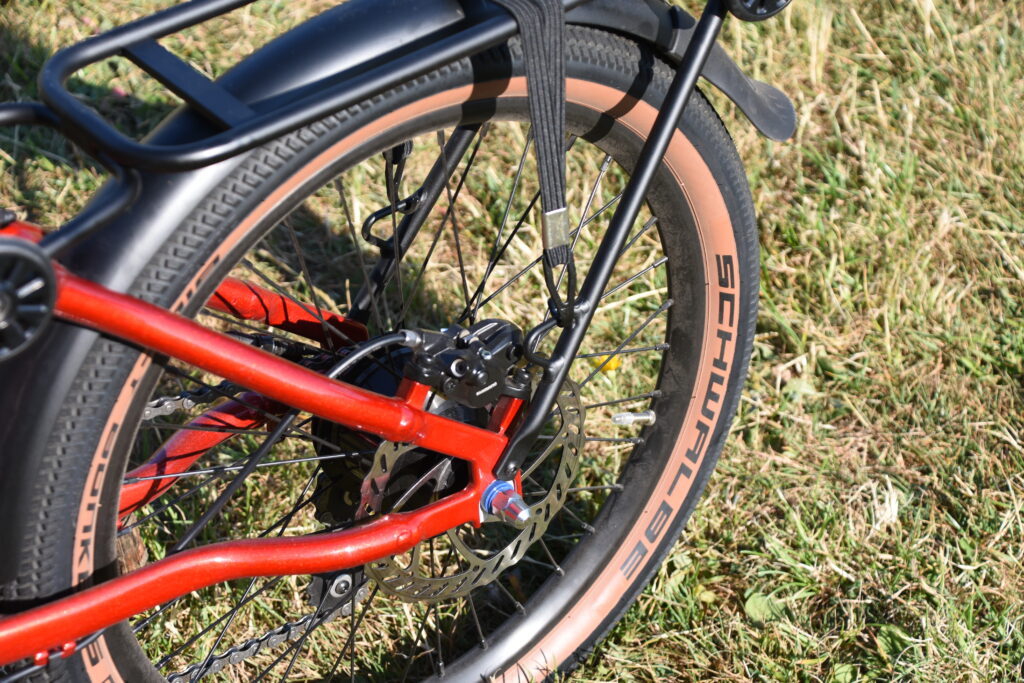
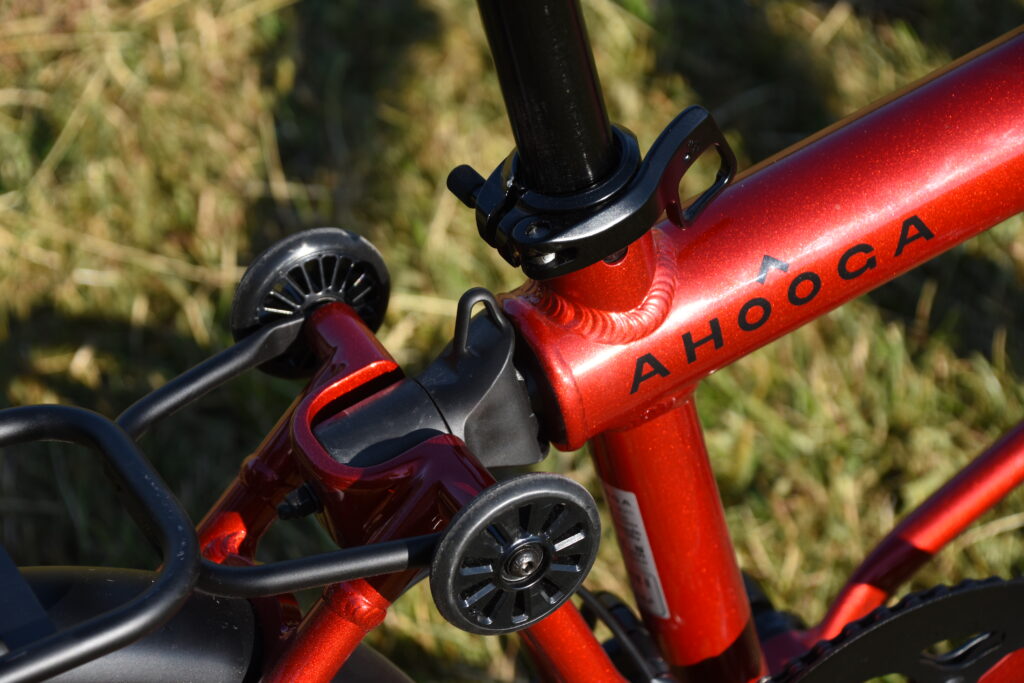
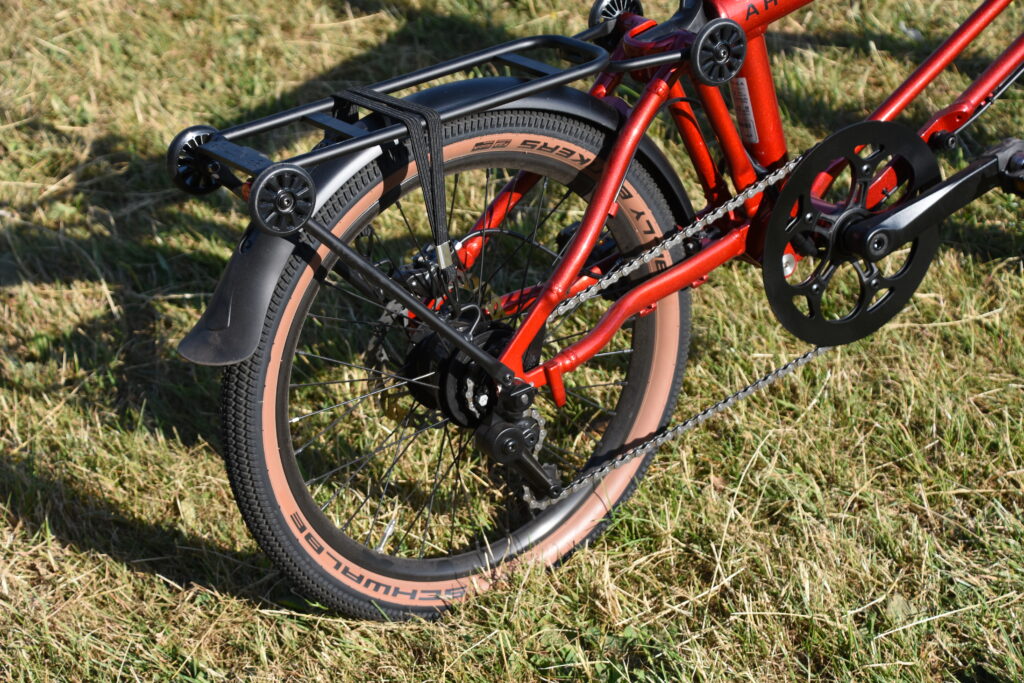
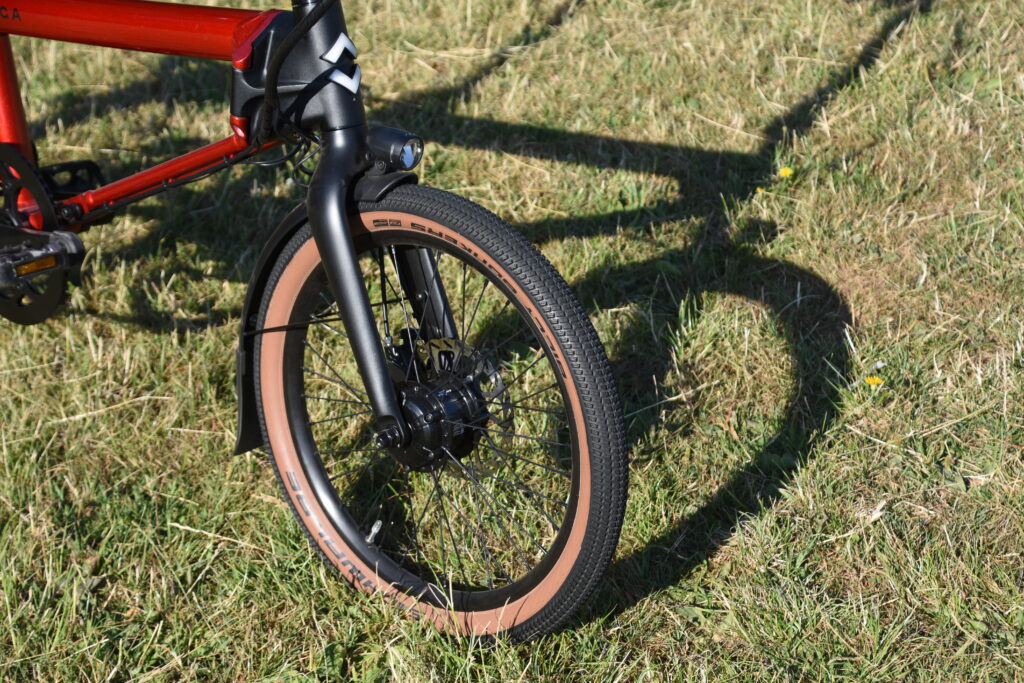
This means a frame that doesn’t have to be beefed up in the middle due to that area becoming a major stress point and this saves weight. This alternative is also said to improve rigidity and testing did indeed show this to be a very rigid bike – though tempered by comfort-inducing features such as an elastomer block and large volume 2in wide tyres.
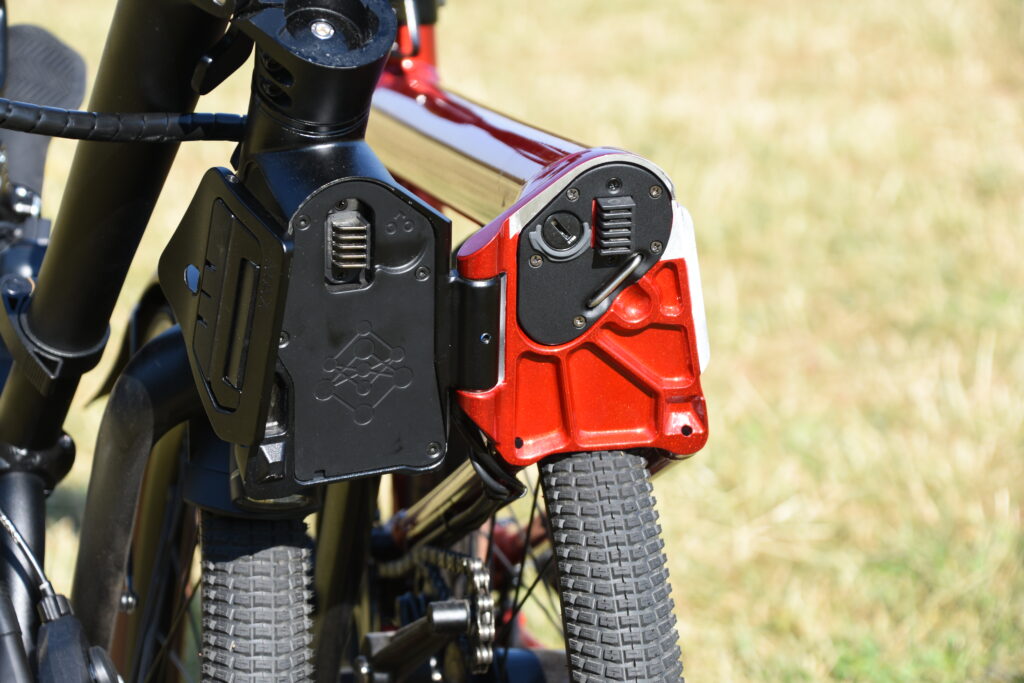
The frame itself is relatively conventional in that it is triangular. The large diameter top tube houses a relatively small capacity, removable 248Wh battery and there are two thin gauge downtubes between which the rear wheel swings when folded.
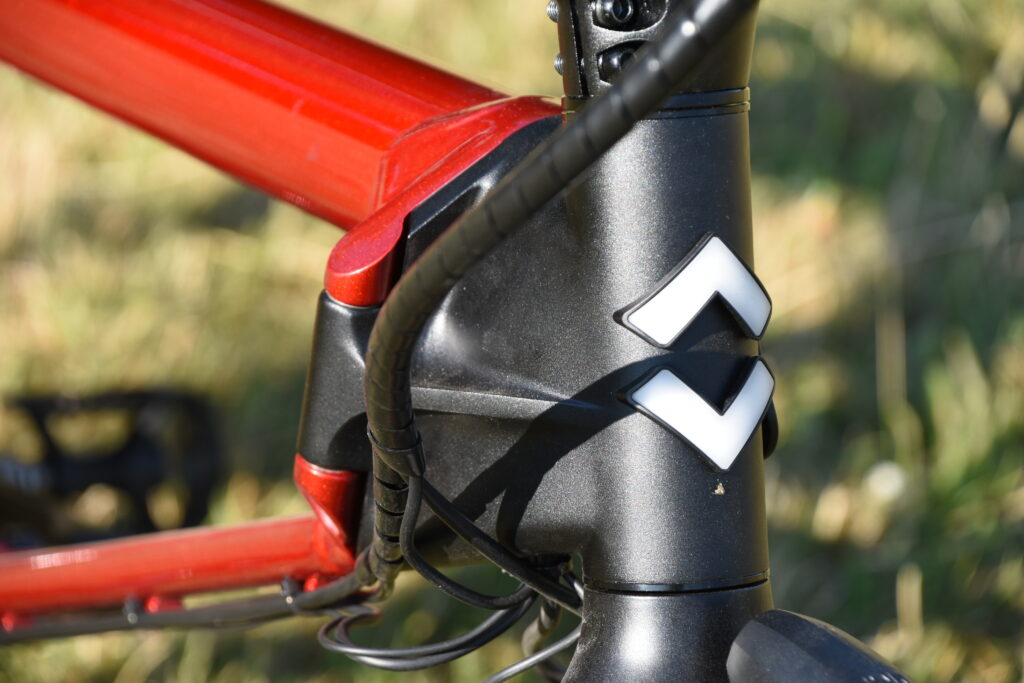
There isn’t actually that much in-frame cable routing, but the design does a very good job of making their presence low profile. Exposed cabling is generally good news for ease of maintenance too.
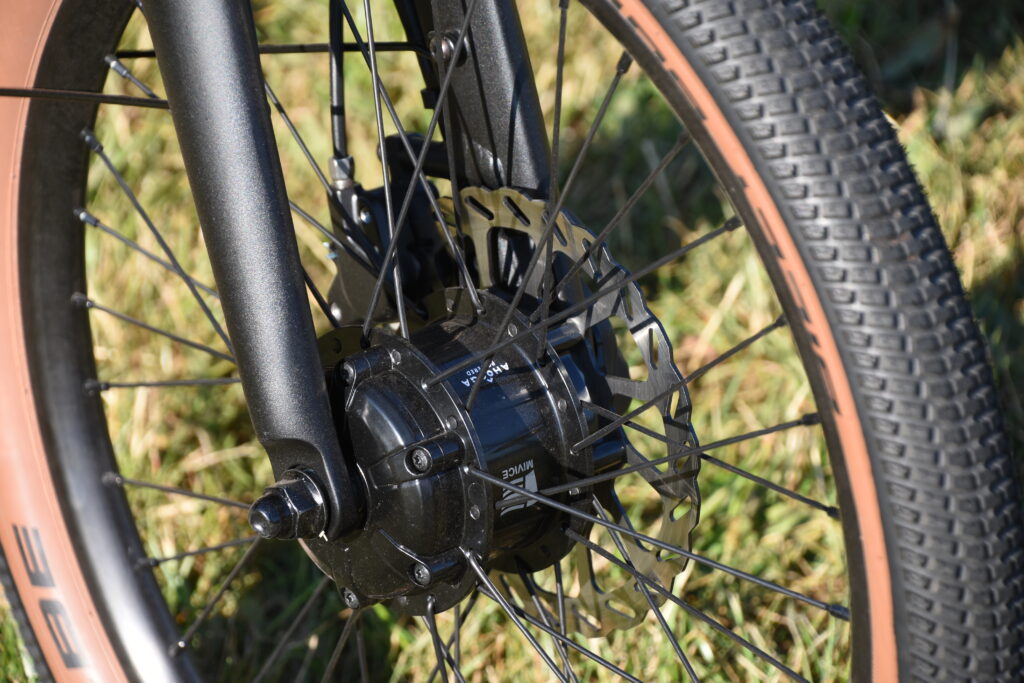
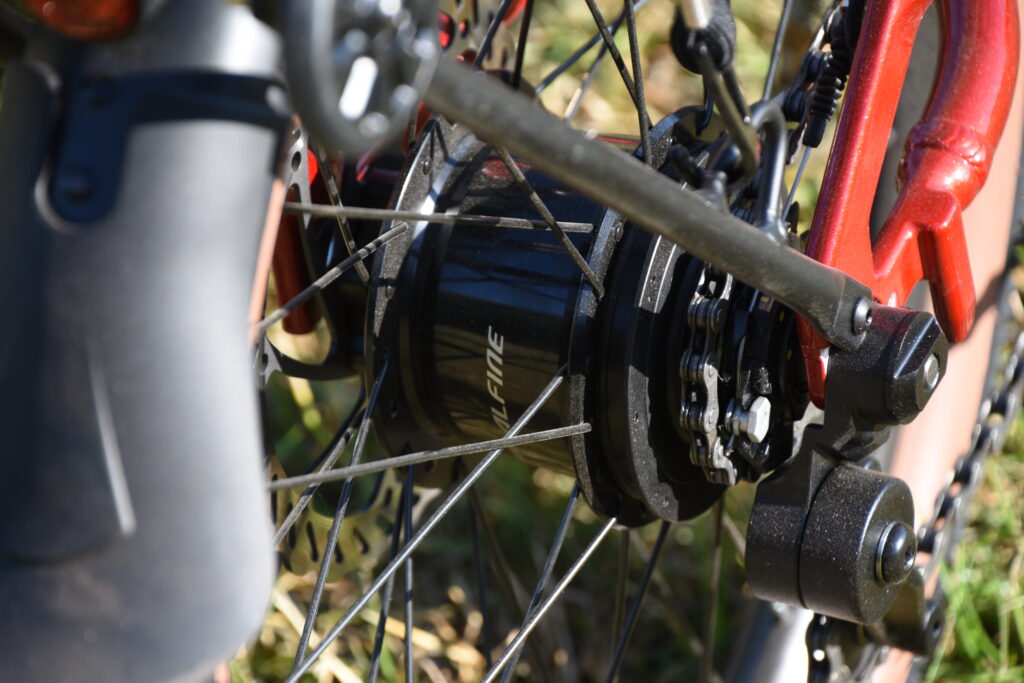
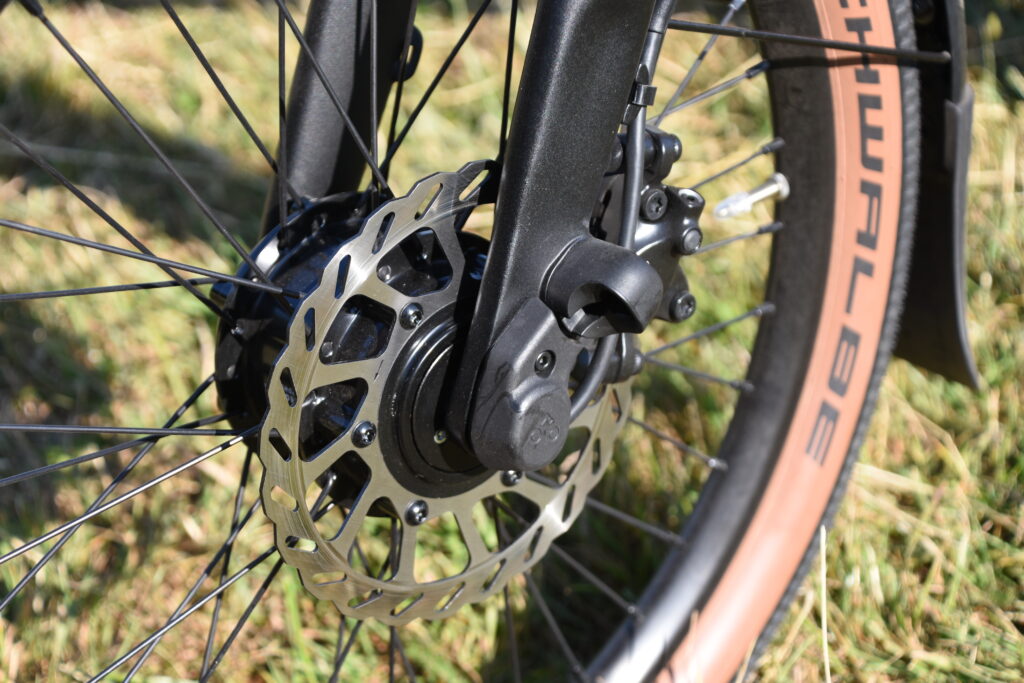
The other distinctively notable feature of the Ahooga is the front hub motor in a world that is dominated by rear hub motors and mid drives. Front hub motors tend to predominate in the cheap and cheerful retrofit kit area, but in choosing the Mivice M060 front hub system, this is anything but a cheap and cheerful approach.
Mivice first came to our attention on the highly successful Tenways CGO600 where we found the rear hub motor to be a standout performer for its lightness, efficiency and hill climbing ability. These qualities are ideal for folders where low weight and maximum power are both important. Mivice has since featured on many successful designs from other manufacturers.
Bike designers have however traditionally shied away from putting a hub motor in the front fork as the wheel can be prone to losing traction and it can also affect handling.
Ahooga seeks to get around the latter point by using a very light (1.5kg) motor which means handling is barely affected. The large volume tyres are pretty grippy and help stop wheelspin, as does the combination of speed and torque sensing in the control software – but more on this in due course.
Suffice to say, I never found loss of front wheel traction to be an issue. The advantage of using a front wheel hub motor is that it frees up the rear wheel to use hub gears and in this case the E-Max Alfine boasts a Shimano 8-speed system.
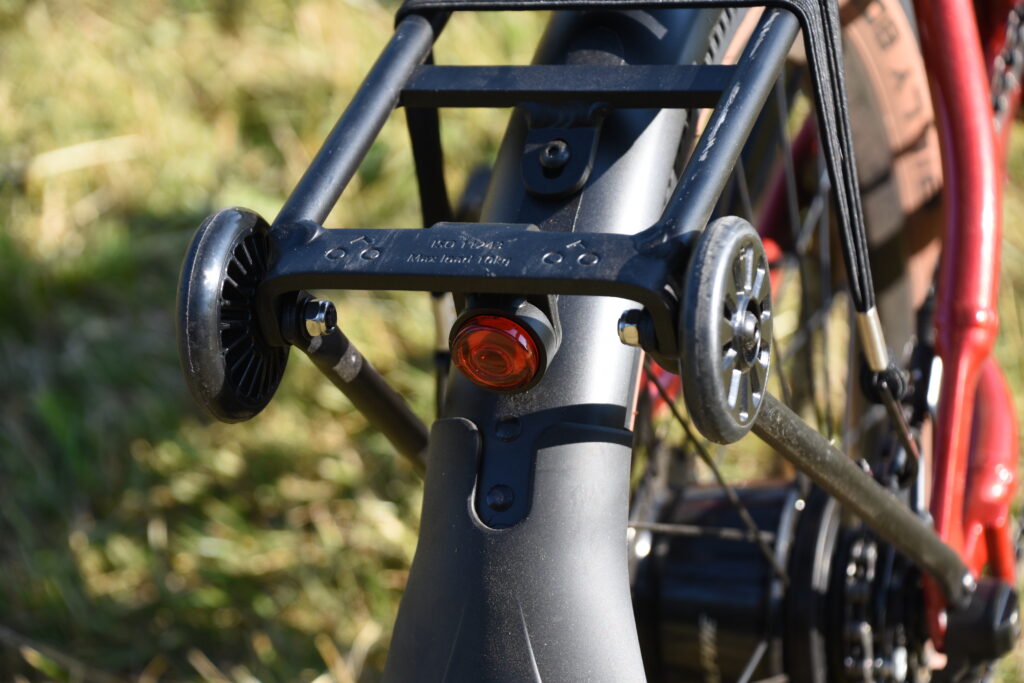
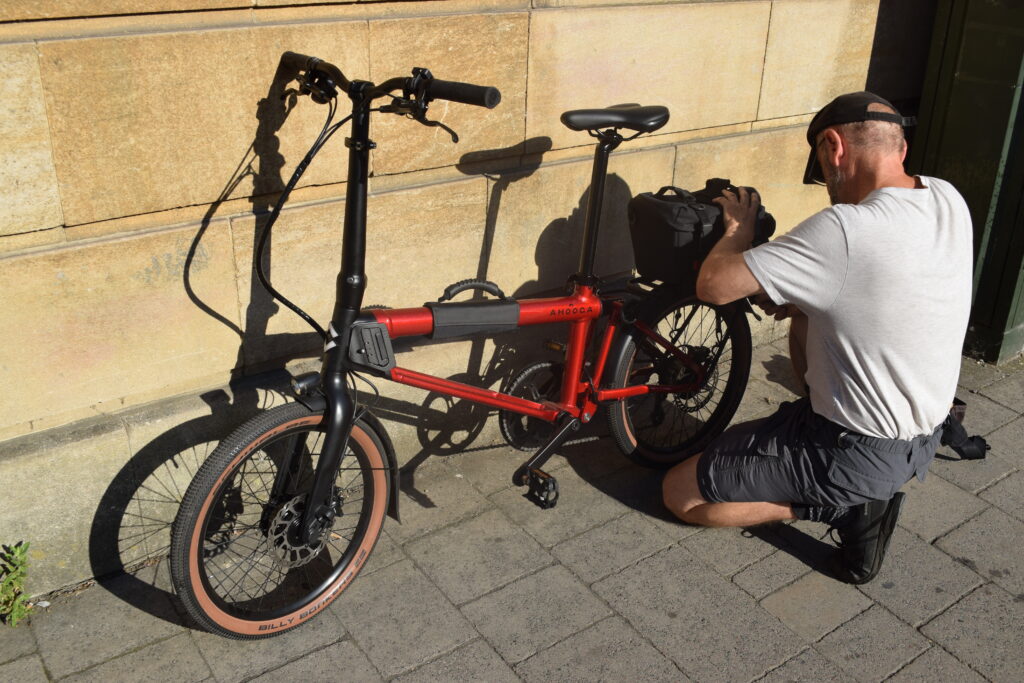
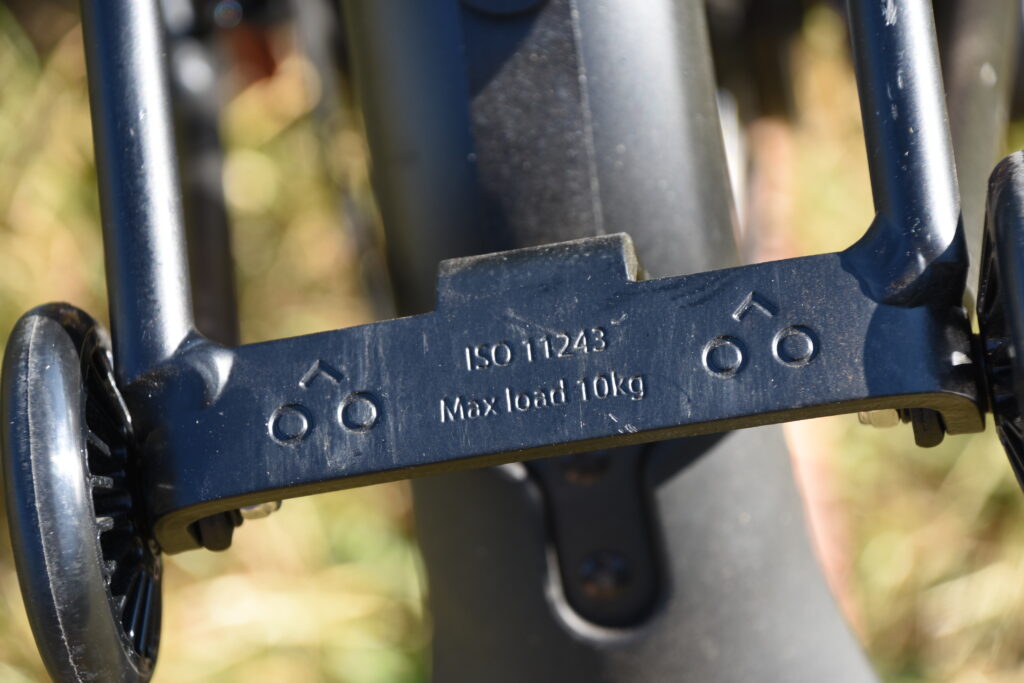
The rest of the spec list is good quality, but more conventional: Shimano MT200 hydraulic brakes, full length mudguards and hardwired lights (with an extra frame-integrated light at the front). The rear rack is optional and rated at a rather disappointing 10kg – though I would wager it would be capable of handling quite a bit more than that.
The fold
I’m starting with the fold as it’s so obviously the element where many e-folders are most compromised. Ahooga has not fallen into the trap of simply copying other designs and has instead come up with a compact and secure fold of its own that puts the bike firmly in the practical train commuter market.
The tri-fold approach should allow for a smaller folded package and the E-Max delivers with dimensions of 72 x 73 x 37cm (tester’s measurements). That’s very much in same impressive ballpark as the legendarily compact Brompton fold that is now used on the 20in-wheeled Electric G-line (75cm x 69cm x 46cm – again tester’s measurements).
As hinted at already, the fold itself, although unique to Ahooga, feels somewhat Bromptonesque. The rear triangle is unlocked by twisting a large plastic cylinder, then the rear wheel and triangle swing under the middle of the bike. Ahooga’s own offset hinge assembly means the front wheel, headset and bars swing to the driveside of the bike and the end of the front wheel axle slots over a very sturdy alloy tab welded to the rear frame. Finally, the seatpost slots down to lock everything in position and the bars fold down to the side of the folded package.
It’s not quite as quick and intuitive as the Brompton fold, and the front hinge in particular needs you to get plenty of fingers in there to lever it open, but a few practices means it’s no sweat to quickly fold the bike on a station platform and hop on a train with it.
The one proviso to that is that it weighed some 18.4kg on my scales. This is not superlight, but it’s certainly not heavy. Remove the battery and you have a 17.5kg folded package. The Brompton Electric G-line – this bike’s most obvious competitor – weighs 16.2kg with the battery removed. (It’s almost instantly removable but you do then have an extra piece of luggage weighing 3.4kg to carry).
In reality, I’d be happy train commuting with either, though I’m a fairly fit and reasonably strong 60-year-old. This kind of weight might be a bit of a challenge for some riders.
Having said that, most other 20in-wheeled machines are considerably heavier and often by several kilos.
Even if you opt for something like the much lighter ADO Air Carbon, you will get something with a larger and more cumbersome folded size and fewer gears (just one, in fact) into the bargain.
Whilst Estarli e-folders are in the same weight category as the E-Max, the fold is certainly not as small, secure and compact. In general though, to get much lighter (and smaller) than the E-Max Alfine, you are looking at 16in wheeled machines and all the riding compromises that brings.
As a regular train and folding bike user, to me it’s a huge plus that Ahooga has avoided the almost ubiquitous magnet system that many brands use to secure the fold. It has instead gone for something much more secure. The last thing you want is a folded bike springing apart on you as you board a busy train and there’s not much chance of that here.
Ahooga also sells a handy transport bag (£139.95) if you need to bag the bike to accord with the stricter rules that apply on some intercity trains. The bag packs up reasonably small and can be stuffed in a small backpack to carry with you on your travels.
Ahooga also makes the easily removable Carry Handle Max (£49.95) that velcros onto the frame and which I found useful for hoiking the bike onto luggage shelves on trains.
The large wheels on the rear of the frame can act like a trolley – just pop the handlebars up and use them as a handle to roll the bike along. This is very handy for train platforms and the like.
The ride
The E-Max Alfine is a one size frame, but it has adjustable handlebar height. Ahooga says it will suit riders from 4ft 9in to 6ft 9in. I’m an averageish 5ft 8in and the sizing was perfect for me, but I’d suggest riders at either end of this height scale grab a test ride to make sure they really can live with the space available from seat to bars.
Other than any height-dependent concerns you might have, it should be a very easy e-bike to get on with. It’s got a nice low step-over height and the ride is comfortable thanks to the large volume tyres and a degree of suspension in the rear elastomer block (though as someone who rides off-road a lot, I would like to see the option of a softer rear suspension block).
The motor system in particular is very impressive. Like its rear hub cousins, the Mivice front hub motor uses a torque sensing power delivery system that is one of the smoothest and most impressive out there. It feels like it’s responding to your pedal pressure and the power delivered is proportional to that pressure. This gives the sense you are responsible for activating as much or as little power as you want with your riding style and gear selection, rather than just turning the pedals so that the motor kicks in.
It’s interesting that Brompton has now abandoned front hub motors in favour of its new e-Motiq rear hub system. Having ridden the older Brompton system, I can certainly say the Mivice on the Ahooga is superior. It’s lighter and much smoother on the power delivery front – as I noted in my review of Brompton’s P Line, “For a premium priced e-bike it could be a little smoother with a bit more punch up really steep hills.”
In contrast, I thought the Ahooga was a great hill climber, especially given it is such a physically small and light motor. On my ultra steep hill climb test, it was more than competitive against all other models I’ve tried recently, with the exception of the new breed of super high torque mid-drives from the likes of Bosch which are really in a category of their own (and certainly don’t appear on lightweight electric folding bikes).
As already mentioned, a front hub design brings with it the possibility of wheelspin and losing traction. Whilst I did notice a tiny bit of very occasional slippage, we are talking fractions of a second here, and this only occurred in the higher power levels and on steeper slopes. On some of those occasions, I was actively trying to get it to wheelspin by upping the power level and pedal pressure when I wouldn’t be riding like that ordinarily.
I initially thought there was some kind of automatic traction control software in the electronics, as if there was any hint of wheelspin it almost immediately seemed to regain traction. However, it appears that its impressive performance is simply due to a combination of grippy tyres and the behaviour of the torque sensing software which backs off power delivery at any hint of front wheel spin.
Ahooga says there is also a speed sensor at play, but this is used to produce a smooth set off from a standstill and the torque sensor takes over when you are actually in motion. Whatever wizardry is actually taking place at a microelectronic level, it feels sophisticated and impressive.
It’s usually at this point in any review that I have a little moan that the gearing could have been lower and indeed the 32in bottom gear is not particularly low, but the peppy performance of the hub motor did make it feel a little lower than this. If you want lower gearing for more extreme use, it may well be possible to reduce the size of the chainwheel or increase the size of the rear sprocket, but you should check this with your dealer.
With such a small battery on the E-Max, range is never going to be huge, but it is probably fine for the kind of multi-modal commuting it’s intended for. On my very hilly test commuting run, I reckoned I would get around 20 miles from the 248Wh of capacity in warm but windy conditions.
Ahooga claims a maximum range of around 37 miles and this is feasible, but you would probably need to be a pretty light rider in very benign conditions and keeping to the lower couple of power levels most of the time.
The hub motor doesn’t have a huge amount of drag with the power switched off, so if you do run out of battery, riding a couple of miles shouldn’t be too much of an ordeal. Note Ahooga also offers a range extender battery of 150Wh for £379.95.
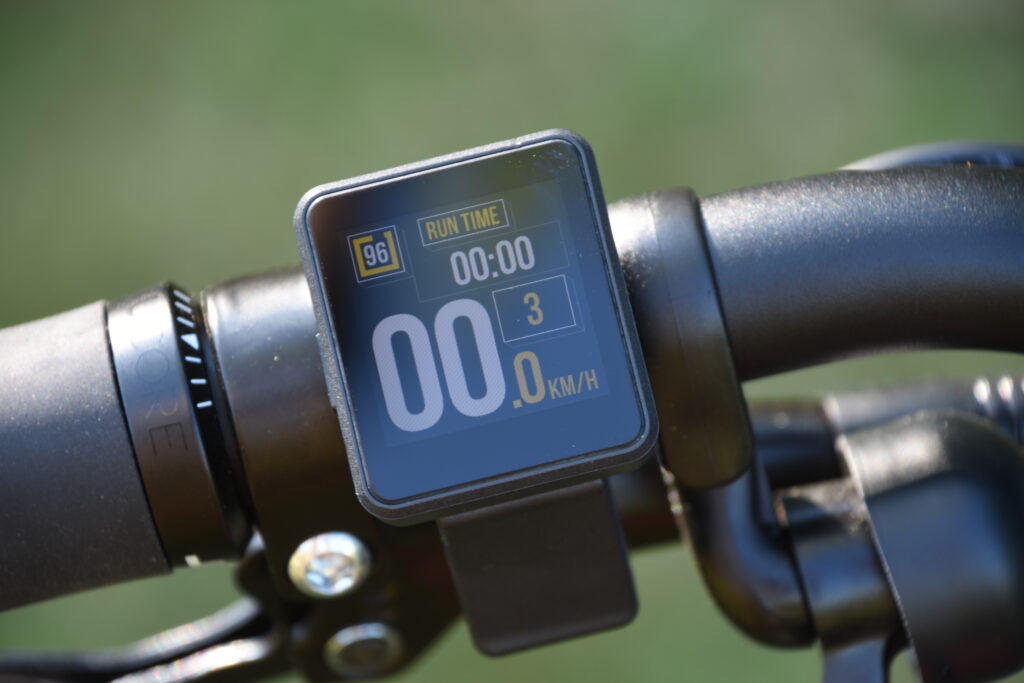
The only real quibbles I had were with the small display text, which made it hard to see the remaining battery charge percentage in particular, and the fact the weight limit for the rear rack was a lowly 10kg.
The combined display and push button unit itself was pretty easy to use to cycle through the five nicely graduated power levels. Another plus was that it was fairly easy to fit standard size panniers to the rear rack without any heel catch.
Gearing and braking worked reliably and smoothly, as you would expect, and I’d give a special mention to the hardwired lights. The front and rear ‘main’ lights are powerful with the front light illuminating even unlit paths well. The extra in-frame light is not just an eyecatching design feature, it provides a large and very noticeable area of bright white light at the front of the bike. Whilst not at all blinding, it will almost certainly make oncoming drivers doubly aware of your presence.
Whilst a kickstand is an optional extra, you may not need it if you have the rear rack because it’s easy enough to swing the rear end under the middle of the bike so it stands on it, a la Brompton. When using the rear rack for luggage however, the kickstand could definitely be useful.
Competition and value
At nearly £3,000 without any extras, the E-Max Alfine is certainly getting into premium priced e-bike territory. But for a unique design with premium components, I think it’s sound value.
Ahooga also makes the E-Max Derailleur model which simply swaps out the rear hub gears for a Microshift Acolyte 8-speed derailleur. This saves you £200 and (according to Ahooga) around 1kg in weight. Note the model tested here had the optional rear rack at an extra cost of £119.95.
Brompton’s Electric G-line is however the nearest competitor to the E-Max in terms of weight (16.2kg as a folded package without the easily removable battery which weighs 3.4kg) and price. It has a bigger battery but a rather limited gear range courtesy of four derailleur gears, which would suggest reduced hill climbing ability in comparison.
Prices start at £3,499 and if you want the version with the handlebar display, you can expect to pay an extra £200. There will be a full review of the Electric G-line shortly, so keep your eyes on the website for the lowdown.
If you want an e-folder that has more carrying capacity and motor power than either the Ahooga or the Electric G-line, then Bosch-powered Tern is undoubtedly the go-to brand. Note though that these bikes are significantly heavier than either and don’t fold as compactly or securely.
If a £3K e-folder is beyond your budget, you should certainly take a look at the 20in folders from the likes of Mirider, UTO and Estarli.
Mirider and Estarli use magnets to secure the fold and so can’t really compete with the effectiveness of the Ahooga’s (or Brompton’s) folding ability. We haven’t tested any of the latest UTO range, but some models also appear to use magnet fixings. For more detail on other folding options see our best e-folders selection from 2025.
The Ahooga E-Max range really does occupy a premium sweet spot unoccupied by any other e-folder that I’m aware of. At its heart is a very reasonably-sized and very secure folded package, combined with a light but effective motor system, comfortable and grippy large volume tyres and componentry you’d expect to find on pricier full-sized e-bikes.
I’d have liked to have seen a slightly larger capacity battery and a higher load rating on the rear rack, but for me neither of these cavils was a deal breaker. The Ahooga E-Max really does open up new riding possibilities in the way it combines portability with impressive riding ability.
Test Report
What does the manufacturer say about this product?:
The E-Max breaks free from the norm with its patented design: the double triangle offers superior agility and rivals any full-size bike. Big ride. Small fold.
Fully integrated invisible e-support
Rides like a full-size bike — thanks to its signature triangle frame
All the comfort and cargo versatility of a big bike, in a compact form
Tell us some more about the technical aspects of this product:
Alu 6061 Patented double triangle frame
Mivice M060 front hub motor, 250W / 36V – max torque 35 Nm, 5 assist levels
248Wh – Samsung cells, extendable to 428Wh
Mivice high-resolution color display display
Shimano Alfine 8 hub gear
Shimano Hydraulic MT200 disc brakes with 160mm rotors
Schwalbe Billy Bonkers tyres 20” x 2”
Test bike includes optional rear rack with 10kg load rating
Hardwired lights (two at the front – Busch & Müller Myc E 50 lux projector frame integrated Spanninga) and mudguards as standard (kickstand optional)
Any further comments on quality?:
Appears well made and durable
How does the price compare to that of similar products in the market, including ones recently tested?:
Similar to other premium electric folders
List the components used to build up the bike:
As above
Tell us what the bike is for and who it’s aimed at. What do the manufacturers say about it?:
A 20in wheeled folder with a quick fold aimed at city commuters and especially train commuters. If you opt for the range extender, it would make it suitable for longer day rides.
Where does this model sit in the range? Tell us briefly about the cheaper options and the more expensive options:
Top of the range
Tell us about the build quality and finish of the frame and fork:
Looks attractive, strong and durable
Tell us about the materials used in the frame and fork:
Alu 6061 alloy frame and fork
Tell us about the geometry of the frame and fork:
The patented double triangle frame is unusual for a folding bike and gives stable geometry with quite an upright riding position.
How was the bike in terms of height and reach? How did it compare to other bikes of the same stated size?:
The one size frame was a good fit for me at 5ftin 8in. The handlebar height is adjustable.
Was the bike comfortable to ride? Tell us how you felt about the ride quality:
Comfortable yet fast, as the frame feels very strong and stiff. You notice the lack of frame give on very bumpy off-road paths, though that is not the bike’s natural territory.
Did the bike feel stiff in the right places? Did any part of the bike feel too stiff or too flexible?:
Given that it is a folding bike, the outstanding stiffness is important, though the large volume tyres and elastomer block where the rear triangle and mainframe meet give some suspension effect.
Was there any toe overlap with the front wheel? If so, was it a problem?:
No
How would you describe the steering? Was it lively, neutral or unresponsive?:
For a 20in wheeled bike, pretty neutral
Tell us some more about the ride experience. How did the bike feel overall? Did it do particular things well or badly?:
A good compromise of stability and manoeuvrability.
Which components had the most effect (good or bad) on the bike’s performance? Would you recommend any changes?:
Overall excellent and responsive electric assist drive system and fast running but grippy tyres combine to give a fun and lively ride
What kind of motor is it? :
Mivice M060 front hub motor
What are the stated motor system specs? (Torque/power/maximum assistance speed):
250W / 36V – max torque 35 Nm, 5 assist levels
Tell us some more about the motor. How did it feel overall? Did it do particular things well or badly?:
Lively and responsive thanks to on board speed and torque sensors. Occasional wheelspin at the front (drive) wheel, though this was never really an issue.
How did the motor perform at low speed? (e.g. on steeper climbs or setting off with heavy loads):
Very well
How did the motor perform at higher speed? Was it noisy? Did assistance cut out smoothly/abruptly at the 25km/h assistance limit?:
Very well – smooth cut out
What type of battery is it? Is the manufacturer named?:
248Wh – Samsung cells, extendable to 428Wh
Ahooga branded but manufacturer listed as Celexpert Energy Co Ltd (Taiwan based lithium battery specialist)
Where is the battery on the bike? Is it removable?:
In the mainframe. Yes it is removable
What are the stated battery specs? (Capacity/voltage):
36V, 6.8Ah, 248Wh
Tell us about charging the battery. What’s the charger like? How long does it take?:
2A charger should give a substantially full charge in less than three hours
Tell us about the assistance levels. How many are there? Are they all useful?:
Yes, nicely graduated
What do the manufacturers say about the range of the bike?:
Up to 30 miles
What was your experience of the operational range of the bike?:
20 miles on a hilly route. 30 miles is just about plausible for some riders, but a bit of a reach.
Any comments on drivetrain performance?:
Reliable
Any issues with drivetrain durability?:
No
Tell us some more about the drivetrain. Anything you particularly did or didn’t like? Any components which didn’t work well together?:
Predictable changes but would have preferred a gripshift changer for reliable shifting
Tell us some more about the wheels. Did they work well in the conditions you encountered?:
Fine for on road and light off road conditions
Tell us some more about the tyres. Did they work well in the conditions you encountered? Would you change the tyres? If so what for?:
Free rolling but good grip on and off road
Any comments on brake performance?:
Strong, reliable and progressive
Any issues with brake durability?:
No
Tell us some more about the brakes. Did they work well in the conditions you encountered? Would you change anything? If so, why?:
Strong, reliable and progressive
Any issues with controls durability?:
No
Tell us some more about the controls. Any particularly good or bad components? How would the controls work for larger or smaller riders?:
See above on gearshifter comment – otherwise all fine
Does the bike have a maximum luggage weight, or a maximum gross weight?:
10kg on optional rear rack
Did you enjoy using the product? Yes
Would you consider buying the product? Yes
Would you recommend the product to a friend? Yes
Use this box to explain your overall score
A clever and unique design that is one of the best 20in-wheeled folders out there
About the tester
Age: 59Height: 172cmWeight: 70kg
I usually ride: E-bikes of any descriptionMy best bike is: Riese & Muller Homage
I’ve been riding for: Over 20 yearsI ride: Most daysI would class myself as: Experienced
I regularly do the following types of riding: Commuting, Touring, Fitness riding