



If you want to cycle through the winter, whether you’re commuting or training in the evenings, a good front light is essential.
Front lights come in a vast range of prices and outputs, but you don’t need to spend a fortune as the lights in this roundup demonstrate. Most front lights these days use LEDs which take very little battery power so you can expect decent runtimes, and brightness levels that were unimaginable a couple of decades ago.
If you’re cycling in a built up urban area, you want a light to be seen by rather than one that can light up the road ahead. Many are designed for commuting with a lens and reflector intended to offer a good range of visibility. Been seen from the side as well as the front is an important consideration. If you’re venturing onto poorly lit streets and dark country lanes, then you need to think about a more powerful light to help illuminate the way.
Most of the lights below fall better into the first category of lights to be seen by. At the top of the price range you can start to get powerful lights that will be good for a bit of country lane night riding.
The 10 LED lights here are priced at under £50, and all of them having been tested by road.cc staff.
10 of the best front lights under £50
- Lezyne Zecto Drive 250 — £25.00
- Moon Meteor-X Auto Pro — £25.99
- Lezyne Strip Drive Front — £26.49
- Giant Recon HL 350 — £34.99
- Moon Meteor Vortex 1000 — £36.95
- Gemini Atlas 500 — £37.00
- Lezyne Classic Drive 500 — £38.24
- Exposure Trace DayBright — £40.50
- Knog Bilby Headlamp — £44.00
- Lezyne Classic Drive 700Xl — £45.00
Lezyne Zecto Drive 250 — £25.00
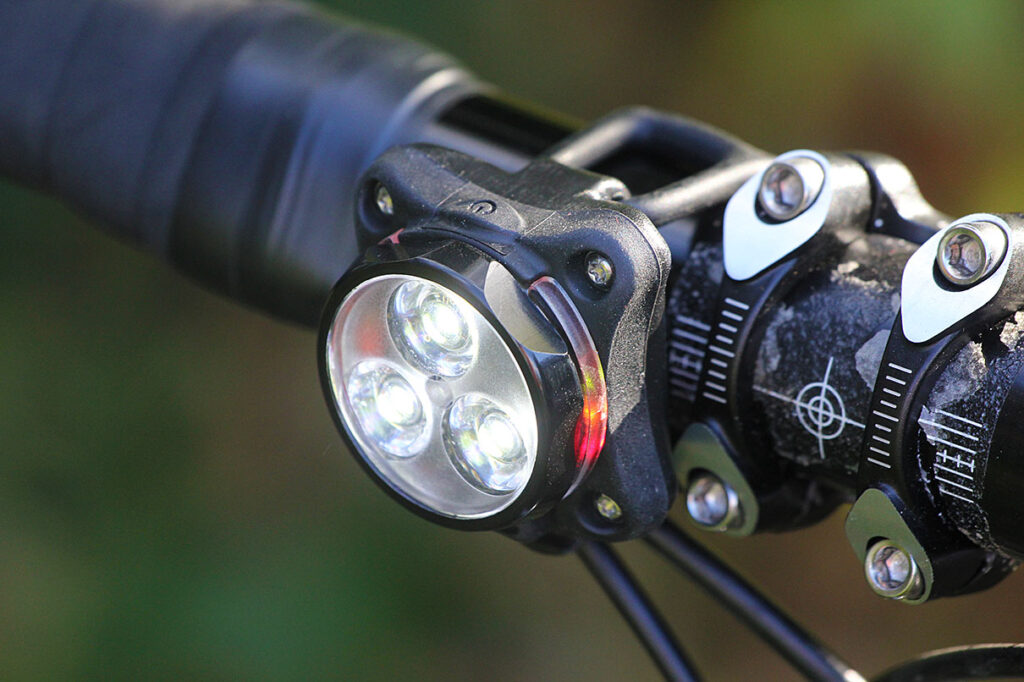
The Zecto Drive Front Light from Lezyne is a excellent piece of kit. It’s designed to alert drivers of your presence, rather than to help you see the way on unlit roads, although it’s good at that as well. It clips easily to your bike, helmet or backpack, and is neat and sturdy. It’s also rechargeable, waterproof and fairly priced.
The Zecto Drive Front has six lighting modes, including constant ‘economy’ (20 lumens, 5 hours), constant ‘blast’ (40 lumens, 3 hours), and three flash modes (all at 40 lumens, ranging from 3 to 5 hours, depending on how the individual LEDs are employed).
There’s also a flashing ‘daytime’ mode (80 lumens, 6h 45mins); although the light is brighter, it doesn’t flash as often, thus extending battery run-time.
For general winter club-run or training duties where you’re making the occasional early start (or a late finish) and need lights for just an hour or two – perhaps using ‘daytime’ mode for the bulk of your ride – the Zecto Drive Front is highly recommended.
Read our review of the Lezyne Zecto Drive 250
Find a Lezyne dealer
Moon Meteor-X Auto Pro — £25.99
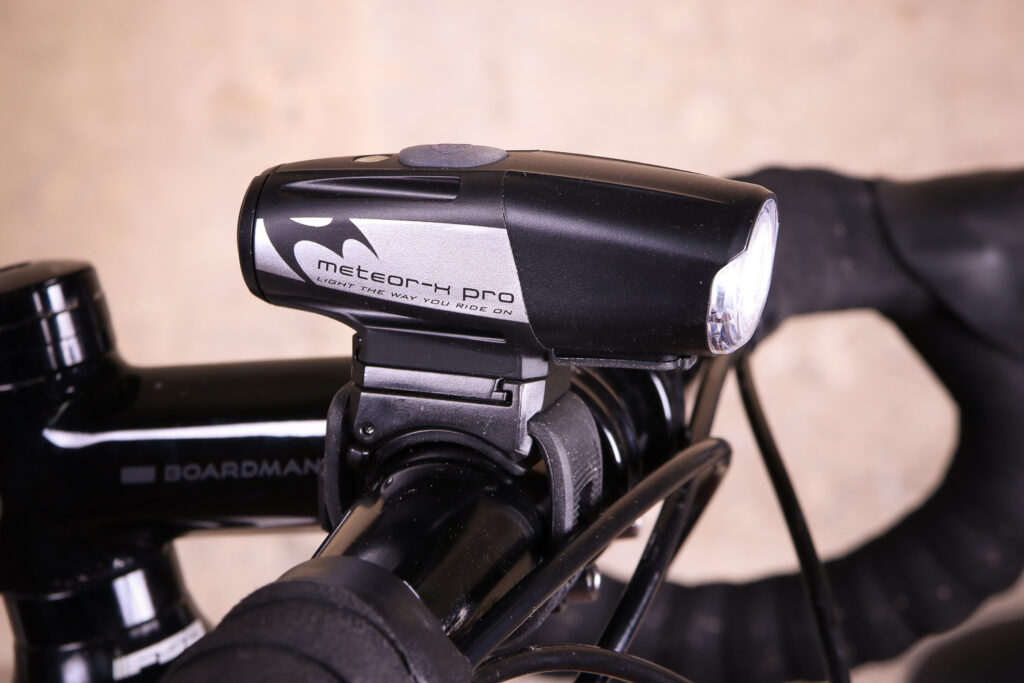
The Moon Meteor-X Pro is a brilliant (sorry) light that packs way more punch than its price tag would suggest. It’s easily capable of acting as a primary light for night commuting and the day flash is perfect for an anytime blinker.
For the size of the unit, though, we’re pretty impressed by the output. Visibility is good when used alone, even on unlit roads under tree cover. The beam is nicely direct, illuminating what you need to see, with very little wasted power out of the sides.
You can of course drop the lumens to 250, giving you 3 hours of run time. I didn’t quite get that on one daytime training ride, the light went out after 2 hours 53 minutes, but it was a pretty cold day. This setting is perfect for street-lit rides in the evening.
Our favourite setting is the daytime flash, which puts out 700 lumens in a slow rhythm. We actually used this at night, along with a main light; the setting might be called Day Flash, but we found it really useful for getting that extra bit of attention from drivers on narrower lanes.
Read our review of the Moon Meteor-X Auto Pro
Find a Moon dealer
Lezyne Strip Drive Front — £26.49
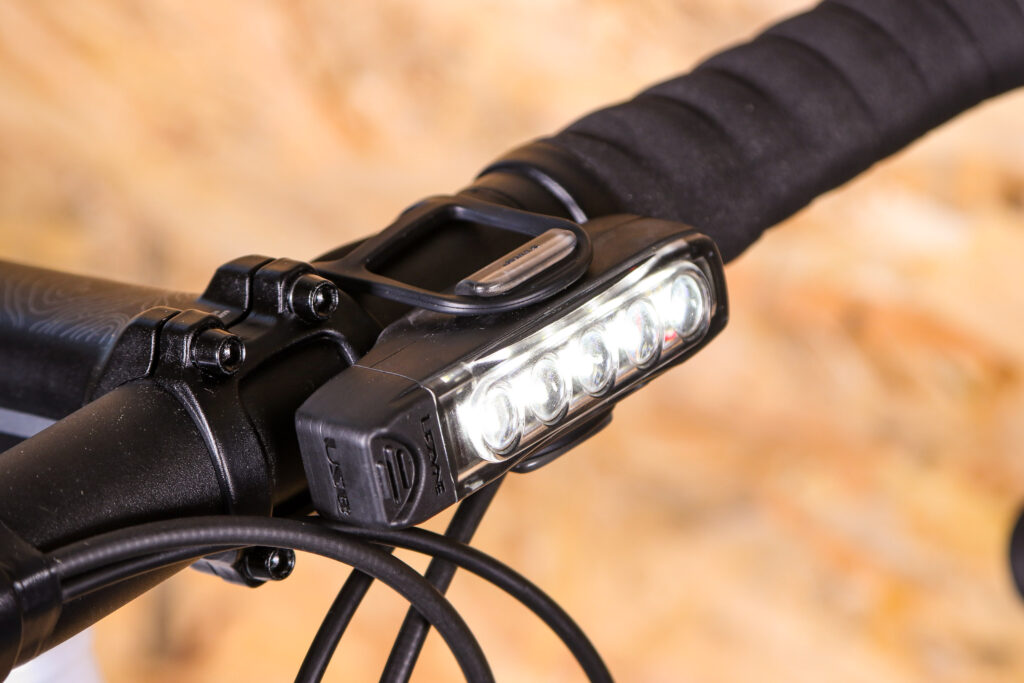
The Lezyne Strip Drive 400 has a bright and really eye-catching day time flash, commendable battery life and faster charging. It’s also fairly light, easy to operate, has loads of functions and is waterproof too. It’s more of a be-seen rather than seeing light, though.
The Lezyne Strip Drive is well made, bright, easy to use and feels really robust. It’s an excellent way of getting yourself seen, day or night, whatever the weather, at a competitive price.
Read our review of the Lezyne Strip Drive Front
Find a Lezyne dealer
Giant Recon HL 350 — £34.99

The Giant Recon HL 350 is an excellent front commuter light, delivering a decent level of brightness, good run times and fast USB charging in a compact lightweight package.
The full-power beam is sufficient for me to see even on dark roads, but it really comes into its own in towns and suburbs. The beam is nicely average – neither narrow nor wide – giving good visibility to a decent distance. The flashing modes are ideal for daylight, too.
With its fast charging and decent battery life, low weight and compact design, it’s hard to find fault. The sturdy build and strong water resistance (it can actually be submerged) mean it should last well too. I certainly didn’t have any issues in the rain.
The HL 350 is a supremely well-designed, user-friendly commuter light that ticks all the boxes – and is good value for money too.
Read our review of the Giant Recon HL 350
Find a Giant dealer
Moon Meteor Vortex 1000 — £36.95
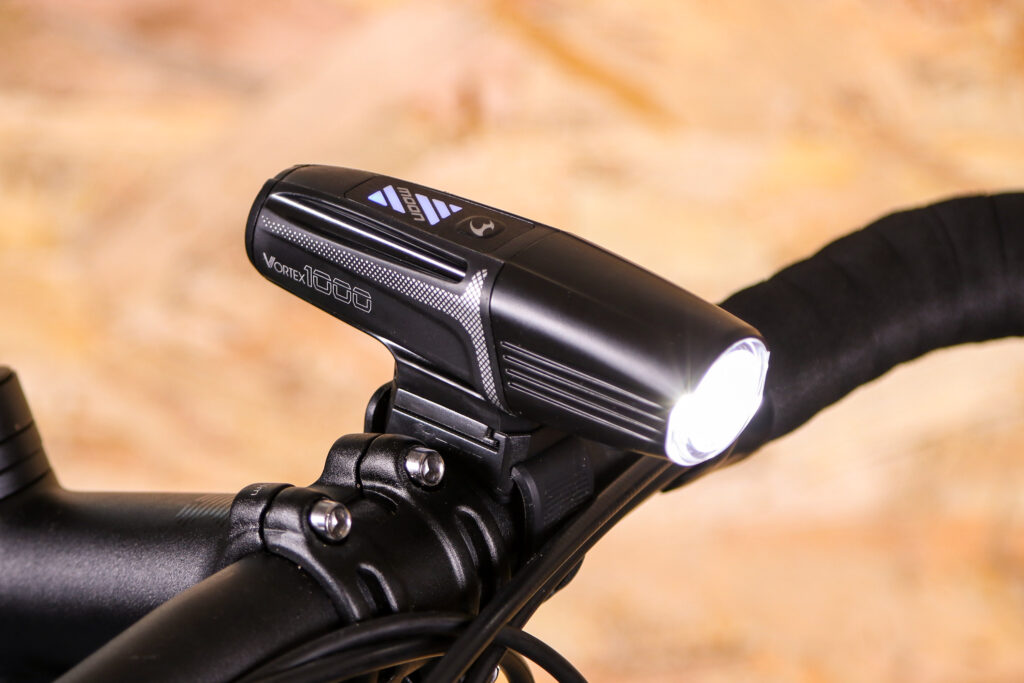
The Moon Vortex 1000 is a great light with settings to satisfy most road riders – it does everything from flooding pitch black lanes to getting you seen around town during the day. The programmable output is great and run times are decent, while the now-replaceable battery enables longer rides at maximum output. Only the clamp and the button niggle, really.
In addition to the 1000 lumen Boost mode, there are two more steady modes – 700 lumens and 100 lumens – plus three flashing, one of which is a daylight flash. There’s also an SOS mode, which is designated for emergencies only.
Lens and reflector quality is good, though the beam is rather concentrated, almost like a torch. It throws the bulk of its light towards a central point (see beam comparison), though even so, the overspill is still enough to illuminate verges on dark lanes. I felt confident riding at 20+ mph at night; it highlights potholes, debris, road kill and live animals in your tracks just fine.
Read our review of the Moon Meteor Vortex 1000
Find a Moon dealer
Gemini Atlas 500 — £37.00
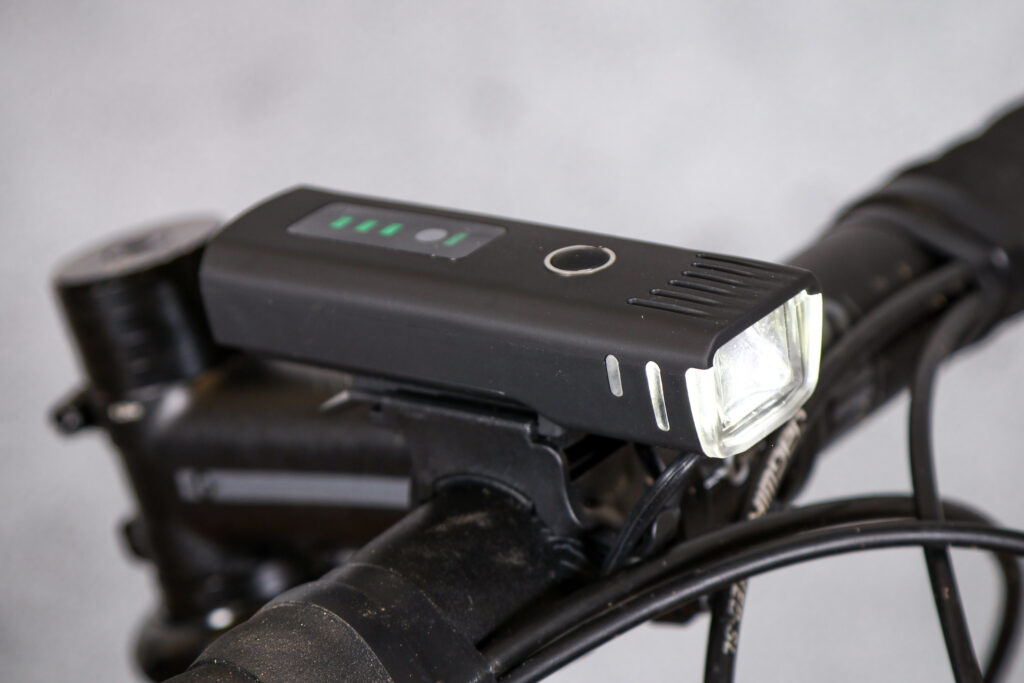
The Gemini Atlas 500 is an StVZO certified unit that offers a usable amount of light on the road without blinding other road users. It’s also simple to operate, lightweight and compact, and the ambient light sensor is a useful bonus. The run-time isn’t quite as long as stated, but it’s still impressive.
The unit is small, given the reasonable power output, and at 86g it’s pretty light too – you could happily use this even on your Sunday best bike without feeling like you’re incurring much of a weight penalty. It feels very sturdy, too. It’s a straightforward but smart looking light, with a soft-touch feel to the poly carbon composite exterior.
At its highest 500 lumens setting, the Atlas 500 isn’t quite bright enough to make those dark lanes or unlit paths feel like riding in the daytime, but it’s certainly enough to pick out details in front of you and to the sides to ride confidently, even when you’re covering ground quickly. Handily, the Atlas 500 also features two cutouts on each side of the unit, giving it enhanced side visibility, which is useful on the road.
Read our review of the Gemini Atlas 500
Find a Gemini dealer
Lezyne Classic Drive 500 — £38.24
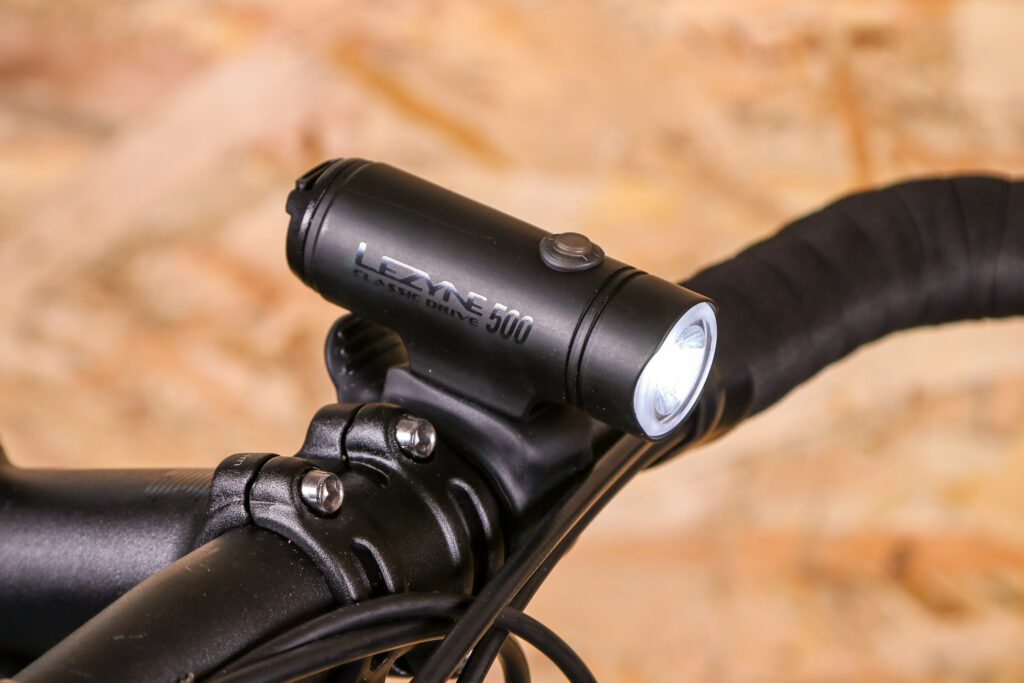
The Classic Drive 500 has a neat, minimalist look – a compact 8cm-long aluminium cylinder, with a swivel mount, and a single hook and strap to fit to handlebars, helmets and also fork legs.
It’s straightforward to use, with a single rubber button to turn the light on and off, which also displays the battery level and charging status. Hold the button down for two seconds to turn it on, press the button once to cycle through each of the eight modes, and hold it down for two seconds to turn it off. It’s nice to see a memory function feature, which turns the light back on in the last used mode.
Using the full-whack 500-lumen Blast mode gives a bright white, circular spotlight that’s good for rolling along at about 16-17mph when using it as the sole source of illumination. This did flatten the battery in just over the 1 hour 30 minutes claimed run-time, but considering the small size of the Classic Drive 500, that’s pretty decent.
The Day Flash mode gives a “disruptor style flash” that should certainly get you noticed by other road users; despite using the full 500 lumens in this mode, it can keep going for 11 hours. Impressive.
Read our review of the Lezyne Classic Drive 500
Find a Lezyne dealer
Exposure Trace DayBright — £40.50
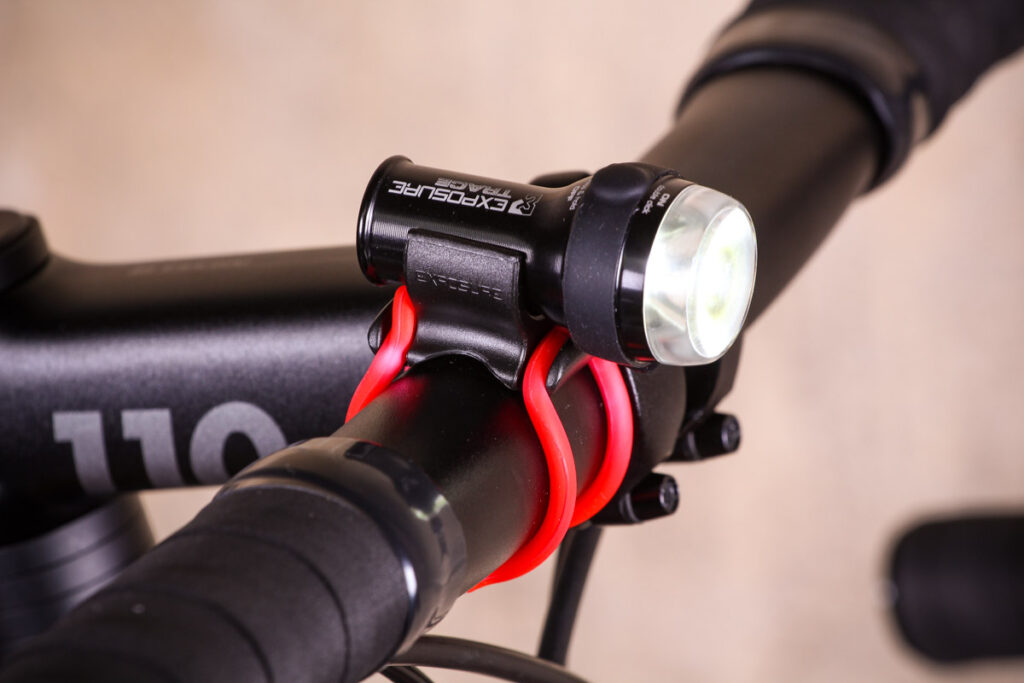
The Exposure Trace Daybright is a small and lightweight option for getting you seen (rather than for illuminating the way ahead), whether that be on a well-lit urban commute or for riding during daylight hours. The tough and durable design means that although you can buy cheaper alternatives, it should last you years.
The Trace is a really neat little option that’ll get you noticed both at nighttime and in broad daylight. It’s also small and light enough to tuck away in a bag or pocket to get you home in the event of your main light failing.
Read our review of the Exposure Trace DayBright
Find an Exposure dealer
Knog Bilby Headlamp — £44.00

The Knog Bilby is a feature-loaded rechargeable head torch with a wealth of features and functions. It’s light, bright and a typically Knog-ish funky take on the staid old head torch design. There are a couple of issues that mean it might not suit everyone in all circumstances, and the sheer range of lighting options can make it bewildering, but once you get to grips with it, it’s a pretty impressive bit of kit.
Tester Matt writes: “Knog says the Bilby is ‘the world’s most powerful silicone headlamp’ and I can quite believe it. At full 400-lumens boost mode it is dazzlingly bright and will highlight things at a fair distance (I reckon 100 feet/30 metres is easily possible). Even in the less extreme 200-lumen spotlight mode, you’ll be able to pick things out at the roadside. When not on the bike, I found myself using the quite useful downward-facing reading light a lot, too.
“The Bilby has more real-world applications than ‘just’ a helmet torch. Indeed, I’d says it’s probably the most impressive head torch I’ve ever used. It’s feature packed and comfortable. But while it’s easy to get around your head, it’s not always quite so easy to get your head around all its functions. Nevertheless, it’s comfortable, cool and clever.”
Read our review of the Knog Bilby Headlamp
Find a Knog dealer
Lezyne Classic Drive 700Xl — £45.00
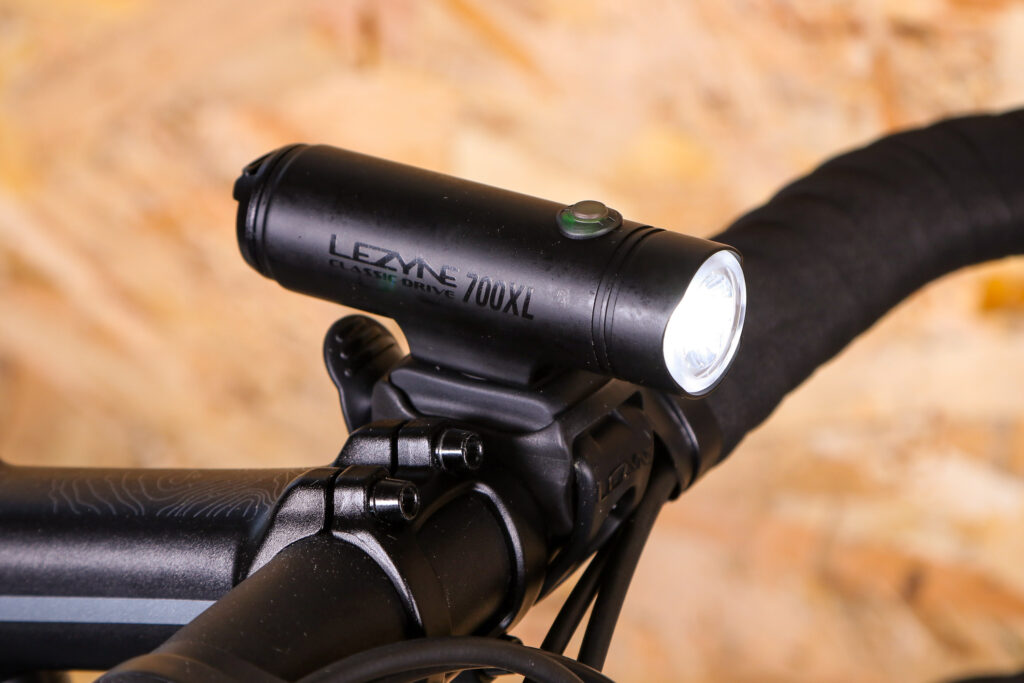
Lezyne’s Classic Drive 700XL front light is a very good option for road rides that might see you getting back in the dark, and commutes on semi-lit roads. The lightweight design means you don’t notice it when not in use, and the ‘race mode’ is excellent for quickly switching from full beam to ‘dip’.
Tester Liam writes: “The majority of my riding through the week in the winter is split between a short lunch ride if I can find the time, and commuting. Sometimes the lunch ride has to be delayed if work requires, and the commute home is always in the dark now that we’re well into winter. The Lezyne Classic Drive 700XL has been ideal for this mix of riding, providing a punchy beam that is just about enough to see by on unlit roads – impressive from a light that is also small and lightweight.
“The Lezyne Classic Drive 700XL is easy to mount, easy to operate and it kicks out just enough light to guide you along unlit roads. The run-time on full blast might be a bit short for some, but if you’re looking to light a short post-work ride, this is a very good option.”
Read our review of the Lezyne Classic Drive 700Xl
Find a Lezyne dealer
There are plenty more reviews of high-rated front lights under about £50 in the review archive here. And why not check out the big road.cc lights test with the useful beam comparison.














48 thoughts on “10 best cycling front lights under £50 — fairly cheap night-time vision and visibility”
Why is the Blackburn even
Why is the Blackburn even included here?
Road.cc’s own verdict is “a disappointing light which lacks the power to make it a contender at this price range” and specifically says “the Scorch’s 140 lumen don’t go very far and you certainly wouldn’t be able to navigate on unlit roads” entirely contradicting this article’s introduction “at the top of the price range you can start to get powerful lights that will be good for a bit of country lane night riding.”
The eBay Special Cree XM-L lights, on the other hand, seem to be much more highly respected by the community, and perform very very well in the ‘the big road.cc lights test 2013’, yet even the latest dual LED model only costs £30, slap bang in the middle of this article’s price range and, unlike the Blackburn, is surely one “of the best LED front lights to get you through the winter”. So why the omission?
The overall impression leaves the reader questioning the editorial independence of this article… 😕
Cantab wrote:Why is the
Just had another look at the article and on reflection I’ve removed the Blackburn and replaced with the Moon, a cracking little light for 50 notes that gets a very good review.
David Arthur wrote:Cantab
Thank you for being so responsive! I’m in the market for a new front light at around this sort of price point, so I was quite disappointed when I clicked through on the Blackbrun and it had such a poor review… The Moon looks pretty good! Apologies if my initial comment was a little OTT! :S
Cantab wrote:The eBay Special
because this is lights we’ve tested, and the cree hasn’t been tested yet
It seems road.cc may be going
It seems road.cc may be going the same way as Bike Radar.
Please follow the true course road.cc. I’d hate to see the same ridiculous number of critisising comments here as I see on other cycling websites.
I’m pretty sure there run by
I’m pretty sure there run by the same group of people.
Both based in bath, review the same products virtually a few weeks apart from one s d another.
I think these are useful guides for those not in the know still.
The handlebar mount on my
The handlebar mount on my moon meteor broke after less than 100 miles on the streets of Bristol – my personal experience suggests you will find more dependable units elsewhere.
Also as an aside, is this article not a bit late in the year?
Although Moon make a cracking
Although Moon make a cracking little light, I had the same issue with my Shield rear light. A righteous hack with a couple of bits from a wooden coffee stirrer blagged from Costa and a dab of EvoStik gave it the same integrity as the US version of this product, the Serfas. Though now I never disconnect the light from the mounting, undoing the silicon strap each time.
Anybody got any reviews on the Niterider Lumina Micro 220?
To first comment, why don’t
To first comment, why don’t you get positive reviews for cree etc lights from eBay etc? Think about who funds this website, I don’t see cree funding or advertising here. It is therefore logical that these sites review sponsors products, as this is where income is derived. The cree lights are exceptional value for money for sure but you are not going to see them reviewed on this site, bike radar or any magazine
Mpittick wrote:To first
look out for our cree review coming soon :H
I did the first training ride
I did the first training ride last night with my son using two Cree lights – XML T-6 and a SolarStorm – with a Cateye SingleShot as a back-up for the road and in case the other’s ran out of juice… and there was no comparison between the Cree’s and the Cateye (which I used to think was a reasonable commuter light).
The Cree’s provide an incredible spread of light, and the only real issue is that they dazzle oncoming cars (I was having to shield the SolarStorm with my hand at times)… but positioning might reduce that effect.
To put this into context… the Cree XML T-6 came from a UK supplier and the SolarStorm from China, both about £20.
Take a look at the following for a relative picture of the spread…
Quote:The cree lights are
They reviewed it under the “magicshine” brand
http://road.cc/content/review/73067-magicshine-mj808-e-front-light
Do people ‘get’ the deal with
Do people ‘get’ the deal with chinese ebay specials? (and are they same people who criticise giants like Starbucks et al for their creative tax practices?)
Buy from ebay, bike shops close, people lose jobs, they claim benefits. Buy products from shops and get warranty and service and bike shops and cycle product distributors stay open and the “employed in bike shops” people pay tax and spend their wages in other shops.
Unlike movies, (Blockbusters closure anyone?) I don’t think you can download or stream a bike over your broadband line.
allez neg wrote:Do people
Do you ‘get’ the deal with the LBS? It’s just crazy expensive and a lot of us are skint. It’s not the fault of the bike shop though, think of a £500 bottom of the range LBS road bike: you go in, talk to the salesman and and try a few bikes, you choose one but don’t want the one that’s in stock because it’s been on display and been ridden (by yourself) so they order one in for you and assemble it, you then come in and want more of the staff’s time to setup and fit the bike for you, then you will want a first free service after you have ragged it around a bit. By now you have probably used the time of a salesman for an hour and a half at £7 an hour and an hour of mechanic’s time at £9, round that to £21 with NI. Now if the bike shop is lucky they will have 35% margin on the bike, so they will have paid £270. From the £500 sale price £83 goes straight to the taxman, £60 is taken as a fee because you bought the bike on cyclescheme, so after the above costs the bike shop is left with £66, from which it has to pay its rent, rates, bills and other overheads and still try to make a profit.
Meanwhile supplier will have its own costs and pay the manufacturer around £130.
The manufacturer often doesn’t actually manufacture the bikes themselves but will place an order with a factory, where the factory gate price is likely to be around £40.
Now nobody I know has £500, so loads of people do the stupid thing and order a bike from SportsDirect.com for £100 and some people do the sensible thing and buy a nice old bike with Reynolds tubing from me, or another of the growing number of independent mechanics for £50 without any formal warranty.
So when it comes down to needing a light because you have no choice but to ride unlit roads at night and only having £20 to spend because your family needs to eat, do you buy the cree or whatever £20 gets you in the LBS and compromise your own safety for sentimental reasons and just perpetuate the bullshit that is the cycle trade?
My LBS has no end of idiots queuing up to pay them £15 to change a headset, which even if you stop for a beer halfway through can’t take longer than 15 minutes, that’s £60 an hour. They also have hoards of fat old blokes practically throwing money at them for the latest top end bikes and bits, if I turned up with £20 for a light they would sneer at me and probably recommend a cree.
I’ve been in the trade for a very long time and I know what it’s like, it’s bollocks, both the consumer and the LBS are being ripped off, hence the local bike shop as I remember it is almost dead already, times change, we have to change too.
drfabulous0 wrote:My LBS has
.
A bike qualified mechanic can be just as skilled as the average car mechanic, perhaps more so these days, given the the complexities of modern bikes. And there’s very few garages that charge £60 an hour these days; my local one charges £90.
It’s partly because many LBS proprietors have failed to anticipate the changes. Revenue can be increased quite easily with a little imagination. Letting cyclists bring their bikes into the shop, an acknowledgement upon entering the shop, offering free coffee, free basic maintenance courses for women, an evening delivery service, proper FAQs on the shop’s website, some sort of effort to actually answer emails, a range of reasonably priced parts for older and more basic bikes, a “courtesy” bike, even “after hours” pasta parties.
Bike shops have to be imaginative, and see themselves as part of their community, because regulation could affect sportives, and the cycle to work scheme may not last forever.
Neil753 wrote:drfabulous0
Agreed, but the mechanic himself will only see a tiny fraction of that money.
This is exactly what bike shops need to be doing and those that do will do well for themselves, but it’s not how bike shops used to be.
@Allez neg, I was joking about the beer, but how long do you think it takes a professional mechanic with the correct tools to change a headset? Seriously man, the only excuse for these prices is the cost of the tools.
allez neg wrote:Unlike
Just wait until 3D Printing takes off!
Well, some comprehensive and
Well, some comprehensive and coherent replies, all I know is that the owner of the bike shop that I used to work for seems to do ok in terms of money and lifestyle, has a decent customer base and manages to employ 2 staff fulltime. As such he contributes to the local community and also to ol Gideon Osborne.
One other thing – I’d not fancy trusting any of my bikes to someone who can apparently replace a headset in 15 minutes, with or without the beer break…… :/
*Rolls up sleeves and wades
*Rolls up sleeves and wades in*
The Cree eBay (‘CreeBay’?) light market over the last few years has been nothing short of a revolution – there is simply no other word for it.
I cannot recall a technology being so rapidly and thoroughly democratised. Only a few years ago the performance delivered by Cree lights was only delivered by lightsets costing many hundreds of quid.
Now top-class lighting can be had for £20-30, which is within the reach of everyone. In the last few months the bog standard Cree X-ML T6 single LED with 4 cells has dropped well below £20, and can now be had for £15-16 including postage.
This has been largely driven by the manufacturing power of China’s Shenzhen district, coupled with UK-based resellers cutting out distributors and retailers. The no-quibble Paypal guarantee helps a lot too. There is, of course, nothing stopping a local bikeshop from ordering a few hundred of these lights on Alibaba and selling them with a markup. They could even offer a walk-in warranty replacement, which would remove the last vestiges of fear from purchasers concerned over buying on eBay from overseas.
As a True Story, the Test Valley CC has over the last year been riding at night, 2hrs on a Thursday on pitch-black lanes. This has only been enabled by Cree lights – we are all people with families, and no way would an Exposure or whatever at £200 be justified. But as a result of this increased nocturnal activity the LBS has profited from the sale of new gilets, jackets, reflective overshoes, clear-lensed glasses and of course general bike stuff that comes with increased mileage. So loosing a sale they never would have had has netted them income.
Time for people to stop bemoaning others making purchasing decisions and start suggesting ways their LBS could offer newer, more innovative services. Times change, needs change. If your LBS can’t or won’t change they are doomed.
…and every single one of
…and every single one of these lights will dazzle oncoming pedestrians, cyclists and motorists. Road.cc should be advocating the use of lights that conform to the German STVZO standard.
Furthermore, lumens is not an accurate identifier of light output, it should be abandoned in favour of lux.
on the contrary, lumens *is*
on the contrary, lumens *is* an accurate measure of light output.
Lux is the amount of light falling onto a surface which varies with the light fixture mounting position :B
At the risk of sounding a bit too geeky, what should be clarified as more and more lights use LED is the difference between the lumens from the LED chip itself versus actual the ‘luminaire lumens’. Mounting the same Cree chip inside a different housing (with different reflector or spacing from the lens etc) will give a different output and so manufacturers should give us Luminaire Lumen values for an accurate view of the light output.
When you’re cycling, your
When you’re cycling, your light is invariably illuminating the ground in front of you. I see no point in buying a 1,000 lumen light which spends 50% of it’s time illuminating the sky, when you need 100% of it on the road.
Peowpeowpeowlasers wrote:When
The Standard CreeBay light can have an aftermarket ‘wide angle’ lense added that directs the light into a horizontal band, greatly enhancing the brightness where you need it. £5: http://item.mobileweb.ebay.co.uk/viewitem?itemId=261339511889
Must-do upgrade IMHO.
Peowpeowpeowlasers wrote:When
it’s about time we had dipped beams to prevent dazzle… they’re so bright now, everybody else is being dazzled…
Paul_C
Have a look at B&M, Philips et al, Lights designed as bike lights not modified torches. I would like to see some more real lights being developed for road use by the likes of hope, exposure etc.
mrmo wrote:Paul_C
Have a look at B&M, Philips et al, Lights designed as bike lights not modified torches. I would like to see some more real lights being developed for road use by the likes of hope, exposure etc.— Peowpeowpeowlasers
N+1 and all that. Of course none of these lights tested are even road legal. They all have rubbish beam patterns and I’am fed up with being dazzled by them.
Just goes to show how much of a “slut” to the cycle (rip off) industry that “Road CC” is that they do not even mention whether they are actually certified road legal.
Giles Pargiter wrote: none of
Road.cc has extraordinary good quality reviews of bicycle lights. They’re one of the reasons I started reading road.cc. It’s probable that the only reason you’re aware of the beam patterns is because road.cc testers spent hours making up the great graphs and photos.
Honestly, some people just don’t know how to say “thank you”.
Ush wrote:Giles Pargiter
Road.cc has extraordinary good quality reviews of bicycle lights. They’re one of the reasons I started reading road.cc. It’s probable that the only reason you’re aware of the beam patterns is because road.cc testers spent hours making up the great graphs and photos.
Honestly, some people just don’t know how to say “thank you”.— Giles Pargiter
Main reason why I become aware of the beam patterns is because most of the beam is into my eyes.
IMO they are not “Cycle” lights unless they are type approved for road use – which Road cc do not even indicate.
If you did use a “type approved” light you would find nearly all of them are very nearly as bright as ordinary dip beam head lights which are measured in Lux at specific distances and points. These do not shine light into others eyes, when correctly aligned, but do light your way. This is far more meaningfull than using a measure of lumens.
Giles Pargiter wrote:Ush
Road.cc has extraordinary good quality reviews of bicycle lights. They’re one of the reasons I started reading road.cc. It’s probable that the only reason you’re aware of the beam patterns is because road.cc testers spent hours making up the great graphs and photos.
Honestly, some people just don’t know how to say “thank you”.— Ush
Main reason why I become aware of the beam patterns is because most of the beam is into my eyes.
IMO they are not “Cycle” lights unless they are type approved for road use – which Road cc do not even indicate.
If you did use a “type approved” light you would find nearly all of them are very nearly as bright as ordinary dip beam head lights which are measured in Lux at specific distances and points. These do not shine light into others eyes, when correctly aligned, but do light your way. This is far more meaningfull than using a measure of lumens.— Giles Pargiter
I do use a “road approved” light (b&m dynamo), and it’s undoubtedly good at lighting the road. It does, though, need to be supplemented by a torch, for two reasons. First, part of my commute is offroad, for which all that light “shining into the sky” is useful for seeing tree branches, deer and so on. Second, some people coming out of driveways are not really looking, so don’t always notice my nice polite legal lights. Dazzling them may upset them, but at least they notice and stop.
Unfortunately, the original
Unfortunately, the original comparisons of watts against Lumens was about as useful as comparing chalk with cheese. I just wish that they would all use the same system, then after a while we could relate it to what we have.
agreed. Watts is irrelevant
agreed. Watts is irrelevant tool for comparison of light output as it is the power consumption. Although it could give you an estimate on older lights, it is largely irrelevant when it comes to LED for judging output.
Lux can be used, but a benchmark should be established of where the lux level is measured and in relation to the mounting position of the light.
e.g. output gives 100lx on the ground, 3m in front of the light fixture when mounted at 1m height (or something along those lines).
Until then Lumens, or for more accuracy use Luminaire Lumens, is the only real comparable unit of light output for these.
As a halfway house between
As a halfway house between Creebay(!) and ye olde LBS I use a torch from Maplin (A76JX since you ask) and a handlebar clamp I bought off of um.. ebay. £30, 3W, 2 chargers, a spare 18650 and even a little black condommy thing to put it in. Rainproof and faultless.
Id add the Cateye Volt 300 to
Id add the Cateye Volt 300 to that list selected after the Road.cc big light review and it hasn’t disappointed on the brightness front. http://road.cc/content/news/97193-big-roadcc-lights-test-2013
Its RRP is £49.99 but it can be got for around £40
Moon XP300 is widely
Moon XP300 is widely available for <£40 right now but listed at £100+. I'd suggest it spanks any of the lights here if you;re interested in lighting your way, and is well within the sub £50 category in reality.
Bigpikle wrote:Moon XP300 is
Agree with that. i have one on my helmet and one on my bars, both got from wiggle in the sale.
super light
Just to respond to some of
Just to respond to some of the points raised. There are some truly great lights being made by UK manufacturers, Hope is the highest profile and 4Fourth another, but they’re desperately expensive… especially if you’re unsure whether night-training is going to work for you. We ordered a Cree SolarStorm from China at the start of October, it was £20 and if it proved the theory that getting home and then heading out on a bike was practical, then it meant we could consider an upgrade to the Hope-or-similar lights. Unfortunately the SolarStorm didn’t arrive as expected, so we bought the T-6 from a UK supplier, only for the SolarStorm to arrive a few days later… so we have an unexpected comparison.
Between our Cree lights and the Hope-standard (apologies for using them as the benchmark), there are a growing band of UK businesses offering Cree-type lights at intermediate prices… this is throwing the entire market into confusion… I absolutely don’t advocate the ‘cheap option’ (and no longer use Amazon for anything), but equally I feel that the UK has lost it’s ability to manufacture, so why should I pay a surcharge to a UK company to import something manufactured in China, when I can arrange that import myself?
I have no doubt that we will upgrade to UK lights next season and put our money where the proverbial mouth is, but at the moment these Cree lights are proving stunning.
drfabulous0
drfabulous0 wrote:
snipping…..They also have hoards of fat old blokes practically throwing money at them for the latest top end bikes and bits, if I turned up with £20 for a light they would sneer at me and probably recommend a cree……snipped.
Hey you! We can’t help getting old and fat – it just kinda happens.
😕
Apart from that – good post!
Wot no Lezyn units? Just
Wot no Lezyn units? Just invested in a pair of Lezyn units that are USB rechargeable and don’t require carrying a USB cable around with me… I did have a previous pair of rechargeables, but the charging adapter was never in the right place when it needed recharging. The rear lamp could not do my 45 minute commute each way without going dead…
What Creed are doing is
What Creed are doing is showing up all the other manufactures as being over priced, yes there are some issues with Creed such as the lens and reflectors, but they are getting better all the time.
As for the comment about the idiot who says that a “A bike qualified mechanic can be just as skilled as the average car mechanic”… what world are you living in ! I am not for one second trying to put down the excellent bike mechanics of this world or suggesting that they could not be car mechanics, but lets strip down an engine or gearbox, compare that to stripping a rear hub ! you cannot compare these 2 very different jobs.
Rohloff 14 speed internal
Rohloff 14 speed internal hub?
Some of these units
Some of these units definitely appear to be ‘cone of light’ / non-shaped beams – so inefficient at getting light where you need it. I started off with ‘ebay special XML-T6’ lights with swapped in fresnel lens – which helps elongate the ‘hot spot’, but now choose shaped beams where the LED is in the roof of the unit and reflects out with mirrored surface. Shaped beams / cutoffs definitely needed.
Any reason not to include
Any reason not to include Halford’s light for £50?
https://www.halfords.com/cycling/bike-accessories/bike-lights/halfords-advanced-1600-lumen-front-bike-light-253334.html
Also, why is your spiel for the Zecto 250 copy/pasted from your review of a different light (the Zecto 80)?
Sriracha wrote:
Thats obvious. Halfords obviously didnt pay road.cc enough to feature their product in their recommendations. (and i dont think road.cc do reviews of halfords products anyway for that same reason because there is a lack of them and halfords have been doing their own kit for a while)
and the copy/paste for the Lezyne was lazy-ne editing. (pardon the pun)
It’s not obvious because it’s
It’s not obvious because it’s not true – no one pays to be featured in a road.cc buyer’s guide.
I’ll suggest that we get the Halfords light mentioned above in for review, thanks for the suggestion.
Can’t argue against the Zecto
Can’t argue against the Zecto Drive lights – they get me through murky daytime weather until dusk, although I would want something more substantial if I was riding in real darkness.
On offer at Tredz for the front and rear set for anyone who wants an early xmas present – https://www.tredz.co.uk/.Lezyne-Zecto-Drive-250-80-USB-Rechargeable-Light-Set_111998.htm – which is why I thought I’d mention it.
You can also get a £5 off voucher there if you hang around for a minute or two on the site, making it a rather bargainous £34.99
But one might argue about why
But one might argue about why they have attributed the features and performance of a previous model to the Zecto 250 under discussion, complete with a link to the review of the wrong light which is no longer available in any case.
Viz. [I]”There’s also a flashing ‘daytime’ mode (80 lumens, 6h 45mins)”[/i]
Very happy with my Cateye
Very happy with my Cateye Ampp 800. Can be had online for about £45.
If you go to this website’s
If you go to this website’s buyers guide you can compare the lights mentioned in this article to see which one is the best, and the best one for lighting up the road was the Moon Vortex 1000 by a landslide over the others. You need a light that you can see the road with adequately, and the Moon light does a really good job at that, and the cost is extremely reasonable, I haven’t seen a better light than that one for the money.