


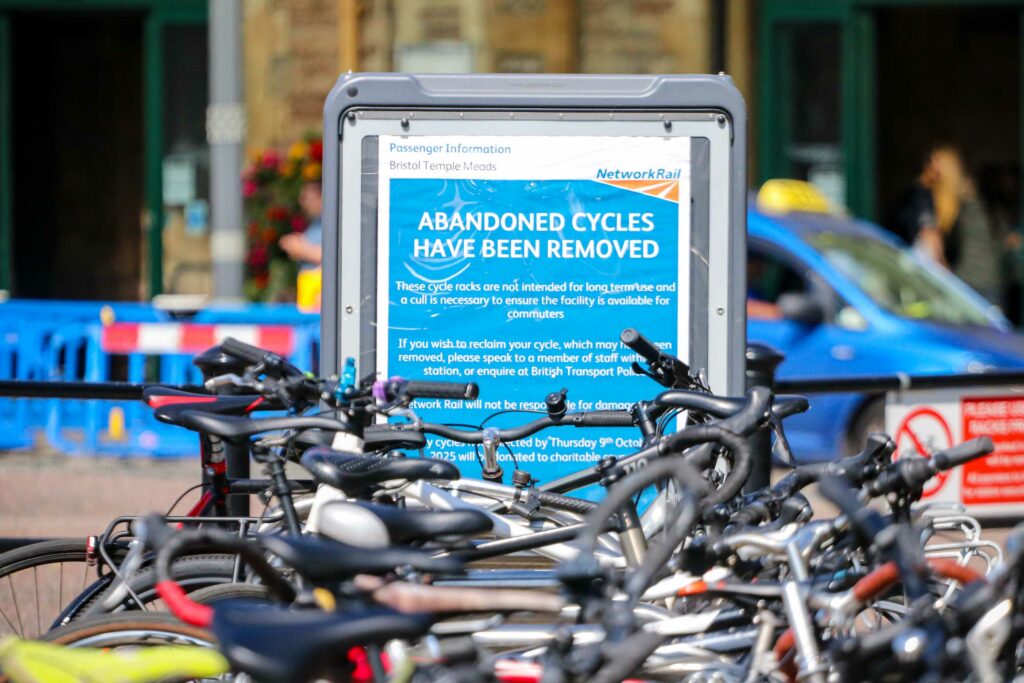

The number of reported bike thefts at British railway stations fell by 11 per cent in the first half of 2026 – though the proportion of cases resulting in a charge or summons more than doubled, new analysis of British Transport Police data has revealed.
The analysis, carried out by insurers Cycleplan and obtained through a Freedom of Information Act, comes after the British Transport Police (BTP) was forced to perform an abrupt U-turn in January on a controversial policy not to investigate stolen bikes if they were left outside train stations for more than two hours.
In 2024, the British Transport Police (BTP) amended its Crime Screening Policy to clarify that the force would not investigate bike thefts at stations if the value of the stolen bike was below £200 or if it had been left in the same location for over two hours.

The amended policy first attracted widespread media attention in October 2025, following a story about an attempted bicycle theft at Watford Junction railway station. It swiftly became the subject of severe criticism from cycling campaigners and commuters, who claimed that it effectively “decriminalised” bike theft at stations, especially for those cycling to catch a train to work.
The British Transport Police initially attempted to defend the move and argued reviewing CCTV footage meant officers had less time “investigating crimes which cause the most harm”.
However, in January, the BTP backtracked on the policy, reaffirming its commitment to “bringing more bike thieves to justice in 2026 than ever before”, after Cycling UK argued that it “sent the wrong message about whose journeys matter”.
According to the data obtained by Cycleplan, since the BTP’s policy U-turn, the number of reported bike thefts at British railway stations has fallen by 11 per cent year-on-year. Between January and June 2026, 1,900 bicycles were reported as stolen at stations, down from 2,135 during the same period in 2025.
Meanwhile, in what campaigners will point to as a direct consequence of the BTP’s backtracking, the proportion of concluded bike theft cases which have resulted in a charge or summons has doubled in the first half of 2026, from 4.4 per cent between January and June 2025 to nine per cent this year.
The use of CCTV footage to track down bike thieves at stations – which the BTP’s previous policy aimed to marginalise – has also increased this year, assisting in 10.3 per cent of reported cases, compared to just 6.7 per cent in 2025.
When it comes to individual stations, Cambridge North tops the list of Britain’s worst railway bike theft hotspots, with 35 reported thefts in the first six months of 2026, up from 27 the previous year. Clapham Junction’s number of reported thefts also rose from seven in 2025 to 27 in 2026, with Hitchin also experiencing 27 bike thefts this year so far, 22 more than the same period last year.
St Albans City, Reading, and Oxford have all witnessed a drop in the number of reported bike thefts, though the three stations still feature in the top six of the hot spot list.
“It’s encouraging to see railway bike theft fall by 11 per cent year-on-year, but 1,900 reported thefts in just six months shows that cyclists still face a significant risk when leaving their bikes at stations,” Cycleplan’s chief underwriting officer Sean Carney said in a statement.
“What really stands out is how much the picture varies across the country. While thefts have fallen overall, some stations, including Clapham Junction and Hitchin, have seen substantial increases. This shows why cyclists shouldn’t become complacent just because the national trend is moving in the right direction.
“There are also some positive signs when it comes to tackling theft. The data shows increased use of CCTV, while a higher proportion of concluded cases resulted in a charge or summons compared with last year.
“However, prevention remains one of the best ways for cyclists to protect their bikes. We’d encourage anyone leaving a bike at a station to use good-quality locks, secure the frame to a designated cycle stand and register their bike with a recognised cycle database.
“Train operators and station partners also have an important role to play in preventing and investigating cycle theft, including making effective use of CCTV and other available evidence.”
While the number of reported bike thefts has dropped, it must be noted that the confusion surrounding the British Transport Police’s bike theft policy has led to wider concerns about a fall in the number of people leaving their bikes at transport hubs.
In fact, in March, data published by West Midlands Combined Authority suggested there was a drop of around 20 per cent in people using bike parking facilities at the region’s rail and bus stations since the scrapped policy first attracted national attention.
In a bid to allay fears about bike thefts at public transport hubs being low priority, Transport for West Midlands’ Head of Security and Policing, Kerry Blakeman, said the authority’s stance is “absolutely clear”.
“Where we spot individuals acting suspiciously in any of our cycle hubs, we contact the police,” he said.
> “Theft is now legal in Britain”: Only 0.5% of station bike thefts lead to charges
“We have the ability to speak to them via police radio and also have the ability to be able to drop images live into their control room.
“For me, if there is a crime in action we will do that and communicate with the police. We’re here to try to prevent and detect crime and we’re supporting the police in the delivery of that.
“Why wouldn’t you take an active response to stopping criminals in their tracks? Where we have active CCTV we will continue to proactively monitor those stations for people who are about to commit crime.
“We are 24/7, 365. We will do the majority of that viewing and we will narrow down the footage to literally, ‘there you go, there’s your snapshot of the bike before, there’s the person stealing it’.”

















2 thoughts on “Reported bike thefts at train stations fall by 11% after British Transport Police’s ‘no investigation’ U-turn… but proportion of thieves charged doubles”
“It’s encouraging to see railway bike theft fall by 11 per cent year-on-year” said Sean Carney.
The statistics don’t say railway bike theft has fallen by 11 per cent – they say *reports* of railway bike theft have fallen by 11 per cent. It’s possible (and arguably likely) that at least some of this is driven by a drop in reporting, once it was made public that BTP won’t investigate most thefts.
I’m intrigued what the data says for Scotland. Last year in Stirling, I had my bike (plus tailfin setup and camping kit) removed from the station cycle park and left against a rail to see if I noticed it. Thankfully I did and quickly made my way to get my train. I reported it online to PS when I got home, it was left for less than a hour and I mentioned that as a solo female traveller the most unnerving bit, was someone clearly watching me. Despite it being logged and a PS email to arrange a call back, the call back never came. They then had the nerve to text me a response questionnaire on how they’d done.