



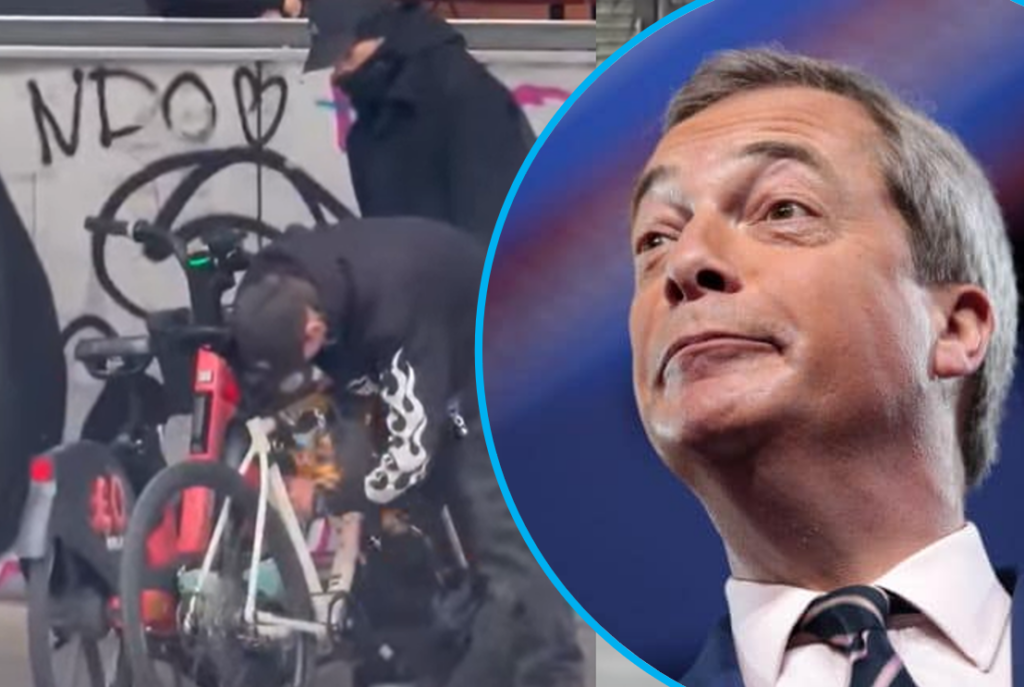
The British Transport Police will not investigate bike thefts outside train stations if the bike has been left there for more than two hours.
Speaking to the BBC, the BTP said, “The more time our officers spend reviewing CCTV, the less time they have available for patrolling railway stations and trains, investigating crimes which cause the most harm”
Tom Fyans, from the London Cycling Campaign, said that the lack of enforcement was stopping people from cycling to train stations.
“A lack of secure cycle parking at stations, and next to no action against thieves, leaves London way behind the Netherlands, where nearly half of trips to stations are by bike.
“Many victims of theft in the capital just stop cycling – if we want to reduce car trips in London and encourage cycling, we have to redouble enforcement against cycle theft.”
Simon Feldman told the BBC that he reported a theft that happened whilst he was on shift in London. He had left his bike for 10 hours.
“Even though it’s right under a camera. And I found out that if you have left your bike for more than two hours, they won’t investigate it,” he said.
“I was pretty shocked because what it’s doing effectively is decriminalising bike theft and I realised how many people are being affected by this.
“Lots of people across the country cycle to a station every day and their possessions aren’t being looked after. They’re not safe. Hundreds of thousands of pounds are being thrown into secure bike parking and it isn’t secure,” he said.
“These cameras, you could put a bag over them and that would be exactly the same purpose they serve. The footage is never watched, the footage isn’t monitored so the cameras don’t do anything, so the thieves are so confident now they just take the bikes in broad daylight.
British Transport Police said: “Whilst we know that bike thefts are upsetting, inconvenient and potentially costly, there can often be limited opportunity for investigation.
“Our experience tells us at an early stage that there are some crimes that are unlikely to ever be solved – such as those without a clear estimate of time or location for the incident or if there is a lack of CCTV or witnesses.”

“The more time our officers spend reviewing CCTV footage for these offences, the less time they have available for patrolling railway stations and trains, investigating crimes which cause the most harm and providing a visible presence across the network.
“We will continue to apply a test of proportionality when determining an investigation – looking at factors such as timeframes, witnesses, the availability of CCTV, the impact on the victim or whether there is a realistic prospect of a successful outcome.
“Any offence which is not investigated will still provide us with valuable intelligence, used to direct our patrols and operations.”
The BTP have also said it will not investigate car thefts if the vehicle has been left for more than two hours, and will not investigate any bikes worth less than £200.
“Letting cyclists down across the country and providing further barriers to people riding a bike”
Cycling campaigners have been reacting to the decision throughout the afternoon, British Cycling accusing the British Transport Police of “letting cyclists down” and “providing further barriers to people riding a bike”.
“Bikes are a vital mode of transport, and way to access work, education or vital services,” a spokesperson told us. “The theft of a bike is a horrible experience shared by too many people across the country, and decriminalising this activity will only serve to deter more people from choosing cycling, whilst preventing those already riding a bike from continuing to do so.”
Likewise, Sophie Gordon from Cycling UK, told us the decision tells people that they should expect to sort bike thefts themselves.
“The decision not to investigate bike theft when cycles have been left for longer than two hours will hit the lowest income groups the hardest,” she said. “These are often working people who might not be able to afford a car and are relying on bikes and public transport to get to work. If you’re on shift or at work, you will inevitably be away longer than a couple of hours.
“Bike theft is not a petty crime but has serious social consequences and the police need to take it seriously – to have your means of getting around stolen can be devastating. By partnering with cycle trade, planners and other groups, the police could find ways to prevent cycle theft, seeing as that’s more effective than enforcement, but it’s not acceptable for the police to say they will be doing less to investigate theft, when they should be doing more. Otherwise it starts to feel like people should ‘See it. Say it. Sort it yourself’.”

-300x199.jpg "“He wants bikes in traffic lanes. Give him what he wants”: Cyclists urged to “slow every street down to bicycle speed” and ride in middle of lane amid premier’s war on cycle paths + more on the live blog")








48 thoughts on ““Effectively decriminalising bike thefts”: Bikes stolen from train stations that were left for more than two hours will not be investigated, says British Transport Police”
Are they idiots? Length of
Are they idiots? Length of time of the footage shouldn’t be a factor. It should take 5 minutes to find the footage of the theft. Say you leave the bike there, return 24 hours later, and the bike isn’t there. Apply a binary logic:
– Look at an image from the 12 hour mark – is the bike still there? If yes, you know it was stolen in the second half. If no, it was in the first half of the time period.
-Look at the 6 or 18 hour mark, as per before. This will narrow it down to which quarter of the 24 hours..
-look at the 3 hour mark within that 6 hour period, to narrow it down to the eighth of the 24 hour period, i.e. a 3 hour slot.
Following this logic, another 7 steps takes you to a roughly 1 minute period within that original 24 hours.
In other words, in less than a minute you can shrink a 24 hour slot into a three hour slot, and a few more minutes to a 1 minute slot. The 2 hours-or-less is a piss-poor excuse. They are either stupid or don’t care. Or both.
Also,…
Also,…
“Constable, my bike has a tracker. You start on the video; I’ll start on the location. If I get there first, anything I do to get the bike back is also decriminalised. It’s only fair!”
I expect the issue is a lot
I expect the issue is a lot of the footage isn’t that good.
So long distance (camera up high), awkward angle, panning camera, heavy compression for data storage + transmission, multiple cameras.
Oh, can’t actually tell if bike is there or not, instead have to look for it arriving/leaving.
Of course a 2 hour slot still isn’t that useful unless you can either binary chop (at which point you can handle any length of video) or use motion detection (remove any stationary video), which depending on how busy bike stand is will either reduce a days video to a sane level, or just leave you with way too much video to go through.
(Note that correct way to do this isn’t raw binary chop; You start by removing any video without motion (trivial as video is compressed with motion vectors…), preferably regional (i.e. motion in just section of video including stolen bicycle), then binary chop whats left (can add more intelligence; rather than binary chopping x hours of video, binary chop on motion events)
This policy makes zero sense
This policy makes zero sense for cases where the bike in question is secured in an area covered by CCTV. It doesn’t matter if it’s 2 hours or 2 weeks, it should only take a few minutes to identify the time the bike was stolen. Take the time when the bike was parked to when it was noted stolen and go to the time half way between these. Is the bike there? Yes, half the remaining time forward from then and check again. No, half the time back from then. Repeat until you’ve got footage of it being stolen. Not rocket science. It’s not like they’re having to fast forward a video tape, all digital these days. Pathetic
I think you seriously
I think you seriously overestimate the intelligence of the average law enforcement officer.
Of course I didn’t pay my
Of course I didn’t pay my fare officer, the journey was longer than 2 minutes.
Finding the right bit of CCTV
Finding the right bit of CCTV is the sort of thing AI could do in about 5 seconds.
I mean, a human could do it
I mean, a human could do it in less than a minute. It’s not difficult, unless you’re as thick as a pig.
I think you may be doing pigs
I think you may be doing pigs a disservice – problem solving, spatial awareness, time perception, tool use – they could probably do the job just fine.
So the police won’t
So the police won’t investigate crimes because they would rather spend their time
standing around doing fuck all“providing a visible presence”?At face value, this is not
At face value, this is not such a stupid approach, provided it actually leaves more people on the beat – I would rather they deterred / prevented the theft than investigated it.
The problem is that research
The problem is that research consistently shows that random patrols are ineffective at reducing crime, whilst targeting prolific offenders and disrupting criminal networks does work.
Ah, but does that make people
Ah, but does that make people *feel* safer? Perhaps in the long run…(maybe they’d find something else to be concerned about). But it likely has to happen before the next electoral cycle – or maybe before the next headline?
The college of policing state
The college of policing state that ‘bobbies on the beat’ makes no difference to crime rates.
Given the number of police
Given the number of police bodies and the proliforation and opportunistic/blatent nature of the criminal underclass I suspect that might be true. But given the College of Policing’s record, I have to question the statement.
bensynnock wrote:
https://www.college.police.uk/research/what-works-policing-reduce-crime/visible-police-patrol
It also goes on to say
It also goes on to say “targeting hot spots simply results in crime moving around the corner or being displaced elsewhere.”, which is what you might expect.
It is staggering just how
It is staggering just how many in the police are ignorant of binary search. A simple algorithm known for many *millenia*, that a bright child would think of. Yet, most police officers seem not to know of it. Either the stereotype of police is true, or they just don’t want to know how to do their job efficiently, or both.
Do they have a sign also at
Do they have a sign also at the car parks that says “All boot spaces to be vacant and left visibly clear for inspection”
Why do only cyclists have to remove panniers, but cars are free to carry b0mbs if the driver chooses?
The UK is truly fcked with the anti-cycling bias even at the institutional level.
I’ve noticed that a lot of
I’ve noticed that a lot of cars have now got their winter camouflage on. Grey sky, grey road, grey car, no lights. Almost invisible.
There should be a public information campaign to get people to paint their cars in hi-vis paint at this time of year.
It really does only take a
It really does only take a minute or two to identify when the bike was stolen it’s the ‘leg’ work that comes after that’s possibly the issue. It all comes down to funding. Since I no longer commute I have no skin in the game. If I did I’d be writing to my mayor , who happens to also be the police and crime commissioner, to explain what joined up thinking looked like : less carbon emissions from a combination of public transport and cycling , less NHS pressure , because I’m healthier. I’d write to them and ask them what they were going to do . I’d also write to my MP , regardless of party, and ask them to ask the relevant minister , join a all party interest group , table and early day motion etc. I have too much time on my hands.
From the BBC report:
From the BBC report:
“Car thefts will not be investigated if the vehicle has been left for more than two hours…”
My hope is, that while the outrage from us cyclists will be ignored… they won’t be able to ignore it from drivers or the motoring lobby.
That’s potentially misleading
That’s potentially misleading reporting from the BBC. BTP policy to cars applies to “theft from, damage to or interference with a motor vehicle” which suggests to me that they may still investigate thefts *of* cars parked for more than 2 hours.
My main issue re bike theft
My main issue re bike theft is that car theft is mainly dealt with by arresting people with stolen cars.
See all the stories of people finding their bike being stolen, with proof (serial numbers, unique modifications, etc) but police won’t take any action against seller (despite being provided address)…
The way to deal with it is target the selling/buying side. When your ‘amazing deal’ on facebook marketplace results in the police seizing the bike and executing a search warrant for other stolen property, people would soon stop buying ‘amazingly cheap bikes’ from facebook, ebay, local pub, etc etc.
And chances are the sellers are selling a whole pile of stolen stuff online, so you can catch them with shedloads…
I’m sure bike thieves are
I’m sure bike thieves are delighted at this news.
If their patrol car was
If their patrol car was stolen they would not rest.
Seeing as BTP are the only
Seeing as BTP are the only police for railway land, this is an official announcement to thieves that if you see a bike you like at a station, to charge up your angle grinder for 121 minutes, then you can take the bike by force without any prospect of investigation.
Great.
If it “won’t be investigated” will it even be recorded as a crime ? Will you be able to get a crime reference number for insurance purposes?
1. Buy a sh1t bike to leave
1. Buy a sh1t bike to leave at the train station. 2. Buy a lock that costs at least half the value of the bike. 3. Park your sh1t bike with the good lock near to something much nicer with a far cheaper lock. 4. Job done.
The perception is that the
The perception is that the police don’t address anti-social driving, near misses etc, and show zero interest in pursuing bike thieves let alone muggers threatening riders with violence. I really want to start a second sentence with the word ‘but’ followed by a description of feverish policing activity in the background, but that just isn’t possible.
I have written to my GLA members and local councillors and received the usual platitudes in response. This month I applied to be on the local sounding board, where the Safer Neighbourhood Teams ask a panel of locals for what they should be concentrating on (probably fewer meetings and more policing). If I get accepted I look forward to learning if it makes any difference.
Sadly, the SNTs do not deal
Sadly, the SNTs do not deal with road traffic offences. I have asked myself at SNT meetings for my ward. This is very annoying because I feel this accounts for a lot of the antisocial behaviour in my local area. Perhaps there needs to be another organisation that deals with neighbourhood road safety, or the SNTs just need to man up and take on that responsibility?
See it,
See it,
Say it,
Aah forget it!
Shurely: see it, steal it,
Shurely: see it, steal it, sod it?
The BTP officer is funded by
The BTP is funded by the railways. If they no longer have enough money to police the railways then it would be a whole lot better if they renegotiated their funding deal with the railways rather than reduce their obligations to the public in this cowardly way that is just inviting more theft.
So instead of the police saying “Oh it is a terrible problem but unfortunately there’s nothing much we can do” as they all too often do, perhaps they can actually go and sort out the funding they need.
Is there a statutory
Is there a statutory definition of what police are supposed to do? If so, what action can be taken against them when they fail to fulfill it? Can we take out a class action suit against them? (I’ve not had a bike stolen from a station, largely because I refuse to take one there due to risk of theft…)
What would the response be if
What would the response be if the word ‘vehicle’ were used instead of bike or bicycle? “You left your car there for more than two hours? Sorry.”
Um yes. Exactly the same. It
Um yes. Exactly the same. It’s even in the article.
“The more time our officers
“The more time our officers spend reviewing CCTV, the less time they have available for patrolling…”
Do they think we’re stupid? You don’t deploy patrol officers to scan video footage. It would be like hospitals using trained medics to clean the floors. In any case, these days Ai can scan video footage better than patrol officers can. They’re talking bollox.
You point is valid but the AI
You point is valid but the AI bit is irrelevant. The software doesn’t exist and if it did would still have to procure it.
Really?
Really?
https://cctv.co.uk/how-ai-cctv-is-rewriting-surveillance-in-the-capital/
Love the sign – “Cycles
Love the sign – “Cycles parked in other areas will be removed.”
How about they delete “in other areas”?
Edit – they don’t extend the same robust approach to removing[i] cars [/i]parked on “other areas”, like pavements and yellow lines. Somehow cars are treated as inviolate.
I have a £99 Tapo camera in
I have a £99 Tapo camera in my garden which runs off a 5″ solar panel directed at the sky, and is connected to my broadband. In favourable conditions you could even DIY something at a train station. Essentially, it records when it sees activity – you can filter what sort of activity if there’s a lot going to be in view. The £199 model probably does a lot more.
It really does sound like like BTP and others need to raise their game on this. That said, sketchy images of man in hoodie with angle grinder at 11.48 and case solved aren’t the same thing.
The biggest negative this
The biggest negative this will have is people avoiding train stations for storage…not to mention how do they justify this to station staff who may bike it to work and typically have to rely on the same infrastructure
how do they justify this to
how do they justify this to station staff who may bike it to work?
They don’t, because they think they’re better off without cyclist scum causing pollution and traffic jams
Indeed – killing the very
Indeed – killing the very market which it would be great (for the public as a whole) to encourage. And indeed which in the future could be the *most popular way to arrive at a station*… but not yet, and for some “can’t get there from here”…
Meanwhile in NL…
Meanwhile, the ALL Party
Meanwhile, the ALL Party Parliamentary Group on Cycling and Walking are scratching their heads and rubbing their chins puzzling about why the percentage of even short trips invoving ‘Active Travel’ is so low- in North Lancashire it’s essentially zero. It’s the police and drivers!!
https://upride.cc/incident/kn21axh_lancspolice_closepass/
https://upride.cc/incident/cd10wer_audiq7_closerpass/
Spending more than 2 hours
Spending more than 2 hours making a bike thief deceased? No foul. You’re good to go guvnor.
Look what can be achieved
Look what can be achieved when the victim can track the stolen goods, and – crucially – somebody gives a f…
“The security there was eager to help out and they found the phone was in a box,…”
https://www.bbc.co.uk/news/articles/c20vlpwrzwdo
Notice also how the Met Police seem happy to take the credit, despite … read the BBC article.
Leader of the BTP is on R4
Head of the BTP is on BBC R4 now, Tuesday 7/10/2025, 0844, making all kinds of excuses and refusing to answer direct questions. One of the excuses is that the cameras don’t have sufficient resolution: why not?
He did start off by saying, at length, that he appreciated how important bikes were to their owner and how they had such beneficial effects.