


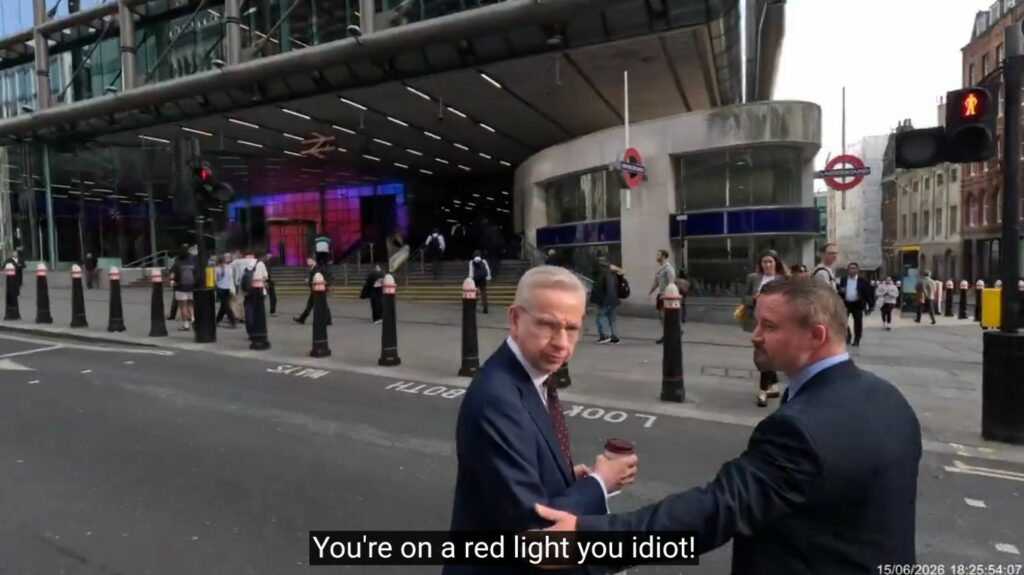

There’s a chance you might have seen a clip of a confrontation between a cyclist and a certain Baron Gove of Torry in the past 48 hours. It was an unnecessary confrontation in my opinion, and I’ll now do my best to explain why.
As a cyclist myself can I apologise on behalf of the community for this unmannerly individual https://t.co/qCPHNrznbe
— Michael Gove (@michaelgove) June 16, 2026
The rider who posted the footage – a prolific London camera cyclist who once captured a van driver allegedly doing something very inappropriate while behind the wheel (let’s leave it at that) – waited for the light to go green, and turned left onto the main carriageway. There is a ‘no left turn/except cycles’ sign, so the cyclist proceeded correctly.
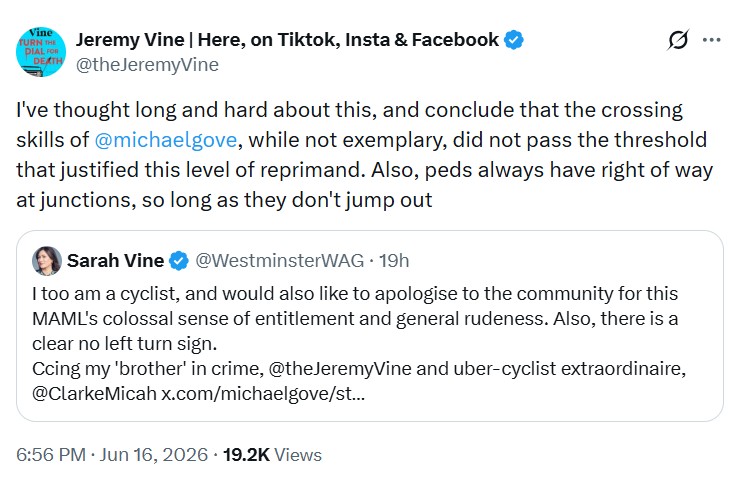
The UK’s Highway Code now incorporates the concept of the Hierarchy of Road users, and Rule H2 says that pedestrians “have priority when on a zebra crossing, on a parallel crossing or at light controlled crossings when they have a green signal”.
The lights on the pedestrian crossing had been red for several seconds when we see Mr Gove and another man step off the pavement, which means they should have waited (for this reason I believe Jeremy Vine is actually incorrect in saying Gove had “right of way” in the tweet shown above, but in general his assessment of the footage is similar to mine).
Rule H1 of the Code clearly states that it is the responsibility of “ALL road users, including pedestrians, cyclists and horse riders, to have regard for their own and other road users’ safety” – however, Rule H1 also says that we must be “considerate to other road users and understand their responsibility for the safety of others”: “Cyclists, horse riders and drivers of horse drawn vehicles likewise have a responsibility to reduce danger to pedestrians”, it continues.
This ambiguous wording essentially means that even if a pedestrian is not acting responsibly, you still have some responsibility for their safety. In the event of a collision, that means the cyclist could be found partly liable.
The case of Robert Hazeldean – a cyclist who was successfully sued by pedestrian Gemma Brushett following a collision even though he was cycling through a green light at a junction – is a prime example of this, although unlike Gove, it was said that Brushett was already crossing the road when Hazeldean set off (thanks to specialist cycling lawyer Rory McCarron for reminding us of this case).
But… in our angry cyclist’s interaction with the editor of the Spectator there was no collision, so pretty much everything I’ve written above is hypothetical. The cyclist did everything right… until he opened his mouth, and posted the footage to the world’s worst social media platform, accompanied with a scathing caption implying that Gove is a “menace” to cyclists.
Several of our Near Miss of the Day articles on road.cc have featured cyclists who said words they perhaps shouldn’t have after close passes from irresponsible or dangerous drivers, and I openly admit to having done this myself – but from my own experiences, this is often a physical gut reaction to a terrifying encounter, and not necessarily directed at the perpetrator. Those who haven’t experienced it might struggle to understand and file it under bad manners or unnecessary aggression, including a couple of police officers we’ve featured over the years who wrongly claimed they were unable to prosecute dangerous drivers if the victim can be heard swearing in the footage.
In this case, I don’t believe it was a fight or flight reaction. The cyclist came to a stop and avoided a collision with Gove, and couldn’t have done any more here in my opinion, despite what some might be saying on social media in a desperate attempt to pin the blame on the cyclist. What he absolutely could have avoided was the unpleasant words directed at Gove in the aftermath, whether he/anyone else thinks he deserved it or not.
In his retort, Gove was careful not to go into details about who was or wasn’t in the wrong. His use of “unmannerly” appears to be referring to the cyclist’s reaction only, and of course, there’s the obligatory “as a cyclist myself” remark: “A misinformed social media pile-on directed towards anyone who rides a bike, due to the actions of one individual who I could have ignored when he posted the footage to social media? Not on me. I’m a cyclist myself.”
So, what can we learn from this “unmannerly” non-collision? Because of how the situation played out, nothing much.
Mr Gove came away thinking he had an unnecessarily unpleasant interaction with a ‘typical cyclist’ while going about his day. Buoyed by the ill-informed reaction to the footage from some corners of ‘X’, he hasn’t yet publicly acknowledged that he could have done anything to avoid that interaction. The cyclist maintains that he was technically in the right, so continues to excuse himself for reacting the way he did in the aftermath.
The result? A few carefully considered observations, drowned out by many more claiming that the footage is typical of ‘cyclists’ – a homogeneous blob that exists to be hated and maligned, and this footage will only reinforce that stance to people who unfortunately think that way.
So, if any readers experience a close call with former education secretaries or any other pedestrians when you have priority at a junction or crossing, here’s my advice: say nothing and go on your way, ask if the pedestrian is ok, or even calmly explain that you went on a green light so got a bit of a scare. You could even still post the footage to your social media hellsite of choice – in this case I still think the algorithm would have been sufficiently interested, but the optics (a calm reaction vs an angry one) might have swayed the verdict more in your favour in the court of public opinion.
Anger and fear is understandable if you’re the more vulnerable road user, as cyclists know all too well. If you’re not the more vulnerable road user, a little bit of understanding and restraint may go a long way.











20 thoughts on “Michael Gove vs the disgruntled camera cyclist: Sometimes optics matter more than being in the right”
I don’t think the reprimand was excessive in this case, no matter how politely you point out their errors some people will justify to themselves that they did nothing wrong.
Depends on your definition of wrong. I often cross on red pedestrian signals. They are warnings it may not be safe to cross rather than mandatory do not cross signals. Where Gove failed was in not checking it was safe before crossing on red. I don’t think that deserved the reaction it got from the cyclist here. Being unnecessarily rude probably just makes him remember the encounter, not think about how close he came to an accident by not following basic road safety guidance.
Gove’s level of awareness didn’t seem to be that of an experienced cyclist…
Also, if the cyclist had been either paying more attention or not simply insistent on barrelling through regardless (unclear which from the video), it seems like they could have just slowed fractionally and passed behind without much drama or having to come to a stop.
Hang on, you can’t expect for pedestrians and cyclists to acquire Dutch levels of insight and understanding * just by putting in a few cycle lanes!
Because many of the Dutch cycle at some point and where separate infra is needed it will nowadays be a separate cycle path (not lane on road) with separate pedestrian footway (except deep in countryside) …
… this means pedestrians and cyclists know how to negotiate with each other and thus there is rarely a need for a formal crossing. If lights are needed to cross the road pedestrians will wait in a safe area separating the cycle path and road.
@mdavidford I’m not sure its fair to say he was barrelling through when he was making a left turn after just starting when the light turned green,
@LeadenSkies I agree Gove wasn’t behaving illegally but it’s surely wrong to walk out into the road against a red light without looking? The cyclist being slightly rude is the least he should expect in those circumstances.
Not sure what relevance what he’d just done previously has to the question.
@mdavidford Barreling suggests he was travelling at speed whereas he had just started riding and was making a turn so his balance might not have been good enough to have slowed and adjusted his line.
I don’t think it does – just processing on without regard to the circumstances. Replace it with ‘pushing’ if you like – makes no difference to the point.
From what I can see in the video, he’d completed the turn and had sufficient opportunity to slow – it wouldn’t have taken much of an adjustment.
* ‘processing’ > ‘proceeding’
@ mdavidford – can’t reply to the relevant post because threading issues but, to be fair, most dictionaries associate ‘barrelling’ (in this context) with speed and lack of control – neither of which describe this cyclist.
@quiff Well, that’s the beauty of language – it’s mutable and indeterminate, and a dictionary definition never captures the full nuance of practical usage.
In any case, as I say, I’m not wedded to the term, and it’s entirely peripheral to the point.
@mdavidford I recognise the limitations of a dictionary definition (or three), but it is a fair indication of prevailing current usage. If you want to change the meaning of language, you barrel on, but don’t be surprised if others don’t follow your argument as a result!
But again, it’s irrelevant to the argument.
@Backladder Under the new hierarchy of road users we cyclists have a duty of care to pedestrians. In this instance the duty of care amounts to two things. First avoid the pedestrian. Tick. Secondly point out the error of their ways to try to improve their safety in future. Tick.
Gove absolutely might have been complete unrepentant even if the cyclist was perfectly polite. But that wouldn’t have given him any room to accuse the cyclist of being “unmannerly”, which is the only thing Gove could realistically have accused him of doing wrong here.
As someone who regularly unleashes the fruitier sections of his vocabulary on drivers who do things that put me at risk of injury or worse, I have to say I agree with Jack here, the misdemeanour is not sufficiently egregious to justify the aggression. In this situation, which one faces numerous times in a day cycling in London, I find a simple “I think you’ll find it’s actually my light, chap/madam” suffices and nine times out of ten it elicits a sheepish apology. If the pedestrian wants to up the ante by giving back I’m quite prepared to respond in kind, but it’s not a situation that requires such immediate aggression.
That said it is Michael Gove so some forms of aggression would be justified, if the cyclist had said, “Exports are down 14% and we didn’t even have a small boats problem before Brexit, you idiot” I’d cheer him on.
There are several things on this planet, that when I look at them, my skill crawls and bile salivates in my mouth; and Michael Gove is one of them. So perhaps my thoughts on this are biased. And I shall keep them to myself.
I think the author is trying too hard to “both sides” this one.
The basic error is Gove’s – he was wandering across a pedestrian crossing on red for him with his head in a cup of coffee, and started well after it was on red. The Highway Code says “should not cross” in these circumstances.
He then tried to excuse this by red herrings. Conservatives, including Gove, are supposed to have taking personal responsibility for their actions as a core value. Perhaps having the crooked coward Boris Johnson and Fruit Loop Liz as elected leaders demonstrates that this is merely historical.
Gove is permitting a culture war being fought in the pages of his magazine; that is a war where Conservatives are demonising cycling because they hope it will save the rump Conservative Party. One example was their sudden reversal of support for the Welsh 20mph default limit.
Should noodles have reacted less sharply – perhaps. A chat with Michael Gove to stop him wandering around the streets like a lobotomised koala may have been beneficial.