



Zoe Bäckstedt’s classics season gets underway at Omloop Het Nieuwsblad tomorrow, the British multi-disciplinary star having returned to racing over the winter following a serious training crash in November which left her with multiple fractures and a new sense of faith in her use of a helmet.
At the time, the 21-year-old, who won the U23 time trial at the World Championships in Rwanda and is expected to continue to translate her talent to the pro ranks, revealed she had suffered hand and wrist fractures in the crash and was left believing her helmet had “saved my life”.
Bäckstedt urged other riders to wear a helmet too and, ahead of Opening Weekend, told the BBC she fears what could have happened if she had not been wearing one.
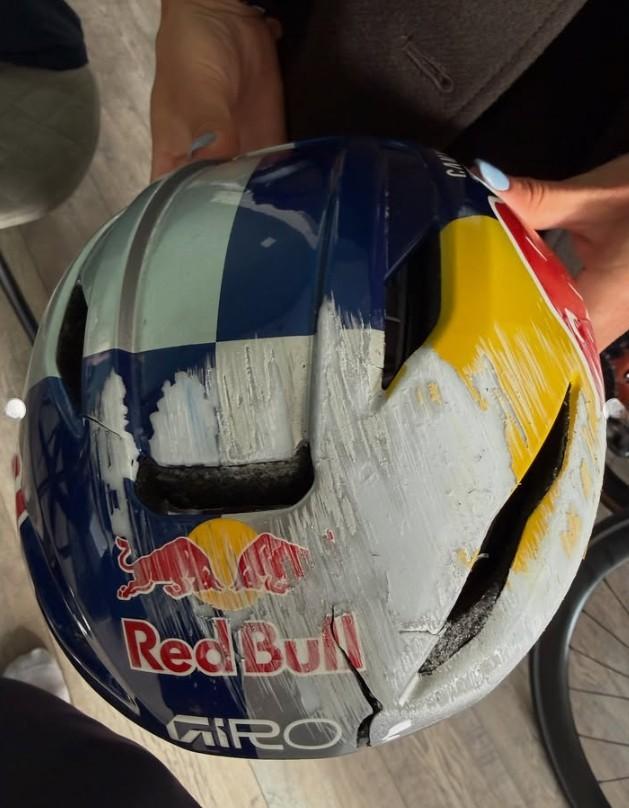
“Who knows what would have happened if I hadn’t had it on, maybe I wouldn’t be here today, the way the helmet broke into so many pieces,” she said. “When I crashed I didn’t even realise what was happening, because click your fingers and it was over. I stood back up and had the immediate aftershock of, ‘this isn’t good’.
“Everywhere I go, I try to wear a helmet, even if it’s just two kilometres away, it can save you so much if you’re in an unfortunate accident.”
When the crash happened, back in November, Bäckstedt shared photos online of her badly damaged Red Bull-branded Giro helmet and thanked the lid brand for its protection.
“One thing I know for sure, my helmet saved my life. Thank you Giro Cycling. Wear a helmet, please,” she wrote.
Bäckstedt’s winter of cyclocross was disrupted by the crash, however she did return to action in the post-Christmas period and reeled off a string of top-10 finishes at UCI World Cup events before finishing seventh at the World Championships.
> Perhaps my helmet did save my life — but that doesn’t mean you need to wear one
The daughter of 2004 Paris-Roubaix winner Magnus Bäckstedt and 1998 British national road race champion Megan Hughes, who also rides alongside sister Elynor in the pro peloton, Zoe’s 2026 road season began with a strong showing at the UAE Tour, including a third-place on stage one and finishing second in the youth classification.

One of Bäckstedt’s biggest goals remains a couple of years down the line, the Welsh rider telling the BBC her “obvious dream” is to be Olympic champion in Los Angeles in 2028.
“That’s one in the future that would be a very big goal of mine,” she said. “I want to go for Los Angeles 2028, I want to give my everything to be on the start line and go for a podium, that would be pretty cool to do. If I hadn’t been sick in 2024, I would have liked to have also been on the start line [in Paris], it just wasn’t my year.
“That was hard to accept but it just made me hungrier to be on the start line in LA.”
For now, a classics season beckons, starting with Omloop tomorrow.








84 thoughts on ““If I hadn’t had it on, maybe I wouldn’t be here today”: Zoe Bäckstedt recalls horror crash which smashed helmet “into so many pieces””
That looks more like a lot of sliding damage which would not have been nice without a helmet.
Anyhow, single vehicle collisions like this are what helmets are best used for – not so much the typical driver hitting you in traffic type of collisions.
But often if you are hit by a driver you will then go sliding across the road, no? The two times I’ve been hit by a car when riding a motorcycle (both at relatively low, cycling-equivalent speeds of around 20 mph) I’ve gone sliding across the road and my helmet ended up with severe striations across it. It didn’t save my life, save me from skull fractures or save me from brain damage (as far as I know) but I’m very glad that the deep scratches were on the helmet and not on my face and scalp.
Totally – I’d much rather have a scratched up (bike) helmet than a scratched up face.
To be honest, I’m not totally convinced that her life was saved by her helmet, but I can understand her believing that after having such a tumble.
That crack in the helmet is where it would have been protecting the base or her skull where it meets the spine. The back of the head and especially this area is a very dangerous place to have any hard impact. unprotected rear of the head injuries are more likely to be fatal than frontal or side impacts.
If it was, she had the helmet on back to front.
One thing to keep in mind is that cracks in helmets are usually the result of tensile forces as the plastic foam is strong under compression, but weak under tension. It’s possible that the crack formed due to the forces applied elsewhere e.g. if you snap a piece of spaghetti (or a Shimano crank), the break is not where you’re holding it and applying force.
While we can all be glad that she wasn’t killed, unfounded assumptions help no-one.
“One thing I know for sure, my helmet saved my life.”
If there’s one thing I know for sure, it’s that she doesn’t know that for sure, it’s an assumption based on a damaged helmet. Unless she repeats the same collision in exactly the same way but without a helmet, and dies, her assumption is wrong. It might have saved her from some nasty injuries, but it is unlikely that it saved her life.
I thought these “helmet saved my life” stories had finally disappeared, because the death rate of cyclists doesn’t fall as helmet wearing rates increase. There are thousands of these stories, many more than the average death rate of cyclists, so either wearing a helmet makes you much more likely to be in a fatal crash, or they aren’t true. The death rate of professional cyclists doesn’t seem to have fallen since the imposition of the helmet rule, but I haven’t checked recently, and the figures are too small to be confident.
“Everywhere I go, I try to wear a helmet….” I’m glad to hear that, as walking has the same death rate for distance travelled as cycling, I’m just slightly puzzled about how she washes her hair in the shower with a helmet on.
Helmets save lives in certain types of accidents. It baffles me that people ridicule cyclists for wearing a helmet. Do they help in every crash, no of course not. Do they help in this sort of crash? Absolutely.
Do medical professionals say time and time again that helmets help? Yes they do.
Anti helmet campaigning is bizarre in the extreme. Even the Dutch government now asks all riders to wear a helmet.
People don’t ridicule cyclists for wearing helmets, they ridicule them for making unsubstantiated claims about helmets because if they don’t then the government will start to seriously think about mandating them.
People do ridicule cyclists for wearing helmets though, go on any helmet discussion on Facebook or Twitter and it won’t be long before somebody starts in about “sheeple wearing their precious little polystyrene hats”. Many people also ridicule helmet wearers on the assumption that wearing a helmet automatically makes them in favour of mandatory helmets; I do, and I’m not, and many people I know hold the same position but still get shot down as presumed advocates of mandatory helmets if they try to say anything positive about them.
I’ll bow to your superior knowledge of facebook and twitter as I don’t use them (and I’m not going to start if your description is accurate) and I’m not accusing anyone of campaigning for mandatory helmets but I do believe we have to reject the regular unsubstantiated claims of their effectiveness.
People do ridicule cyclists for wearing helmets though
They certainly do! I remember being mocked with shouted abuse for wearing a helmet (I had been after one ever since I saw Americans wearing Bell helmets some time before) on Maryhill Road in Glasgow in 1976. Somebody brought one back for me after a holiday in the USA.
“Helmets save lives in certain types of accidents.”
They also increase the risk of the most dangerous injury, Diffuse Axonal Injury, caused by rapid rotation of the head. After thirty years of denying that helmets increased that risk, the helmet industry realised that there was even more money to be made by producing helmets that might possibly reduce that risk, MIPS etc.
Helmets were sold because people were endlessly told that a helmet would save their life, not by the manufacturers, but by helmet zealots. Since it has been proved beyond doubt that helmets don’t save lives, the helmet zealots have switched to saving injury, which they probably do. But they also increase the likelihood of a collision, as helmetted riders have more.
The biggest reasons that I oppose such misleading, inaccurate stories like this are that they deter people from cycling because they show it as dangerous, they distract from measures that actually make cycling safer, and the whole cycle helmet promotion thing started out from the worst of bad science, Thompson, Rivara and Thompson, A case-control study of the effectiveness of bicycle safety helmets, 1989 https://www.cyclehelmets.org/1068.html
Genuine question, how much of that increased likelihood is attributable to the fact that less confident/ more nervous riders might be more likely to wear a helmet and also more likely to have a crash, and also to the fact that people are more likely to wear helmets in a perceived-risk environment? If all urban commuters wear helmets and nobody who rides on quiet country roads wears a helmet, obviously the urban commuters are going to be have more collisions and so the figures would show riders with helmets have more collisions but it would be primarily attributable to the environment, not the helmets. Is there any research that shows that amongst a cohort of riders of similar experience and ability, riding in the same type of environment, those wearing helmets will have more collisions?
I don’t know of any research into that question but from my own experience a helmet interferes with my awareness of traffic around me, the noise from the wind in the helmet is louder than the sound of modern quiet cars and other cyclists so perhaps your urban commuters are crashing because they can’t hear other traffic around them?
(reply to Backladder as ability to reply to more than the fourth reply seems to have been removed)
I really hope that’s tongue in cheek, because if it isn’t it’s just ludicrous. I have never noticed the slightest discrepancy between wind noise when riding with a helmet and when riding without so it must be minimal at best. I’ve read quite a lot of debate about helmets, here and elsewhere, and you’re the first person I’ve ever seen suggesting that people wearing helmets might crash because of wind noise.
Reply t o Rendel
I’m serious, it might be a combination of my head shape and the helmet I use but I definitely have more wind rush around my ears with a helmet and notice it when bunch racing compared to social riding.
Okay, well I don’t doubt your experience but I can only say it’s not mine and from the lack of mention generally in discussions not that of many other people. Maybe when you’re racing with your head down the wind breaks over the crown and then round into your ears, intuitively I would say that riding heads up, which is what most commuters do, a helmet would be more likely slightly to deflect the wind away from your ears than into them.
Well, they (medical professionals) almost always make “life-saving” claims about helmets though they’re typically not that well versed in how bike helmets are designed to work (i.e. reducing acceleration by the foam compressing). Also, their view is skewed as they usually only see alive cyclists who’ve had a collision, so they’re not in a good position to evaluate how effective helmets are.
Again, the issue with bike helmets is not whether they do or do not provide some protection (they obviously do), but whether the cycling population is well served by focussing on PPE such as helmets instead of focussing on road traffic safety measures (e.g. increased enforcement of traffic laws, providing separate infrastructure etc).
I mean, you never seem to hear of medical professionals stating how many lives have been saved by separated infrastructure even when stats across different countries suggest that they are much more effective in reducing the general danger level that cyclists face.
My father undertook post mortems and attended coronors inquests until his retirement and early death. He saw the riders who died in accidents. He built up decades of observed experience. He made us wear a helmet.
Did he also make you wear a helmet for taking a shower, changing a lightbulb or being a passenger in a car? Statistically, those are also very likely to result in possibly fatal head injuries and the exact same argument applies to protecting your head for those rare accidents.
Also, what was his opinion on traffic safety and separate infrastructure? I suspect his views and observations were coloured by the media’s constant focussing on bike helmets and not actual effective methods to reduce danger.
Here is where Burt has a very good point.
The stats just don’t support the claims of safety benefits, especially when combined with the effects of speeding motor vehicles.
Burt actually said above (somewhat to my surprise, I admit) that helmets “probably do” protect against injury, but not death. Something with which I agree.
“My father undertook post mortems and attended coronors inquests until his retirement and early death. He saw the riders who died in accidents. He built up decades of observed experience. He made us wear a helmet.”
That is the very definition of observation bias.
Did he also do post mortems on people who had died from obesity and diabetes because they didn’t ride a bike? If so, he would have seen massively more of them than cyclists.
RE: NL. Indeed it’s true that the authorities are *recommending* them (though not all cycling groups IIRC) *. That is relatively recent (apart from one health and safety org there).
Thing is – this is in a context where they have *already* made cycling so safe that they have significant numbers of very young and very old riders **. Both known to be both at greater risk of crashing and of worse outcomes if they do.
Certainly in the UK it can feel like “it’s something we as cyclists can do” in the absence of most of the more effective means of preventing injury or mitigating consequences eg. “eliminate the major hazard” or “separate people from that hazard” – that being drivers of motor vehicles.
Regardless – even in the UK on average the most significant effect on health involving cycling is positive – from cycling (as opposed to not)! If wearing a helmet makes anyone more likely to cycle then I say wear one!
* I believe many groups point to the statistics and suggest that the most cost-effective intervention may still be taking any money that would be spend on promoting helmet use and spending it on getting more cycling and reducing car use, even there.
** That’s “safe” but the biggest part is “subjectively safe” – as most people go by how things feel, not reading stats. Of course there are lots of reasons why far more people cycle there: convenience, it’s been normalised as a mode of transport, there have been measures to discourage driving short distances, indeed a different philosophy of transport (see sustainable safety).
Why do these medical professionals never mention shit driving or infrastructure? And why do they never say anything about all the other activities that helmets might also help with e.g. Driving or being a pedestrian.
If you strap something to your head, and you fall, and the thing strapped to your head is damaged, you can NOT infer you would have died if not for that thing. Particularly when that thing is itself fairly fragile.
To make the flaw in such logic clear, if you strapped eggs to your head, fell and the eggs broke, would you seriously be able to claim “The eggs saved my life!!!”?
Skulls are already pretty tough things. Hair is also a pretty good abrasion resistant material protecting your skin.
They really aren’t that tough, researchers have found that a simple skull fracture can be caused by a force as low as 10kgs; it has been known for people to fracture their skulls simply by walking into a door frame, and a very significant proportion of fractured skulls come from simple low-impact falls when walking. The idea that hair can protect you from abrasions is pretty risible, maybe if it was woven into a mat it might but on your head it’s in individual strands; try running your fingernails over your scalp, does the hair protect you? No, it parts. Now imagine your fingernails are a rough road surface, the same thing would happen. None of this particularly is meant as a pro-helmet argument, but if you think you can rely on your skull and your hair to get you out of a crash undamaged I’m afraid you might well end up severely disappointed.
“caused by a force as low as 10kgs”
This sentence does not make much sense. Either you are misremembering or mischaracterising whatever research this was, or else this research you are quoting was done by people unqualified in this area.
73 Newtons in this planet’s gravity is the equivalent of 7.44 kgf (kilogram force). Although kgf has largely been superseded by Newtons as a measure of force it is still used in China, by the European space agency and various other bodies. So no, not misremembering, not mischaracterising, and not research done by unqualified persons.
https://www.forensicmed.co.uk/pathology/head-injury/skull-fracture/
Rendel, you’re quoting some web site that is *heavily* summarising some textbook, which is not freely available. Even so, you have selectively quoted the summary, the remainder of which is:
“A simple fracture can occur by walking into a fixed object (force required = 73N), whilst a simple fall through 1 m causing a frontal impact (510N) can also result in linear or mosaic fractures. Fractures have been absent when an impact force of 1314 N was recorded.”
Other information I find online suggests skull fractures correlate with impacts at 1 kN and above.
The reality is likely complex and varied. I suspect your 73 N figure is very much at some strange low extreme (thin skull, and some other unstated factors – who knows).
My goodness, you really are determined to defend your muddleheaded comment, aren’t you? Firstly you tried lofty patronisation, telling me that I must be “misremembering or mischaracterising” the research I was quoting, then when I give you chapter and verse you tried to claim that I was selectively quoting (I wasn’t, I was just quoting the portion relevant to our discussion, if I was going to selectively quote why would I give you a link to the original source?) and then tried to rubbish the source on the bizarre grounds that it is quoting a book that is “not freely available”. You then tried to dismiss the research on the basis that “other information I find online” (no quotation, no source) disagrees with it. I mean really, hats (or helmets) off for trying, if nothing else.
However, let’s assume that your assertion that it takes a force of 1000 N to cause a simple fracture in a human skull is correct (it isn’t, but let’s assume). In walking trip falls where the subject’s head contacts a solid surface, say a doorframe or a kerbstone, it’s common for the skull to experience a momentary force of between 70-120 G. As I’m sure you know, 1G equates to approximately 9.8 N, so a person tripping when walking and smashing their head on a solid object can experience a force of well in excess of 1000 N. This makes your assertion that you don’t need a helmet because the good old skull is pretty tough look fairly silly, given that it can fracture in a simple fall from a height of less than 2 m with no other force exerted upon it. By all means argue that helmets aren’t an effective protection against skull fractures, but claiming that there’s no need to worry about skull damage because it’s pretty tough is almost as risible as your claim that your hair will protect you from abrasions, something about which I’m still chuckling days later.
Speak for yourself, why not
Dagnammit – have road.cc stopped the img tags from working?
Yes.
What a shitshow
If there’s one thing for sure, you don’t anything about her crash. Her helmet shows a crack, and that’s significant. Maybe you think it’s no big deal. That’s your right, but don’t think you’re making any informed decision or that you know anything about potential consequences.
After having had a closed head injury and going through everything that followed, I can safely say I don’t want to ever go through that again. As a result, I do what I can to make sure I get home safe and intact. I understand the physics behind how a helmet works, and I further understand the limitations of helmets. With that said, I’m willing to pay for the possibility that a helmet might dissipate enough energy to keep me alive if for whatever I have to exchange energy and momentum with a car, road, or whatever.
As for your handwaving statistics, come back when you understand statistics and all the factors that influence statistical outcomes.
Assuming that post is aimed at me, it’s hard to tell with the new dreadful system:
“Her helmet shows a crack, and that’s significant.” Yes, but probably not in the way you think. Helmets are supposed to work by absorbing energy by deformation, and if they’ve cracked, they’ve failed catastrophically and haven’t absorbed much energy.
“I understand the physics behind how a helmet works,…” Given the above, are you sure about that?
“That’s your right, but don’t think you’re making any informed decision or that you know anything about potential consequences.” I was one of the first people in my area to wear a helmet, until someone asked me if I’d checked the data on the actual effects of helmets: I did so and never wore one again. I think I’m pretty informed on the subject as my MSc dissertation was about cycle helmets and I keep up to date with the published studies.
“As for your handwaving statistics, come back when you understand statistics and all the factors that influence statistical outcomes.”
I’m not sure which “handwaving statistics” you’re referring to, since my post contained none. I’m no master of stats, but I have a basic understanding as my engineering education, quality control, BSc and MSc all demanded that.
I see Mont Pythons upper class twits have been replaced by male anti helmet twits who probably ride under 10000 km/year while wearing bike gloves, ladies bib capris, power meters to register the watts they dont produce ,gps because they are easily lost on a tiny island, a mobile phone to call the wifey in case the ride gets too hilly or wet or fast or windy, all while complaining their tushy hurts. They always ask for proof..you could crash a few times on purpose without and with a helmet and send us the pictures. Do pros complain about helmets?..if you rode in a country with sun you would know that styrofoam actually keeps your head cool.. Ps ice hockey players say they dont need mouthguards..ask them to smile
OK, all the stuff I said elsewhere on this thread in defence of helmets, I take it all back. I’d sooner be seen as an anti-lidder than be associated with that heap of steaming ordure.
Who was responsible for organising the prizes on Bullseye? Tonight’s star prize was a luxury fitted kitchen. How are you supposed to split that between two contestants? Absolutely ridiculous.
Its nice that they have these little things called kilometres for all the show offs to ride large numbers of, but in the UK road signs use miles and speed limits are in miles per hour so come back when you are using big boy units!
You’re making a big assumption there that “anonymous person posting on the internet” is in the UK.
He’s talking about our “tiny island” so I think its fair comment 😉
Chocks away…
[Placeholder for obligatory ‘Helmet Row’ photo]
Dagnamit!
“But medics say..” check.
“One saved *me* once” check.
…
The one in the story certainly has taken a good scrape. If her head had been in that place (plausible – but not certain, helmet being bigger than head) that would have been extremely unpleasant. And likely any hat without a chin-strap would have come off.
“Who knows what would have happened if I hadn’t had it on, maybe I wouldn’t be here today,”
Can’t argue with that tbf.
And a quote for our sponsors?
“One thing I know for sure, my helmet saved my life. Thank you Giro Cycling.”
Person who gains financially from the support of a helmet company makes superlative claims for the product they are financially rewarded to wear and promote.
Shocker.
Just like James Cracknell. A fact not mentioned in his video, or by anybody interviewing him, and even though that broke the BBC Editorial Policy, my complaint was dismissed.
Zoe, Jonas, Remco and other pros who got injured in traffic accidents while out training should be part of a UCI-sponsored global ad campaign dedicated to road safety on two wheels. In 2026, wearing a helmet is a no brainer. Except for brainless cyclists.
In 2026, wearing a helmet is a no brainer. Except for brainless cyclists.
Agreed, if you don’t have a brain perhaps a helmet is less useful? Although perhaps even cyclists with no brains would appreciate protection from abrasions and some mitigation to soft tissue and even bone injury?
Aargh edit button back please!
I 100% agree with pro-cyclists when they say helmets are essential – just as I agree with Max Verstappen and Sebastien Ogier when they insist that helmets (and roll cages, six-point harnesses, and flame-retardant underwear) are essential.
Should I wear one to cycle to work, or the shops? I don’t wear a helmet when I drive to work, my car doesn’t have a six point harness or a roll cage and – you might not believe this – I don’t even own any flame retardant underwear.
Yes but…you’re not going to crash your car at 200 mph+ and are highly unlikely to roll it (and you may not have a roll cage but you do have a built-in safety cage), whereas cycling to work, given a suitable downhill, I can (fairly) easily reach the speeds for which pro cyclists wear helmets (30mph+). It’s vanishingly unlikely that you will experience anything like the crash severity an F1 driver will face, whereas cycling, especially if you come into contact with a motor vehicle, it’s quite possible you will experience the same crash severity as a pro cyclist, so if you agree with them that they should wear helmets when racing there is a pretty good came that you should emulate them.
Pro cyclists wear helmets as it is mandated. Before it was mandated, very few wore them.
Infrastructure, separation, 20 mph, traffic calming are far more important.
I couldn’t agree more, and when we have all that everywhere I might think about leaving off the helmet, but until then if I have to share the road with huge fast-moving chunks of metal, many of them piloted by persons of limited intelligence and even less self control, I’m going to keep the lid, which even Burt agrees can “probably” offer some protection from injury.
I do not achieve the speeds of pro-cyclists (45mph+) when I cycle to work or the shops, just as I do not achieve 200mph+ when I drive to the shops.
You’re just not working/shopping at the bottom of the right hill!
If it saves one life…
And the irony is that helmet promotion and mandation kills lots of people and they don’t reduce the death rate of cyclists.
The benefits of cycling vastly outweigh the risks, and helmet promotion and mandation deter cycling (the only proven effect) so those deterred lose those benefits and die earlier.
It’s more about the nomex suit, car helmet and five point harnesses (with HANS), but “reply” ain’t what it used to be…
Oh sir! sir! Johnnys riding his bike without a helmet, he’s going to die when he falls off!,
Yes what a silly boy he is !
Anyway jump in the car we’re going to be late for school and I hope no one gets in my way especially bleeding cyclists!!
I wonder if AI will see what fools we are..
Considering that AIs are trained on large datasets of Internet content, they’re pretty much our condensed stupidity as a species. Also, current AIs are Large Language Models which is pretty much just a clever bag of words.
Clever is not a synonym for enormous 😉
LLMs are indeed an enormous bag of words, but they are also a clever bag of words as when they pick the next most probable word, they are using a multi-dimensional mappings or relations between words and so they appear to communicate like a human, but they are only simulacrums and have no understanding or intelligence.
Having seen the strava AI comments I would dispute that it is clever, I suppose other AIs could be better.
I’m glad I had my trousers on. If I hadn’t I might have been arrested.
It proves that soft and brittle polystyrene cycling helmets break very easily.
“I think I nearly died doing extreme sport and my main takeaway is that the rest of you should all wear PPE to go to tesco”.
BBC loves helmet stories. I blame that Dan guy.
Looking at the casualty statistics it’s far more likely that you will suffer death or serious injury riding to Tesco’s than participating in racing, primarily because of the presence of cars. If you don’t think helmets offer any protection then fine, don’t wear one; if you believe they do offer some protection you’re probably more likely to experience the benefit if you wear one for everyday commuting and leisure riding and leave it off for racing than vice versa. Certainly if I was offered a choice when riding to my local Herne Hill velodrome of wearing one to ride through traffic to get there but taking it off to ride round the track or vice versa I would choose the first option.
If you could show me a cycling helmet that’s designed to protect me when I’m hit by a motor vehicle that would be really helpful. All the ones I’ve seen so far are only intended to protect me if I fall off a bike.
They do exist, but they’re expensive and they look something like this:- https://www.freepik.com/free-ai-image/war-zone-with-tank_67396907.htm
Don’t know about you but when I’ve been hit by a motor vehicle I’ve fallen off my bike, and wearing a helmet intended to protect me if I fall off has mitigated my injuries.
People ask for evidence. I’m one of those “doctors who say”: when I’m not cycling I’m a children’s intensive care consultant.
Here’s evidence: the number of children admitted to children’s intensive care with cycling related head trauma whilst wearing helmets on our unit.
Over a 7.5 year period, we admitted 22 young people with cycling related serious head injury. None were helmeted. Population data showed helmet wearing in the age group was 17%. This is a statistically significant difference.
Of those with follow up data, only 3/18 survived intact.
Since then, I haven’t published more data, but I know that we have admitted a grand total of zero young people who had a helmet on when they crashed.
Reference:
Cycling related traumatic brain injury requiring intensive care: association with non-helmet wearing in young people
Injury, Volume 50, Issue 1p61-64 January 2019
Given that the reporting of whether a cyclist is wearing a helmet or not is, to say the least, patchy and unreliable, your data is suspect and so are the conclusions. Unless there was irrefutable proof of the lack of helmet at the time of the incident, then you’re making assumptions.
Even if you have that proof, those figures are so small as to be at best, not robust.
Not to mention, of course, observer bias. How many children were admitted in the same period for other activities?
Seriously…. Yes of course my data is robust. That’s what science is all about.
If you don’t want to believe the data, then I don’t know what to say.
“Seriously…. Yes of course my data is robust. That’s what science is all about.”
Ah, proof by assertion, so very, very robust. Glad you cleared that up.
I see many children in the ER with life altering injuries caused by crashing bikes while not wearing helmets. I also hear stories from paramedics about children who don’t even live long enough after a crash to get to the ER. Same with adults, but less so.
Listen to the people whose job it is to scrape you off the road. Wear a helmet, don’t trash people who do, and don’t nitpick about whether a helmet saved a life – if she thinks it did, that’s her right.
I’d rather listen to the people who are working to prevent so many traffic collisions. There’s no clear evidence that helmets do anything to make cyclists safer (though there is limited evidence to suggest that bike helmets make cyclists less safe) though they do provide a small amount of protection that is likely ineffective in multi-vehicle collisions.
You’re using a strange logic really. I wouldn’t head straight to rubbish collectors to inform me about the best shopping decisions, though it is clearly their job to collect the remnants of my shopping. Similarly, I wouldn’t go to a sewer engineer to get the best health advice to keep my toilets regular etc.
To be honest, your mention of “children in the ER” seems like an emotional distraction technique to prevent people from thinking clearly.
“I see many children in the ER with life altering injuries caused by crashing bikes while not wearing helmets. I also hear stories from paramedics about children who don’t even live long enough after a crash to get to the ER. Same with adults, but less so.”
Again, observer bias writ large. Do you also see the many, many more people who die because of obesity and associated illnesses because they didn’t cycle? The health benefits of cycling outweigh the negatives by a huge margin, but this is never acknowledged by ER staff who only see dead/injured cyclists not the people who die from not cycling. Just because you see something doesn’t mean it is universal, and there is much more too it than just ER.
“Listen to the people whose job it is to scrape you off the road.”
Why would I listen to people with such a narrow viewpoint that they can’t acknowledge that there is more too it than just what they see? People who literally don’t understand that it’s far bigger than them and their skewed views.
“Wear a helmet, don’t trash people who do, and don’t nitpick about whether a helmet saved a life – if she thinks it did, that’s her right.”
No, I won’t wear a helmet, that’s my choice and having read a lot about it, that is completely justified. I don’t tell people what to do, maybe you could do the same? I do suggest that they go and look at the evidence and data, otherwise, like you, they might be arguing from a false premise.
She is entitled to think that a helmet saved her life, and it isn’t nitpicking to say that is extremely unlikely, given the data. It also isn’t nitpicking to point out that her sponsors likely include the company that made the helmet.
I can’t leave this ‘ER’ stuff unchallenged! We do not say ER!!
Perhaps the poster is not in the UK?
The one thing that seems fairly clear is they’re not in NL, and probably not in Copenhagen, Malmö, Seville…
Speak for yourself. I say it all the time – like every time I bring the other half a cup of tea or something.