


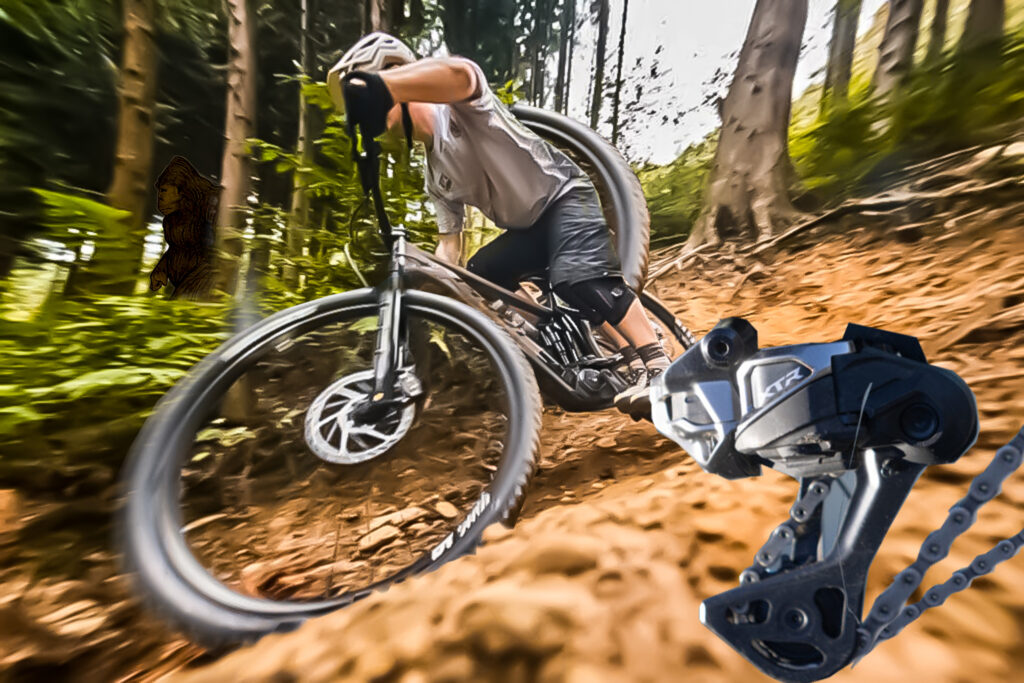

Everywhere, I’m seeing YouTube thumbnails, event posters, social video, and marketing that have all been churned out by AI. While this is just the tip of the iceberg when we consider what other parts of our lives AI is rapidly encroaching into, it’s a bit worrying to me that an industry driven by and created by people is increasingly turning to AI. Cycling is inherently about people, so I think stuff created by AI shouldn’t mix with it, or sports in general.
I will preface my rant by stating that I am incredibly against artificial intelligence in the creative space. While I can recognise its utility in other areas, I am naturally a creative human, and honestly, it’s hurting my job.
This is my writing you’re reading, and I’ve been a commercial photographer for 15 years or so now. I’m a huge appreciator of the arts in many, many forms. I love the work of Caravaggio just as much as I appreciate Coheed and Cambria’s music, and the Blade Runner films are amongst my top five. Let’s not forget about Alien… well ahead of its time, I tell you, as everyone else says.
My appreciation only grows knowing that people were behind these awesome things. These people have mastered their crafts to create things that only inspire awe, in my eyes. Coca-Cola’s Christmas advert, however, lacked soul and felt like a ruse, regardless of how much care was used when writing its thousands of prompts…
But, as with everything, artificial intelligence is creeping into the cycling world in a whole bunch of ways. For example, Fox’s current range of suspension forks uses crowns with a handful of holes in them, cut to shed grams while boosting stiffness. This came as a result of generative design, and admittedly it works rather well.
All over YouTube, there are AI-generated thumbnails; events use posters generated by AI to promote themselves, and I’ve seen brands at shows displaying full banners filled with AI-generated materials. I fully understand that time is valuable, and it can take time to learn the skills required. Hiring very talented artists to create such things can be expensive, but there are some real negatives and trends appearing.
Everything is beginning to look AI-generated. And just to circle back on hiring talent to create things for you: yes, it’s cheaper to throw something into ChatGPT for it to throw up for you, but there are a lot of aspiring graphic designers, photographers, videographers, copywriters, and more looking to get a foothold in their respective industries. Hiring people this way does a lot of good by giving these people an opportunity to shine, but also by developing what could be long-standing and mutually beneficial relationships, all while making work that’s more attractive but, importantly, more effective.
AI similarities translate into other industries, too; but how is a brand, event, product, or image meant to stand out amongst the crowd when the poster, picture, or YouTube thumbnail follows an identical style to everything else? A touch of false advertising can creep in here, too, as I’ve seen images of products from brands where the products are misleadingly large compared to the generate scenery they are shown in.
That’s not to say that brands using traditional techniques haven’t got it wrong in the past. Take Jaguar’s controversial rebrand, for example. And I’ve even heard stories of cycling brands of yesteryear hiring women to parade around their trade stands at shows, wearing nothing but body paint. Not cool.
Cycling is one of many industries that is made by people, to create something for people. The people aspect is a huge part of why I enjoy my job so much, and seeing people’s influence on their brand is what creates the iconic images and identities of brands like YT Industries, known for hiring folk like Christopher Walken to star in a film… for a bike. That particular campaign aired years ago now, yet it still sticks in my mind, and is an ingredient that makes that brand unique, ignoring YT’s recent turmoil for a moment.
The types of people who build those instantly recognisable campaigns are those who have experienced cycling first-hand for years, too. Folk like brand managers are out there riding bikes, chatting to other riders and getting properly stuck into the community. With that, they know what consumers want (let’s ignore 32-inch wheels for now), and they know how consumers feel about the nuances of cycling in general. That’s not to say that AI doesn’t, but AI has never ridden a bike.
Even if the good old personal touch leads brands, influencers and the like to make mistakes, I’d rather that than have a dystopian similarity when scrolling the socials, or picking which video I’d like to watch next. Those mistakes, quirks, and nuances are what make something recognisable, get people talking, and incite an emotional response, for better or worse. Not the same old AI-generated copy slapped onto an AI-filtered image.
Cycling is aspirational, which can be good, and sometimes exclusionary (which is a topic for another day). I want to see pictures and videos of actual places that I might want to ride. I want to see what can be done with a bike by people who know how to ride them. I want to be inspired to ride my bike. At the moment, AI-generated content cannot do that.
While my Photoshop skills aren’t developed for much more than editing pictures, and my YouTube thumbnails are probably a bit naff (see above), I’d rather be known for creating naff thumbnails than slamming pictures through the AI machine to make something for me that looks similar to other AI-generated assets, to then get lost in the sea of other AI-generated thumbnails. Hopefully, my fumbling through programs like Photoshop shows a bit more personality, or at least, care.
For most of us, cycling is a passion. With passion comes emotion, and with emotion comes being human. Watering down that emotion, whether you’re a brand, influencer, or event organiser, leads to exactly that. A lack of emotion. That human connection is what cycling is all about, and that can be experienced first-hand by going out and riding with mates.
Scrape that, AI.
-300x199.jpg "“He wants bikes in traffic lanes. Give him what he wants”: Cyclists urged to “slow every street down to bicycle speed” and ride in middle of lane amid premier’s war on cycle paths + more on the live blog")











20 thoughts on “AI is destroying the personality that cycling thrives on”
AI is sloppifying lots of different areas, and there are a bunch of people pushing it, and a great number more taking the lazy option. It’s going to take time before societies start to really push back and rebalance the value they place on human produced content. It will get worse before it gets better.
AI “slop” is a pointless finger pointing. This is the new revolution and after graphic designers and accountants and radiologists- photographers will need to retrain for the new environment.
No ideal but it is real and now. Adapt and survive
@Freddy56 is it like not needing to use paper and a slide rule, or … is it more like the car and “traffic in towns”?
Perhaps it’s no more healthy to avoid thought and mental effort than physical exercise? Perhaps we’d all avoid massive cost and health issues if – like the car – we could agree some sensible limits at the beginning?
OTOH given the never-before-seen sums going in to this, and the large number of (smart and already powerful/ wealthy) folks and organisations desperately needing to make it “too big to fail” to protect their speculation …
… and human nature (plus captive audience now we’re all already online and almost everything from clothing to cereal coming with chips)
… I think you may be right in that even if we have no use for it (and it’ll make us redundant), tough.
@Freddy56 nah. There’s nothing to give into or adapt to. Ai might be around for a while in some form, but in the end it will not be as prevalent and seemingly ubiquitous as it is today. I’m thinking we’ll have more localized models trained on small, specific datasets rather than a gigantic dataset of stolen information. It does nothing but regurgitate those stolen ideas humans have already created but in slightly different ways. It can’t truly create anything new. It is a novelty that will wear off and try to overstay its welcome. It will be fun to watch it fail, specially when those investors start asking for returns.
@Freddy56 wrote “No ideal but it is real and now. Adapt and survive”
It’s a very similar situation to climate change. As a species we had a choice to reduce carbon emissions or do nothing and learn to live with consequences. We chose the latter and now we wait to see which one will kill us off first.
This article reads like it was written by AI.
@mdavidford Nah, only a human could have written this, whatever it means: “Cycling is inherently about people, so I think stuff created by AI shouldn’t mix it, or sports in general.”
@quiff I think all human generated text should have the disclaimer “I am human and can make mistakes. Please double-check responses.”
AI is cancel culture
Anyone who thinks it’s good has no talent and wants to be homogenised into a world of bland sameness.
Isn’t the opposite of someone who’s homogenised split personality disorder?
Gold top personality disorder.
Personally I am quite looking forward to the day (in 2027 apparently) when AIs & their drone assistants take over all the dull stuff and we get to ride our bikes all day.
Ironically, I am writing this under an article by one of my favourite and most (for lack of a better word) “personal” cycling journalists. So, Liam, please do not take this personally.
BUT.
You, cycling media, are part of the problem. You propel the frenzy for the new, the latest and the hunger for undeliverable promises, and virtually earn commission with each item sold. And what better and more convenient way to make an undeliverable promise than to create its image with AI?
Every day you repeat whatever BS is pushed by manufacturers, replicate their (often AI-made) materials, and then everyone is surprised that bike prices have gone through the roof, while bikes themselves have become less and less accessible or even understandable for the average hobbyist or even human being in general.
AI is not the problem. It is but a new means to boost the transformation we have found ourselves in.
@tomlew
Absolut! This response hits the nail on the head. The gradual encroachment then hegemony of the mass media has been a creeping sickness for millennia albeit only lately revealed as the omnipresent toxoplasmic mind-plague that it is. Few humans are left who are not utterly possessed by one variety of mad-memeplex infection or another.
Consider the historical effects of mind infections such as religions and ideologies. Consider, then, the very similar effects on humans and all about them within an ecology from the various smaller mind diseases such as consumerism, motornormativity and now 1001 utterly ludicrous, but widely believed & acted upon, conspiracy theories, racist prejudies and similar flowing down the mass media rivers like turds in The Thames.
No doubt websites like this and others supposedly “serving special interests” will see themselves as a boon to their readers. In fact, they’re just another symptom of the general malaise of consumer-rabies. They also enjoy their own Daily Hate Mail variety of heroes and villains, just with a different slant from that gutter press rag’s groupings of us vs them.
And yet here we are still reading …….. and forming another klutch of daft opinions about things we actually know nothing about, of any truth or cogency.
@tomlew A good point. This opinion piece seems to be complaining about how AI is being used to sell us stuff, rather than using humans to sell us stuff.
AI has no impact on me enjoying cycling, how I ride, the people I ride with etc that the article says.
People are hard wired to be lazy. From an evolutionary perspective non-essential activity just gets in the way of our core function: reproduction. This is why people drive half a mile to a supermarket to get a few groceries rather than walk, they’re not being lazy in the pejorative sense, they’re being ‘lazy’ because that’s our biological programming. This goes some way to explain why there’s an obesity problem in a world where day-to-day activity levels have dropped off of a cliff edge as work has become a sedentary activity. What’s this got to do with AI? If ‘automation’ has driven westerners into a sedentary existence – we don’t dig, hunt, build or walk miles everyday just to be able to eat – with all the attendant health issues that have resulted, what’s AI going to do to people’s ability to think when it ‘relieves’ us of the need to exert some brain power to solve a problem or make a decision?
@jaymack “what’s AI going to do to people’s ability to think when it ‘relieves’ us of the need to exert some brain power to solve a problem or make a decision?”
I feel that this is already underway.
Ironically, in an era where most people have a device in their pocket that gives them access to previously unavailable levels of information, the levels of disinformation are truly shocking.
At the core of this, is an apparent lack of critical thinking skills – just as having a calculator doesn’t provide basic mathematics skills, having information at your disposal doesn’t provide the skills necessary to distill that information.
AI is just an acceleration of that process
I worked in the TV industry for a few decades and I’m old enough to remember when Photoshop was considered the next great thing, but also the killer of creativity. And then there was Avid and Flame – which were going to destroy jobs and manipulate images. As a young person in the 90s I worked in Soho and moving images were still stored on tape. We would dub film and beta onto different formats for distribution. But then along came digital! And away went hundreds of jobs and creatives.
Think back to 90s London and the thousands of cycle and motor bike couriers zipping around the streets. They are mostly gone – and it was digital that killed that industry. Suddenly no one needed a physical package delivered. It was sent by cable instead.
@Rome73 The technologies you talk of automated physical processes. The hype of “AI” is that it will automate away thinking processes. There is a bit of a difference.
We’ll see how it shakes out. “AI” is useful at generating stuff, but it is nowhere near capable of the precision and rigour that some claim for it.
A lot of people aren’t capable of that precision and rigour either, though.