Plans to remove a protected cycle route in Reading and re-open the road to motorists in both directions have been deemed to have a net positive impact on the environment by the council, due to expected reductions in congestion and increased volumes of traffic in a nearby bus lane.
Sidmouth Street, a 300-metre long road in the town centre, was first converted into a two-way cycle lane as a temporary measure during the coronavirus pandemic, with drivers only able to travel northbound on the remaining lane. The lane, and several other road closures to drivers, was made possible with £1.4 million of emergency active travel funding made available by the government to the council.
> FROM 2020: Reading announces pop-up cycle lanes after two cyclists are killed in one day
In April 2022, the council responded to a resident’s criticism of the two-way cycle lane as a “white elephant” by releasing data showing 76 cyclists using the lane in a 12 hour period, “a respectable level of use” that justified its maintenance. Five months later, the council’s traffic management sub-committee voted to make the Sidmouth Street cycle lane permanent.
However in the intervening years the council, which has been controlled by the Labour Party since 2012, has soured on the lane, and in February announced the lane would be “scaled back” as it had been “underutilised” by cyclists. The council also said there was a lack of funding to connect the cycle lane with other active travel infrastructure nearby.

Councillors have blamed the funding model, introduced by the previous Conservative Government, that led to the cycle lane’s construction, arguing it created a “Hunger Games-style system where local authorities had to rush to put in bids, to scramble against one another and to compete, and the funds allocated in perhaps quite an inconsistent way, which made it difficult for local authorities to be strategic and think long term.”
Following the publication of the town’s Local Transport plan in June, the council lead for transport said, “Some people, many people, need to drive and many people will have a vehicle, and from time to time they will use it. Let’s leave the road to them, and let’s talk about the vehicle that they are driving.”
John Ennis said the council’s priorities were to “to boost electric vehicle charging, active travel schemes and speeding up bus journeys,” and commissioned a review and public consultation of the Sidmouth Street lanes. The local Green Party, which is the largest opposition party on the council, has also criticised the council for its disjointed construction of cycle lanes.
The findings of the council’s consultation and its officers’ recommendations have now been published and will be voted on at a meeting next week. 13 responses were received to the public consultation, with six supporting a proposal that the Local Democracy Reporter says would have retained the two-way cycle lane whilst narrowing it to create an additional turning lane for drivers.
Seven responses opposed the proposal, and the council say: “A number of comments criticised the apparent prioritisation of motor traffic over Active Travel, describing this as contrary to climate, equality and transport policy goals. Some wanted stronger evidence that the design meets cycling standards and does not reduce safety, including a proper audit and clearer explanation of transitions, crossings and segregation.”
Meanwhile over a new survey of three consecutive days in April, 55 “average daily cycle movements” were recorded along the cycle lane in both directions, a 28 per cent decrease compared to 2022’s results, though the number of pedestrians counted was significantly higher.
However, the report recommends the council adopts a new design that would abolish the two-way cycle lane and replace it with a shared path to be used by pedestrians and cyclists. The wider lanes would then enable wider berths for car parking and the restoration of two-way car traffic. This proposal would require another public consultation.
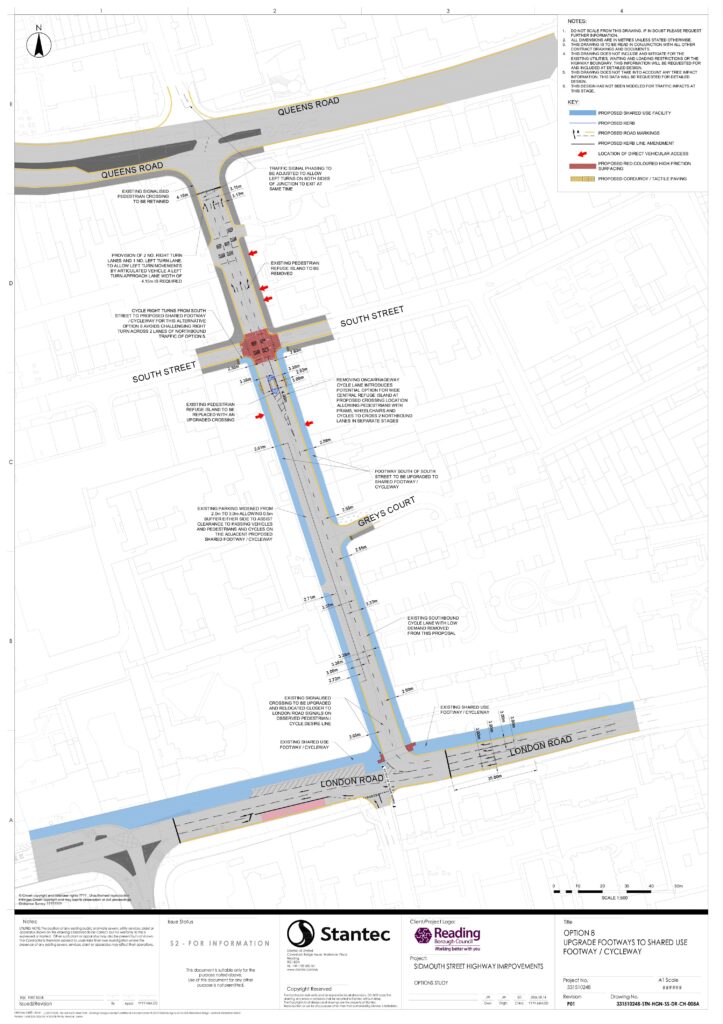
The report author writes that these recommendations “align with the council’s priorities, namely, to deliver a sustainable and healthy environment and reduce our carbon footprint.
“In this instance, it is expected that the changes on Sidmouth Street will improve the overall traffic flows on Sidmouth Street and London Road, and supported by the new bus lane on London Road, offers a variety of sustainable transport options for those travelling to or through Reading.
“It is acknowledged that removing the on-street cycle facilities from Sidmouth Street may impact some cyclists that use this route for travel, however based on the survey results it is considered that the new proposed scheme will deliver wider benefits, including to pedestrians and cyclists, through improved crossing facilities and connection to/from South Street.
“A climate impact assessment has been undertaken, and it has been assessed that this proposal will have a Net Positive impact. The purpose of this scheme is to support growth in sustainable transport, through the introduction of a bus lane on London Road.
“Whilst acknowledging the reduction in active travel provisions, it is expected that an overall net benefit will be achieved, due to the frequency and volume of use of the new bus lane. This is accompanied by a reduction in congestion, through the provision of additional vehicle capacity on Sidmouth Street.”
Construction and removal of the Sidmouth Street two-way bike lane is budgeted within nearby bus lane plans on London Road, which are due to cost £1.5 million. if the council’s forthcoming consultation passes without a hitch, the scheme is set to be implemented in March 2027.