



Councillors in Reading have clashed over proposals to shorten a cycle lane as part of a local transport plan that the lead councillor argues should “leave the road” to “people [who] need to drive.”
In February, Reading Borough Council announced that, rather than expanding the cycle network to better utilise the two-way cycle lane on Sidmouth Street, east of the town centre, they would scale it back to “make the best possible use of the road space we have”. The lane was first installed as a pop-up lane during the coronavirus pandemic, after two cyclists were killed following collisions with drivers.
> Reading announces pop-up cycle lanes after two cyclists are killed in one day
Despite the lanes being made permanent in 2022, the council previously claimed they had been “underutilised” due to a lack of funds made available to link the road to other cycle routes in the town.
Now, presenting the council’s latest Local Transport Delivery Plan to the council’s strategic environment, planning and transport committee, lead councillor for climate strategy and transport John Ennis said the council’s priorities would be “to boost electric vehicle charging, active travel schemes and speeding up bus journeys,” as reported by Reading’s Local Democracy Reporter.
“Some people, many people, need to drive and many people will have a vehicle, and from time to time they will use it. Let’s leave the road to them, and let’s talk about the vehicle that they are driving.
“Let’s ensure that if they are driving on the road, let’s ensure it’s a vehicle that is not having pollutant emissions,” the Labour councillor added.
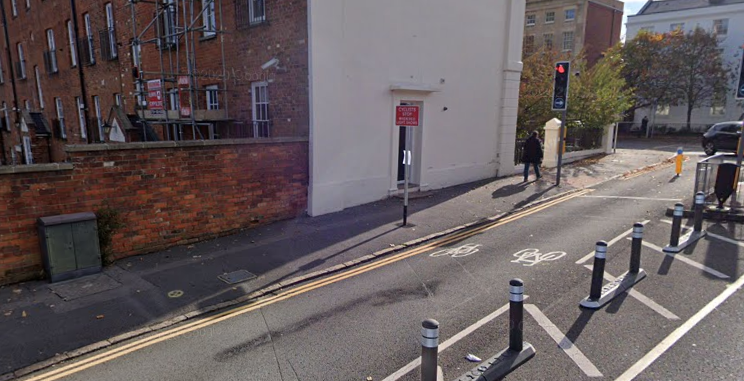
> Call to remove “senseless” cycle lane, according to local paper story using one resident’s opinion
In response to the proposal, an opposition Green councillor labelled the original Sidmouth Street cycle lane shortening a ‘waste of time and money’, whilst expressing disappointment with the council’s proposal.
“I guess we’ll have to wait for a change of council if we’re hoping to get anything other than more or less more of the same when it comes to transport.”
Other Labour councillors admitted the cycle lane was flawed but blamed the funding model, introduced by the previous Conservative Government, that led to the cycle lane’s construction, arguing it created a “Hunger Games-style system where local authorities had to rush to put in bids, to scramble against one another and to compete, and the funds allocated in perhaps quite an inconsistent way, which made it difficult for local authorities to be strategic and think long term.”
>Another councillor argued the lane, made permanent in 2022,“was a COVID measure to get people cycling and making sure people were separate. We had a vision, we wanted to link it along with other cycle lanes. We didn’t get the funding because some political parties are boasting that they are going to take power.”
Reading Borough Council has been Labour-run for 39 of the last 40 years. A third of councillors were up for re-election in last week’s local elections. However, in contrast to national trends, Labour lost only three of its 10 defending seats, whilst the largest opposition Green Party made modest gains. Reform UK did not win a seat, with their only councillor losing re-election.
Despite certain objections, the Local Delivery Plan was unanimously approved by the council committee, with the final plan due to be submitted to the government in September.



















11 thoughts on ““Let’s leave the road to drivers,” says council’s climate and transport chief – as “white elephant” cycle lane shortened to introduce “expanded capacity for vehicles””
Ah, the easy lie that electric cars will solve our problems without having to get off our backsides:
– Zero pollution? Not from the brakes and tyres.
– Zero pollution? Not from the electricity production.
– Zero pollution? Not from the catastrophic rare earth minerals mining required for batteries.
And that’s before you get onto issues with creating a grid capable of providing sufficient electricity for all these vehicles. And the damage to the roads (and people) from the additional weight.
“let’s ensure it’s a vehicle that is not having pollutant emissions”
Yes, preach! Oh, you’re talking about electric cars, aren’t you.
“Emit elsewhere” – it is an effort at harm minimization *
…BUT it’s fairly minimal harm minimisation. (Because otherwise it runs into “change?!”)
* Including to the corporate balance sheets / political order.
Not forgetting, of course, that EVs are significantly heavier than their petrol or diesel equivalents. It’s one reason why there are so many potholes nowadays.
With Labour councillors like that, who needs Reform!
If you look at the comments in the linked article
you will see that the cycle lane is in fact in the wrong place. The problem here is one of long term planning to create high quality joined up cycle infrastructure. I think London has shown that when this is provided it will be used. Unfortunately “long term” is not in politicians’ vocabulary due mainly to our political system. As is also mentioned in the article, the “hunger games” funding model for active travel is not helpful.
Look at the latest round of funding, not one piece of infrastructure provided but another £1 million spent.
https://www.gov.uk/government/news/innovative-walking-wheeling-and-cycling-projects-win-share-of-1-million
Hear hear! There’s vast amounts of road space that aren’t even normally used. It’s mostly there to help drivers feel more relaxed. eg. to help drivers go faster while paying less attention *and* crash less often! *
Then there’s the “alternative parking for those who have drives”.
And we haven’t even got to the fact that motoring is inherently space-inefficient compared to most other modes.
And as the councillor accidentally notes – much (most?) driving is optional – it’s about choices (albeit “how we’ve chosen to organise our lives”) *because* driving is easy and convenient.
Oh…
* Unused road space: https://robertweetman.wordpress.com/2026/04/14/redundant-carriageway/
Choices in how we allocate precious urban space, and the fact that people can both still be able to drive and can cope with driving less: https://bicycledutch.wordpress.com/2026/01/21/when-space-runs-out-rethinking-the-role-of-the-car-in-dutch-cities/
“Some people, many people, need to drive and many people will have a vehicle, and from time to time they will use it. Let’s leave the road to them, and let’s talk about the vehicle that they are driving.”
This is true. Many people do need to drive. Whats even more true is that a huge number of journeys don’t need to be driven and a huge number of journeys are made by car through sheer laziness and because the infrastructure is so hostile to any other form of transport. When walking you have to deal with cars blocking the pavement and the desperate lack of zebra crossings. Don’t get me started on the highway code change to give pedestrians priority at junctions. What do we reckon? 10% of drivers do and I would wager that a huge number of those people were doing that before the change just because they are nice.
Cyclists have to deal with shitty infrastructure that makes it more dangerous for cyclists along with all the dangers that cars pose. Public transport is expensive and crap in many places.
The car is the defacto because people are lazy and the alternatives have been ignored/diminished for so long that they aren’t attractive. Make driving unattractive.
@mctrials23 Let’s not forget that many of the people who genuinely need to drive now wouldn’t need to if the infrastructure was less motonormative; I’ve known several elderly/disabled people who have said they would be more than happy with an 8 mph mobility scooter for doing their shopping and general transport around town but they don’t feel safe on the roads and the pavements often aren’t wide enough or (outside London) are blocked with parked cars. Electric mobility scooters are absolutely ideal for short journeys for people too infirm to cycle but they will always be limited in their uptake, like cycling, until the infrastructure priorities are changed away from automobiles and towards human beings.
@Rendel Harris I would love to know the genuine number of people who actually need to drive because I would imagine that its actually really small. I think that the vast majority find it far easier and more comfortable.
Unfortunately, the people who “need to drive” are co-opted whenever drivers want to avoid giving up anything to another group. “Won’t you think of the disabled who need to drive”. Sure, lets get as many cars off the roads as possible so that the people who need to get about by car can do so easily and quickly. Lets get all cars off pavements so people with wheelchairs and prams can actually use them.