

The number of car journeys in London is set to increase faster than the number of journeys on foot or by bike if policies to encourage active travel aren’t implemented, a new report from the Mayor of London has warned.
Transport for London has conducted ‘Strategic Transport Modelling’, examining how the capital’s transport network is set to function over the next decade in light of expected population growth and a rise in the number of jobs through to 2036.
In 2023, used as a base year for TfL’s statistics, 8.5 million journeys during weekdays in term time were classified as ‘active’, compared to 8.3 million journeys in ‘highway vehicles’ (such as a car or taxi) and 8.2 million on public transport.
The report explains that its forecasts are not predictions, and that “the purpose of this strategic modelling is not to try and predict the future but to identify the highest risks to inform potential mitigations and investment.”
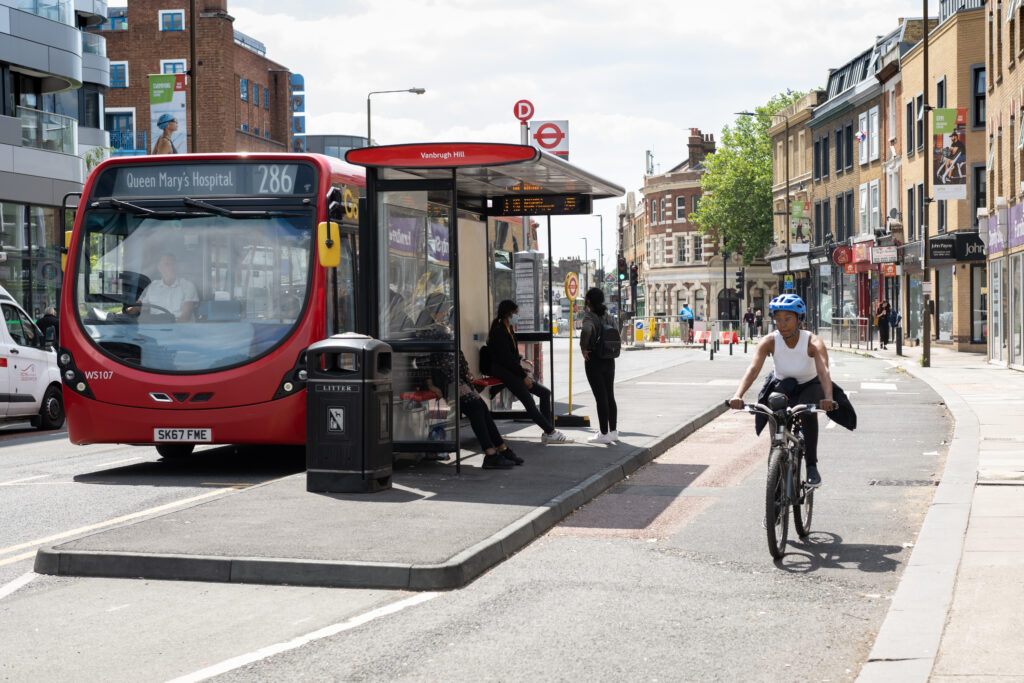
However, anticipating a population growth of 940,000 people, as well as an additional 490,000 jobs, highway trips are expected to grow by 10 percent, compared to only a six percent growth for active travel, suggesting that car use would overtake journeys made on foot or by bike.
Those figures headlined a Guardian story on the Mayor’s report, and were considered “disappointing” and “a U-turn” by Ralph Smyth, an adviser to the Transport Action Network.
Writing on Bluesky, Smyth said “With population growth, keeping the share of car trips fixed means more traffic.
“The mayor of London’s U-turn isn’t just disappointing for Londoners. It now seriously calls into question the Government’s plan to give wide-ranging powers to mayors across England, without corresponding responsibilities to cut carbon, crashes and pollution.”
Smyth also told the ‘paper that Lord Khan “seems to want to turn back the clock and increase cars across the capital.” However, the mayor’s office disputed those findings, with a spokesperson stressing that the published model “is based on a scenario in which no additional active travel schemes will be introduced over the next decade – which clearly is not the case, and the modelling will help identify what future transport schemes may be needed.”
The London Cycling Campaign offered a more nuanced criticism, suggesting that “TfL should not be modelling for ongoing heavy car use in London, but instead articulating how to do land-use planning and transport policy to get a lot less of it.”
During Sadiq Khan’s mayoralty, TfL’s cycling network has expanded dramatically to more than 450 kilometres in length, with the number of journeys made by bike also increasing. There has also been a significant improvement in air quality in the city.

More recently, he has also been criticised for reducing bike parking provisions for new affordable homes, and for a lack of cycling infrastructure in or around Oxford Street following its partial pedestrianisation.
Whilst their strategic model forecasts that the number of private vehicle journeys will remain 30-35 per cent of all trips in the capital in ten years’ time, the mayor’s Climate Action Plan sets a target of reducing that to 20 per cent by 2041.
The mayor has also been bidding to expand and standardise the regulations of dockless hire e-bikes throughout London, though those powers are not expected to be formally devolved for several months.