



Jonas Vingegaard’s sports director has called into question the sporting integrity of the Tour de France’s nighttime doping tests, after the UCI released a statement defending the out of hours controls, insisting that they are reserved for “limited and justified circumstances”.
On Wednesday afternoon, cycling’s governing body issued a press release acknowledging the potential impact nighttime tests (outside the ‘normal’ testing hours of 6am to 11pm) could have on riders’ rest and recovery, while also pointing out that they “serve an overriding interest: the fight against doping”.
Speaking to road.cc at the end of stage 17 in Voiron, Visma-Lease a Bike sports director Marc Reef – whose GC leader Vingegaard crashed out of the Tour the day after being wakened by anti-doping officials at 2am – noted that the testers have the right to knock on riders’ doors at any time during the race’s three weeks.
However, Reef warned that the “unfair” nature of their timings could have an impact on the outcome of the Tour.
“I think that the rules are that 12am in the evening before the race starts until 12am when we finish in Paris, they have the chance to test the riders. And I think that is what they did,” Reef told road.cc outside the Visma team bus.
“I think it’s about the sporting integrity. It’s good for sporting integrity to test because that is really good.
“But at the same moment, it also harms the sporting integrity because you have different moments during the night when you’re going to test riders, and for the competition that’s not really fair. So I think that’s something to look into.”
Asked if he felt that Visma and other teams such as UAE Team Emirates were being targeted by the testers, Reef bluntly responded with a simple “no”.
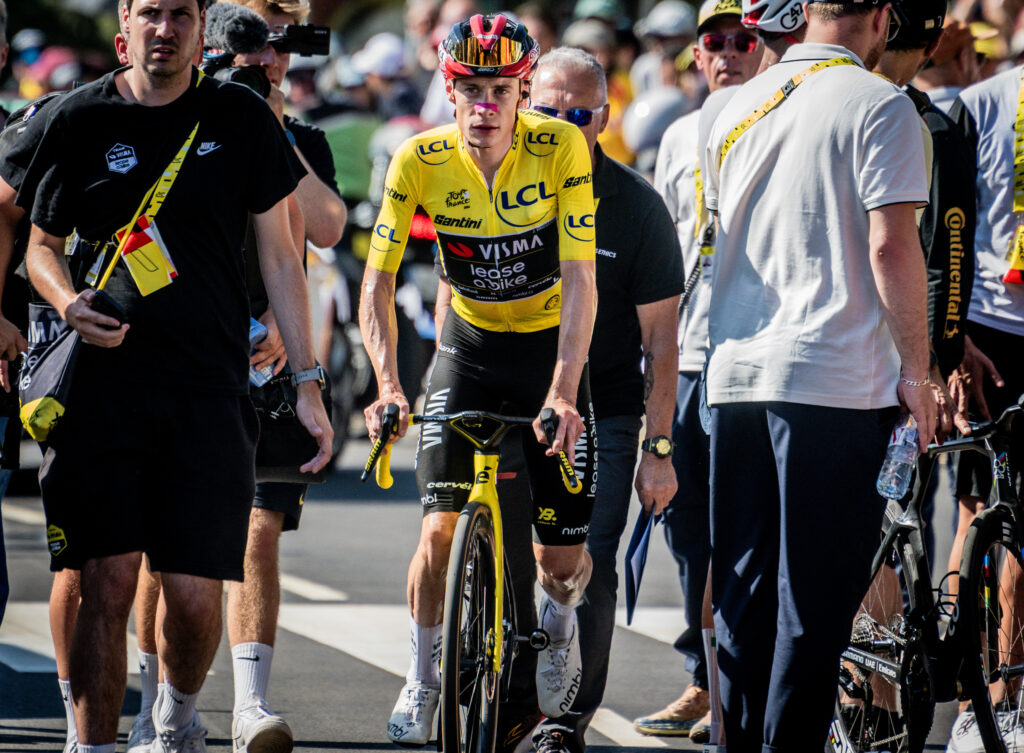
The controversy surrounding nocturnal drug tests at the Tour first erupted on Sunday, when Vingegaard and yellow jersey Tadej Pogačar, the then-top two at this year’s Tour, were woken up at 2am and 5am respectively to submit samples to the International Testing Agency’s anti-doping officials.
It has since emerged that Pogačar and Vingegaard are not the only riders to have their doors knocked by drug testers in the middle of the night, with sources within multiple teams informing road.cc that their riders have been subject to tests carried out in the early hours of the morning at this year’s Tour.
On the other hand, one source at an established Tour team told road.cc that, as far as the squad’s doctors can remember, their riders have never been required to submit an anti-doping sample between 11pm and 6am.
The controversy took another turn on Sunday afternoon, when Vingegaard was forced to abandon the race after breaking his collarbone in a crash, prompting Pogačar to suggest that the Dane’s interrupted sleep may have caused a momentary lapse of concentration leading to his Tour-ending crash.
According to the UCI’s rules, anti-doping controls may be carried out outside the normal hours of 6am to 11pm (which, before 2016, were the only times tests could take place) if there is a “serious and specific suspicion that the rider may be engaged in doping”.
Whether there is sufficient suspicion to carry out nocturnal testing must be approved by a judge of liberties and detention (JLD) at the Paris judicial court, with that judge also determining whether waiting until the morning could lead to the “risk of loss of evidence”.
Provided these conditions are met, nighttime tests enable anti-doping authorities to act on information they believe may indicate doping, especially if riders are using methods, such as micro-dosing, which mean certain products wouldn’t show up in their samples if the tests were carried out just hours later.
Nevertheless, the CPA riders’ union were among those criticising the “intrusive” methods seemingly favoured by the ITA at this year’s Tour.
“The Tour de France is a competition that demands exceptional physical effort,” the CPA said in a statement.
“The quality of sleep and recovery is essential not only for performance but also for the health and safety of the riders.
“It is clear that this practice hinders athletes’ recovery during the most important and difficult race on the global calendar and runs counter to the intended objectives.
“Cycling contributes approximately €10m to funding the fight against doping within the ITA for the collection and analysis of samples, while at the same WADA spends, on average, only $5 million per year across all sports on basic research to develop new methods for detecting and identifying new doping substances.
“Would it therefore be more appropriate to invest more in scientific research and detection technologies, rather than increasing the number of particularly intrusive unannounced tests?”
On Wednesday afternoon, in response to the CPA’s statement, as well as criticism from riders and pundits, the UCI defended the tests, describing them as essential in the fight against doping, while admitting that they may be “onerous” for the peloton.
“Following a number of reactions in recent days to unannounced anti-doping controls carried out by the International Testing Agency (ITA) during the Tour de France – in particular following the statement issued by the association of professional riders (CPA) – the Union Cycliste Internationale (UCI) wishes to respond and to reaffirm that the fight against doping is an absolute priority,” the governing body said.
“The UCI of course acknowledges that night-time testing can disrupt riders’ rest and recovery, and wishes to reiterate that carrying out such controls outside normal hours remains an exceptional measure, reserved for limited and justified circumstances.
“While fully aware of how onerous such a measure is for riders, the UCI nevertheless underscores that these controls serve an overriding interest: the fight against doping.
“In 2021, the UCI entrusted the ITA with the management of its anti-doping programme – including the planning and execution of controls – in order to guarantee its independence and maximise its effectiveness.
“With this in mind, the UCI fully supports the ITA’s use of every means at its disposal to carry out its mission as effectively as possible, in compliance, naturally, with the World Anti-Doping Code of the World Anti-Doping Agency (WADA), UCI Regulations, and legislation applicable in each country for the conduct of controls (as in the present case, with the approval of the competent judge) and/or the gathering of intelligence.”
The governing body continued: “The UCI considers it essential that all stakeholders unite and support the anti-doping programme in place in cycling, which is now recognised by the relevant sporting authorities as a benchmark in this field.
“The requirement for independence, rigour and effectiveness in its anti-doping programme comes at a cost to cycling, one borne collectively by all of its stakeholders: every year, more than €10 million is invested in the collection, analysis and re-analysis of samples, as well as in intelligence-gathering, across events falling within the UCI’s regulatory remit, including the Tour de France.
“This investment reflects the UCI’s determination to protect riders who respect the rules, and to relentlessly pursue the reinforcement of its arsenal against those who cheat.
“The UCI will continue to support the ITA in carrying out its mission, in full and complete respect for its independence, in the service of a cleaner and more credible sport of cycling.”
















5 thoughts on “Tour de France nighttime doping tests “harming sporting integrity”, claims Visma sports director – after UCI insists 2am controls “justified” and essential to “fight against doping””
Midnight testing in the middle of a cycling grand tour is only justified if it catches a doping cheat, otherwise it is unconscionable. The UCI’s own rules say it is only justified if there is real suspicion of doping. …Where is the evidence?
@GravelIsNothingNew
If it doesn’t catch any doping cheats then it shows it’s justified as the threat of being tested at any hour has stopped people doping. Interesting logic though, investigations can only be justified if they’re certain to discover a particular outcome, in which case there’s no sense in having the investigation in the first place…
…and why was Jonas tested at 2am, whilst Tadej was tested in the morning at 5am?
@GravelIsNothingNew
I’m assuming that they must have gone from one to the next, arriving at 2am for Jonas, I’m guessing they probably didn’t conduct the test for at least 30+ minutes while they put everything in place to make sure the sample is secure etc, plus the time at the end logging and securing it. then Travel from the Hotel Jumbo are staying in to UAE’s hotel (presuming they’re not in the same one) locating Tadej’s room, setting up etc again.
If they wanted to do it properly they should probably have multiple testing teams arriving at the same times, and test the top 5 or so on GC
Are the UCI going to release the evidence that they had prompting the “serious and specific” suspicions? By getting court approval to test at the times they did, they must believe that it’s highly likely both of the riders are doing something illegal, it would be interesting to know where that comes from, rather than the “they’re by far the two best riders at the tour, they must be doing something suspicious”