



For the first time since 2020, the top two positions of the Tour de France will not be populated by both Tadej Pogačar and Jonas Vingegaard.
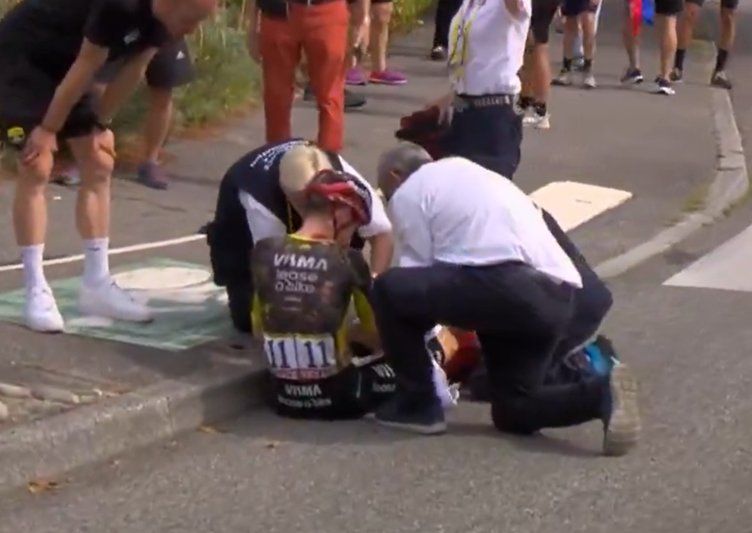
The latest instalment of one of cycling’s greatest grand tour rivalries came to an abrupt end on Sunday afternoon on a sharp downhill right-hander, around 20km from the finish at Plateau de Solaison.
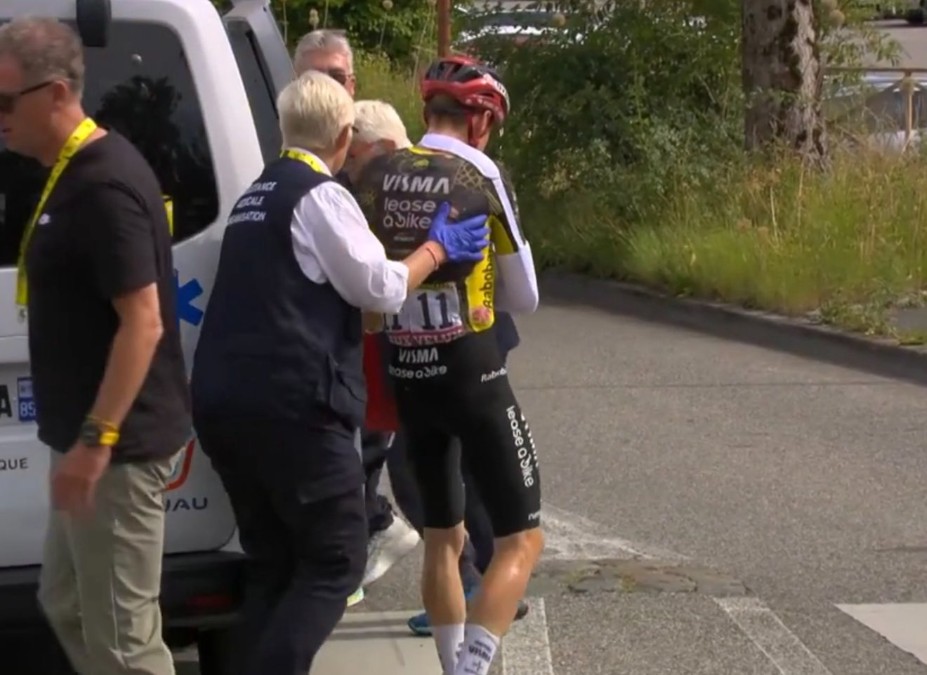
Vingegaard was the first to hit the deck. He was the last to get up. After a few minutes, the Dane, clutching his right shoulder, gingerly made his way to the ambulance, his collarbone broken, his Tour in shatters.
> Two-time winner Jonas Vingegaard crashes out of Tour de France
Not too long after Remco Evenepoel outsprinted the UAE duo of Pogačar and Del Toro to secure the first Tour road stage victory of his career, and his third in total, the recriminations began.
According to Vingegaard’s Visma-Lease a Bike teammate Davide Piganzoli, the crash may have been caused by an errant manoeuvre from one of the race’s motorbike riders, travelling in front of the peloton.
“The motorbike was just in front of the bunch and maybe did not take the best trajectory,” Piganzoli told TV reporters at the finish line. “We hit something and I saw that Jonas, who was just behind me, had crashed.”
A replay of the Jonas Vingegaard crash. The end of his 2026 Tour de France. What a shame. I feel for him. It’s so bloody awful. Damn!#TDF2026 pic.twitter.com/WKRPphxmGd
— René Bugner (@RNBWCV) July 19, 2026
That observation was repeated by Matteo Jorgenson, who was asked whether the corner in question was particularly dangerous.
“It didn’t seem like it, the motorbike double checked in the corner and took the left side of this traffic island, Victor [Campenaerts] was following his line, and it was definitely not the smooth line to the right,” the American said.
“We ended up braking, and I’m sure there was a ripple effect, he crossed wheels or hit… As often happens in this sport you have a plan, you’re in good shape, these things happen, and they’re hard to accept, but they have to be accepted.”
For Vingegaard’s perennial rival for the yellow jersey, Pogačar, another factor may have been in play.
Ahead of stage 15, the Tour’s leading duo were woken up in the middle of the night by anti-doping officials, as part of the race’s quota of random drug tests. The yellow jersey received his knock on the door at 5am, limiting him to four hours’ sleep and forcing him to ease into a long morning spent listening to Eminem.
Vingegaard, meanwhile, was wakened at 2am, a decision Pogačar – speaking to France Télévisions shortly after the finish – suggested could have contributed to a crucial momentary lapse of concentration during the stage.
“Me, I had a control at 5am in the morning, but I’m not complaining, my deep sleep was over, I was in the end of the sleep,” the four-time Tour winner said.
“But Jonas did his control at three in the morning. You never know, maybe this was the consequence of one bad sleep, this one moment of bad concentration, because the only time we can recover in the Tour is when we sleep. I feel really bad for him that he had the control at 2am in the morning.”
Pogačar warmed to this theory in his follow-up interviews for the Tour’s international feed, while paying tribute to the rider he’s shared the podium with for the past five years.
“It’s really, really sad to see that Jonas is out, because since 2021, we were always battling out for the victory,” he said.
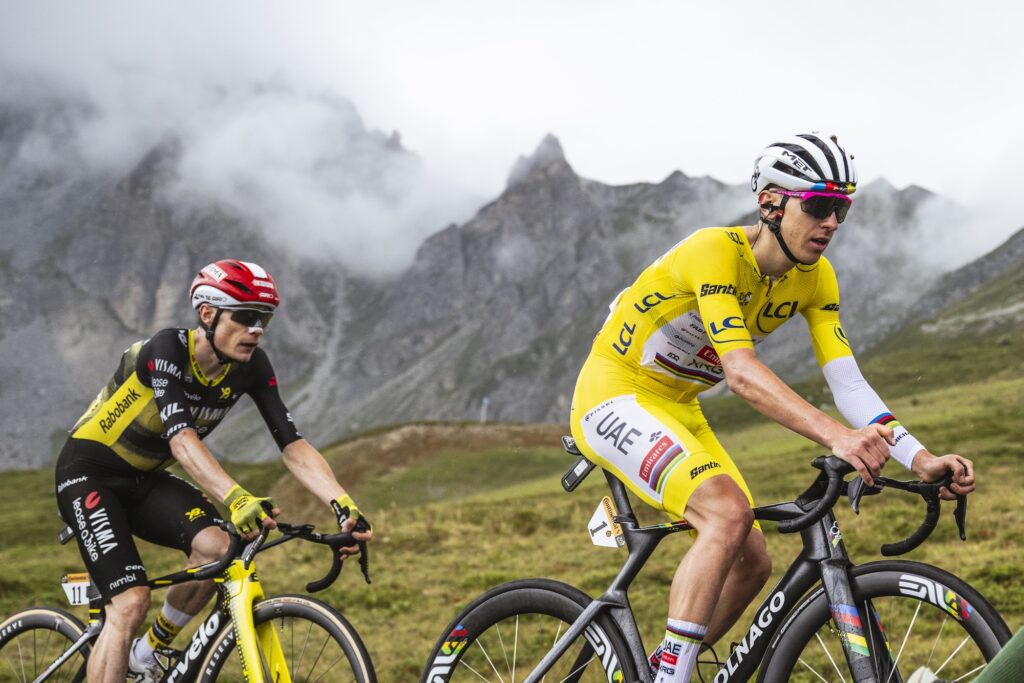
“Maybe at the beginning we didn’t have the best relationship, but in the last two years, we became good rivals, good, respected rivals and competitors, but I also think kind of friends. And yeah, the Tour will not be the same without him.
“It got me thinking just before in interview for France TV. Today we had doping control, and he had it at two in the morning. That got me thinking, maybe this is also a reason.
“When your sleep is ruined one night, maybe you are a little bit less concentrated in the descent, and his Tour is ruined. Maybe this…
“I don’t blame that, but it could be also a little bit connected. It’s just really sad to see him leave.”
According to the UCI’s rules, anti-doping controls may be carried out outside the normal hours of 6am to 11pm (which, before 2016, were the only times tests could take place) if there is a “serious and specific suspicion that the rider may be engaged in doping”.
In a statement released on Sunday night, the ITA said: “The ITA is conscious that night-time testing may be disruptive to riders’ rest and recovery. Due consideration has therefore been given to minimise as much as possible the impact testing activities have on riders.
“However, the ITA, on behalf of the UCI [the governing body], has the responsibility to ensure the effectiveness of the cycling anti‑doping programme and the integrity of cycling races.”
“Effective testing must, in limited and justified circumstances, be capable to occur outside standard daytime hours. All testing activities conducted at the Tour are subject to the safeguards established under the world anti-doping code, the UCI anti-doping rules and French law, with due consideration for riders’ welfare, equity and fundamental rights.”
Meanwhile, Jorgenson, scathingly critical of the drug tester’s nocturnal visit prior to the stage, adopted a more philosophical take on his team leader’s Tour abandon than the yellow jersey.
“Bike racing sucks sometimes, it really does,” the American said.













15 thoughts on “Was Jonas Vingegaard’s Tour de France-ending crash caused by drug testers waking him up at 2am? Tadej Pogačar thinks so”
Clickbait is the worst. It’s borderline gaslighting. At no point did Pogačar say the early doping control was the cause of he crash. He said this…. “I don’t blame that, but it could be also a little bit connected. It’s just really sad to see him leave.” Nothing to do with the title of this article. Obviously it’s not a life changing thing. It’s just looking at the bigger picture. Journalism has basically become clickbait, opinions disguised as news and client journalism. So depressing.
@ttbkaboom “Obviously it’s not a life changing thing.” – depending what you exactly mean by “it”.
Vingegaard’s crash definitely was a life-changing thing for him. He lost a chance to win the Tour, even if it wasn’t a huge one, and God knows how long he’s going to be recovering now.
BTW @Ryan Mallon “Evenepoel outsprinted the UAE duo of Pogačar and Del Toro to secure the first Tour road stage victory of his career, and his third in total” – this begs for an edit. If I understand the idea correctly, the sentence should read “his third Tour stage victory in total”, otherwise it may be interpreted as his third stage stage win ever, in any race.
@Terry Hutt – the problem is, the title does not reflect what was said. Clickbait-or-not aside, Pog simply did NOT say he thought the crash had been caused by the testers.
@tomlew “The third Tour stage win of his career and his first non-TT stage” would certainly be a lot clearer.
It was this specific example of clickbait wasn’t a life changing thing. Not the crash, which was horrible. Hopefully being a collarbone the surgery was straight forward and there won’t be any lingering effects like with the horror crash he had in the Basque Country. Cheers
It was this specific example of clickbait wasn’t a life changing thing. Not the crash. Cheers
I really don’t have an issue with the title of this piece. I suppose they could have changed the last word from “so” to “maybe”. I just feel bad for Jonas. Seriously 2am? Sound like a bad deal to me.
@Terry Hutt I know I would find it impossible to win a stage of the Tour if I were woken up at 2 AM.
Same. Although someone fitter than I (like yourself) might have a chance if as compensation they were allowed to start then…
@Terry Hutt But the headline is not an accurate reflection of what Pog said. Did you hear the part where he said “I don’t blame that”?
Bit of a stretch to call road cc content creators journalists . Web sites like this are really an extension of the marketing side of the cycling industry.
I don’t doubt that the reviews are fairly honest and are useful in drawing attention to us a consumers products we will likely be interested in buying.
However the news articles just tend to be assembled from material pretty readily available from other sources and need to have a headline with a bit of spin on them to get you reading or at least opening them.
Hard to complain about it really unless you want to pay for real investigative journalism, web sites like this rely on clickbait as it is numbers which attract the marketers and pay to run the website .
@michaelc Hobby journalism is not about defending democracy, so let’s not expect Watergate-style investigations, it’s just not that caliber. Still, Road.cc are pretty good at filtering absolute BS or at least presenting their own angle.
Also, they’ve done quite a few nice in-depth stories, including the Shimano crank debacle. Their involvement in urban and recreational cycling advocacy is impressive as well.
Just imagine they could be like both BR’s have been over the past few years!
“According to the UCI’s rules, anti-doping controls may be carried out outside the normal hours of 6am to 11pm (which, before 2016, were the only times tests could take place) if there is a “serious and specific suspicion that the rider may be engaged in doping”.”
I want to know what serious and specific suspicions they have about these two riders, especially if the tests return negative. I’m all for clean racing but grand tours are tough enough without your sleep being disturbed on a whim.
That isn’t actually what the rules say. They say that it should be between 6 and 11 unless either the rider has requested a 5 am whereabouts slot, or “valid grounds exist for Testing overnight”, which is about as vague as can be.
Also, Target Testing (which I assume is what the article is referring to, although that isn’t given as a specific reason to test outside normal hours) isn’t just for where there are suspicions of doping – one of the criteria for being included is riders “who compete regularly at the highest level of international Competition”.
However, the UCI might be in violation of of its obligation to consider “the physical and other demands of the sport of cycling (and/or its disciplines), considering in particular the physiological requirements of the sport of cycling / its disciplines” when planning its testing.
@mdavidford UCI don’t even know how to police their own rules effectively and consistently, so what did you expect?
The only time one of the greatest F1 drivers, Fangio, crashed his car was when he had very little sleep the night before the race.