


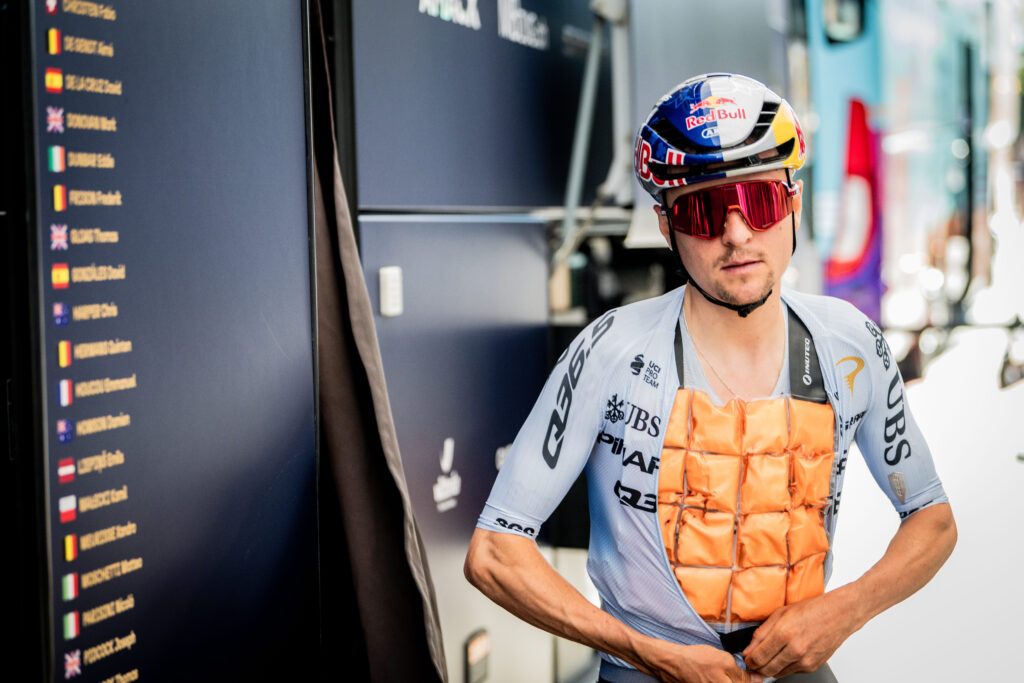

It was a case of out of the frying pan and into the (literal) fire for the Tour de France peloton on Monday, as the riders traded the sticky heat of Barcelona for even more scorching temperatures in the Eastern Pyrenees.
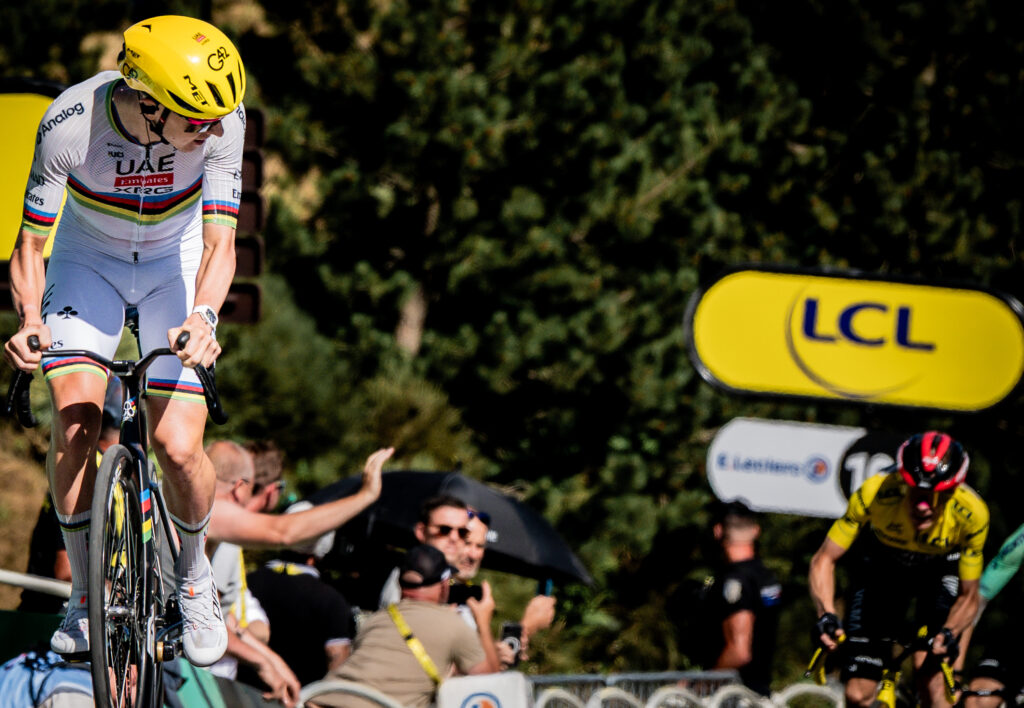
Tadej Pogačar’s first stage win of the 2026 Tour, a blistering sprint fit for the current weather that also propelled him into the yellow jersey on countback, took place at a largely deserted finish line in Les Angles, the traditional masses of barrier-bashing fans replaced by accredited team staff, volunteers, journalists, and a smattering of hardy spectators who gamely trudged up a steep ski slope to be in attendance.
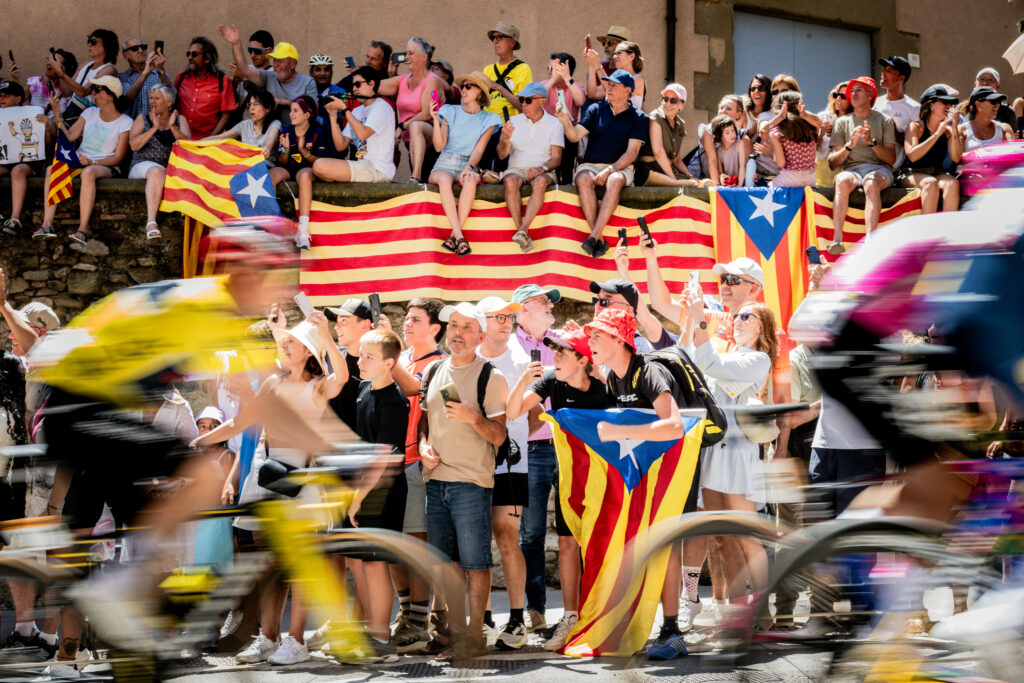
That bizarre, almost eerie scene was the result of the race organisers’ decision to ‘invite’ fans not to attend the final 40km of the stage, due to the risk of wildfires in the area (though judging by the admittedly smaller than usual crowds on other parts of the final climb, some of those invitations got lost in the post).
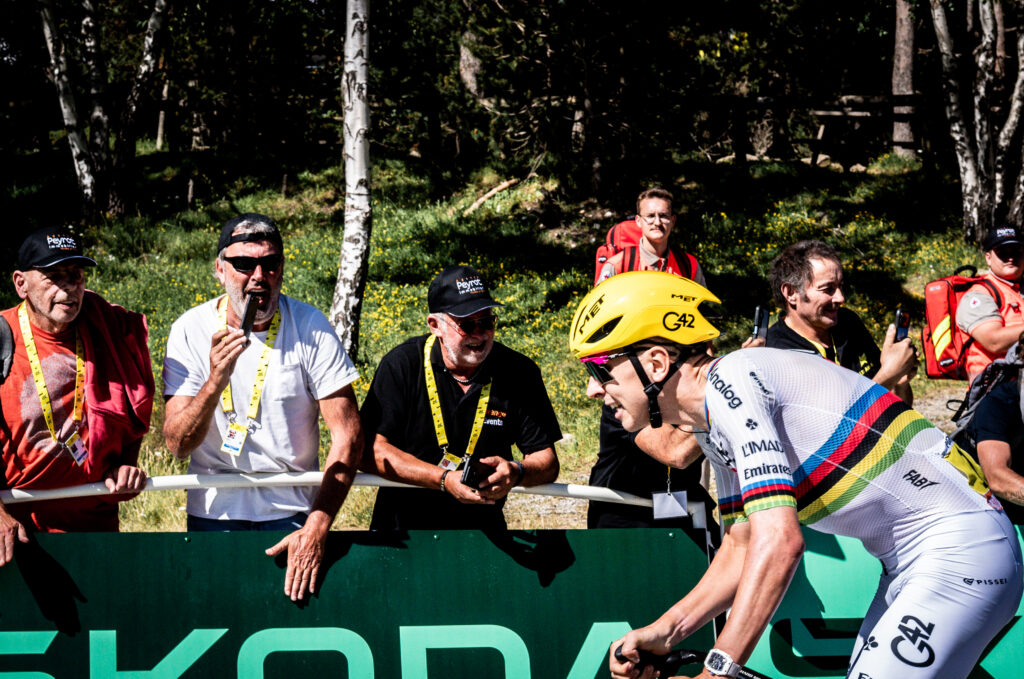
Devastating wildfires on the D66 road, around 70km from Les Angles, also forced the organisers to divert the off-course route used by journalists and other non-race vehicle drivers to travel to the finish.
On the race route itself, as the Tour crossed the border back into France, the peloton was forced to endure temperatures in the high thirties, hitting 40°C at one point (Tuesday’s stage from Carcassonne to Foix is expected to reach 41°C), during a frenetic, relentless day of racing.
British star Tom Pidcock was one of the big favourites who suffered the most in the blistering heat of the Eastern Pyrenees, the Pinarello Q36.5 rider admitting at the finish that he felt “cooked” after finishing 16th, 18 seconds behind Pogačar.
Asked about the ominously dominant display by the four-time Tour winner, Pidcock told a group of reporters, including road.cc, that “I think more of the story is how bloody hot it was all day”.
“I don’t think I’ve done such a hard race before in such heat before, it’s ridiculous,” he said. “It was a war zone. I think the peloton went through 10,000 bidons today. And I didn’t have anything in the final, I was a bit cooked.”
> Tour de France fans told not to attend stage finish due to “frightening” Pyrenean wildfires
Other riders and team staff, however, offered a somewhat less dramatic assessment of the conditions affecting the peloton at the start of this year’s Tour.
EF Education-EasyPost rider Max Walker, riding his first career grand tour, told road.cc at the finish that heat adaptation had played a major role in his preparation for the race.
“I’ve done quite a lot of prepping the heat, so maybe that’s helping me a bit compared to other riders, but I’m feeling good at the moment,” the Manx rider said.
Asked how he was dealing with the heat on the road, and Pidcock’s 10,000 bidons comment, Walker continued: “Well, my job on the team is to go get the bottles, so I was back and forth a lot.
“You’re pouring water over yourself, keeping ice down. That’s all you can do, really. For me, it’s just not going over my limit, because once you go over your limit, you can’t really recover from it. I think most riders after the Dauphiné ordered a heat block to get ready for the Tour.”
When the subject of potential stage cancellations due to extreme heat – a topic broached frequently in recent days at the Tour – Walker was noncommittal.
“I don’t really know to be honest, but I think we raced pretty well today, so I think at the moment it’s all okay,” Walker told road.cc.
“That’s cycling, we race in all terrains. So you’ve got to be adaptable. If you don’t, change your programme. Cycling’s always been like that”
That attitude was echoed by a number of team staff road.cc spoke to at the start of Monday’s stage in Granollers, who pointed out that the current temperatures are nothing new at the Tour.
“I remember 10 years ago, it was still 30, 40 degrees, 35 plus in central France, so I don’t know, maybe it’s a little bit hotter now,” former Tour stage winner Steve Cummings, a sports director at Jayco-AlUla, said in Granollers.
“Tomorrow it’s forecast 38, 41, but we’ve had that before at the Tour. And in terms of cooling protocols, I remember the 2004 Olympics, we were doing stuff for Athens then, similar to stuff to that we’re doing now, so I’m not sure, it’s just down to trends sometimes.”
He continued: “When it comes to cooling, it’s basically in three steps, really. Before the race, we’ve got a pre-cooling thing, and during the race it’s common sense, really, icy drinks, cold drinks, to cool from the inside out. And then ice socks and cold water to cool from the outside in the perceptual cooler.
“Then after the race it’s about trying to get the core temperature down as quick as possible. Some teams have ice baths, we haven’t got one as that’s a budget thing, but we’ve got our ways of just wet, cold wet towels. That’s what we do.
“I think the big thing in world cycling is the operational side of it, how much resources you have, and what you can do with what you have.
“We try to do the maximum, we’ve got some really smart people, way smarter than me, who know about cooling protocols and all the latest science and all that, so we just try to implement that as best we can on the ground.”
Meanwhile, Movistar sports director Matt White told us that scorching July heat was an unavoidable factor of bike racing and that riders simply need to adapt to the conditions.
“Well, it’s been a hot summer so far, and everyone’s got their own protocols to try to reduce it,” the Australian said.
“The big thing is hydration, the guys try to stay as cool as possible during the stage, and then lowering the core body temperature after the stage.
“But it’s summer, everyone expects hot weather, it’s just whether it’s hot or very hot. That’s the Tour, that’s the Vuelta. We can’t control the weather, but it could be 20 degrees in three days’ time. Who knows?
“But looks like it’s going to be a hot summer for everybody, so we just have to adapt as best we can.”
Asked whether the Tour would cancel stages if temperatures continued to soar, White was blunt.
“It’ll never happen. The show must go on. I can’t see it, I just think there’s too much money involved,” he said.
“Now, if it was extreme, but what’s extreme? At the Tour Down Under, they’d cancel the stage if it was 40 degrees, wouldn’t they? But here?
“Two years ago at the Vuelta when we started in Lisbon, I think the average for the first week was thirty-six or seven. There’s no way they would have been run at other races. And at the Tour Down Under, they’ve shortened stages, but I don’t agree with that either.
“If you come to Australia in January, if you don’t like the heat, don’t come. It’s the race, you know. If you don’t like the cold, don’t go to Paris-Nice in March.
“You know, you can’t complain about that shit, that’s cycling. That’s cycling, we race in all terrains. So you’ve got to be adaptable. If you don’t, change your programme. Cycling’s always been like that.”
White also admitted that starting stages earlier and reducing their length could be a solution to combatting the heat if temperatures continue to rise.
“Well, it’s going to be a gradual thing. I think the thing that would have to change would be the length of the stages,” he said.
“But you’re not going to change a lot. If you start the stage at 10 instead of 12, you get a couple of hours in the stage. They could do that, though they’re looking at prime time television. But at the end of the day, there could be shorter stages starting early, that would be the long-term solution.”








5 thoughts on ““It was a war zone”: Tom Pidcock shocked by ‘hardest ever’ Tour de France heat – but rival sports director says “that’s cycling, you can’t complain about that s***””
It was pointed out on the TNT commentary that the organisers had said people living on or near the course were still welcome to attend, and that presumably included people staying in campsites, hotels and holiday rentals, so the number who were actually ignoring the request to stay away was probably considerably lower than it might have appeared.
“If you start the stage at 10 instead of 12, you get a couple of hours in the stage. They could do that, though they’re looking at prime time television.”
Has the definition of prime time television changed?
There is nothing better than eloquent Australian political correctness to restate the obvious and put things into perspective :
It’s summer, so, yep, it’s hot, really hot. Some years are cooler or wetter, though. UCI bureaucrats can’t control the weather, can they?
If it’s too hot for you, change your programme, says a former pro and experienced DS. Astana prepare their riders’ racing schedules by factoring in their resistance to cold and hot weather conditions. Some of their riders only do the Asian circuit and race against Thai, Malaysian and Vietnamese top shots in really hot and super humid conditions.
In case of a heatwave, ASO could opt for earlier starts, say 08. or 09.00 a.m. One may assume that early live broadcasting is less lucrative for TdF organisers.
Prime time for the whole world will be early mornings very soon as the planet burns. …Take it from someone who has lived consistently in 40-50c degree heat, if you deny it, heat stroke gets you. The TDF and all cycling events should begin in the early hours of the morning. It will be total madness to continue starting at midday as the climate ramps up.
I can only guess what it’s been like in Europe but it’s been hot in the UK for 2nd time right now, 1st time hot now similar tho after the 1st that got you used to it with a smack in the face. I said to a friend, after I rode in the day when it was about 25’c air temp when riding, it saps your energy, tho I used to race in the evenings with high temps 🤷