


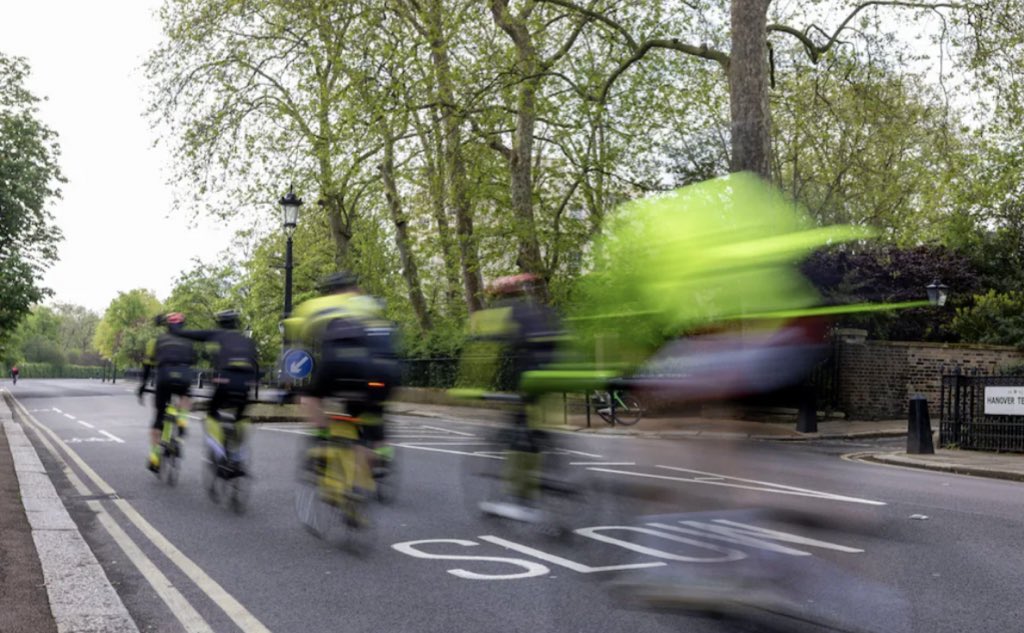

The son of a woman who died when she was hit by a cyclist in Regent’s Park has urged a local council to introduce speed limits for cyclists.
Hilda Griffiths, 81, died in hospital in 2022, two months after a cyclist riding between 25-29mph struck her in Regent’s Park. The collision happened when Ms Griffiths was crossing the road to a pedestrian island and stepped out in front of a group of cyclists. The cyclist later said he had “zero reaction time” to avoid colliding with Griffiths. Brian Fitzgerald was not prosecuted and a tribunal recorded a verdict of “accidental cycling collision death.”
Griffiths’ death started a long-running debate on cycle and pedestrian safety in the Royal Parks, which are popular among many cyclists. Last year, the Royal Parks charity issued a new ‘code of conduct’ as part of a cycle safety campaign which issued, as guidance, a 20mph limit on cyclists using the parks, in line with limits for cars. However, the Parks authority is not able to enforce the code and has previously asked the Metropolitan Police to prosecute speeding cyclists in the same way as cars. New pedestrian crossings have also been introduced in the park, including where Griffiths was critically injured.

On a national level, Griffith’s death was one of the catalysts for introducing a new ‘dangerous cycling law’ as part of the government’s latest Crime and Policing Bill. The new legislation introduces new criminal offences for charges of causing death or serious injury by dangerous, careless or inconsiderate cycling. The law overhauled legislation that was being used from the Victorian era, and makes it less likely that cases such as Fitzgerald’s would avoid future prosecution.
On Wednesday Gerard Griffiths told Westminster City Council, which partly covers Regent’s Park, that he wanted to “raise the issue of dangerous and speeding cyclists,” adding that he believed cycling speed limits “will act as a deterrent and change the behaviour of those who ignore the rules.”
Citing recent trials of cycling speed limits that have begun in the Netherlands, he ended his question asking, “Will Westminster lead the way on cycling speed limits, and what will you do to protect pedestrians?”
In response, Conservative Cllr Tim Mitchell, Cabinet member for City Management, said “I absolutely agree that cyclists speeding, riding on the pavement and ignoring red lights pose a real danger to pedestrians and other road users.
“Unfortunately there is no national legislation governing speed limits for bicycles or e-bikes on the public highway.”

Mitchell added that the Council regularly liaised with police and Lime to encourage safer cycling and enforcement of cyclists jumping red lights, but that the local authority lacked the statutory powers to directly enforce road safety measures themselves.
The trials referred to in the Netherlands are taking place in Houten, near Utrecht and Amsterdam, starting later this year. The proposals see signs deployed encouraging cyclists to ride below 20kph (12mph). City planners have welcomed the proposal as a means of slowing down traffic without building cycle lanes “in people’s living rooms.” Other residents are concerned however that they have been punished for the behaviour of e-bike riders.




62 thoughts on “Son of pensioner killed by cyclist calls for cycling speed limits to deter “dangerous” riders and “protect pedestrians””
Maybe, the authorities should work on a way to make drivers of motor vehicles obey speed limits.
Although, I suppose that if she’d been hit by a car doing that speed, she’d likely to have been killed outright.
And there would be no discussion about “dangerous and speeding cyclists” which has yet to be defined.
So again we have one of those rare, tragic, cases where a cyclist and pedestrian collide and the pedestrian dies as a result.
Again we have a case of a pedestrian who stepped out in front of a moving vehicle without looking properly, giving the cyclist little to no chance to avoid them, much like the Charlie Anniston case (although his biek was illegal, tests by Police showed even on a normal bike with good brakes he probably couldn’t have avoided the collision), also the case in South London, where a pedestrian ran across on a red man, and a cyclist hit them, (Here the cyclist absolutely should have been prosecuted for the illegal spec e-bike and failing to stop, but the pedestrian ran into the SIDE of his front wheel as shown on CCTV from a shop beside the road)
Now we have an elderly woman who has stepped out directly ahead of not one, but a group of cyclists.
When did we last hear calls to change the laws for drivers when someone stepped out so close in front of a car that the driver had no chance to avoid them ?
Not as rare as they should be after taking milage into account. Clearly part of that equation is better education of pedestrians , but I have no issues with making cyclists subject to the speed limits. The majority do not exceed 20mph, except for the rare occasions they have a good breeze or an incline in their favour. Those that have the capability are often already recording their data anyway, the excuse that cycles are not fitted with speedometers seems very lame in this day and age.
the excuse that cycles are not fitted with speedometers seems very lame in this day and age
The police just love their dodge that no cyclist speedometer is anything other than a worthless child’s toy, rather like the bike it’s monitoring, so I’m not keen on the idea that the b******s can suddenly choose to accept them when looking to victimise cyclists. LancsFilth initially said they couldn’t do anything about offences like this because I ‘might have been travelling at less than 10 mph which would make the manoeuvre legal ‘.
This was before they hit on the Master Dodge of just ignoring all reports of driver offences from cyclists.
@Robert Hardy
The argument is not as simple as “cycles cycles are not fitted with speedometers”, it is that there is currently no legal requirement for cycles to be fitted speedometers.
If you were to now introduce a legally enforceable speed limit, you are also requiring every bike owner to go out a retro-add a speedometer in some form.
Which leads to the question … what form would that take? For many people recording data from their rides, the phone in their pocket or backpack will be recording the data (so the rider can’t see the speed), or their watch on their wrist, or a dedicated computer on the handlebars. Does that need to be standardised? Do they all need to be the same type, with the same specs? Should they register speed using GPS or (more likely) wheel fitted speed sensor?
Is it going to be illegal to be out longer than you intended and your phone/watch/computer runs out of charge?
Like many things in this life, it seems simple … make cyclists obey a legally enforceable speed limit. In reality that is only the start of a long and technical conversation about how that is achieved in practise.
@Jetmans Dad Like many things in this life, it seems simple … make cyclists obey a legally enforceable speed limit
If the Filth are going to start prosecuting cyclists for the rare offence of exceeding speed limits, they would have to start doing it for the much more frequent and worse offences by drivers. Worse still, recognising cycle speedometers for the accurate devices they can be would theoretically make it more difficult to ignore very frequent offences like this, although in practice they ignore them anyway. The police definitely don’t want to acknowledge the existence of those offences, or the accurate speedos
@wtjs …the accurate speedos…
@Jetmans Dad That and fitting vehicles with speedometers doesn’t exactly improve road safety.
@Surreyrider agree with the drift …
… but one should consider if it would be even worse without them? Especially given car technology has advanced to take the bumps out (and the shake / rattle / wind in your hair / engine and road noise and other indicators you’re going quite a clip).
There are also quite a few who feel that speed limits are nonsense and it would be safer if drivers were left to manage their own speed. (Because roads have “natural” speeds … well, they do have design speeds, but IMHO often those are too fast for the most safety-critical functions of the road…)
Some have even posted here…
@Robert Hardy I have heard this but does this actually account for where drivers rack up the majority of miles, ie. motorways where pedestrians are generally quite rare…
@Robert Hardy I would also hazard a guess that cyclists are involved in more “I didn’t look before I walked into the road” collisions because a shocking number of people don’t seem to look in the road before they walk out. I assume they just listen for the sound of cars.
Had a chap pushing a motorbike into the road from behind a parked car the other day that had I not been paying attention, would have taken out myself and my 2 children on the back. I cannot believe that he didn’t check at all before doing that. If a car hit him doing that at 20mph he would have been in serious trouble with the motorbike smasking into him and probably landing on top of him.
@mctrials23 we know from psychological studies and things like the “killer Keynsham optical illusion cycle path” * that there is a lot of “navigation on auto-pilot” going on. Perhaps more the rule than the exception.
I suspect that:
– People often “look with their ears” before eg. stepping into a road as you say. This is an issue for cyclists…
– We’ve all been trained by experience to “look for the motor vehicles” in these spaces. I think that explains some of the near SMIDSY crashes I’ve had, where a driver appeared to be looking at me. Brain probably just discarded my image as “noise / normt a car”
– Memory and fairly simple pattern matching guide people. Hence cycle infra (very variable in design and implementation detail) causes “havok” when “new”. Locals have to relearn their mental map / routine, and because non-locals rarely encounter it or it’s different in their locality (so “new” to them) it confuses their pattern recognition also.
* And if we’re honest – introspection. There are certainly times I’ve been busy with a thought and then notice that I’ve been walking / cycling or even driving that whole time…
So long as we have speed limits & culpability for ignoring “traffic signals” & the like (looking at you Gove) for pedestrians & horse riders too – might as well get ahead on things whilst we’re at it & future proof this essential legislation before someone gets killed by one of them.
Whilst we’re at it, pedestrians should have registration numbers tattoed to their foreheads, be forced to wear hi-viz whenever outdoors & pay “road tax” to cover the cost of all that incredibly well designed (cough cough) pedestrian infrastructure that is clearly part of the “war on drivers,” as well as the street lighting that the free loading swines take advantage of on a daily basis.
Having being quite badly bruised in an unavoidable collision with a pedestrian who ran out into the road without looking, as a cyclist I want a crackdown on those dangerous pedestrians who walk into roads without looking. The potential for fatalities goes both directions, on both pedestrians and cyclists.
@the little onion Hit the deck because a pedestrian crossed the road while the light was green for road traffic. I shouted “watch out!”, she froze then reversed while I was riding around her from behind. Bang! A pedestrian collided with me and my bike while crossing the road when
it was forbidden. Crikey!
Unfortunately (at least in the UK now) you just have to expect the unexpected around pedestrians *.
Just slow down and be prepared for sudden odd moves – or indeed the opposite, people freezing when you “appear out of nowhere” (despite sporting hi-viz, daylight running lights, ringing bells / running spokey-dokeys…)
Annoying but ultimately to your benefit as well as theirs…
* And indeed drivers…
@chrisonabike this is kind of the truth of the matter. We have to be careful in built up areas or where pedestrians might do something unexpected. We can’t complain about drivers doing silly things around us if we aren’t willing to extend the same behaviour to pedestrians. Kids are stupid and run out into the road sometimes. You just have to ride to the conditions.
She should be campaigning to teach pedestrians to look both ways before crossing, instead.
Your reminder that there is nothing to stop cyclists being prosecuted for causing death by the manner of their riding – indeed there are (are they in use?) new laws on this.
…and indeed cyclists have been prosecuted and convicted.
How *easy* this is – that’s another thing. Hard to gauge given how uncommonly this occurs.
Your reminder also that “penalties as deterrents” for road crime is … very questionable.
For those affected – one is too many. But cyclist-caused deaths stand out by their rarity AND because we have normalised – well, minimized protests about – deaths due to motor vehicle drivers.
How to stop deaths in the first place? You can’t go wrong with a “sustainable safety” approach, instead of the UK’s one which has leant heavily on reducing the number of vulnerable road users out and about and invoking the law as a backstop.
While impossible to know why she stepped out here I suspect in cases like this one it is simply “not expecting cyclists” or “being unfamiliar with the speed cyclists can attain”. And alas the only thing that really changes that is having *more* cyclists and enough “practical learning”…
I’m sorry for the Mr Griffith’s loss but it was widely reported at the time that his mum stepped into the road without looking and around 2 metres from the approaching cyclists.
Had the cyclists been a car she would have likely been run over and killed and the story wouldn’t even be reported as “news”.
Likewise had she stepped out, knocked over and killed the cyclist it would likely not have been “news” worth reporting.
The root cause of the death was failure to look before stepping out into the road.
But then there would would have been grounds for prosecuting the driver in that circumstance as he would have been substantially exceeding the speed limit. The cyclist was innocent under the law but I consider him profoundly responsible for that death. We ask for considerable consideration by motorists and we have now been given legal backing for it, it does not become us to defend hairing round public park roads in substantial excess of a speed limit considered to offer reasonable safety to vulnerable road users.
“in –substantial– slight excess of a speed limit considered to offer reasonable safety to vulnerable road users *from two tonne metal boxes*.”
FTFY
@mdavidford steady on – an 80kg cyclist on a 20kg bike would only need to be doing a little over 89mph to have the same kinetic energy as a 2 ton car at 20mph.
So same ballpark, really…
(Usual reference to speed being the major issue as kinetic energy goes up with the square of velocity / much greater braking distances required etc)
What has KE to do with it? If you are hit by a large object you don’t absorb all its KE. Being hit by a car is no better than being hit by a bus at the same speed. What matters is how much acceleration you experience.
@Sriracha
Not following you there, according to an online impact force calculator if you are hit by a 1000 kg object at 20 mph in an impact lasting 0.1 seconds, the peak impact force is 178 kn, if you are hit by a 10,000 kg object at the same speed and impact time it’s 1788 kn. Isn’t it self evident that being hit by a heavier object at the same speed does more damage than the lighter one?
@Rendel Harris
That calculation is incorrect. If a 2000kg vehicle at 10m/s hits a stationary 100kg person then assuming an inelastic collision the person will start moving at 9.52m/s. The vehicle will continue moving at 9.52m/s. With a 10000kg vehicle the person starts moving at 9.9m/s. So the energy difference going into the person hit is 9.9^2/9.52^2 which is about 8%. Basically in a collision there isn’t a way to transfer most of the energy from the vehicle into the person when the vehicle is much heavier than the person. So most of the vehicles energy stays in the vehicle which is barely slowed down by hitting someone.
The shape of the vehicle is much more important. This is why it is actually much worse to be got by a bus because if a car hits you it is likely that you go over the bonnet but if a bus hits you that is almost impossible so you are likely to go under the bus, if you are lucky you’ll get knocked to one side of the bus.
@JohnnyBiking and the “taller bonnet” type of car/truck is also not helping safety. So it might still be “best” being hit by a cyclist. (Still wouldn’t want to end up under one of those visiting Sumo wrestlers plus Santander bike though.)
Bits of a car are made to deform too, absorbing energy and increasing impact time, ain’t so for a bus…
@ktache isn’t it mostly European standards which apply for impacts with pedestrians?
notjustbikes was suggesting in on of his videos that as a result of the US tariff strong-arm tactics Europe at least might be doing a deal with “reciprocal recognition of standards”. That would essentially declare the US tests as good – and apparently US car makers get to mark their *own* homework also…
I think we have to be realistic. It appears that the pedestrian was at fault and thus the cyclist should have no blame what so ever. Indeed they should be compensated, ideally from the pedestrian house insurance and if not through the MIB which exists for similar purposes. Equally motorised vehicle users should not be penalised for the stupidity of people. I recall, but sadly cannot prove it, evidence that something like 955 of all car/pedestrian collisions were the pedestrians fault and yet drivers are penalised by having to have ridiculous “soft” panels on cars which serve little or no purpose when linked to cars hitting road users. Think also 4wd bull bars being banned for no legitimate reason.
@mattsccm Can you be a bit more specific, is that 955 worldwide since the invention of the motor car?
@Backladder Did they fail to press SHIFT? Did they mean 95%? If so, again, citation needed.
Think also 4wd bull bars being banned for no legitimate reason
Oh dear ! the unsubtle pro-driver, pro-panzer trolls are not very good at disguising themselves, are they? One can only hope that Clarkson and this disciple never have cause to regret their advocacy for these killing armaments to be added to their already pedestrian-and-cyclist hostile guzzlers. No, that’s too subtle for them – what I really hope is that they, or their families, do have cause for such regret.
@mattsccm The MIB exists to compensate victims of accidents caused by the drivers/riders of uninsured and untraced *motor vehicles*, not pedestrians or cyclists. So the MIB would have rightly refused any claim by the victim here. If the at-fault pedestrian had no third party liability insurance that would’ve covered this incident, the victim could have pursued a claim against her estate. The ‘optics’ (terrible word but it’s become common parlance, sadly) of a cyclist pursuing a claim against a dead lady’s estate, however, might have made it inadvisable.
@mattsccm “Think also 4wd bull bars being banned for no legitimate reason.”
OK, now I regret engaging with you, you sad little troll.
@smallbeer You obviously don’t realise how many bulls there are wandering around Chelsea, in and out of the china shops, that he needs to protect his Range Rover from.
I agree, it’s bloody ‘elf and safety overreach, can’t help some people, I put some meat, sorry, neat decoration on the front of mine and the polis were round poking their noses in like that (mind you, that was a mistake…) (etc)
@mattsccm Bull bars aren’t banned, they just have to conform to regulations so they are deformable or have plates that allow crumple give on contact, rather than rigid steel bars that can smash into pedestrians and cyclists with no give at all, catch them and drag them under the wheels. If you think that’s a problem, do one. Why should who is responsible for a collision remove the responsibility of people driving a tonne of machinery on the road from having safety features to at least mitigate some of the effects of a collision?
I think there’s a significant problem being ignored here:
“Introducing new rules will change the behaviour of those who ignore the rules”
Really?
my thoughts exactly…I wonder how that approach is working, with motor vehicle drivers…🤔
Check out the Evening Standard Facebook post on this – clear implication that the lady was killed on a no cyclist path, not on an open busy road.
I’d be willing to bet that’s lazy use of stock photography rather than deliberate misinformation, but the result is still the same.
I do not wish to diminish the personal tragedy, but one never hear calls for pedestrians or even hikers to wear clothing with integrated lightening rods.
I think this case is a lesson for us all, cyclists and pedestrians to be careful and mindful of others when we’re out and about, especially on shared paths. Both groups have as much right as the other to be there. Mutual consideration and respect will help a lot.
@60somethingcyclist hmm… that’s a good lesson, but perhaps not one to draw from this case where someone stepped out in front of and close to an oncoming cyclist.
There may be other lessons from this case – eg. how do we best train people to expect cyclists, understand that cyclists can move unexpectedly quickly, and educate cyclists that speed awareness matters for them also (even if not explicitly in law).
And perhaps what places it’s appropriate for cyclists to train / exercise in (and provision of such places if there’s sufficient demand but they’re lacking)?
But it’s hard to extrapolate that from even a handful of incidents, never mind one.
@60somethingcyclist Looks like you’ve stepped straight into silly comment mode without looking at all at the actual facts of the case. It has nothing to do with shared paths, the cyclist was on a public road on the vehicle carriageway, the pedestrian was standing on a traffic island waiting to cross. Evidence from independent witnesses shows that the pedestrian stepped out into the path of the cyclist without warning when he was around two metres from her. Much has been made of the fact that he was possibly riding at 5mph more than the motor vehicle speed limit for the road but he could have been riding at 10 mph and he still would have had no chance of avoiding her. The pedestrian was solely responsible for the incident and no amount of “mutual consideration and respect” would have changed that. Suggest reading the articles and evidence in future before commenting with such nonsense.
Not as rare as they should be after taking milage into account. Clearly part of that equation is better education of pedestrians , but I have no issues with making cyclists subject to the speed limits. The majority do not exceed 20mph, except for the rare occasions they have a good breeze or an incline in their favour. Those that have the capability are often already recording their data anyway, the excuse that cycles are not fitted with speedometers seems very lame in this day and age.
@Robert Hardy hard to evaluate that – what are you comparing to? Motor vehicles? But things are quite different:
Obviously there are fundamental differences of speed (and acceleration) / size and audibility / visibility.
Then there’s behaviour – most people aren’t trained (by experience) to expect cyclists. Most of us are educated then trained or perhaps to look for the *motor vehicles* though – sometimes such that people look straight through/past the cyclists.
And of course even on roads cyclists aren’t cycling exactly like drivers drive.
But there are other things which make collisions more likely: given where people mostly cycle vs. where they drive I think it’s far more likely that cyclists will “interact” with pedestrians.
That factor only increases when you think that much UK “infra” is in fact simply signs legitimising the use of unchanged *pedestrian* infra by cyclists.
And of course the UK also hosts other sub-optimal infra which may make things more problematic. Like cycle lanes at the side of the road (compare eg. a standard Dutch signalised crossing with a UK one). And in general “non-standard” designs which even if they aren’t actively increasing danger aren’t good because it may be unclear who is to go where and what they will be doing.
Currently many people in the UK get so little exposure to cycle infra and cyclists they wouldn’t get much chance to “learn” even if the designs were more standard.
@Robert Hardy 20mph isn’t as fast as you seem to think, this 57-year-old-not-that-fit rider can easily achieve it on the flat in still conditions and most averagely fit people can on a decent bike. The argument that it wouldn’t be a problem to impose speed limits on cyclists because those who can achieve 20mph already have speedometers is an entirely specious one, firstly as I’ve said a huge number of people can achieve 20mph, not just Garmin-obsessed racers, and secondly you would have to make speedometers compulsory for everyone on a bike, you can’t pass a law saying it’s illegal not to have a speedometer if you’re going to go above the speed limit. How many cycling incidents are caused by supposedly excessive speed? It wasn’t a factor in this case, the cyclist would still have hit her if he’d been doing 15mph or even 10mph. Charlie Alliston was under the car speed limit. It’s a non-issue and only of interest to those seeking yet another stick with which to beat cyclists.
“you can’t pass a law saying it’s illegal not to have a speedometer if you’re going to go above the speed limit.”
I don’t think this would be a good idea, nor even speed limits (and presumably mandatory speedometers everywhere) …
… but is there any theoretical legal impediment to that? Or even simply enacting a law that cyclists are not permitted to ride faster on roads than the motor vehicle speed limit (or some other limit) and leaving it up to cyclists how they go about complying with that? (Not a lawyer not a legal theorist though…)
What’s wrong with that? Most of the best comments here are silly ones. More often than not involving squirrels.
I think we have forgotten that cars do way more damage and we still haven’t got a comprehensive-lasting solution to deal with dangerous drivers
I’ve often said in debate with drivers that a pedestrian should be able to complete their journey safely even if they are a complete idiot and entirely ignorant of the rules of the road.
I can’t then say that this doesn’t count if the result of their error is that they are hit by a bike. There’s a responsibility here for everybody to take the duty of care that they have over vulnerable road users seriously. As cyclists we want drivers to be alert to our presence and to take precautions that, even if we do something they don’t expect us to do, they will not hit us. We must apply that same responsibility to ourselves and pedestrians.
I have one question. Did any one of the cyclists in that group observe the lady approaching the road and ring their bell?
@bensynnock given the facts of this case, does your argument work if she had stepped out in front of a car on this road?
Would you have expected a motorist to beep whenever they saw some people standing beside a road? Or should cyclists always ring their bells to compensate for their lack of “motor car audio/visual signature”? And would pedestrians know what to do? What about deaf pedestrians?
I think we generally have to assume people shouldn’t step out into a road in front of a vehicle. That can be qualified though – but I think that is done by “better infra”.
We already sometimes take measures to block pedestrians crossing “busy roads”, provide signalised or even “grade-separated” crossings. And keep them completely away from motorways etc. And I guess there may be expectations that when people see “park” they drop their guard a bit?
I do think some kind of “what about cyclists using spaces for racing / training?” argument could be made though.
@bensynnock
We, and car drivers, must indeed exercise the utmost care for vulnerable road users, but if you take it to the logical extreme the only way you can absolutely guarantee never hitting a vulnerable road user is not to cycle or drive at all under any circumstances. As the Highway Code makes clear, “The hierarchy places those road users most at risk in the event of a collision at the top of the hierarchy. It does not remove the need for everyone to behave responsibly.” In a case like this where the pedestrian has made an absolutely suicidal move by stepping onto the roadway into the path of a fast-moving cyclist when they were two metres away you can’t say that the cyclist has failed in their duty of care, the cyclist was approaching on a clear straight road in good visibility, the lady was standing still on the island then suddenly stepped out when he was so close that he had no time to make any reaction at all, let alone brake or swerve round her. She, sadly, for unknown reasons, failed in her “need to behave responsibly”. Unless duty of care encompasses coming to a complete stop when one sees a pedestrian waiting to cross (when there is no marked crossing) I don’t think it was breached here.
PS re the cyclist ringing a bell (or as a sports cyclist more likely shouting a warning), they would have no reason to: the lady wasn’t “approaching the road”, she had got to the island in the middle of the road and was standing still, then she stepped out. As far as I can see there was no reason to think anything but that she had seen him and was waiting for him to pass before crossing the lane.
Thanks for the calculations. And as you point out, the difference in the change of velocity (aka acceleration, which is what matters) experienced by the hapless pedestrian is minimal.
I don’t understand the popular fixation with “energy absorbed” or “energy transferred” which seems to seize the imagination in these scenarios – notwithstanding the fact, as you point out, that most of the KE of the impacting vehicle is not in any case transferred.
@Sriracha I’m guilty of this because it’s easier than going through the collision dynamics (which I’d no doubt get wrong).
It’s a proxy – I guess it’s more fairly useful for explaining to the occupants of motor vehicles why less speed could be better (for them) eg. when crashing into an minimally yielding hard object? And for a gross “what damage does the vehicle do” in a collision – cyclists don’t commonly bend or break street furniture, or buildings…
As you say accelerations are more to the point. Of course as others note with larger heavier vehicles you could still suffer additional impacts (vehicle carries you on its front into an unyielding object, or you go under it / into a wheel arch). Plus potential crush if it ends on top of you.
The new proposed laws seem to be manifestly excessive and are designed to allow the police to win more prosecutions against cyclists as well as appeasing the general public who tend to overreact to any tragic mishap i.e. accident by wanting somebody to go to jail for a very long time.
In the meantime where are the safe cycle spaces in the UK? They don’t exist because the authorities save a lot of money by criminalising unfortunate and often unavoidable accidents that are caused as a result of inadequate infrastructure.