



Amsterdam is set to become one of the first Dutch cities to trial a new 20kph speed limit on cycle paths and bike lanes, as part of a national campaign to improve safety for cyclists and promote behavioural change.
However, no fines will be issued to speeding cyclists as part of the trial – which will focus on signage alerting bike path users to the new speed limit and cameras designed to monitor usage – prompting some locals to question whether the scheme will have any effect, particularly on young people riding powerful, illegally modified ‘e-bikes’ and fatbikes.
The speed limit trial forms part of the Dutch government’s multi-year cycling strategy, announced in 2025, which policy makers hope will boost safety and cut road deaths and injuries. Local councils will be able to impose speed limits on cycle lanes and bike paths, and trial moving electric cargo bikes, primarily used for deliveries, onto roads.
No formal legislation is to be finalised or decided upon until the response from the trials has been collated although, clearly, if it is a success then national traffic legislation could be updated.
A number of towns and cities volunteered for the initial trial, with Amsterdam and Houten, near Utrecht, being chosen by the government.
Houten’s trial is due to start on 8 June, while in September the 20kph speed limit will be introduced on Amsterdam’s Fossa Iberica, a busy, narrow street near one of the city’s main shopping centres.
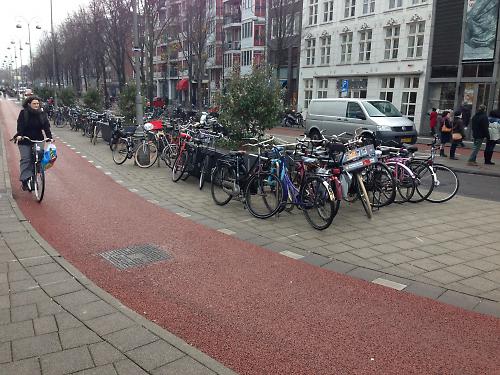
Over 1,000 cyclists and moped riders – including cargo bike-riding shoppers and schoolchildren on high-powered fatbikes – use the Fossa Iberica every day, with collisions on the route increasing since 2023, according to AD.
Traffic signs highlighting the speed limit will be installed on the road, along with cameras introduced to record the “position, speed, and type” of road users. At the end of the trial, cyclists will also take part in a questionnaire designed to gauge its effectiveness.
“The main objective, namely gaining insight into behavioural change and its effects on road safety, remains easy to investigate,” Vincent Karremans, the Dutch government’s minister for infrastructure, said this week.
Pointing to the Netherlands’ sobering collision statistics – last year, 281 Dutch cyclists (a third of all road user deaths in the country) and 80,900 were treated in hospital for injuries, up nine per cent on the previous year – Karrenmans said: “We want to utilise everything that contributes to road safety. If the trials in Houten and later in Amsterdam are a success, we can start testing this on a larger scale.”
However, the minister emphasised that the scheme does not mean the government aims to introduce a blanket speed limit for cyclists across the country, saying: “Whether such a maximum speed is a solution will always require a case-by-case assessment.”
Local politicians in Houten and Amsterdam have welcomed the trial, with Amsterdam councillor Melanie van der Horst stating that it will ensure parents with children and the elderly can “feel safer on the bike path again”.
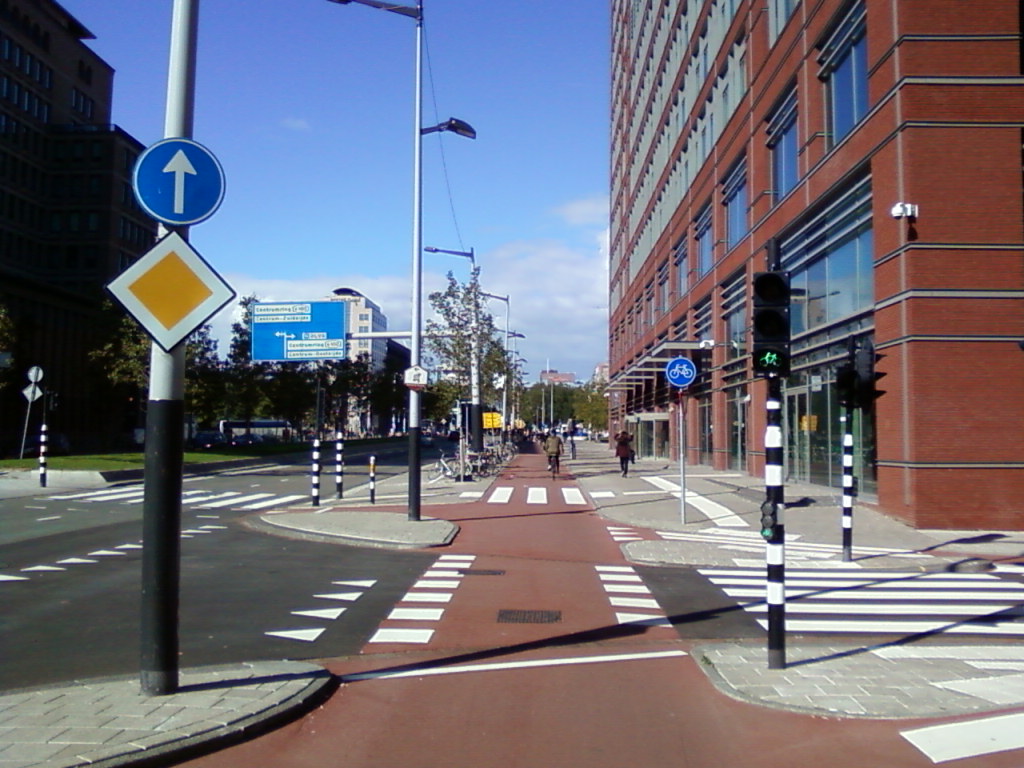
“It is good that we are given room to experiment. In Amsterdam, we have been struggling with unsafe conditions on bike paths for some time now, due to increasing congestion and the growing number of electric vehicles on them,” she said.
In Houten, the Netherlands’ ‘cycling city of the year’ in 2008 and 2018 and widely regarded as a model for cycling infrastructure due to its bike path-focused layout, councillor Wouter van den Berg said: “This pilot aligns with Houten’s position as a leading cycling municipality. We feel it is our duty to participate.
“Even in Houten, there is still room for improvement, which is why we continue to invest in safe cycle paths, fast through-cycle routes, and widening cycle paths where possible.”
However, some Houten residents are sceptical that the trial – especially its lack of enforcement – will have much of an impact.
“Young people on bicycles, and especially on fatbikes or mopeds, simply don’t give a damn about a sign like that,” one local told AD. “If you introduce such a ban, you have to enforce it. Otherwise, it’s pointless. So just station enforcement officers there and have them actually issue fines for observed violations.”
Nevertheless, Dick de Waard, a professor of traffic psychology at Groningen University, says the focus on voluntary compliance has the potential to work.
“All these e-bikes have a clear speedometer. Cyclists can see how fast they are going and slow down,” he said.
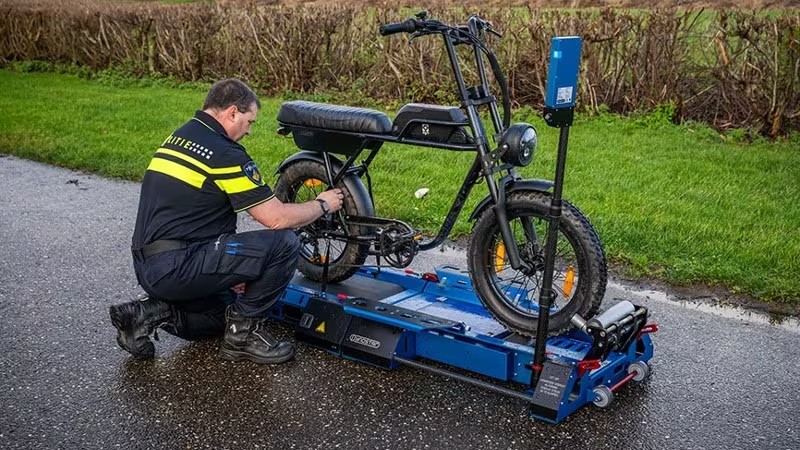
This latest attempt to clamp down on people using illegally modified fatbikes in the Netherlands comes two months after the city of Enschede banned the high-powered vehicles from its centre. And at the end of April, the Dutch government announced that it was planning to introduce a minimum age requirement for fatbikes, as well as a compulsory helmet law for young e-bike users.
When plans for a 20kph bike lane speed limit trial were first announced last year, Dutch cycling campaigners argued that enforcement of illegally modified or overly powerful ‘e-bikes’ would be a more effective first step to make the country’s cycling infrastructure safer.
“[Electric bikes] on cycle paths are already not allowed to go faster than 25 kilometres per hour, because then the pedal assistance has to stop,” Wim Bot of the Cyclists’ Union explained at the time.
At the moment, the Dutch rules mirror the UK’s laws in that e-bikes can have an electric motor with a maximum power of 250 watts, but this must cut out at 25km/h (15mph), meaning any ‘bike’ which does not abide by these standards is technically classed as an electric moped and requires insurance, registration, and a helmet.
However, like in the UK, the surge in popularity and lack of enforcement means such riders of such vehicles can be seen regularly, particularly in urban areas and using city bike paths.
“The problem is that there’s absolutely no enforcement,” Bot continued, suggesting that would be a better starting point, rather than trialling cycle path speed limits.
With 30km/h (18.6mph) speed limits already introduced in most urban areas, the Dutch Cyclists’ Union representative suggested it would be safer for faster riders to use roads instead, leaving cycling infrastructure for slower-moving cycle traffic.
Ideally, there would be separate cycle lanes for fast cyclists too, like there are in parts of Denmark. However, he accepted that “we often don’t have enough space for that”.















14 thoughts on ““Young people don’t give a damn about a sign”: Amsterdam set to trial 20kph speed limit on cycle paths to clamp down on fast illegal e-bikes – but lack of fines slammed as “pointless””
Problems of success, eh?
I haven’t been through the stats but the idea of actually observing behaviour first (in advance of fines, that is) is the way forward. (And consistent with “sustainable safety”).
Is it just “capacity has been reached?” I know some places (eg. Utrecht) are both expanding some infra and developing different “routes” to try to spread the peak cycling load (and presumably reduce places where significant flows are crossing).
There’re still some inelegant infra designs in NL – maybe there are some specific locations / types to address?
Is it “old (or young) people not riding so well (or sensibly) with power assistance?
I believe there are still significant numbers killed and injured by motor traffic (albeit small numbers given all the cyclists and their age range) – perhaps there’s also work to do there?
All things we could (start to) think about in the UK!
Examples of fixing “too many cyclists now:
Improving capacity / junctions / attractiveness:
A “cycle street” (with motor vehicles sharing) – because now there are so many cyclists that’s the safer option:
From a two-way street for motoring to a “bicycle dual carriageway”: https://bicycledutch.wordpress.com/2024/11/20/amsterdams-changing-streets-the-new-weesperzijde-along-the-amstel/
Where a particular corridor is now too busy…
… it may be possible to creating new routes to manage flows:
@chrisonabike I havn’t looked into the links in this story specifically, but having looked at dutch news, the general concern is about elderly on e-bikes being over-represented in accident stats – they don’t have the reactions younger people do, and once in an accident they come out of it with worse outcomes than younger people.
Another concern is young kids on e-bikes, just not having the knowledge of the risks of speed and/or the self-control to be sensible. As the article says, there are moves afoot to restrict access and also require helmets for kids.
Those were my thoughts initially but apparently it’s not the case at all. The whole thing about elderly people is a knee jerk reaction to accident figures. However it transpires that the number of elderly people getting injured has risen simply because of the massive increase in the overall number of elderly taking up cycling. The more people ride bikes the more are going to appear in accident stats.
The overall health benefits for elderly people cycling far, far outweighs any negatives from accidents.
@tandemtwo2 I doubt there’s been a huge rise in elderly cycling bikes – cause older folk have long been cycling in NL – most cyclist fatalities in NL long were elderly people, and a good chunk of those were them simply having some serious medical event while on some regular cycling journey.
My understanding was there’s been a rise in them cycling on eBikes, and the recent rise in injuries tallies with the increased use of eBikes amongst elderly cyclists. I havn’t dug into the actual stats myself to see if that is valid, but there are certainly are concerns in NL about this. SWOV would be one organisation for road safety research, I’ll link to their page in english in a follow up comment.
SWOV fact sheet on pedelecs, which older cyclists are disproportionately riding I think, given the phrasing, with further links: https://swov.nl/en/fact-sheet/pedelecs-and-speed-pedelecs
GCN did a very detailed and in depth programme examining all the statistical evidence. As per usual the government proposed rule changes aren’t backed up by the actual ‘full picture’ data.
This could be a bit of an issue for sports cyclists in NL, if they end up restricted to ≤30 km/h and even ≤20 km/h in lots of places.
In Belgium, groups of cyclists (can’t remember the exact number, something like ≥12 or so) are at least permitted to use the road and ignore any mandatory fietspad. However, NL does not have such an exception – though there has been lobbying for years to have the Belgian exception adopted in NL too.
But that’s still an issue for smaller groups or solitary riders who want to go out and train.
As for Dutch laws mirroring UK, I think you’ll find it was that the UK had adopted EU regulations… I think at least some of the limits / classes predate BrExit (??).
@Paul J well, NL does have high population density. I doubt UK cyclists would do that well training through eg. the middle of the Leeds and Bradford conurbation (and UK cyclists are also banned from some roads). I’m a bit for “freedom” but we should recognise there isn’t a “right to rally” for motorists.
OTOH in NL that high population density is patchily distributed. Do the current pros all train abroad?
“Watch this space” I guess – it’s always possible someone brings in unnecessarily restricted rules? Having cycled through NL a couple of times (albeit at touring speed and now time back) it seems there would be scope for a ride-out in many places? But then I wasn’t there with a chain gang…
“UK cyclists are also banned from some roads”…apart from the obvious IE motorways, which roads are cyclists banned from in the UK?
@tandemtwo2 Well, some “special roads” for a start (not sure how many there are?). Edinburgh has a couple: the A720 (Edinburgh Bypass) and also apart of the A1 dual carriageway.
Not a motorway. Motorways are special roads, but not all special roads are motorways.
@tandemtwo2 Certain sections of the Oxford Ring Road. Though, oddly, not all of it, and in particular, not the most hideous part along the A34. Go figure.
A 12mph speed limit is ludicrous.
I’m not that fit and my bikes are absolutely not top of the line and yet my AVERAGE speed over a decent journey/commute WITH STOPPING at red lights etc is easily 12mph.
So my cruising speed is going to be at least 15 if not 18mph.
It seems a little slow… but at 12mph you’re exceeding the average traffic speed for central London, and only just slower than the average for Bristol or Edinburgh (apparently 14 / 13.6 mph, but slower at busy times of course).
I presume the idea is to protect the 8-80 casual(-ish) cyclists (many on robust Dutch bikes). And that this is in an extremely densely populated capital city, full of people walking, cycling, driving, on trams…
Also it’s hard for current UK cyclists – for whom the norm is “ride like a car” eg. sprint between lots of long waits at junctions or traffic lights – to appreciate how the Dutch system facilitates good average speed via steady but continuous progress. That involves “network-level route planning” / “disentangling of modes” and better junction design. And indeed where there are traffic lights those make much more use of detection of approaching cyclists and variable phases. There’s also the fact that cyclists rarely have to stop for *pedestrian* crossings (those are informal across most cycle paths) and sometimes can ignore motor vehicle traffic lights completely.
Personally I suspect that this may be the wrong tool for what they’re trying to achieve. But then again perhaps “if you have enough people doing something unfortunately you may get more than enough people doing it badly”?