



Sentencing is a much-discussed topic on road.cc, particularly with regards to the punishments handed down to drivers who seriously injure or kill cyclists. To provide a more straightforward reference point, we’re introducing a regular round-up of sentencing stories from local publishers and police forces from around the UK, and sometimes internationally in particularly notable cases.
Not only will this series help us to collate information for our more in-depth coverage around sentencing, but we’re hoping it could also be of use to readers, academics, and those in the legal profession as a starting point for analysing the state of play when it comes to sentencing for driving and cycling offences.
Much like our Near Miss of the Day series, we’re not doing this for ‘clicks’ – but we make no secret of the fact that the article format is designed to get attention, and generate discussion. Though road.cc acknowledges there is a problem with inconsistent and lenient sentences for killer drivers, we’re intentionally steering clear of editorialising in our reporting here, which means we’re not just going to be selecting cases where we’ve decided in-house that the punishment didn’t fit the crime.
The aim is to provide a true picture of how people are sentenced for driving and cycling offences for further analysis. Are sentences wildly inconsistent depending on the judge? Are sentences becoming more lenient, or harsher over time? We can’t change the law, or a judge’s decision – but change starts with a discussion, and an acknowledgement the current system isn’t fit for purpose. This is why the maximum sentence for death by dangerous driving was increased to life imprisonment in 2022, and why the Highway Code was updated to include minimum passing distances for drivers around cyclists and the Hierarchy of Road users.
All sources are credited with a link, and where a case has been picked up nationally, we’ll always credit local publishers who have attended court.
“I can’t believe the way Lucy was killed that morning doing something she loved”: Dangerous driver who would have had at least 10 seconds to spot cyclist before fatal collision jailed for three years

Lucy John was an experienced cyclist who had competed on the bike in races and completed Ironman triathlons. She had ridden the stretch of road where she was killed near her South Wales home more than 150 times and was clearly visible on the road.
On the morning of the collision which killed her, Lucy texted her husband: “Going for a quick spin on the bike before I go food shopping.” Just five minutes later she was hit and killed by a driver.
At the end of January, the driver responsible, Jamie Edwards, was jailed for three years after he pleaded guilty to causing death by dangerous driving. The sentencing hearing at Cardiff Crown Court heard he was unable to offer an explanation for the collision other than he had not seen Lucy.
> “A giant shining beacon of energy” – tributes paid to cyclist killed in crash in South Wales
The prosecutor pointed out the rider was wearing a clearly visible blue and pink top and would have been in the driver’s sight for at least ten seconds before the collision. Edwards was also banned from driving for five years.
Sentencing, Judge Shomon Khan said: “Lucy was in the prime of her life and had so much to give. She meant so much to so many. She was at the centre of her family’s lives and their lives have been shattered. Each feels incomplete, their hearts have been ripped out. The impact it’s had on each of them is heartrending.”
Lucy’s husband Evan said in a victim impact statement that he “can’t believe the way Lucy was killed that morning doing something she loved”.
British legal ‘first’ as e-bike rider handed suspended sentence for killing 91-year-old while cycling on pavement
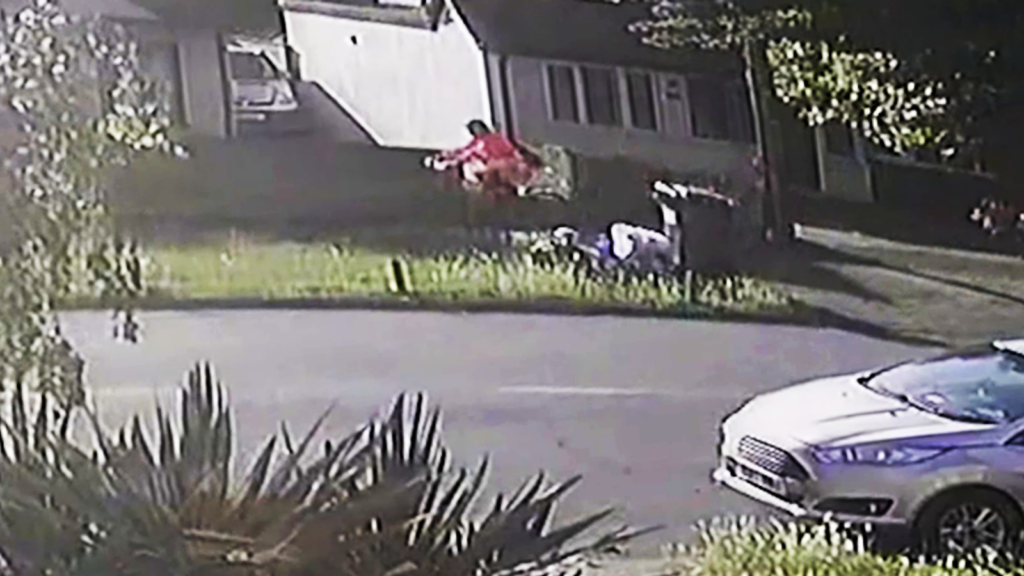
One case you may have already read about was this one from Kent, described as a British legal first, as a cyclist who struck and killed a great-grandfather while riding his e-bike on the pavement was handed a suspended prison sentence.
We covered the sentencing earlier this month, the daughter of 91-year-old Jim Blackwood calling Clifford Cage’s sentence a “historic judgement” and “the first time in British legal history a cyclist has been convicted of manslaughter for killing another human being”.
Cage received a 15-month jail term, suspended for two years, after pleading guilty to manslaughter following the death of Mr Blackwood in July 2023.

Maidstone Crown Court heard that Cage was riding an e-bike on the pavement on City Way in Rochester on 6 July 2023 when he struck Mr Blackwood, who was taking the bins out at the time.
Cage called the emergency services following the collision and attempted to assist the 91-year-old, a former Royal Engineer in the British Army, who served in Northern Ireland and Malaya.
Mr Blackwood was then taken to hospital, where his health deteriorated. He died three months later, on 13 October, after “suffering significantly”.
The cyclist was charged with manslaughter, as well as causing bodily harm by wanton or furious driving, originally pleading not guilty to both charges. However, on 28 October 2025, he changed his plea and accepted responsibility for the great-grandfather’s death, admitting to the more serious manslaughter charge.
According to the Crown Prosecution Service, the case is the first time a cyclist has been convicted of manslaughter in relation to a fatal collision on a pavement, and the first time a manslaughter charge was sought concerning an e-bike crash.
During the sentencing, the court heard that Cage had been riding on the footpath following two near misses with motorists on the road earlier that day. The cyclist claimed that he was not “pedalling mad” before the crash, and that Mr Blackwood had stepped out from behind a bush, giving him no time to stop.
It was also pointed out in the court that a tree on the path was overgrown and had obstructed Cage’s view of Mr Blackwood, who was described by the judge as “elderly and frail”.
Our full story can be read here.
Suspended sentence for driver who left cyclist in a coma for two weeks but claimed he thought he hit a tree branch, as judge notes 68-year-old motorist voluntarily stopped driving
At Ipswich Crown Court a driver was sentenced over a collision back in August 2020 which left a cyclist in a coma for two weeks. The East Anglian Daily Times reported that the cyclist in his late 70s, Ian Baxter, was “catapulted” off his bike and remained in hospital for seven weeks, two of which were in an induced coma.
The driver involved, Stephen Kilpatrick, initially did not stop at the scene but returned later. He claimed he had seen damage to his wing mirror and told police he assumed he had hit a tree branch.
The 68-year-old’s licence has been revoked, but the judge called it a demonstration of a “very responsible attitude” that he has already voluntarily stopped driving.
“The bottom line is, you simply didn’t see him and you didn’t allow enough room as you should have done,” the judge said, before calling the incident “a truly heart-breaking case for all involved”.
Kilpatrick was sentenced to 20 months in prison, suspended for 20 months, and he will be required to complete 40 rehabilitation days too.
“My life and the lives of my family have changed dramatically”: 12-month driving ban and £893 fine for driver who left 73-year-old cyclist with life-changing injuries
In Norfolk, a driver who admitted causing serious injury by careless driving was ordered to pay £1,360 and received a 12-month driving ban after an elderly cyclist was left with life-changing injuries by a collision.
The local newspaper reported from court that Laura Aves-Carter claimed she had not seen the cyclist, a 73-year-old man who was left with fractures to his spine, neck and ribs. In a victim impact statement, the rider reports he struggles to get more than four hours of sleep a night, suffers short-term memory loss, has constant ringing in his ears and has scarring on his face.
Aves-Carter was fined £893 and ordered to pay a £357 victim surcharge and £110 costs, although no compensation was given to the rider as the judge ruled “the sentencing act does not allow compensation orders to be made in these cases”.
“Too often, road traffic offences are treated as second-tier crimes, even when the consequences can be life-changing”
One common theme from almost all court cases we cover, whether mentioned by the prosecution, during sentencing remarks or victim impact statements is how life-changingly devastating for so many people one moment of inattention, distraction or dangerous driving can be. Campaigners and cyclists alike have regularly questioned sentencing severity for road offences, Cycling UK telling us that “too often, road traffic offences are treated as second-tier crimes”.

Sarah Whitebread, Head of Policy and Public Affairs at Cycling UK, said: “That mindset has contributed to dangerous and careless drivers reducing or even avoiding disqualification through claims of ‘exceptional hardship’. Speeding, driving while exhausted or passing dangerously close to someone aren’t harmless slip-ups, they are decisions that can leave families grieving.
“If someone drives dangerously and puts lives at risk, taking them off the road for a period is not excessive. It’s common sense. The courts’ first duty must be to protect the public and if the government is serious about meeting casualty reduction targets set out in the Road Safety Strategy, sentencing has to match the seriousness of the harm.”












26 thoughts on “3 years for causing death by dangerous driving, driver who left cyclist in coma avoids prison + ‘legal first’ as cyclist convicted of manslaughter over fatal pavement collision: road.cc sentencing round-up”
Excellent idea for a series. What’s happened to NMOTD though, haven’t seen a new one in ages? I’m pretty sure the submission supply won’t have dried up…
I think it just means we’ve fixed the problem.
I’m assuming that the weight of irony expended in that comment is comparable with the weight of the combined mass of Trump supporters heading for their rightful home in a supermassive black hole. NMotD is a casualty of the determination by an increasing number of cyclist-hostile police forces (is there any other type?) that the real offenders and Enemies of the People are cyclists whingeing about close passing, and that any driver passing aforementioned whingeing cyclist without KSI’ing him wasn’t passing close enough. The result of this normalisation of offences against cyclists is seen on here when the trolls write ‘I wouldn’t have reported that! I see 10 of those a day and they don’t trouble Tough Old Me!’
https://upride.cc/incident/hk21rxt_focus_dangerousdriving/ (profanity alert)
We realise it’s been a while, NMOTD is definitely not going away – we have made a conscious decision to increase the threshold for what we decide to publish. That means gathering some more details from the victim and ideally getting a response from the police force concerned before publishing.
A great initiative – well done. As I grow older (I’ve just turned 65), my fear of being hit by a vehicle while out riding is sadly increasing. My concern is that no matter what I do, such as lights, bright clothing, riding primary, etc, I have no control over the actions of other people.
A good idea, but it will only provide a useful overview of sentencing if the methodology is right. Relying on press coverage and press releases is unlikely to be rigorous enough, but I don’t know how you would go about collecting statistics on all sentences. And then there’s the cases where no charges are brought.
Which is to say, good luck to you!
We’re mostly interested in the topline info, i.e. what the verdicts were in well-publicised cases involving cyclists, so we have an archive of content about sentencing that’s easy to reference.
Absolutely the info in these rounds-ups alone won’t be enough to demonstrate definitively that sentences for drivers who seriously injure or kill are too harsh/proportionate/too lenient, sentences for cyclists who kill are too harsh/proportionate/too lenient etc, but we want it to be a starting point for further discussion.
You may be interested in this forum topic on CUK then
A place to record lenient sentencing for motorvehicle…
https://forum.cyclinguk.org/viewtopic.php?t=50829
What I would like to see is a comparison to the sentences handed down to drivers who kill cyclists to those given to people sentenced for manslaughter in other circumstances. Be that negligence, or incidents where a person has killed someone through aggressive behaviour.
I would also like to see a comparison to sentences given to drivers who caused death by dangerous driving to other motorists or car passengers.
Overall, I want to see the difference and how disproportionately lean the sentences to drivers who kill cyclists are compared to anywhere else.
At the risk of stating the obvious, a cyclist who kills someone is such a rare bird that much can be made of the offender (even if the circumstances aren’t actually or solely their fault).
But death by motor vehicle is so routine (5 per average day) that it is normalised, and sympathy given to the poor driver who has the luxury of living with it for the rest of their life.
A side-by-side comparison might help highlight the incongruity. Can we then find a set of MPs who can speak with clarity and wisdom to carry over the usual witless charmers?
Dan! Please make this your No 1 mission. And look up the case of the lady Time Trialler, killed by a van driver who admitted he was looking at barbecue photos on his phone whilst driving – HE GOT LET OFF WITH A SUSPENDED SENTENCE. But around the same time, a truck driver, also fiddling with his phone, ploughed into a car, killed a man – HE GOT SIX YEARS. Are cyclists of such a lower value? It’s sickening.
And the Porsche driver in Harrogate who was proven to have cocaine in his system, from attending a party the previous evening (during lockdown), had been using his phone prior to the collision, on a clear and straight road.
9 months in jail – out in 4, and home in time for Christmas. It is truly sickening.
Sorry but your close pass of the day series is clickbait – it has no tangible objective. And that’s just a basic given for any campaign.
When did they ever claim it was a campaign?
Even more pointless then.
It’s just clickbait with no purpose then.
The title of our last Near Miss of the Day article was:
Near Miss of the Day 945: Fuming driver accused of harassing cyclists after deliberately veering towards group ride in “closest attack I’ve ever witnessed”
I fail to see how this is ‘clickbait’, because it’s a pretty accurate description of what happens in the video. It’s a headline designed to grab attention, not mislead.
Quite a few of our Near Miss of the Day articles have been featured in the non-cycling press, raising more awareness of the issue of close passes, and some have even directly contributed to police forces revisiting camera submissions where they originally decided no action was taken. We were even told by Gloucestershire Police that as a result of one of our published NMOTD articles, it was going to set up a new dashcam unit to improve the consistency in its decision making, because the roads policing manager agreed the footage clearly shown the driver should have been prosecuted.
Not bad for ‘clickbait’.
We were even told by Gloucestershire Police that as a result of one of our published NMOTD articles, it was going to set up a new dashcam unit to improve the consistency in its decision making, because the roads policing manager agreed the footage clearly shown the driver should have been prosecuted
Unfortunately, that’s not the same as them actually setting up this new dashcam unit. Police make up stories all the time, and this is the force which invented the ‘cyclist must prove he was inconvenienced by a close pass, or we’ll do nothing no matter how close it was’ dodge. So if the new dashcam unit continues the policies of the old dashcam unit, it’s not much of an improvement. How, for instance, do I prove I was inconvenienced by this one? (which has been held above in purdah in this topic for several days ‘awaiting moderation’)
Late to the party on this but I did save this article when it caught my eye. Desperately saddening to read, especially Lucy’s story.
That was very nearly me Halloween 2017 when a driver smashed me from behind middle of the day and catapulted me onto a telegraph pole. Almost died at scene but for the air ambulance doctors saving my life before being taken to John Radcliffe where they worked some miraculous surgery to address spino-pelvic and other traumas including a brain haemorrhage, snapped ankle etc.
Point is not to cover that detail, per se, but more the aftermath of how the courts found the driver not guilty of dangerous driving, if ever smashing a more vulnerable road user from behind without mitigation can be anything other than dangerous.
Thankfully, there was some justice, albeit limited, for these featured case stories, but in my case there was no reckoning for the driver who did this to me, he went to court only, case dismissed and that was that.
I was both unlucky and then very lucky that day. Regarding the injuries, there is no ‘get out of jail free’ for that (‘scuse pun), they are lifelong and whilst I am able to live again at 80-90%, forever gratefully, it will always be with me and my loved ones, every day I am granted.
Are you able to ride a bike now?
How do you handle the “fear”?
The only way a car accident that kills another, whether it be another car driver, a cyclist, or a pedestrian, is if there is criminal neglect, like intoxicated driving, or far exceeding the speed limit. In this case the term dangerous driving was used, which I assume means reckless driving, so in his case he should have been handed a much stiffer sentence. We weren’t told what he was doing to deserve the term dangerous driving so we’re left to assume he was going considerably over the speed limit, or passing where no passing was allowed, etc. Too many times, a killed cyclist is treated like animal roadkill.
As hard as this for people to understand some accidents are just accidents even if it results in death, it doesn’t automatically qualify the person for jail time, nor should it. About half of all deaths from car accidents had no criminal misconduct going on, just a bad accident. This applies to cyclists or pedestrians.
@froze I think this is why the use of “crash” is better than “accident” – it may help avoid confusion between the legal and the more “health and safety” perspectives.
In legal terms offenses are often narrowly defined, and they require proof eg. sufficient evidence. And in the case of road offences due to motornormativity it sometimes seems there’s an additional hurdle of “needs to be significantly worse than the regular below-legal-standard driving we see every day”.
The other perspective is interested in causes and how bad things can be prevented (though there will be some limit in terms of effort to prevent rare events). From that perspective there are few “accidents”. Most of the crashes are entirely (statistically) predictable consequences of well-understood human behaviours / limitations and their interaction with machinery, rules and the (built) environment.
Some counties have started applying this thoroughly to road safety and public space design (eg. NL’s “sustainable safety”). The UK does so in the rail, air and marine spheres – and even to some degree on the roads (eg. the engineering of motorways). But we cheap out when it comes to motoring in our urban spaces.
More accurate to say that about half of all deaths from car incidents are ruled as having no criminal misconduct going on. Looking for figures to test your claim I found this on the BBC from 2017:
https://www.bbc.co.uk/news/uk-39457880
Jake Thompson was killed on a pedestrian crossing by a lorry driver doing 38mph in a 30mph zone, and yet initially the police said there wasn’t enough evidence and then when it did get to court the judge dismissed it as “no case to answer”. That’s the reality behind many “no criminal misconduct” incidents, either there is insufficient evidence (driver hits cyclist on a lonely road at night with no witnesses), police incompetence or judicial bias. As my motorcycle instructor told me, there is no such thing as a “no-fault accident”, there is always something one or both parties could have done differently that would have avoided it.
initially the police said there wasn’t enough evidence…
Ah, yes! The favourite deployed dodge of the police, if they can’t just get rid of the offence straight away with ‘I didn’t see him…I didn’t mean to do it’. The police really hate it when they are confronted with indisputable evidence and they really hate the confronters. You can imagine the conversations at OpSnap when they get these, after the ritual ‘Sod it! Another one failed to get him’: I don’t think we can get away with saying that’s 1.5m, especially with that Cyclists Beware sign by his nose, straight into the bin with it!
ttps://upride.cc/incident/sk19evu_stagecoach42_closepass/
ttps://upride.cc/incident/yx68uwz_stagecoach42_closepass/
@DanAlexander & all reading this comment, (plus @SarahWhitebread) can I make some appeals to move things further
For those FATAL RTC there will almost certainly be an inquest – I was involved in pressing for the Coroner to order a RULE 28 report at the inquest after a pedestrian went under a bus in North Greenwich, just 8 weeks after another pedestrian making the same journey ended up under a bus at the same time of day, traveling in the same direction at exactly the same location. TfL’s legal team protested but the Coroner demanded the report
Since 2000, when I was very early on the scene after Alex McVitty was killed by the driver of a 32T concrete jigger turning at speed from the right hand lane on London Wall, driving THROUGH Alex to enter a side road with a 7.5Ton WEIGHT LIMIT, I’ve worked independently (and in the past with support of #CyclingUK but now have lost those resources) This truck was driven for a sub contractor for #CemexUK and had killed a second young woman on a bike whilst putting another in a wheelchair
For the dozens of fatal & serious RTC the balanced & objective investigations highlight a serious failure in the competence of those designing managing and maintaining our roads with many #RedFlag issues to make everyone aware of
I was well satisfied after Dr Suzie Bull was killed by a driver ramming her from behind because the portable picnic table over the steering wheel hid her from view, but the company that allowed him to drive the truck with this illegal obstruction over the windscreen was also shut down by Nick Denton the Traffic Commissioner revoking their licences
My work is picking out many other blindingly obvious features from fatal RTC – over 50% of cyclist fatalities involve construction industry trucks, ridiculously using N3G off-road specification (with 40+cm gap UNDER the front) and around 80% of crashes being hit from rear
I’ve around 5 examples of the ‘loose convoy’ with 32T tippers where the lead drivers overtake a cyclist and the second driver kills them Barry Meyer was ‘chasing’ after Mark Drummond in S77 DHL when he hit Barry Neve in 2013 with others on Mile End Road, Wigmore Street, Oxford Parkway, plus my own close call on Knightsbridge, and the possible prevalence of vanity plates
Much more so perhaps a common factor in many RTC that rings alarm bells is the use of 3.0m wide traffic lanes which the DfT’s OWN guidance tells us that the MINIMUM width to operate a bus or truck is 3.25 metres to avoid hitting anything – all the approaches to Holborn Gyratory are (or were) 3.0m & we had 2 deaths in 5 years on Vewrnon Place, with a further 5+ years before the left turn was banned. For the crash that killed Marta K I had an identical move by a truck driver and ended up punching the left had door of the truck cab, when the driver attempted the same left turn from straddling 2 lanes and not signalling the turn
The same 3 metres issue is also behind 2 deaths in 3½ years for young women both cycling in to Glasgow along the same road during the morning peak, where the narrow lanes placed them in line to be hit by the left turning drivers, from the rear and crushed by being driven through 7 years later the railings bent in the first crash remain still bent with no repair or removal and the lanes at the other location remain just 3 metres wide… We make no progress!
This is a very important and informative comment by A V Lowe. I commend it to all!
Never mind all the facts and statistics about poor driving and road design, let’s focus on the cyclists’ clothing and use of headphones instead.