



Serious injuries to cyclists in London are at their highest since records began, according to new data, as the risk of serious injury whilst cycling has also increased.
The latest statistics, initially presented privately to a Transport for London safety panel, also show a significant increase in the number of injuries sustained whilst riding hire bikes in the city as their popularity has surged.
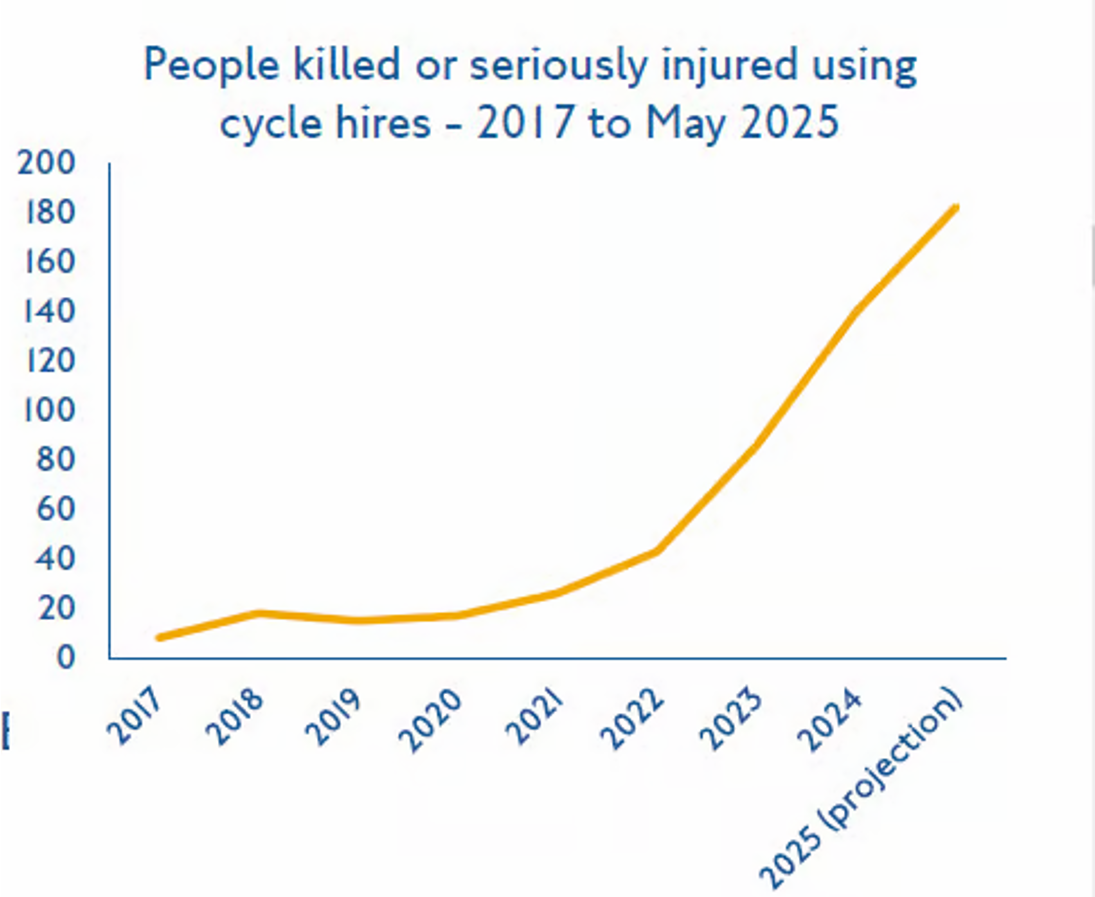
TfL say “it is still too early to make any firm conclusions based on this provisional data,” as reported by The Standard.
In analysing these statistics, there is a risk of drawing conclusions from a narrow portion of data. In particular, the rise in the number of people seriously injured whilst cycling can be attributed to the large rise in the number of people cycling in London.
Data published as part of TfL’s Travel in London report in November 2025 showed that there had been a 12.7 percent increase in total journeys being made by bike, with approximately 1 in 10 of those journeys being made on ‘dockless’ hire bikes. Cycling now comprises 4.7 percent of daily journeys in London and six percent of all road trips. There has also been a rise of 8 percent in serious injuries among all road users.
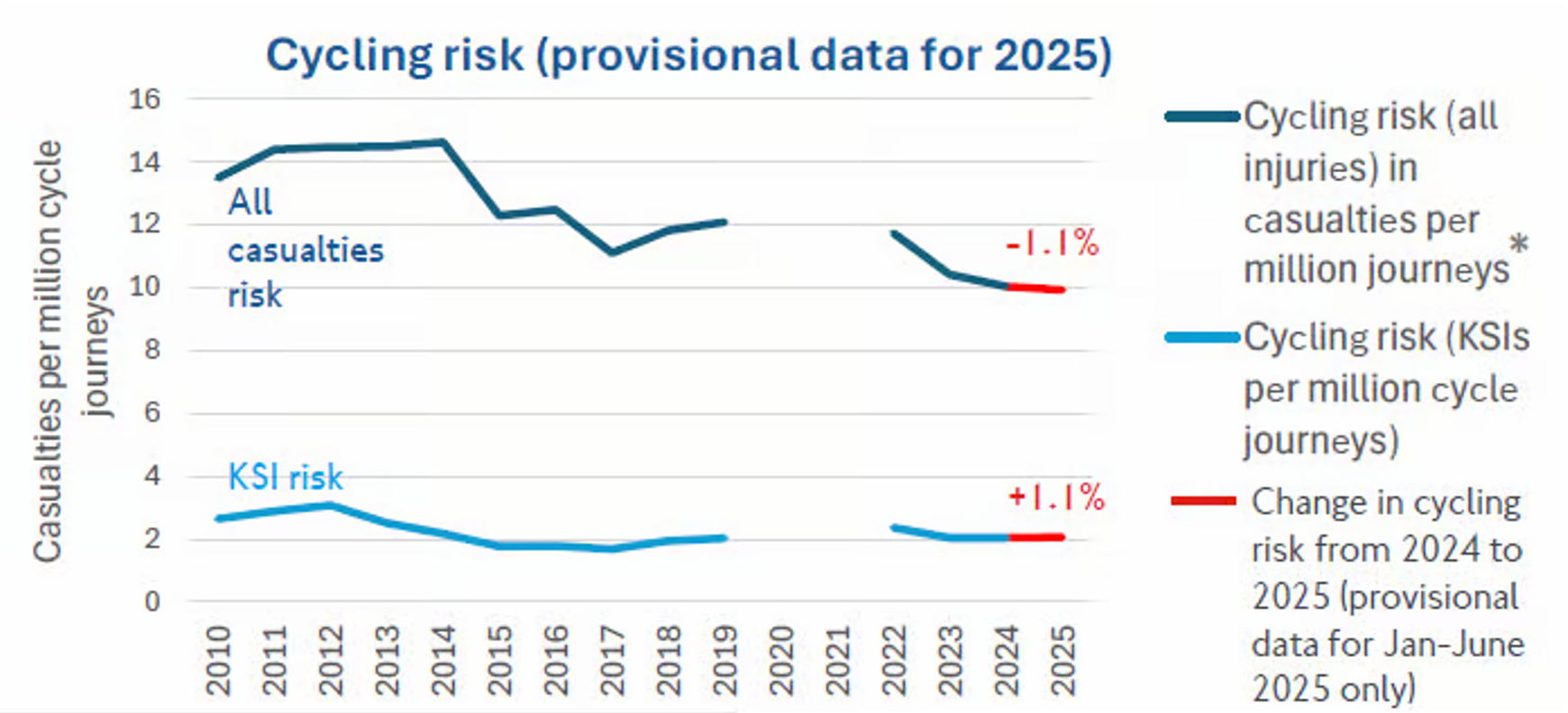
However, the increase in serious injuries is above the rise in cycling’s popularity as a mode of transport, and TfL’s data found that the risk of serious injury whilst cycling has increased by 1.1 percent since last year, at the same time as there has been a decrease in total injury risk. Despite investments in active travel infrastructure, campaigners have criticised TfL for a “lack of action” meaning “more people killed cycling, and fewer people who otherwise would take up cycling doing so.
“TfL and the mayor know London is way behind other global cities on helping drivers switch modes and on delivering a network of truly safe and comfortable streets for cycling.” London Cycling Campaign Chief Executive Tom Fyans told The Standard.
Former Hackney councillor Vincent Stops told the same outlet “2025 will prove to have the highest number of serious cyclist injuries since records began and the rate of serious injury per journey is rising. Yet there are no alarm bells ringing at TfL. This has to change.”
The latest data also pours some cold water on the positivity that has come from cycling in the capital city in recent months. At the time of November’s report, TfL said 76 percent of its Cycleway users felt safe using their segregated infrastructure, but added that the network only accounts for 2.5 percent of cyclable roads in the city. Active travel infrastructure has expanded significantly, from 90km in 2016 to 435km and counting. However, the rise in private, dockless hire bike provision has also raised concerns over the safety of their hire bikes and the company’s ability to maintain a large fleet of bicycles across the city.





















5 thoughts on ““Lack of action means more people killed cycling”: Campaigners demand change as latest stats show cyclists seriously injured in London up 14%”
Take heart. London might be “way behind other global cities,” but it’s way ahead of most major U.S. cities. Just slowing speeds is a major step. While there at Christmas, I couldn’t believe how much quieter and more peaceful London is compared to LA, Seattle, Portland, Denver, Kansas City, etc., etc., etc.
The only thing making Lime bike riders safer for other cyclists is the restricted speeds. A lot of the riders of them have zero spatial awareness. I’m guessing its also becuase they are charged per minute, that they rarely stop at red lights? Not stopping at reds is one thing, but so many don’t even look to see if it is clear before they plough on through. They do contribute to making cycling in London more stressful than it needs to be.
Bit of a misleading headline, “Cyclists seriously injured in London up 14%” without mentioning cycling up 12.7%. The 1.3% variation is surely small enough to be attributed to standard fluctuations? Not everything in the London cycling garden is rosy by any means but it’s certainly not become 14% more dangerous as the headline implies.
With reference to rental e-bikes, apparently (according to the Evening Standard) at a private presentation by Will Norman (walking and cycling commissioner) to TfL’s safety panel it was revealed that rental e-bikes now account for 20% of bicycle KSIs, so I guess the figures are actually quite encouraging for unpowered cyclists on their own bikes, take out the Limes etc and cycling numbers drop by 10% but KSIs by 20%, so it’s actually rather safer.
It’s no shock that rental e-bikes make up such a high proportion of KSIs; I’m not (as previously accused by some here) being anti-e-bike (I had one until not long ago) or anti-cycling to say that a huge number of people using Lime and similar hires ride them like maniacs. I was out in the centre of town last night; taking the bus both there and back it was astonishing to observe the number of Lime bike riders charging through zebra crossings with pedestrians on them, through red lights at pelican crossings, again with pedestrians crossing, and most extraordinarily straight through red lights at crossroads with heavy traffic coming from both left and right. It’s entirely unsurprising that riders of such bikes are so disproportionately represented in the KSI figures, in fact it’s quite surprising that the number isn’t higher. They are a menace, I’m afraid, and a serious danger to pedestrians, other cyclists and themselves.
You are most correct! How the stats are measured makes a big difference. As you point out, overall ridership is up significantly. The article points out the number of trips is also up. Are those ‘short’ trips or ‘long’ trips and what is ‘short’ and ‘long’. Is it an increase in ‘short’ or ‘long’ trips? Is there a way of calculate injuries per Km? It is fairly obvious that the longer the trip, the possibility of an injury go up. There a couple of saying that I keep in mind when viewing statistical data: “liars figure and figures lie” and “Torture the data long enough and it will confess to anything”.
I’d be wary of quoting Vincent on anything. He’s notorious in London for opposing segregated cycling infrastructure.