


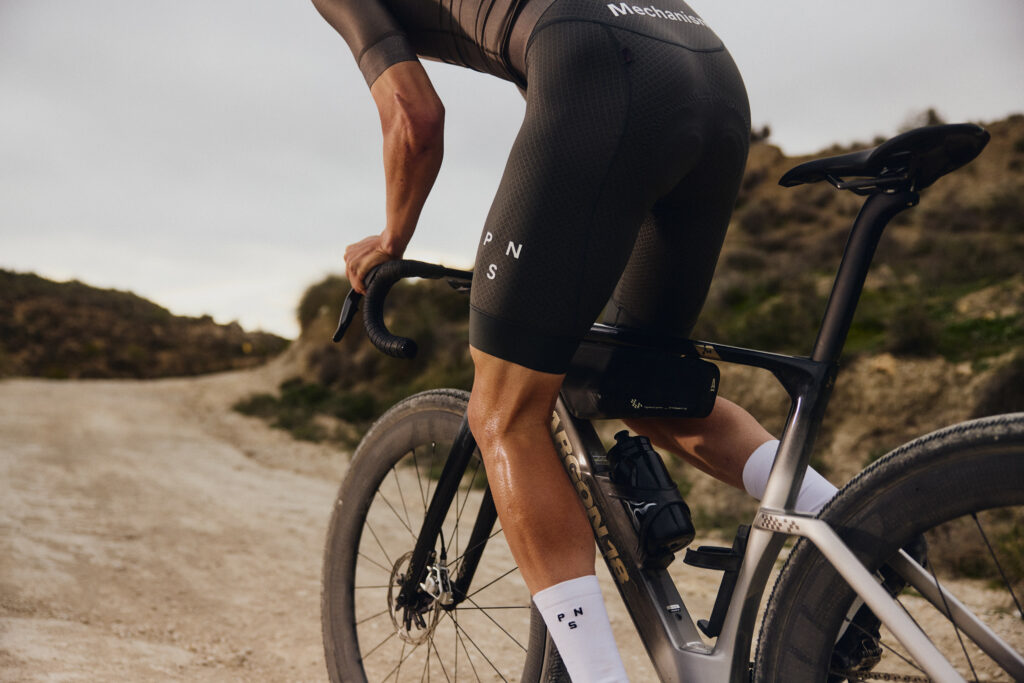

Cyclists across the world will recognise the name Argon 18 as a bike brand that makes cutting edge race machines for track riders, time trialists, and road cyclists. Argon 18 is among the first choices for anybody looking for absolute top-tier performance; if there is a fraction of a watt to be eked out via intelligent aero design, you can be pretty sure Argon 18 will be able to find it.
> Check out the all new Argon 18 Anti Matter here
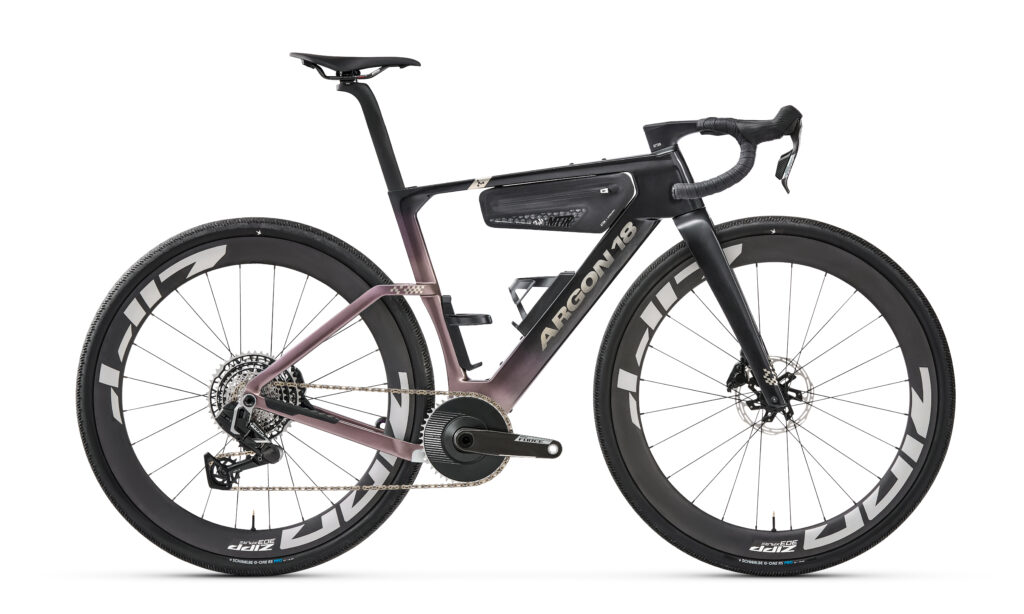
Now, all of that knowledge and experience is being used in a slightly different arena: with the new Argon 18 Anti Matter, the Canadian manufacturer thinks it has redefined performance bikes for modern gravel racing.
“I would never stop anyone from buying one of our bikes but we do need to spread the message: don’t buy the Anti Matter thinking it’s a simple gravel bike,” Argon 18’s product director, Alex Côté laughs.
“If you just enjoy riding on gravel, we have our fantastic Dark Matter. The Anti Matter, on the other hand, is a very aggressive machine for a very specific type of rider – somebody who races on gravel. This is serious weapon. While it might suit the same type of terrain as our Dark Matter, the Anti Matter is for a very different rider.”
Inspiration
Following the launch of the awesome Nitrogen Pro ultra aero road bike last September, the Anti Matter is the second showcase of Argon 18’s in-house R&D lab’s expertise in producing high-performance bikes. In this case, though, it’s one that can cope with a bit of rough stuff.
“The Anti Matter is our take on what a modern gravel race bike should be, what it should look like, and how it should behave,” Alex says.
For Argon 18, fulfilling that criteria required more than just fitting chunkier rubber.
“Of course clearance is one part of the equation – the Anti Matter comes with 55mm of tyre clearance, allowing for 50mm tyres with extra safety space – but overall performance doesn’t only come from the tyres,” Alex says.
“The first thing that impacts speed, even speeds of 20kph upwards, is still aerodynamic drag. When we talk about gravel races, the speeds required to win them have evolved from 28 or 29kph for men and 26 or 27kph for women in the late 2010s, to over 37kph for men and 33kph for women last year. That’s an increase of 30%.
“But the reality of gravel is, that speed is never constant. You have very high-speed moments and you have very low-speed technical bits. Unlike road cycling, where the variation in terrain is very small, on gravel you can’t really isolate a specific pattern in your performance tracking.
“So I think the most exciting part about this was the discovery and the development side of it, where were trying to get the best product for almost every condition.”
Target audience
The result is a feat of carbon engineering with highly sophisticated aero elements that were inspired by – and share a common development thread with –the Nitrogen Pro. The reason for that is, while gravel terrain might be more diverse than road, Alex and his team did find one important common denominator: the rider.
“If you put the Nitrogen Pro and the Anti Matter side-by-side, they’re not identical twins, but there is a definite shared DNA in the geometry,” Alex says.
“When we started doing the research and discovery phase of the Anti Matter’s development, we realised that people who race gravel bikes are the same people who race aero road bikes. It is an almost 90% overlap. And most of the challenges that gravel racers face is being able to replicate their road bike position.
“So, with this transition of road racers to gravel, we found a gap in the market and in our product line for real road bike geometry but adapted for gravel in terms of handling. That’s one of the key features: we made a commitment to achieve pure aero performance and fit without compromise, but in a gravel-focused package.”
To the wind tunnel
Despite its respected position in the market, Argon 18 is still a relatively small company and producing a whole new breakthrough bike is not a cheap business. To maximise the development budget, and because it made absolute sense, the Anti Matter development cycle was combined that of the Nitrogen Pro.

“There was an eight-month delay between the start of the Nitrogen Pro and then the start of the Anti Matter, but most of the research from the Nitrogen Pro was applied the Anti Matter, and that was the intention from the start. It meant we could basically double our resources in the research and development phase,” Alex says.
“We did more than 130 tube shape iterations, which we tested with 800 hours of computation fluid dynamics [CFD] and 45 hours in the wind tunnel. Over the course of two different sessions, we spent four weeks in the wind tunnel at Silverstone. That is very expensive and while it’s easy to go in the wind tunnel for validation of a design, it’s much harder to go in and test for iterations. There was a lot of 3D printing involved!
“All the time, you are trying to understand the impact of one shape on another, because it’s a downstream effect. As you roll through the air, if you change the middle part, you have to see how it affects the rear; if you change the front, how does it affect everything behind it? This sequencing of testing is very, very challenging because your expectation of a standalone section is that it performs in that positive way. But if you put something else in front, it then changes how that part performs.”
Tale of two sections
Outright aero efficiency – testing has shown the Anti Matter provides a 14.5W aerodynamic advantage over the Dark Matter in race conditions – and, ultimately, speed is only one part of the ride experience equation. Even a brand as focused on performance as Argon 18 recognises that an uncomfortable bike is worthless. That fact is only heightened when the terrain under tread is gravel.
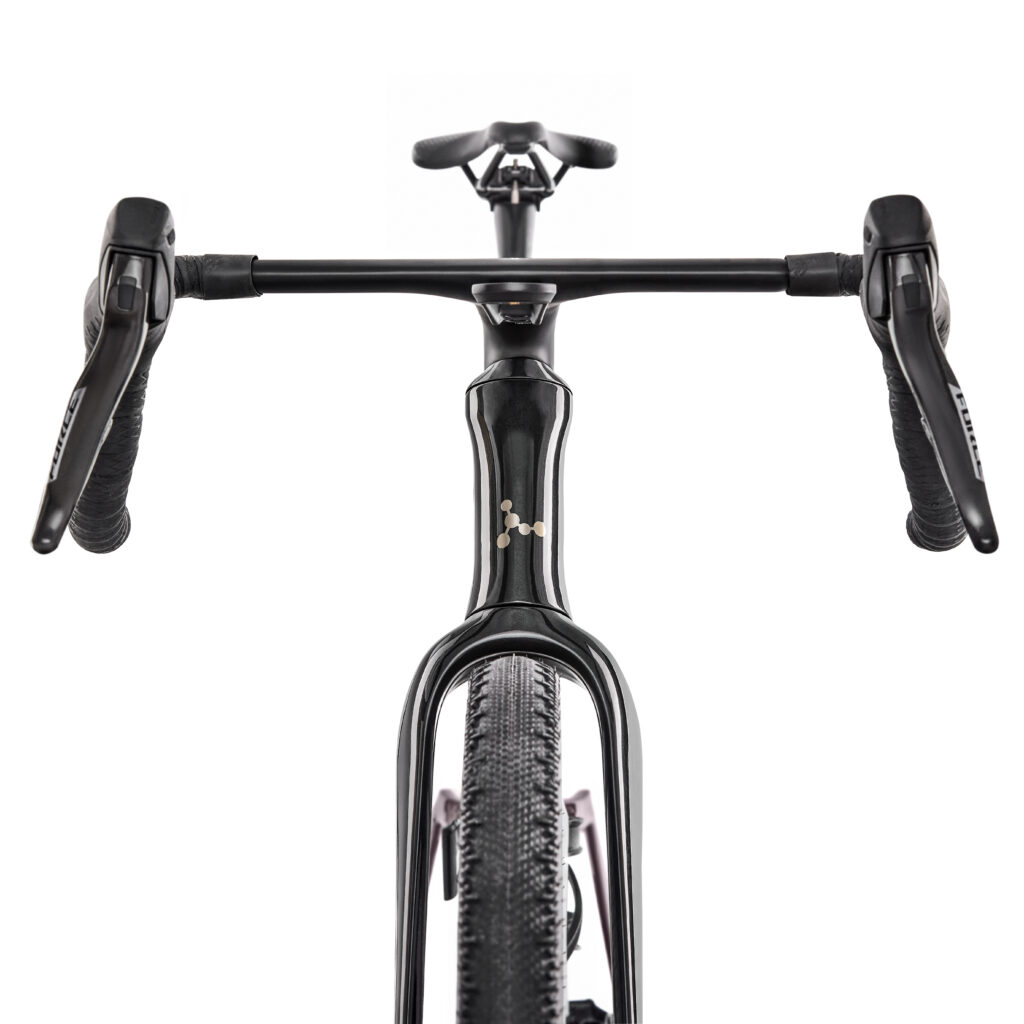
“We definitely didn’t go for the fastest or narrowest product – we still use a round steerer, for example – because that comes with a lot of limitations in terms of ride quality,” Alex says.
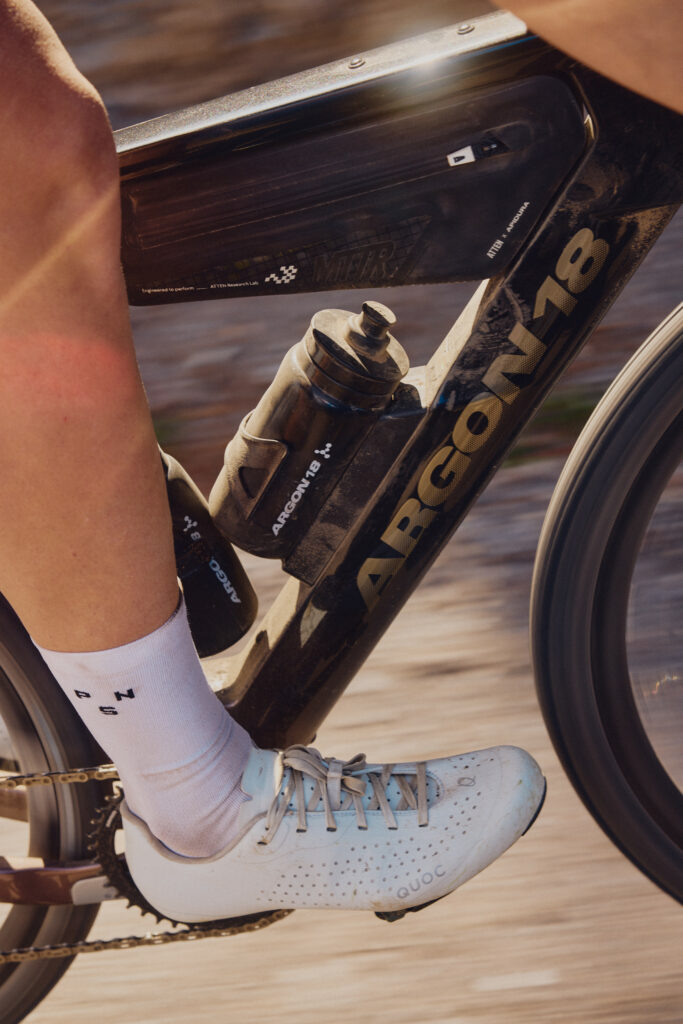
One key design element of Argon 18’s approach is the brand’s signature horizontal dropped seatstays, which effectively act as the transfer point separating the upper and lower sections of the frame.
“We use the top part of the frame to deal with compliance and comfort; the bottom part for stiffness and power transfer,” Alex says.
“This is not a unique approach but I think the way we go about it is very interesting because it’s not just the layup or the geometry, it’s the topology of the tubes – the shape and the thickness of the tubes. The tube shape will have a huge impact on the behaviour of the bike, more so than the carbon lay-up in some cases.
“So I call that little horizontal stay the speed bridge. When you look at the Anti Matter from the side, you wouldn’t notice this. But when you look at it from a slight angle, you definitely see that the upper portion of the seat tube from that speed bridge is a very, very thin, whereas underneath it, it’s way thicker. That’s all for power transfer.”
Real-world riding
Design and theory are one thing, but nobody can ever really know how a bike rides until a sample is in your hands.
“In the six months where we test the first sample, it’s almost never the final version that we go to production with: we usually have half a dozen to a dozen iterations afterwards,” Alex says.
“We have performance targets for the frame in terms of stiffness, lateral, vertical, the compliance, the weight, the quality, and then safety standards need to be top of the chart. We’re not happy with just passing industry standards, we have to exceed them significantly to meet our own expectations.”

Once all of that is met, the Argon 18 team are able to see if they managed to achieve what they set out to do.
“In this case, the end result is something that I am very, very happy with. The intention of having a road bike feel on gravel is met 100%,” Alex says.
“The interaction between the rider and the bike is like a road bike. Your touch points are just where they would be on your road racing bike. But the Anti Matter doesn’t behave like a road bike; it behaves like a real gravel race bike should.”
Argon 18 Anti Matter – prices
The Argon 18 Anti Matter is available in three colourways: Iridium Silver, Mystic Dune, Sea Foam / Neon. It’s also available in five size: XS to XL. And it is available fitted with one of three groupsets: SRAM Red, SRAM Force of SRAM Rival.
Prices are £10,495 (Red), £7,495 (Force), £5,495 (Rival) and a frameset only option will be available in December 2026 at £4,395.
For more information, visit Argon 18’s website now.














2 thoughts on “Argon 18 says the all new Anti Matter is the ultimate carbon aero race bike… for gravel!”
Only came here to see if Surreyrider had commented yet. They’re going to love this one – it’s not even an offroad branded page…
@quiff Should be on a new sub-tier website ‘OffroadRacing.cc’ 🙂