


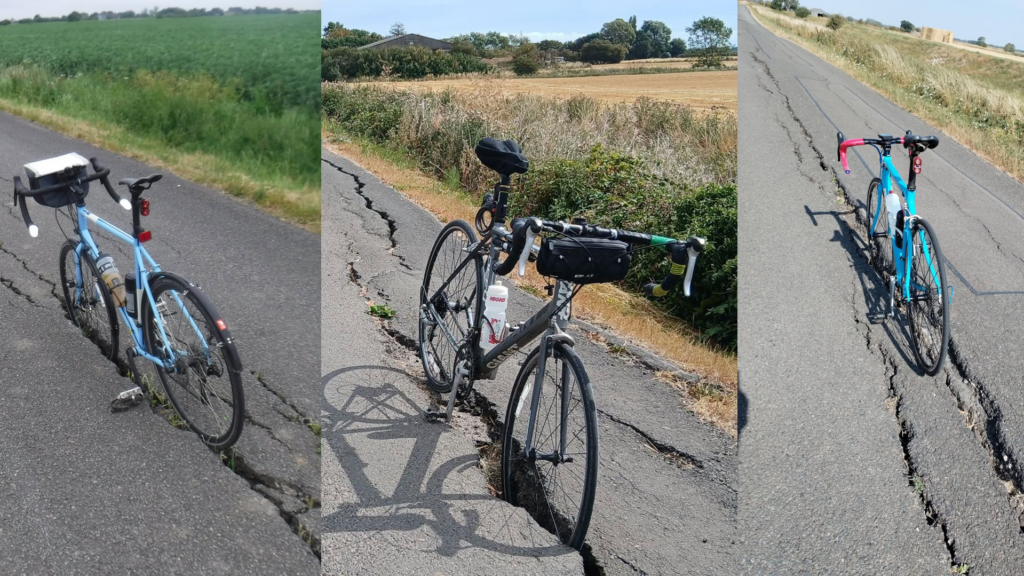

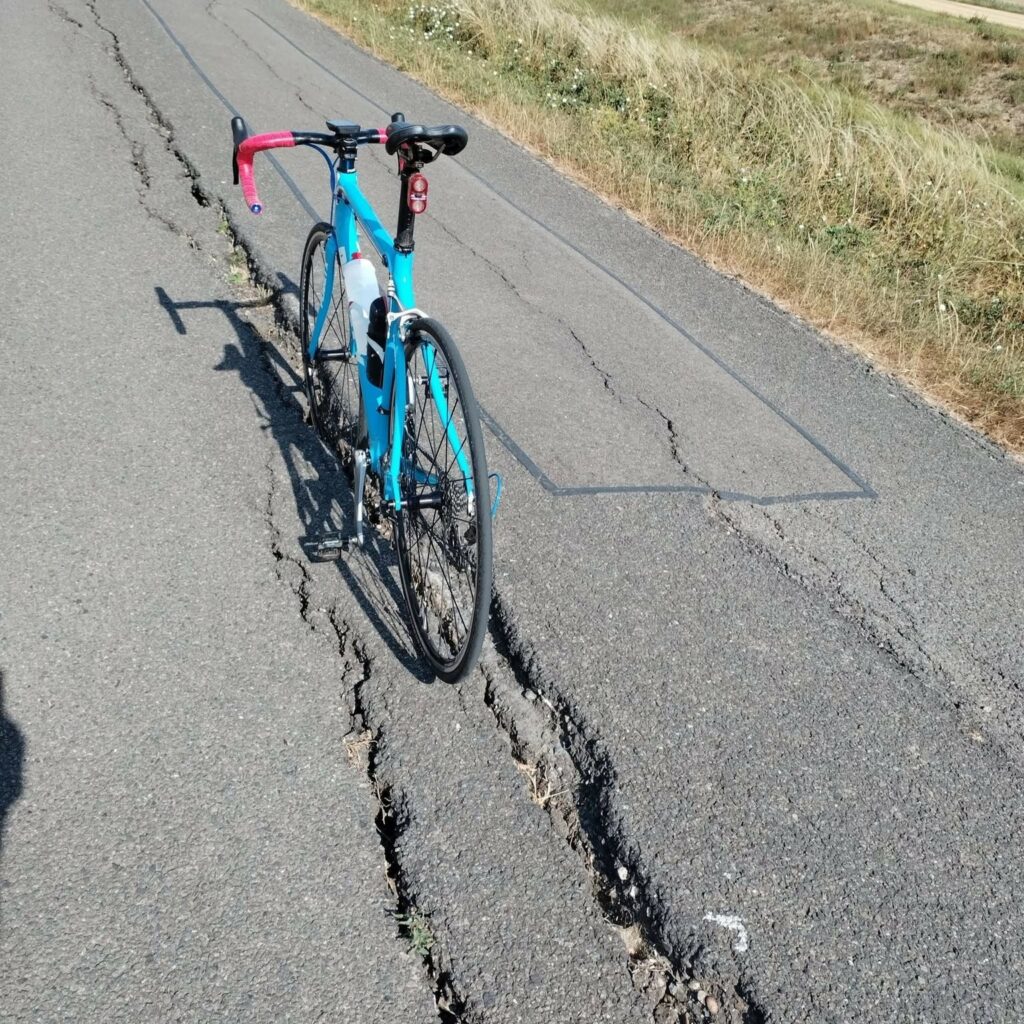
A photo of cracks in a Lincolnshire road has gone viral after a photographer showed he was able to stand his bike in a half-metre deep gap in the road.
Chris Nagel photographed his Giant road bike in a crack on Thorpe Bank, around 10 miles west of Skegness. The cracks can be seen developing on Google Maps as early as 2021. However, the summer of heatwaves that melt and re-shape the road materials has accelerated the erosion of the road’s condition, the CEO of the Road Surface Treatment Organisation told the BBC.
Mike Hansford said road construction was increasingly turning to “geosynthetic solutions” to reduce road cracks, whilst the Head of Highways Assets at Lincolnshire County Council said “drought damage [was] affecting certain roads at the moment as the ground underneath shrinks and shifts in the extreme weather.”
Shaun Butcher added that the road would be repaired “in accordance with [council] policies.”
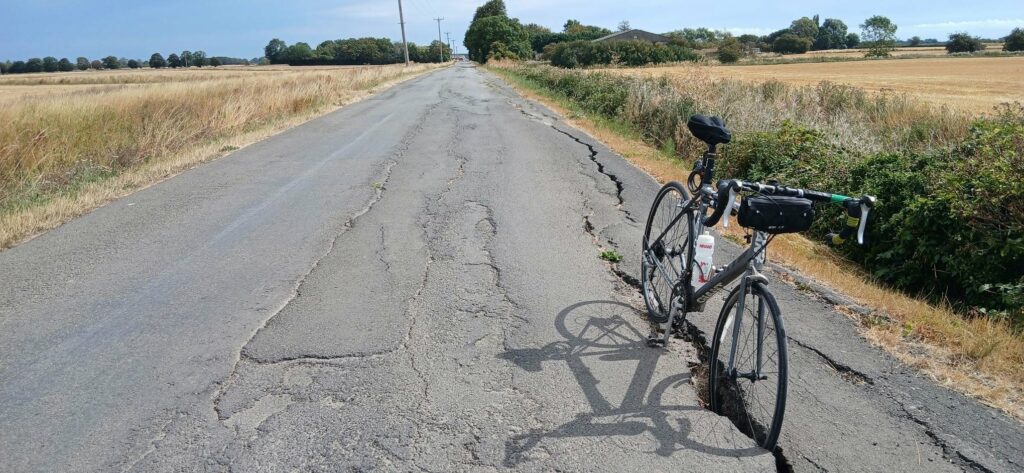
However, social media users were critical of the council’s approach to road maintenance in the area. Part of the Fens, Thorpe Bank itself runs parallel to a dug-in open drain. Some residents pointed out the roads were not originally built for large vehicles and have not been appropriately maintained to accommodate the increasing weight of cars.
“Thorpe Bank, I think they’d be better off bulldozing the whole bank out and reinstating it rather than pussyfooting about with stripping a few inches off the top…. fen roads were never built for the weights they carry now”, Wainfleet resident Paul Dodge wrote.
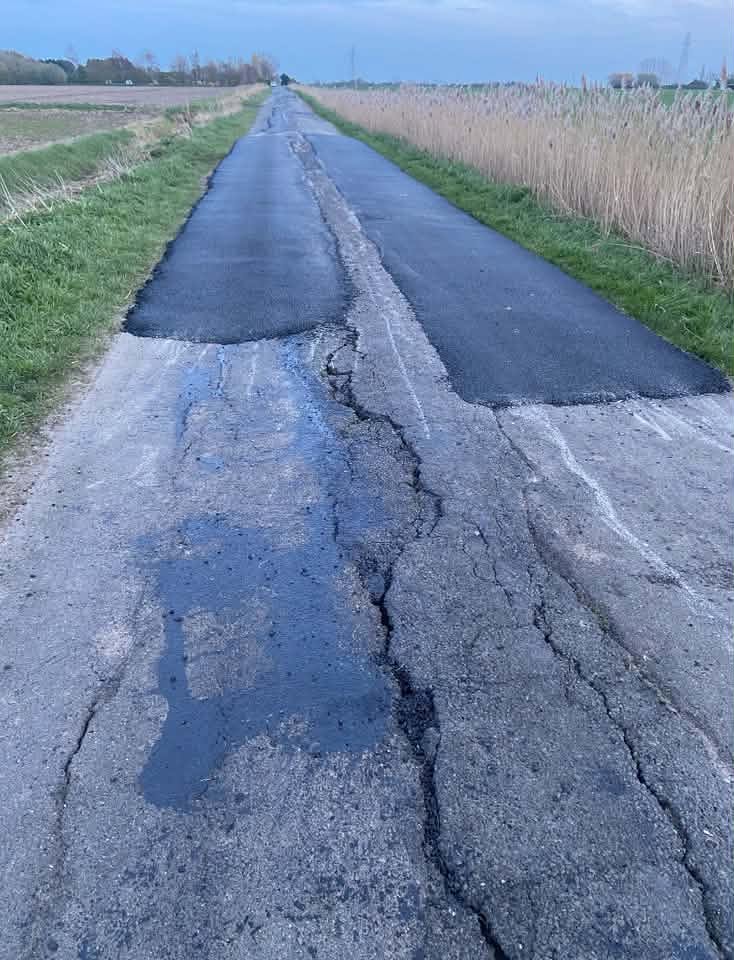
“If I remember correctly they closed this road back in April for near a week for repairs… I was expecting them to come and finish it the following week but nope that’s how it still looks”, Wayne Davey wrote, attaching a photo of the half-finished road repairs.
Nagel’s original post also encouraged other local cyclists to share photos of their own free-standing bikes inside cracks on Lincolnshire roads.
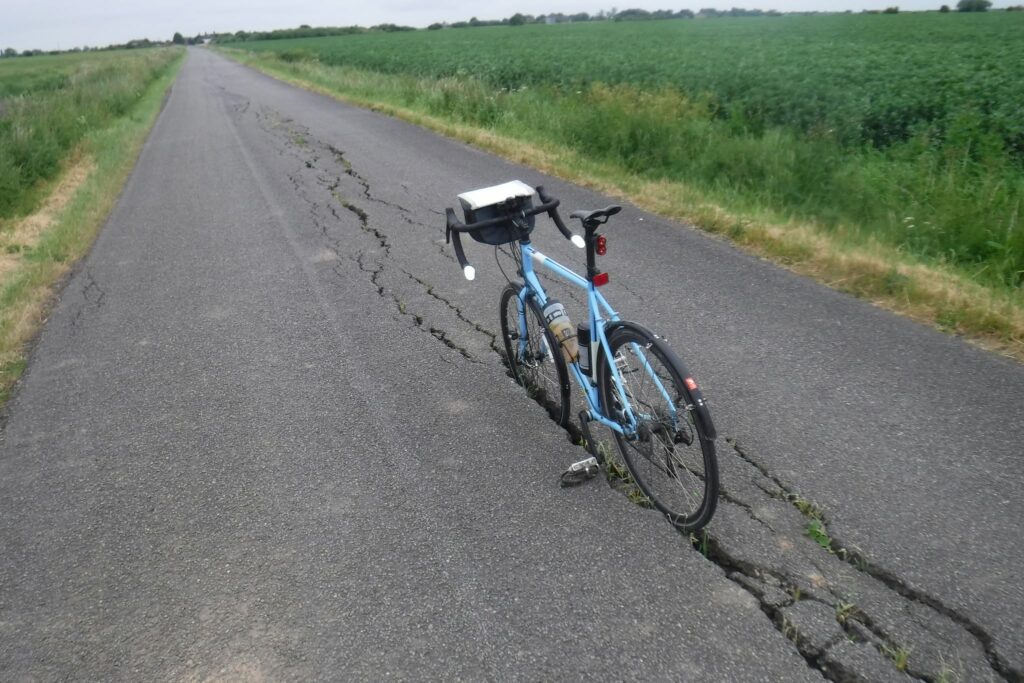
Nagel later told the BBC that even when drivers and motorcyclists “go steady, it’s still too fast to really see how bad the road surface really is. You’ll only see it properly as a cyclist or a pedestrian.”
Having been Conservative-controlled since 2017, Reform UK won control of Lincolnshire County Council in 2025. Road resurfacing is not currently planned on Thorpe’s Bank, though road resurfacing is due to begin on nearby Steeping Road before 2028, according to the council’s road repairs website.
The county is due to host the opening two stages of the Tour of Britain Men in two weeks’ time. Both stages will utilise the Lincolnshire Wolds, with stage two, a looping route from Boston to Skegness, passing through nearby country roads between the villages of Spilsby and Wainfleet.














13 thoughts on ““And drivers wonder why cyclists ride in middle of the road”: Cyclists mock country roads with deep cracks by posting photos of their bikes standing in them”
The comments on Facebook where this was shared were fairly standard, 95% anti-cyclist split fairly evenly between:
– If you can’t see that you shouldn’t be on the road [I did try to suggest that at night in the rain or with ground mist it might not be easy to spot, “Well you shouldn’t be riding then”]
– Good, traps for cyclists, hope they catch plenty
– When cyclists pay to use the roads they’re entitled to ask for repairs and not before
– Bike tyres do more damage to roads than car tyres [made me wonder if Nige was spreading his bread far and wide]
and of course
– When the cracks are big enough to damage my Porsche Cayenne alloys I’ll worry.
Lovely.
That is literally lethal.
https://road.cc/content/news/council-missed-fatal-pothole-focused-dangers-cars-304489
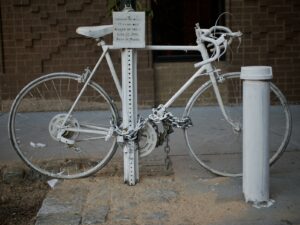
Death of Harry Colledge, and the famous road chasm which oscillated in and out – that was the ludicrous suggestion of the county council when excusing itself for ignoring it
Beautiful 🙂 …no wonder tyres are getting wider 🙂
The truth is that even if a road is not a chasm, the debris along the edge of most roads in the world requires cyclists to ride closer to the centre. Motorists don’t ever think of this, nor do non-cycling police, council staff or politicians
‘Shaun Butcher added that the road would be repaired “in accordance with [council] policies.”’
Not at all then… I live in Lincs and this is very common. My daily run route is exactly like that. Motorists are not immune – which may come as a surprise to some of them. I tore the sidewall out of a car tyre recently on the edge of one of a massive crack like those. The LA paid up no problem but that’s another £100 buying plasters and not going towards proper repairs…
Looks almost like the typical bike stand in front of any shop. But it’s actually even better, as it holds both wheels!
Could it be the Lincolnshire counterpart to the Sheffield – a “Surfleet stand”?
I used to ride that area occasionally – Louth to Donna Nook range and back. The roads are thin heavily cambered county roads which have lots of agricultural vehicles using them more than anything else. They are mostly just breaking apart due to the weight they bare and and the fact most have irrigation ditches next to them. It would take millions to repair them all. I would suggest just not riding on them and sticking to the more well maintained roads around that region. there are lots of good roads around too. going down a quiet country lane thats away from most traffic is obviously going to be in a bad state for the reasons I mentioned above.
@Smoggysteve but around Lincolnshire the “good roads” (any roads) are normally few and are either busy A-roads (lots of trucks!) or effectively A-roads in terms of traffic volume and speed, just narrower and with worse sight lines.
(Use the footways? Good luck there…)
Pity since it is mostly flat and there’s great touring potential…
@chrisonabike AS I said, I rode them roads regularly, I know there are some very bad country roads, and they criss-cross that entire region. Its pan flat and they are very old lanes. The damage is caused mostly by them subsiding hence the cracks, its a losing battle when the majority of the traffic is still heavy tractors. I could ride from Louth to Somercoats on fair roads. I could also ride a shorter route across these lanes and they were poor due to the subsidence. top tip – avoid them and ride a road that not falling apart cos an irrigation ditch is providing no foundational support to it.
@Smoggysteve For me one of the plus points of cycling is in the particular: getting the local knowledge, finding the better route …
… but I think most of the population are less inclined to “magical mystery tour” (with the possibility of the odd bad trip) and more “just getting from A to B safely”. Even when just “out travelling”.
I haven’t done much cycling round Lincolnshire and what I did was mostly about the south. I do know that even trying to get between neighbouring towns there – what a not-unfit person might contemplate as a “journey for transport” – could involve a Hobson’s choice of thundering traffic or the poorly maintained alternatives (or going a very long way round).
I don’t think that’s necessarily inevitable (see Dutch countryside and “just don’t let the motor vehicles drive over everything”).
But I suspect (for several reasons, but especially the “low population density” one) Lincolnshire will be among the last places any transport revolution reaches, if it ever does.
I recently had 2 weeks cycling in France. My first ride back in the UK was commuting to work; on return I said, of all the great things about French cycling (eg amazing climbs and descents, views, quieter roads, considerate drivers (mostly), cafe stops etc), if there was only one thing I could pick out then it would be the vastly better road surfaces; makes such a difference. I was on one French road with UK standard tarmac (ie potholed and bumpy) and there were temporary signs by the side of the road saying ‘Chaussee Deformee’; probably resurfaced by now. Even their bike paths are silky smooth.
I’m a french resident.
Please could you tell me where to find the silky smooth bike paths and the considerate drivers. And those signs which you saw (chausée déformée) have probably been there for years.