



An 81-year old driver who twice crashed into a cyclist will be able to continue to drive after magistrates decided not to ban him.
Instead, Cyril Booker’s driving licence was endorsed with eight penalty points and the pensioner will have to pay a total of £224 in fine, victim surcharge and costs, reports the Daily Gazette.
Booker, from Basildon, admitted driving without due care and attention and failing to stop when he appeared at Colchester Magistrates’ Court this week.
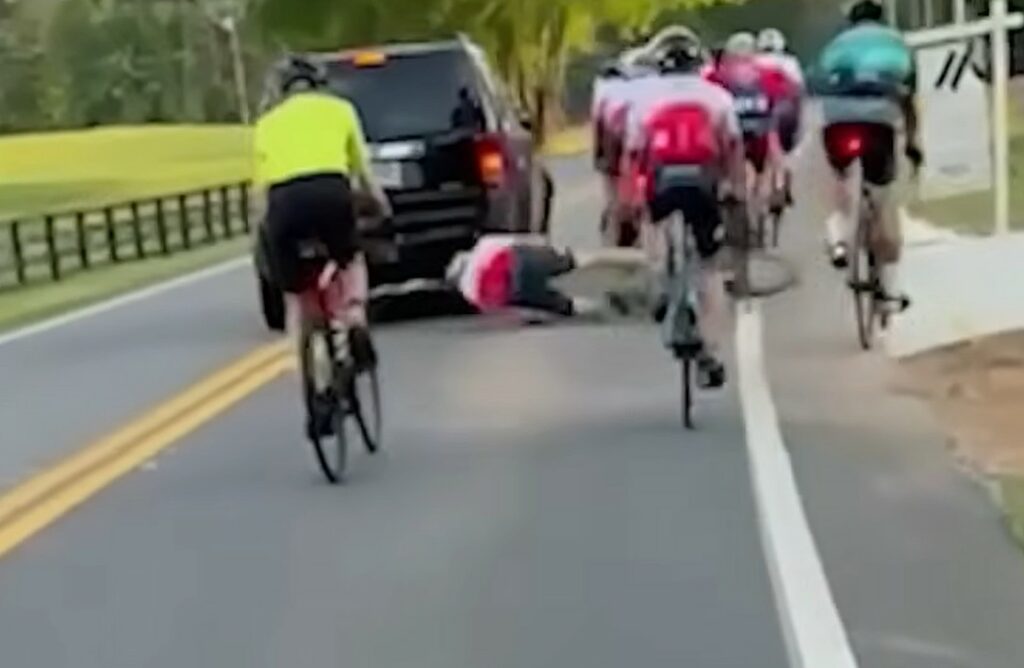
The court heard that he had twice tried to overtake the cyclist while driving his Nissan Juke on Halstead Road, Eight Ash Green, near Colchester on 7 June this year.
However, he twice hit the cyclist as he attempted the manoeuvre, causing unspecified damage.
Several people in the comments to the local newspaper’s article questioned why Booker had been allowed to keep his driving licence, as well as questioning why older drivers are not required to undergo a retest when reapplying for it.
One wrote: “Old people should be retested every certain amount of time, especially those that have held licences for many decades.
“They are dangers to too many people. Guarantee many would fail. That’s the worrying thing.”
Another said: “Everyone should be retested every five years and banned if they fail a second test, which they have to take in the six months after a fail.
“A fail should also be notifiable to an insurer. I can’t drive a fork lift in a warehouse without regular tests.
“Why can I then go outside and drive a ton of metal at speed having passed an hour-long test 25 years ago?”
Currently, motorists aged 70 or over are required to reapply for their driving licence every three years, but there is no requirement for them to retake their driving test.
A poll earlier this year found that almost three in four (74 per cent) Brits agreed that older drivers should be required to retake their driving test with two thirds saying that should happen before the driver’s 80th birthday.
> Three quarters of Brits want drivers to retake their driving test
By contrast, only 18 per cent of respondents believed that current regulations should remain in force.
In a statement released after an 80-year-old driver was handed a suspended jail sentence and banned from driving for life after causing the death of a cyclist by careless driving, the charity Cycling UK called for a review of the licensing system for older drivers.
> Do we need mandatory retesting for older drivers?
“Cycling UK recognises that sentencing elderly and otherwise law-abiding citizens for driving offences, when they have a long and largely unblemished driving record, is an unenviable task for judges more accustomed to punishing offenders they perceive the prisons were designed for,” the organisation said.
“This case however, not for the first time, raises the increasingly important issue of how, with an ageing population where people want to maintain independence and continue driving as long as possible, the DVLA regulates and tests the fitness to drive of those whose reactions, sight and road confidence are declining,” it added.







37 thoughts on “Motorist, 81, who twice crashed into cyclist while overtaking him keeps driving licence”
Still have 18-25 causing more
Still have 18-25 causing more havoc on the roads.
I was reading a psychology of driving where the author says elderly folk struggle more with junctions than anything else. They do drive slower as well to mitigate risks.
I don’t think focusing on one age segment really helps. We need better driving standards all round and less distractions for drivers and more requirement for concentrating.
The plethora of safety devices means the driver can take more risks as the features will bail them out. It was summed up on here for me when someone said their discussion on minis went : would you drive your 80s mini like your current one – no way !
It’s true, young drivers are
It’s true, young drivers are significantly more dangerous than older ones. It isn’t one age group that needs regular re-testing, it’s all of them, me included.
I’m not sure young drivers
I’m not sure young drivers are that much more risky than the very old. Take a look at how much insurance is for 80 year old drivers. There’s a reason for that.
I’d guess insurance for under
I’d guess insurance for under-25s is the highest of all because of their accident rate.
alchemilla wrote:
Ish. As a rule, under 25s pay the highest insurance rates* though rates go up a lot at 70 and again at 80… and big differences depending on the car. An 80 Yr old in a dickhead mobile could pay a lot more than an 18yr old.
*so many don’t have insurance but are fraudulently named drivers on mom or dads insurance.
I can’t recall the exact
I can’t recall the exact statistic but I think drivers aged 17-24 are something like eight times more likely to be involved in a crash than the average driver. I’ll see if I can dig out the research. This is reflected in the huge premiums young drivers pay. Insurance firms are generally very good at cracking the statistics and figuring out who is the biggest risk.
Older drivers not only drive slower, they also tend to drive less. Yes, they do have a higher risk of crashes than the average driver, but only about twice as much as I recall.
I’ll see if I can find the stats.
Both older and younger
Both older and younger drivers are high risk – see chart 3a here: https://www.gov.uk/government/statistics/reported-road-casualties-great-britain-older-driver-factsheet-2020/reported-road-casualties-great-britain-older-drivers-factsheet-2020
However, I do think the causes and therefore solutions are likely to be different. Whilst some of the risk of a young driver may be the result of inexperience, I suspect a large part of it is deliberate disregard for the rules and thrill-seeking behaviour. Re-testing isn’t going to change that – they will simply drive sensible during the test and then resume their previous behaviour as soon as the examiner gets out of the car. (Indeed, even with re-testing every five years, it’s likely to make very little difference as the highest risk is within the youngest age category – by the time a retest is due, the driver is likely to have natually matured).
With older drivers, the higher risk is more likely to be associated with (as Cycling UK say) declining reactions, sight and road confidence. Re-testing could spot those issues earlier, rather than relying on motorists recognising for themselves that they are no longer fit to drive, interventions from friends/family, or their driving career being ended with a collision such as this one.
OnYerBike wrote:
That suggests to me that we need different strategies to deal with the youngest and oldest drivers. The only practical way to deal with young drivers would seem to be extra enforcement of road rules (e.g. automated speed cameras, dashcam footage, more police etc). Re-testing would help identify older drivers that are struggling with driving, but my favourite would be to install black boxes that can measure smoothness of driving and thus detect early signs of slowed reactions.
I’m not sure that a dual
I’m not sure that a dual approach would be necessary.
Accepting that youngsters are more likely to be thrill seeking, I still feel the biggest challenge is around basic competence.
What is worse that a young idiot driving like a loon? An incompetent young idiot driving like a loon!
For every person that sails through the driving test first time, there is someone that takes multiple attempts to meet the basic standard. Now sometimes, that struggle is due to exam nerves, but its often because the person is a poor driver.
It always amazes me that, having finally fluked a pass, we just leave them to it until the day they die. Why wouldn’t this person be as thrill seeking as anyone else? However, their testing track record suggests a poor overall ability.
I personally see a solution where retesting happens after 12 months of a first pass, then 24 months, then five years, then once a decade until the driver reaches 60 (or even 65). After that the frequency ramps up again, every five years to 75, then every 2 years to 80, then annually from there on in.
It could be administered in a positive way, so if you fail the test, you can book straight on to an intense half days training with a retest at the end.
The end result would be better trained, more conscious, and better monitored motorists.
At either end of the age / experience spectrum, the testing costs would likely be mitigated by lower insurance premiums.
I’d like to see black boxes
I’d like to see black boxes installed in all motor vehicles. By using accelerometers and GPS info, they could quite easily produce a metric for smooth driving that could identify both the aging drivers that are less able and also the aggressive young drivers.
I’d suggest that the data is made available primarily to the driver/owner of the vehicle so that people can decide if they want to improve their stats or see a doctor. Maybe have some kind of threshold so that when they go over the threshold for an extended period of time, their insurers or the DVLA are notified.
The principle sounds sensible
The principle sounds sensible. As usual the question is how to break out of the UK “stable status quo” (or vicious circle…):
While (4) exists I don’t think lawmakers will want to change anything. Likely any change wouldn’t succeed or would be immediately reversed. Plus it looks like a quick route out of power and for what? How many people are shouting about this issue now? To fix that needs removing (3) which needs provision of alternatives so that activities don’t require a car (2) … which hopefully will eventually feed in to the perception of motoring as a rite of passage into full adulthood (1). (Apparently Maggie Thatcher wasn’t the source of the famous “failed in life” quote on this).
On the positive side with more people using buses (trams?) and cycling / scootering the problems mass motoring causes become apparent to more people, helping with social and political pressure to address the issue.
We obviously want those re-tested to have a real potential of failing (e.g. rather than it just a bureaucratic formality). So I can see that part being a problem if people don’t feel there are good alternatives to driving (or things they need to drive for). That could create incentives for people to drive illegally. This is already an issue of course – and one that is much larger than most think. Of course to deal with that we need to address another feedback loop e.g. we need better road policing and backup from the courts and ultimately for illegal driving (of all kinds) to be less socially acceptable…
Fortunately younger drivers
Fortunately younger drivers are increasingly required to use forms of ‘black box’ monitoring of their driving style, it can soon make more risky styles of driving unaffordable.
Yes… but although “risk
Yes… but although “risk compensation” is a thing even with a massive increase in people (and more older people) driving the last several decades we have seen a fall in KSIs. That’s due to a multitude of factors but a lot of that is due to design changes (in vehicles) and on the roads.
I certainly agree with “distractions” – that’s always been the case but we seem to be accepting a greater degree of this now, which is not helping. Part of me does see sense in setting the bar higher / forcing people pay attention. However – like the driving test – once people have achieved a standard their attention may decrease as the activity becomes habit. And some of the habits become bad.
I think that yes, we can certainly do better with enforcement and training. So retests of some kind. But accepting that humans gonna human we can get more safety by looking at the environment e.g. safer design.
People easily get overloaded so road design should be very clear. We should engineer things so people are only dealing with one thing at a time where possible. Some crashes can be engineered out entirely: on 2 lane roads if you can’t physically overtake that eliminates one very dangerous type of crash. If modes are completely separate you won’t have one crashing into the other.
Having watched a number of
Having watched a number of drivers of all age groups struggling with basic car control in the snowy weather this week, we need to do something about retraining / retesting all drivers periodically. Our driving standards are atrocious. Modern technology has left people cocooned in their cars, reliant on it’s systems such as traction control, ABS etc and with little idea on how to adjust their inputs (steering, brakes, throttle) to deal with slides or loss of traction. Would it be too sarcastic of me to suggest that the best compulsory safety device we could implement for ensuring drivers paid more attention and kept to sensible speeds appropriate for the conditions would be a six inch sharpened spike welded to the centre of the steering wheel.
LeadenSkies wrote:
That would be great combined with no drivers seatbelt and very weak seat runner bolts. Dangerous drivers would become safer or die quickly, win win. As a bonus they would experience the danger we face every day we choose to go out on two wheels.
NOtotheEU wrote:
And the rusty 12″ bayonet sticking out of the steering wheel.
I am still amazed at the
I am still amazed at the number of people I see braking going round a bend – even learners !
The book I mentioned in my first post does look at a spike on the wheel but the author concludes that this would have little impact: people do not see driving as risky and people who do behave riskily do not compensate for their increased riskiness in other ways. “for example, drivers who do no use seatbelts tend to be young, male and more likely to drive riskily – in other words members of the very group of drivers who are most likely to crash”.
It’s an interesting subject,
It’s an interesting subject, and it’s unclear, to me at least, whether making driving appear much more dangerous to themselves for people who take risks would reduce their risk taking; must read more about it.
EDIT: Actually, having thought about it for a bit, it is likely that the bayonet would reduce their risk-taking behaviour. Everyone has a level of risk that they are willing to accept, so increasing perceived risk is likely to reduce risk taking. It would be fascinating to investigate how much parental attitudes affected risk-taking by their offspring; is the parent’s action in reducing risk to as close to possible as zero affecting the behaviour of their children, who then have very little concept of risk and the consequences of their actions?
eburtthebike wrote:
As I get older, I have changed my views on road safety. I now think (without any scientific evidence whatsover) that cars are too safe for motorists and roads are to safe for motorists. Design seems to favour reducing the amount that drivers have to think about… intuitively that should mean there is more capacity for the important decisions. However I’m not sure it works like that… not needing to think seems to result in ‘I won’t think’ and blame is pushed on to everyone else. I see this in local media with junctions blamed, businesses blamed, colour of the sky blamed (seriously), councils blamed… when the reality is a motorist drove like a prick.
I’d be in favour of deliberately difficult roads and junctions to navigate with messaging that says says it is supposed to be difficult. If you can’t manage it don’t fucking drive.
Doesn’t seem to stop the
Doesn’t seem to stop the carnage in India, Thailand etc. though. Driving there is much more dangerous than the UK (by the numbers). Obviously “but different culture”…
I think the way to make it safer is maybe learn from places where it is very safe for *all* road users. So:
Not like the UK where “we made a desert and called it (road)peace”. *We* have focused on making it safe for the occupants of each motor vehicle. We’ve excluded almost all others from our roads, pushed them to the fringes, made them wait ages to cross roads or take long diversions…
Yes – this is very
Yes – this is very interesting stuff. I would note that humans are equipped with some fairly “budget” heuristics for judging risk. We often judge based on “what others get away with”. Consider eg. use of drugs by “respectable” people with careers, children etc (mentioning no politicians – although maybe that was all youthful folly…)
So spikes are not sufficient – drivers would have to see the gruesome results frequently in media. Much more often than we currently see “horror crash…” in the news. And ideally have a friend or two with scars or a dead relative.
Whatever the age, that’s a
Whatever the age, that’s a bellend on the road that is a danger to others.
All drivers should have to
All drivers should have to undergo a set number of hours refresher training every five years or so. If the hours aren’t undertaken, you get the pleasure of a provisional licence ’till you’ve passed an extended test. Well one can hope I suppose…
Lots of councils have schemes
Lots of councils have schemes for assessing older drivers. E.g. – https://www.hants.gov.uk/transport/roadsafety/drivertraining/driverskills
They’re voluntary, but perhaps they should be compulsary once you reach a certain age.
Let’s not forget that the
Let’s not forget that the DVSA Driving Test is the minimum legal standard of driving to be allowed on the public highway.
The idea of a life long license doesn’t allow for the inevitable change to road traffic volume, road design or vehicle design.
The transport mode genuinely committed to safe operation requires Currency, i.e. that you regularly operate to standard, and Rating for Type, i.e. that you are fully trained on the type of vehicle that you operate.
Clearly DVSA and government don’t believe that road safety needs such commitment, despite the evidence.
It’s great to change regulations to improve safety yet an example of how not to manage change in the last Highway Code update. It should be mandatory training to know what has changed every year. Lives depend on it…
Incompetence is observed in all age groups so that should be the focus not age.
I think this is likely to be
I think this is likely to be a de-facto ban anyway. 81 years old with 8 points and a driving without due care conviction will probably make his insurance unaffordable. I certainly hope it does. Even so, the insurance industry shouldn’t be doing the job of the courts in keeping dangerous drivers off the roads.
Very threadbare story – and a
Very threadbare story – and a google shows up nothing more My initial reaction is to be outraged at the poor decision making of the magistrate involved, however I’d like to know what the rest of the circumstances were.
Did the cyclist testify? What was the damage? How can a cyclist be hit by a car and not fall off the first time. Thats not to say I blame the cylist in any way – similar questions would apply to the driver – its just not particularly clear what the entire facts of this case were.
Never mind the driver’s age.
Never mind the driver’s age. Failure to overtake twice, hitting the cyclist twice and failure to stop, one of those on their own is surely enough to say that this driver should not be on the road.
No doubt somewhere there is someone willing to blame the cyclist.
Welcome to Essex, where Essex
Welcome to Essex, where Essex Man still reigns supreme!
It’s actually a really beautiful county, with lots of great cycling, only spoiled by the lack of foresight when it comes to electing politicians. If you aren’t blue or related to Himmler, Goebbels or Adolf, you won’t get elected. This is reflected in the make up of the local benches.
I truly believe that ALL
I truly believe that ALL drivers, regardless of age or profession, should have to undertake additional checks on a periodic basis. I would propose a theory test every 5 years, and a practical (plus theory) test every 10. Currently there is absolutely nothing in place to ensure that drivers are up to date with the latest HC, and nothing to make sure that drivers with poor ability, bad habits or dangerous attitudes are picked up before they become involved in an incident. We would clearly need to have a massive recruitment drive and investment in the current driver testing capability, but the cost to individual drivers would not be that significant. The benefit of safer drivers would surely be measurable.
I truly believe that ALL
I truly believe that ALL drivers, regardless of age or profession, should have to undertake additional checks on a periodic basis
They have no intention of doing any of this, in the same way as the police have no intention of policing MOTs, RLJs or anything else. Consequently, the rate of offending is increasing rapidly- at least in Lancashire. Two consecutive vehicles had no MOT this morning on the A6- PH11 GSD was the second, so there is no possibility that any new unenforced regulation will be introduced.
Dicklexic wrote:
Your proposal is quite likely workable Dick and might bring about some small improvement in driving standards but, I’m afraid, not the wholesale rise you hope for. The problem, you see, is not that people can’t drive reasonably well, in fact they have proved that they can by passing a test. No, the problem is that, free from day to day supervision, they don’t wish to do so.
It seems to me that, for many people, driving well is too much trouble, it’s uncool, it’s a distraction from their phones, it’s an infringement of their right to do exactly what they want. And your system won’t change any of that, in fact it might actively make things worse by upping the resentment factor.
I fear that the only answer could be recognising that society doesn’t need eighty percent of the population to be drivers and to raise the standard of the test to the IAM Roadsmart level and thereby reserve the skill to those few who deserve it.
Failing to stop at the scene
Failing to stop at the scene of a motoring accident should result in mandatory 18 month driving ban with the power of discretion removed from the magistracy, it is all too often a strategy to delay a breath alcohol test and the 12 month ban that would result from a positive result. I am sympathetic to older drivers continuing to be allowed to drive without retesting, a situation that would induce great anxiety in the many who recognise their limitations and drive accordingly but serious failures of judgement such as this should result in the loss of that societal benefit of the doubt and magistrates or judges who allow such drivers to continue deserve to be held personally fully liable for any futher harm that results from that decision.
I don’t agree with re-tests
I don’t agree with re-tests for older drivers but there should be compulsory annual medical checks for drivers over 75; doctors are best placed to make the call as to whether an elderly person is safe to drive; good driving is more about attitude than driving skills and road rule knowledge; I’d rather see young hooligans and texting twits taken off the road than healthy elderly drivers.
grOg wrote:
I agree with not demonising all older drivers. Re-tests would be useful for all drivers, but I like your idea of specific medical tests for elderly drivers. Also, more road policing would probably be more effective than re-tests as new drivers can be on their best behaviour during a test and then turn into a speed demon when let loose on the roads.
As I mentioned in another
As I mentioned in another thread, the 2 main medical problems are pathological eye damage and dementia. These are the ones that need testing.
I’m not so sure about being on their best behaviour. Once you have bad habits, it is hard to shake them or turn it on for a while.
hirsute wrote:
I was thinking of young boy-racer types that are impeccable during a test, but then have unofficial street races with their mates.