



“Installing a car barrier while allowing pedestrian and cycle access would be the obvious solution – it makes no sense at all”

> Rail operator Southern to remove bike racks at major station over fears car bomb could target railway
Hold on one second…
It may just be a complete coincidence, but is the kid in Tadej Pogačar’s new Jana Water ad wearing Jonas Vingegaard’s new red helmet (complete with white stripe up the middle)?

It’s a theory that’s gaining traction in some corners of social media – but surely not? Otherwise, the psychological battle between the Tour de France’s big two really has been upped a notch.
‘See Jonas, this is how easily I’ll drop you and your red helmet in the Alps…’
Tadej Pogačar hits the commercial trail ahead of the Tour de France with water ad and Continental ambassador role confirmed week before Grand Départ
Move over Chris Froome, there’s a new Tour-winning actor in town:
What’s that old saying about winning the Tour on just bread and Croation bottled water?
Anyway, Tadej’s certainly been busy signing lots of contracts in between all that altitude training, with Continental also announcing this morning that the world champion has joined the tyre manufacturer as its new global brand ambassador.

I’m not sure the UCI would approve of that one on the right…
“As a professional cyclist, I know how crucial it is to trust your tyres. Without the right equipment, I wouldn’t have become the rider I am today,” Pogačar ‘said’ in a statement (I’m sure he starts all his sentences with ‘as a pro cyclist…’).
“Top performance is not only the result of talent, but also of the pursuit of continuous development. Continental and I share the ambition to always make the most of our possibilities – both in terms of sport and development, so this partnership was an obvious choice.”
I’m sure it was extremely obvious when you saw the numbers involved, Tadej.
“I can’t believe this actually works!”
Remember that ‘superman’ descending video that gets shared around the internet every so often? Well, someone finally decided this week to post an updated 2025 version:
I for one am buzzing to see this pop up on my feed every six months until the end of time.
Is this the lightest e-road bike ever? Well Canyon certainly thinks so

> Canyon launches “lightest e-road bike yet”… and it’s sub-10kg
Visma-Lease a Bike reportedly set to announce Nike as new sponsor
The pre-Tour sponsorship deals keep rolling in, with the news that Nike is set to partner with Visma-Lease a Bike, marking the first time the American sportswear giant has sponsored a men’s pro cycling team since Lance Armstrong’s RadioShack squad back in 2011.
The deal with the Jonas Vingegaard-led squad is yet to be officially confirmed, though Nike’s famous swoosh logo was reportedly seen on Visma’s team cars during yesterday’s Dutch national time trial championships, where the squad’s Dylan van Baarle finished second to Lidl-Trek’s Daan Hoole.
After being closely associated with Armstrong during his Tour-winning days, as well as designing the race’s yellow jersey, Nike largely disappeared from the sport in the wake of the Texan’s fall from grace.
However, in recent years, doping scandals seemingly a distant memory, the brand has been rebuilding its cycling presence through Red Bull-style rider partnerships with the likes of Mark Cavendish, Cameron Wurf, Letizia Paternoster, and 2023 Tour de France Femmes winner Demi Vollering, despite not currently manufacturing any cycling-specific products.
And in January, it was confirmed that Nike would sponsor a team for the first time in over 13 years, joining Vollering’s FDJ-Suez squad as its official “lifestyle apparel supplier”.
This new Visma deal, meanwhile, means the American company – 12 and a half years on Armstrong’s doping confession – is finally back in the men’s peloton.
I can’t wait for Jonas and Wout’s take on the ‘What am I on?’ advert… What, still too soon?

“I’ve been on an incredible journey these past 15 years”: Two-time Paralympic champion Lora Fachie announces retirement from competitive cycling
After a glittering 15-year career which saw her win two Paralympic gold medals and four rainbow jerseys, Lora Fachie announced this week that she is retiring from competitive cycling.
The 36-year-old from Liverpool established herself as one of Britain’s great Paralympic cyclists, competing at four Paralympic Games and winning seven medals, including two golds in the Individual Pursuit B in 2016 (when she broke the Paralympic record) and 2021, alongside long-term pilot Corrine Hall.

Fachie and Hall celebrate their second Paralympic gold in Toyko (Alex Whitehead/SWpix.com)
Fachie’s win in Tokyo, when she broke the world record, was made even sweeter by her husband, fellow Paralympic rider Neil Fachie’s victory in the men’s tandem 1km time trial on the same day.
She also won four world titles, three on the road and one on the track, as well as 15 more world championship medals.
After giving birth to her first son, Fraser, in 2022, Fachie returned to medal once again at the 2023 world championships in Scotland, before securing three medals, again across road and track, at her final Paralympics in Paris last year.

Olly Hassell/SWpix.com
“I’ve been on an incredible journey these past 15 years and I’m eternally grateful to British Cycling for giving me so many amazing opportunities. The memories I’ve made along the way I will treasure for ever,” Fachie said in a statement announcing her retirement.
“Although I’m sad to be ending my career at this point, I know I’ve got a lot of exciting opportunities to embrace in the years to come.
“I am looking forward to giving back to sport in a small way by working for British Blind Sport and hopefully improving the experiences of others with a visual impairment within sport and leisure.”
Ouch…
Of all the anonymous internet confession things related to cycling over the years, this one really stings:
I was 11 years old and me and my friend cycling to school got mad at a younger guy parking in “our” space. As revenge we let his tyres down which made him leave his new bike over night in school. It got robbed. 20 yrs later I still feel horrible.
— fesshole 🧻 (@fesshole.bsky.social) June 24, 2025 at 3:25 PM
Top marks to the commenter who wrote: “You let yourself down.” Well played.
“The local authority had ample warning – my accident was one of those that was just waiting to happen”

> Cyclist who “cheated death” after hitting pothole sues council that was aware of “invisible crack” for six weeks
Adam Blythe’s two “massive” marginal gains: Sunshine and classic bars
“I’ve found 2 massive marginal gains,” former pro and current TNT Sports pundit Blythe wrote in an Instagram post today detailing his latest tan-topping-up exercise… sorry, I mean training ride.
“1. Sunshine. 2. Classic Handlebars (why does nobody make classic handlebars anymore?)”
Alright, steady on Adam, or you’ll be getting a job in the UCI’s rule-making office soon.
Anyway, here was me thinking Blythe’s idea of a marginal gain would be a gold frame or a jazzy Hawaiian shirt…

Raleigh says it’s “ushering in a new era of urban mobility” with release of new smart e-bike, the Raleigh ONE – complete with “raft of anti-theft measures”
Raleigh have certainly stepped away from the Chopper with their latest release – the ONE, a striking new ‘smart’ e-bike which the Nottingham-based company says will “usher in a new era of urban mobility” and help encourage more people to cycle in cities.
Available in the UK, Germany, and the Netherlands, the Raleigh ONE, the brand claims, is “the is the one e-bike you need for the city” (hence the name), featuring “simplicity built into every aspect with one gear and one size”.
The bike is powered by a single-speed motor and a 360WH removable battery, giving riders a range of up to 80km in eco mode and around 50km in boost. It also features a one-size aluminium frame and integrated rear-lights with a wraparound design.

Adding to the tech-focused nature of the bike, a rider app, which can be accessed through Raleigh’s membership programme, can connect with the bike, allowing riders to track their journeys, set a security alarm, and receive theft-attempt alerts.
The e-bike also features built-in GPS, mobile connectivity, ‘stolen mode’, and an integrated alarm system – handy when it comes to warding off, or at least tracking down, any potential e-bike thieves.

‘’With the launch of the Raleigh ONE, we’re not just unveiling a new e-bike – we’re ushering in a new era of urban mobility,” Selin Can, the vice president for mobility at Raleigh’s parent company Accell, said in a statement.
“The Raleigh ONE is a bold fusion of heritage and innovation, designed for the city. Smart, secure, and built to last, it enables riders to make journeys with confidence and ease. This is an exciting chapter in the evolution of the Raleigh story.”

Arkéa-B&B Hotels squad confirm title sponsors will not renew sponsorship deals, leaving management “working hard to secure team’s future”
Arkéa-B&B Hotels have confirmed that their two co-title sponsors will step away from the team at the end of the season, leaving the French WorldTour squad scrambling for new financial backing.
“In a challenging financial climate for cycling, Emmanuel Hubert and his teams are fully committed to an active search for new partners,” the team said in a statement issued today.
“The team, the staff, and their representatives would like to sincerely thank Crédit Mutuel Arkéa and B&B Hotles for their commitment and confidence over the last few years.
“Crédit Mutuel Arkéa, first via Fortuneo and then in its own name, has supported the team for almost ten years, a longevity and loyalty that is rare in professional cycling today. The B&B Hotels group, meanwhile, has played a decisive role in enabling the team to turn a corner over the last two years.
“In this period of search for new partners, the structure and its teams are more determined than ever to perform well in the various races that will mark the season, in particular to make the colours of the Arkéa-B&B Hotels jersey shine.”

Zac Williams/SWpix.com
Meanwhile, the squad’s general manager Emmanuel Hubert thanked the two sponsors for “standing by us” and “enabling us to achieve great things in our sport, at the highest level”.
“We’ve brought a lot of joy to our Breton supporters, but not only that, as our team has a strong presence in France and internationally, as was the case again during the recent Tour of Switzerland,” Hubert said.
“Remaining constructive and optimistic, I’m working hard to secure the team’s future. That’s my objective at all times. I know that nothing can be taken for granted, but I want to believe in it.
“I remain confident in our project and will continue to promote it to potential new partners who will be able to identify with our ambition and values.”

Arkéa and B&B Hotels set to end sponsorship of French men’s and women’s teams at the end of 2025, according to leaked memo
They may have just come agonisingly close to winning the Tour de Suisse last week, courtesy of Kévin Vauquelin, but it looks like WorldTour squad Arkéa-B&B Hotels could be without a title sponsor for next season, according to a leaked memo sent to riders and staff this morning.
The email, seen by Daniel Benson and reported on his Substack, reveals that both Arkéa and B&B Hotels will not be renewing their contracts with the French men’s and women’s teams for 2026, with team bosses currently working to secure new sponsorship.
“We have nothing but gratitude to express to them. Their loyalty over the years has allowed our adventure to exist, to grow, and to shine. Their strategic choices are theirs, and we fully respect them,” the email said.
Riders have been told that they are free to speak to other teams and try to secure new deals for next season, though general manager Emmanuel Hubert insisted in the email that “some signs remain encouraging”, while thanking those who have remained committed to the team.
“As long as a spark of possibility remains, I will continue to fight to ensure our adventure continues,” he said.

(Zac Williams/SWpix.com)
Co-operative banking and insurance group Arkéa has sponsored the Breton team since 2016, taking over the old Bretagne-Séché Environnement team, first under the Fortuneo name, before launching a women’s team in 2020.
B&B Hotels joined the squad at the start of last season, a year after its previous second-tier team collapsed following an ill-fated bid to attract substantial financial backing and sign Mark Cavendish.
Despite signing the likes of Nairo Quintana and Arnaud Démare, Arkéa’s biggest success as title sponsor came last July, when French prospect Vauquelin, who turned pro with the team in 2021, won the second stage of the Tour de France in Bologna, after distancing his fellow breakaway riders on the steep San Luca climb.
The 24-year-old has recently been linked with a move away from the Breton outfit, a move that looks set to become a reality if Hubert can’t secure new sponsorship soon.
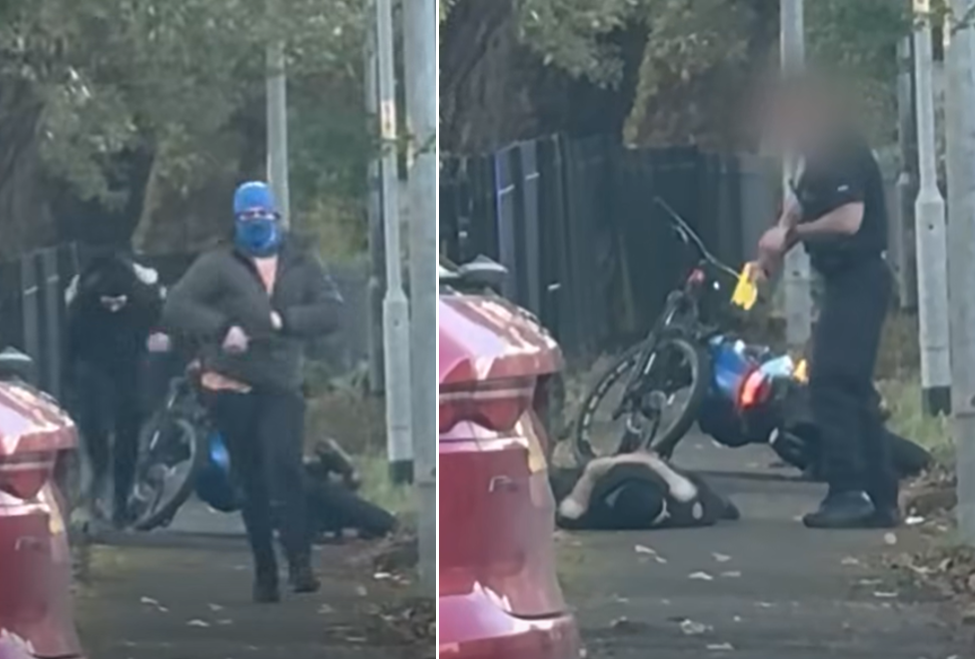
Distracting driving, you say?

Ultra-cyclist Robin Gemperle smashes Tour Divide record, becoming first rider to finish 2,750-mile, unsupported epic in under 12 days
Robin Gemperle has done it again.
The Swiss ultra-cyclist has followed up his wins at last year’s Transcontinental and the 2023 Atlas Mountain Race by securing another big victory at the 2025 Tour Divide, setting the course record in the process.
A few hours ago, Gemperle reached Antelope Wells, New Mexico to finish the gruelling self-supported mountain bike race, which runs the full 2,745-mile length of the Great Divide Mountain Bike Route in the Rocky Mountains, from Banff in Canada to the United States’ border with Mexico.
Gemperle’s time of 11 days, 19 hours, and 14 minutes saw him become the first ever ride to complete the route in under 12 days, beating Justinas Leveika’s previous record, set last year, by just over seven hours.
The cross-country mountain biker-turned-endurance phenom is also only the third person ever to finish the Tour Divide in under 14 days, after Leveika and the late, great Mike Hall, a double winner of the Tour Divide and founder of the Transcontinental, whose 2016 record stood for eight years.
Gemperle’s record-breaking ride – which saw him essentially lead the race from start to finish, eventually finishing 300 miles ahead of his nearest rival – is even more astonishing when you factor in the 140-mile detour riders were forced to take due to fires in central New Mexico, and the addition of an off-pavement re-route north of Steamboat.
And with three mammoth victories in three years, I think it’s fair to say Gemperle has etched his name into the ultra-endurance history books. Chapeau, sir. Now, time for a good sleep.

“If you think nobody’s doped at the Tour de France since 2015 – that’s a joke”: Former pro cyclist says drugs still prevalent in cycling amid “alien” performances and death threats – as German documentary claims blood doping ring suspect now at Ineos
Believe it or not, next month’s Tour de France will mark ten years since a rider was last busted for doping at cycling’s biggest race.
At the 2015 Tour, after stage four, Italian veteran Luca Paolini tested positive for the decidedly non-performance enhancing substance cocaine, capping off a decade of seemingly never-ending scandal, during which it seemed like the racing on the road was a mere distraction from the real drama unfolding in the doping controls.
But since Paolini’s relatively benign cocaine-related dismissal – a far cry, for instance, from the CERA-infested 2008 Tour, and its swarm of positive tests – doping stories have become vanishingly rare at the Tour (with the notable exception of Nairo Quintana’s tramadol positive in 2022, which under WADA rule did not technically constitute an anti-doping rule violation).
However, according to a recent documentary by German broadcaster ARD, ‘Doping Top Secret: In the Slipstream’, doping at the highest level of the sport hasn’t gone away, you know.

> Jan Ullrich insists cycling is now doping free
ARD has been at the forefront of investigations into doping in cycling for two decades, helping expose the sport’s dark underbelly as a generation of world-class German talent, led by Jan Ullrich and Erik Zabel, fell from grace in the wake of 2006’s Operación Puerto scandal.
And two anonymous whistleblowers from inside cycling have told the broadcaster’s latest investigation that doping is still prevalent – and that the sport’s infamous Omertà, its code of silence, remains stubbornly intact.
“Many people in cycling are afraid to talk. I know some who wanted to testify, they were threatened with death when the doping masterminds found out that they wanted to talk,” an anonymous former pro, who rode for a top team and experienced doping, told the documentary.
“To believe that nothing illegal has been taken at the Tour de France since 2015 – that’s a joke. I was close myself and noticed that doping continued.”
Another whistleblower, who ARD says has “deep insights into the professional cycling scene”, reported that Aicar, a muscle-enhancing and fat-burning drug which first appeared in the 2010s, remains the performance enhancer of choice in the peloton.
“People who are active in professional cycling today say: Aicar was and is the means of choice in the peloton,” the insider said, adding that EPO – the blood booster that arguably changed the face of the sport in the 1990s – is also still popular in microdosing form.
Both whistleblowers signed affidavits affirming their statements.
“If I were an athlete, would I take Aicar knowing it’s on the prohibited list? Or would I rather take Aicar’s relatives who are not on the prohibited list?” added nutrition and doping expert Oliver Catlin, the son of the late Don Catlin, regarded as one of the founders of modern drug testing in sport.
Catlin also told the documentary that he found 166 Aicar-like substances simply by searching on Google, noting that only four of them are on the WADA list.
Describing doping controls – as many have before – as mere intelligence tests, Catlin concluded: “If you are caught competing with things that are on the prohibited list, that would be unsurpassed in stupidity in today’s world.”
Meanwhile, the documentary also claimed that as many as 14 figures alleged to have been involved in Operation Aderlass are still working in professional cycling.
In 2021, Erfurt-based German physician Mark Schmidt was sentenced to five years in prison for running a doping ring that included the Alessandro Petacchi, Danilo Hondo, and Borut Bozic, and reportedly involved a form of powered haemoglobin.
ARD reports that one of these figures now holds an “important position” at the Ineos Grenadiers and was part of the team during its Tour-winning glory days as Team Sky in the 2010s.

The documentary claims the man, who cannot be named as the statute of limitations has now expired, may have even played an important role in Schmidt’s doping network, judging by text messages assessed during Operation Aderlass and given to the researchers.
He allegedly introduced Schmidt to a suspected doping dealer, who the doctor recommended to his riders as a supplier of the likes of Aicar, while purchasing blood doping equipment from companies in Vienna and Ljubljana.
The current Ineos employee also allegedly helped plan a visit by the doping doctor to the Tour de France, and asked if he had any of an unspecified substance in stock, messaging him: “If so, can you bring it for the boys?”
Ineos declined to comment on the allegations, while there have been no claims that any of the staff member’s reported actions were made while he was working with the British team.
Of course, while the increased speeds in the peloton and the dramatic jump in climbing performances in recent years – even compared to the doping-dominated Tours of the 2000s – have certainly raised eyebrows, many within the sport argue that these improvements have been found elsewhere, in perfectly legal avenues.
“I think the big developments even outweigh the benefits of illegal substances in the past. We are talking about many improvements: material, aerodynamics, of course, weight, bike handling, grip, comfort,” Colnago product developer Filippo Galli told ARD.
Meanwhile, Kristof de Kegel, a nutritionist at Alpecin–Deceuninck, says “groundbreaking advances” in his field, including better nutrition during races, are behind the recent leap in quality at the very top of the sport.
However, others aren’t as convinced of the apparent EPO-annihilating benefits of better bikes and nutrition.
“We know the limits of human performance,” French sports scientist Pierre Sallet said. “We know what is feasible for a person and what is not. There are certainly grey areas, but at some point the zone turns black, then it’s 100 per cent doping.
“I can’t explain what’s going on on the road. For example: A normal adult male is between 1.6m and 2.2m tall. But the performances that we sometimes see, that would be as if the man were three metres tall.”
Finally, Roger Legeay, the former Crédit Agricole boss and founder of the Movement for Credible Cycling (MPCC), says the UCI and WADA still aren’t doing enough to combat doping.
“That’s precisely why anti-doping is the job of the team managers, the doctors, the sports directors, the riders – they have to do it,” he said.
“All these people from cycling – they are the ones who have to ensure ethical and clean sport that is less suspicious.”



3 thoughts on ““If you think nobody’s doped at the Tour de France since 2015 – that’s a joke”: Ex-pro cyclist says drugs still prevalent amid “alien” performances and death threats – as German doc claims blood doping ring suspect now at Ineos + more on the live blog”
Great, doping allegations
Great, doping allegations that smear the entire peloton yet without naming anyone or showing hard evidence. I’m not saying doping doesn’t happen, I have no idea on that, but useless negativity like this does nothing for the sport.
Legally difficult to name
Legally difficult to name names unless you’re making a case. What I think does nothing for the sport is the lack of investigation into what’s in front of us – or ignoring the way that money and power corrupts everything including bike racing. Why would I believe that thos habits sudden;y stopped after Armstrong’s era? That makes no sense, cheating has been part of racing since the start and it probably still is. Comments like this don’t help the sport –
“I think the big developments even outweigh the benefits of illegal substances in the past. We are talking about many improvements: material, aerodynamics, of course, weight, bike handling, grip, comfort,”
Sorry but only someone selling bikes for a brand that sponsors a prominent outlier racer might suggest that design improvements in bikes in the last 10 years can outweigh EPO in the Armstrong era (I’m adding to what he said but that’s the impression the comments seem to make. We heard similar from Trek, Oakley and Nike didn’t we).
The chances that one human is physically that much different to anyone else that racing can find is about zero. The suggestions that training and nutrition explain it all are not an answer because even if it made that much difference none of those things are secrets that only one team knows about. Yes there’s some great talents on the bikes in the grand tours, I’m a big fan of Pogacar and Vingegaard who really do seem like great guys and brilliant racers, but there’s a realistic probablility something else is going on with at least some of these top performers, it’s naive to think otherwise.
Interesting to know about that fat loss muscle builder. Sky/Ineos guys had times when they looked unusually lean but rode very strongly, in a way many questioned because normally people can’t maintain strength and endurance at a very lean state (for them). Iffy iffy, back in a jiffy .. perhaps. We’ll never really know.
Doping by using substances
Doping by using substances not on the banned list?