


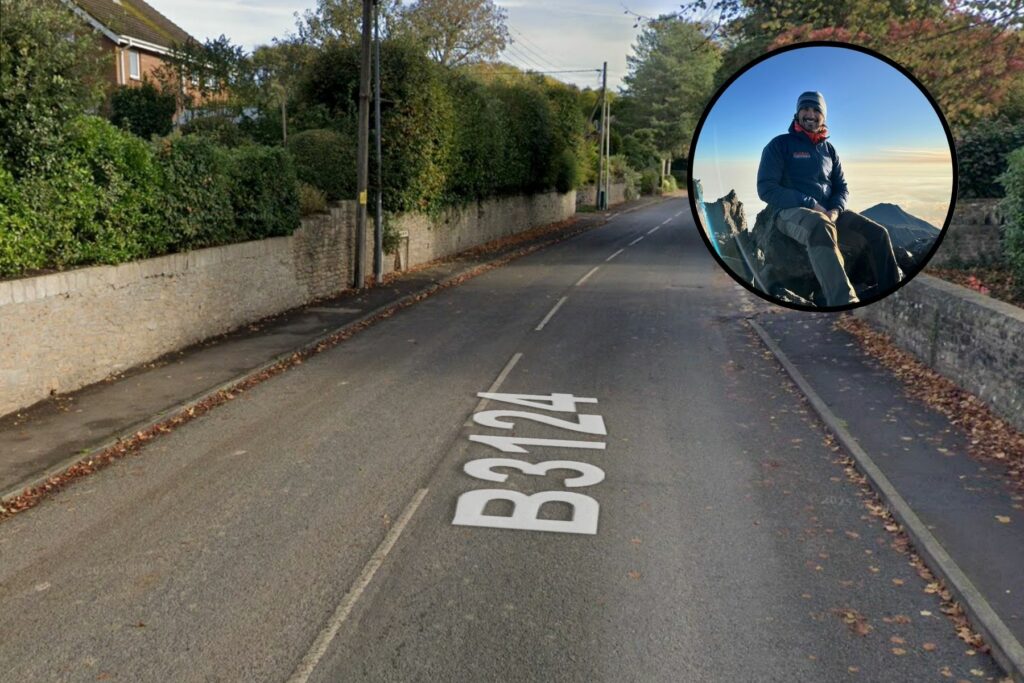

A cyclist who said he “cheated death” and was “fortunate to come out alive” after being catapulted over his handlebars is suing North Somerset Council for failing to act on a pothole that had already caused another crash six weeks earlier.
Andy Bevan, a former Detective Superintendent with Avon and Somerset Police and now an outdoor instructor, suffered serious injuries, including a fractured neck, a broken collarbone, nine fractured ribs, a collapsed lung, and multiple fractures to his pelvis.
He said the pothole, which he described as an “invisible crack”, had been reported by another cyclist after a nearly identical crash more than a month before, but the council decided it did not warrant urgent repair.
“While I recognise it’s almost impossible to fix every pothole overnight,” he said, “the danger had been reported. So as a minimum, they could have put up a sign about it to give cyclists a heads-up.”
While lying injured on Castle Road in Clevedon, the man was helped by a retired GP who told him that he had witnessed a similar crash at the same spot weeks earlier, and had contacted the council to raise the alarm, Gloucestershire Live reports.
Bevan added: “The most disturbing thing is the indiscriminate nature of my accident. Because of the inactivity by those who are supposed to keep our roads safe, there was nothing I personally could have done to avoid what happened.
“My front wheel must have got stuck in one of the extensive cracks in the road, but the area of disrepair was invisible on the approach. It really was the stuff of nightmares for cyclists… what really hurt is that it was all so avoidable.”
> Cyclist sues council for £100,000 after pothole crash
The crash, which happened in September last year, left him unable to work for eight months, forcing the cancellation of work trips, including taking a group up Mount Kilimanjaro, and another up South America’s highest mountain, Aconcagua.
“I count myself fortunate to have come out alive,” he said. “The paramedics told me my helmet saved my life. I was only alive to tell the tale thanks to wearing the appropriate gear.”
He said the accident had severely affected both his health and livelihood, and that he hoped his legal claim would prompt councils to act faster in response to known hazards.
“The local authority had ample warning and my accident was one of those that was just waiting to happen because another cyclist had alerted the powers-that-be to the pothole weeks before but, as far as I can tell, they failed to act promptly,” he said

The injured cyclist is now pursuing legal action against North Somerset Council, represented by Enable Law solicitor Laura Williamson. She said: “Andy is quite rightly seeking damages, but he is also hoping that his claim will focus the minds of local authorities nationwide to make our roads safer for cyclists.”
Williamson added that the council had acknowledged inspecting the road after the first reported crash but deemed it not dangerous enough to require urgent repair.
“Soon after Andy’s accident, warning signs were put up and the road was repaired, but this was too late to spare him a horrific ordeal which had a huge impact on his health and professional activities,” she said. “We are currently preparing court proceedings and quantifying Andy’s losses.”
In response, a North Somerset Council spokesperson said: “We comply with our statutory duty to maintain our roads to a safe condition. We respond to all reports of potholes and other defects and complete repairs wherever deemed necessary. It wouldn’t be appropriate for us to comment on individual incidents and potential claims.”
This is not the first time a local authority has been taken to court following reports of known road defects that went unaddressed.
In January 2024, we reported the case of Paul Hughes, a 57-year-old triathlete from Worcestershire, who suffered life-changing injuries after crashing into a pothole while riding on Sugar Loaf Lane in Staffordshire.
Hughes sustained a broken collarbone, multiple rib fractures, a pelvic fracture, and a fracture to his spine, in addition to a damaged lung and facial injuries. And to make things worse, the pothole had still not been repaired 15 months after the crash.
He spent 10 days in the hospital and said the accident left him unable to work at full capacity. He was later made redundant, and told road.cc he believed it was due to his reduced physical ability after the crash.
“I went with a friend back to the road where it happened,” Hughes said. “He made me ride down it, and it was horrendous. I had a panic attack halfway down. It’s really not right that the pothole is still there, it’s dreadful.”
He added: “You end up riding further out into the middle of the road to avoid potholes, and then you’re in the way of cars. I used to make excuses to go out on my bike — now I make excuses not to. I hope I can get back into it, but I need to get my confidence back.”
His solicitor called the situation “a disgrace,” and pointed out that while councils are under financial pressure, their duty to prevent “life-changing, and even life-threatening” consequences for cyclists should not be dismissed.
Another cyclist sued Dublin City Council two years ago in a multi-million euro claim, the cycle lane designers, and the construction company involved in creating a protected bike lane where he sustained a catastrophic brain injury.
The rider fell from his e-bike after hitting an uneven kerb and striking his head on a series of granite bollards installed within the cycle lane. His lawyers argued that the lane’s design posed a known hazard due to the layout and lack of proper kerb treatment, and that earlier incidents in the same area had gone unaddressed.
In the UK, other cyclists have also successfully held councils accountable for injuries caused by road defects. In July 2023, cyclist Luke Millward received a five-figure settlement from Essex County Council after suffering multiple fractures and soft tissue damage in a crash caused by a pothole on Audley End Road. The council admitted partial liability.
Millward, a physiotherapist, was unable to return to work for a prolonged period. He described the fallout from the crash as “an incredibly challenging period” that affected not just his physical health but his family and mental wellbeing.
“At the time of the incident, my wife and I had just bought a new home that needed work,” he said. “We had a young child, and our second one was on the way. As you can imagine, having a heavily pregnant wife and no kitchen or bathroom brought a huge amount of stress and strain for me and my whole family. I wouldn’t want to go through anything like that ever again.”
















17 thoughts on “Cyclist who “cheated death” after hitting pothole sues council that was aware of “invisible crack” for six weeks”
I’ve never not been astounded
I’ve never not been astounded in how repairs are done on roads in this country, the majority of roads truly damaged whether it be by usage or erosion mostly the former. Many things need to change in this country yet it carries on regardless and it’s just a joke!
This story is in the Bristol
This story is in the Bristol Post. You can imagine the typical comments BTL: apparently the consensus is that cyclists should pay “road tax” because then there wouldn’t be any potholes.
First comment I saw was
First comment I saw was suggesting that the cyclist should be arrested for not “cycling with due care and attention”. Truly some people have the IQ of a potato and the compassion of a turnip.
mctrials23 wrote:
No need to insult honest, caring vegetables by comparing them to Post/Mail readers.
That “Gloucestershire Live”
That “Gloucestershire Live” link in the fifth paragraph goes to an Indian “find therapists near you” site.
….therapyroute.com/therapists/india/jaipur/1
andystow wrote:
Here’s the BristolPost link: https://www.bristolpost.co.uk/news/bristol-news/cyclist-suing-council-after-cheating-10263709
I suspect this is another
I suspect this is another example of motonormativity: that the council’s risk assessment is based on road defects that could potentiallly damage cars, and fails to properly consider the risk that a narrow crack poses to cyclists.
For example, this guidance suggests a longitudinal crack is only a safety concern when it is >40mm wide: https://www.n-somerset.gov.uk/sites/default/files/2020-05/highway%20safety%20inspection%20manual.pdf
Given most road bike tyres are <40mm, a narrower crack is perfectly capable of trapping a wheel and causing a crash (which I assume is what happened to both the cyclists mentioned who had crashed in this location).
There are a lot of aspects of
There are a lot of aspects of cycling where I live that I wouldn’t wish on anyone else, but my city has an app for reporting road problems (and other problems). I encountered a pothole in the bike lane on my ride to work one day, reported it, and received an e-mail that it had been patched by lunch. And the next day, I rode past it and saw that indeed it had been.
Of course there’s
Of course there’s “underinvestment while building more and more roads”. And as others have mentioned the metrics for “good enough” / “needs urgent repair” all being designed around motor vehicles.
Do we also have a problem because we seem to have have lots of “works” that affect the roads, many done by private companies, often with long chains of subcontractors. Is it just too hard / council don’t have resource to ensure that these are done properly (e.g. don’t leave all your kit in the cycle track by default…) and are adequately made good?
Or is it just that there isn’t enough pressure on people in councils to deliver safe road infra? Perhaps the cost/benefit says “just pay the compensation” too often? Edinburgh council seemed to take this line for a long time with the tram infra they’d been advised was not safe enough but they made anyway – result: lots of people injured, paying millions in damages.
Meanwhile in NL … (quick patching, more “avoiding potholes developing“, types of maintenance, longer term road renewal). There does seem to be a different attitude (different organisational structural responsibilities?). Certainly in NL there seems to be a “wait a bit longer but then update everything to current best practice” policy. In Edinburgh when major resurfacing takes place it seems to be “take it all up then put it back the same way”. OTOH maybe that reflects that our road policy and designs simply haven’t evolved in a long time…
“Williamson added that the
“Williamson added that the council had acknowledged inspecting the road after the first reported crash but deemed it not dangerous enough to require urgent repair.”
Not dangerous for drivers, but lethal for cyclists. How can you say that a defect isn’t dangerous enough when it has already caused an incident?
Yeah, but it didn’t damage
Yeah, but it didn’t damage any car tyres or suspension, so it’s not dangerous, right?
https://road.cc/content/news
https://road.cc/content/news/council-missed-fatal-pothole-focused-dangers-cars-304489?page=1 That’s exactly how they think! Put that into the browser or road.cc: Harry Colledge into Google search, and marvel at how Lancashire County Council safety inspectors got away with the suggestion that a linear hole that caused the death of veteran cyclist Harry was reported for years, mysteriously closed up at the times of inspections, and even more mysteriously opened up again to kill him. What actually happened was that the inspectors went on a day out into the country thinking ‘that’s not a problem for my car’ and didn’t even bother getting out of it
It’s a common occurence, see
It’s a common occurence, see here –
https://www.aberdeenlive.news/news/aberdeen-news/cyclist-paid-compensation-aberdeenshire-council-6719509
Living up in Aberdeenshire the roads are bad, I often report potholes etc via the local council app and you can see multiple reports for that strecth of road. I’m not sure at what point they decide that a road must be repaired.
Lately I have seen many small potholes and defects repaired, they have one of the JCB pothole repair machines and seem to making good use of it, although there’s still a reasonable sized team that accompanies the JCB.
Roz that is mentioned in that article is a rather keen cyclist, which probably helps when arguing the case for the defendent as she knows exactly their perspective.
It is a truth universally
It is a truth universally acknowledged that any document or policy containing, either in the text itself or in a description, the word ‘robust’ is 95+% likely to be a load of tripe and lies. Other ‘reporter’ words are available, such as ‘holistic’.
My Local Highways Authority
My Local Highways Authority has “Robust Procedures in Place” to manage potholes.
The website states –
“You have a right to make a claim for compensation if your property has been damaged as a result of a pothole or other defect on a road or footpath. But you will only be given compensation if we are found to have been negligent or in breach of our legal duty under the Highways Act to maintain the highway.
To carry out our responsibilities under the Highways Act, we inspect roads and footpaths regularly following our Code of Practice for Highway Safety Inspections (PDF, 1.5MB). We identity and record defects and repair any we identify as being dangerous. The Highways Act recognises though that it’s not possible to prevent all defects.
This means that in law, the appearance of a defect doesn’t necessarily mean we have been negligent. We must use this law in our defence where appropriate. Any money we pay in compensation comes from public funds, and we have a duty to protect these funds.”
The criteria for declaing a pothole to be dangerous is available and ts clearly motornormative. A defect which is dangerous for a cyclist is only a minor issue for a motor vehicle.
For example:-
1) Groove in the road. Get your front wheel in a groove and you will come off
2) Sharp edges. If you ore on (say) 28mm tyres a pothole deeper than 28mm with sharp edges can blow a tyre or break a rim.
3) Angled edges. A pothole with sharp angled edges can turn the front wheel and cause a fall.
4) Multiple potholes. Avoid one pothole and you are perfectly lined up for the next one.
5) Camouflaged Potholes. Under dappled shade caused by trees in sunny weather, or in the dark.
Etc…..
Why don’t the cycling bodies produce a definitve document and send it to every LHA in the country?
Try riding in Surrey – they
Try riding in Surrey – they don’t fix anything, so every trip’s like Russian roulette.
Quote:
Let me guess: someone drove over the pothole in one of the council’s fleet of two-tonne dual-cab Toyota Hiluxs, barely felt a thing, and concluded it was no threat to any modern car’s suspension. So they pencilled-in a revisit for a couple of years time, to see if by that stage it’d got to state that would justify paying £20K to an independent contractor, the brother-in-law of someone high up in the council, to dump some tarmac into it.