



The Pinnacle Energy fits neatly into the budget category at its current 50 per cent off bargain price – though it would fare rather less well against the competition if you had to pay the supposed full retail price of £1,999. This strikingly long-term discount seems to be a rather obvious sales tactic and arguably an unnecessary one. If a £999 tag (the price it’s been for a good while now) had been stuck on the Energy at the outset, it would still have been an obvious bargain for a fully-equipped town/commuting e-bike with national backup at Evans stores across the country.
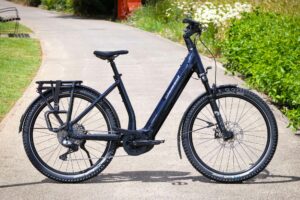
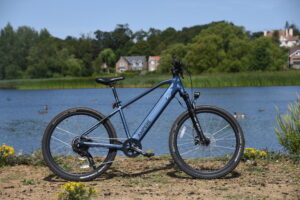
Cynicism about the marketing tactic aside, this looks like a really well-specced e-bike for the lower price. You get a step-through frame, a removable battery, large volume tyres, derailleur gears, hydraulic disc brakes and full commuting equipment.
.JPG)
I was particularly interested to get a Pinnacle-branded e-bike as I’ve had a lightweight non-electric hybrid of theirs that has really impressed me with its performance over the years. If Pinnacle could replicate the high quality ride of my much-trusted machine, they would be onto a winner as decent e-bikes in the sub £1,000 category are few and far between.
For context, Pinnacle is the in-house cycle brand of Evans Cycles, and has had its ups and downs since I bought my hybrid many years ago. Financial trouble instigated a takeover of Evans by Sports Direct (now Frasers Group). There are still over 50 stores nationwide and my local Barnsley one came in really handy during testing, as we shall see. At £999 the presence of local backup is even more of a highlight as we are firmly in the bargain basement area here, where post sales support from other similarly priced online brands is likely to be minimal.
The Energy – everything an everyday rider needs
.JPG)
On a cursory inspection at least, the Energy looks really well set up for the returning cyclist or e-biker. All the features should appeal to those who want an e-bike that stresses ease of use and everyday practicality.
.JPG)
There’s the usual pedal sensor activated rear hub motor – a seemingly ubiquitous feature on e-bikes at this price. In this case, Evans says its from Chinese-based Ananda, which is a good sign, as I’ve always had good experiences with Ananda motor systems. The reasonaby-sized 417Wh removable battery is also about what you’d expect at this price – anything much bigger and you’d have to be suspicious of the quality. (To give some context, large capacity premium quality Bosch batteries cost in the £600-£1,000 bracket.)
.JPG)
The rest of the spec is pretty much what you would expect at the £999 price point. There are seven derailleur gears, a small LCD type display, large volume Kenda K1293 27.5 x 2.4in tyres and full equipment in the form of a sturdy looking rack, plastic mudguards and a hardwired front and independently-powered rear light combo. You don’t always get hydraulic disc brakes on budget e-bikes, with cheaper cables often being substituted, so I was really pleased to see Pinnacle had specced Tektro hydraulics.
At 25.2kg, again it’s about what you’d expect a step-through budget spec design to weigh and there will certainly be quite a few similar designs out there that are heavier.
It’s a cheap e-bike but does the ride feel cheap?
.JPG)
Certainly not! It looked like a great e-bike for any level of e-biking ability and so it proved. Here’s a rundown of the reasons why.
The step-through frame is dead easy to get on and off and the riding position is comfy for most shapes and sizes of rider due to a handlebar stem with fore and aft adjustment. The Energy’s comfort credentials are reinforced once underway with those wide tyres being aided by softly sprung front suspension.
The power is equally user friendly. Whilst it is a budget system in design, relying on a pedal motion sensor, the Ananda motor and controller system provides pretty smooth power delivery once you get the cranks turning. Most importantly, there isn’t so much lag or run-on that you feel you aren’t controlling the motor power with your pedal action.

Best of all, you get power all the way up to 15.5mph in all five power levels. Many budget e-bikes use the cheapest possible controller that will limit power by restricting speed. This means that in level one, for example, assisted pedalling might cut out at 5-6mph. In contrast, even in lower power levels the Energy offers appreciable assistance all the way up to 15.5mph. That means efficient and easy riding even in the lowest power levels – a great way to extend your range.
> Torque it up: What is the maximum peak power from a 250W e-bike motor?
Overall, hill climbing was very effective, even up steeper hills. According to the rating of the controller, helpfully printed on the battery, I calculated possible peak power of around 600W, which is pretty good for a humble rear hub motor. It also felt to have a decent amount of torque at lower speeds, which always helps with climbing. Overall it was an impressive performance.
.JPG)
Whilst power wilted a bit on my usual ultra-steep hill test, a bit of additional pedal effort helped get me to the top. Lower gearing would have helped, but it is an exceptionally tough climb and like many budget setups the Energy doesn’t have a particularly wide range of gears, so I was quite pleased with what it achieved here.
Given the smooth performance of the motor, it’s not altogether surprising you can expect good range from the 417Wh battery. On largely flat but unsealed and occasionally muddy off-road tracks, only two bars of five were down after 20 miles. My estimate was that 40 miles might be achievable – though perhaps half that if you opt for higher power levels.
Brakes and tyres were standout features that aided comfortable and controlled riding. There was not only good stopping power but it was also well modulated, again helping to contribute to that feeling of a safe, smooth ride. The chunky Kenda tyres tackled icy, unsealed surfaces on the Trans Pennine Trail between Wakefield and Barnsley well and had good grip as I gingerly descended the ice after the hill climb test.
.JPG)
The tyres did suffer a puncture, but it’s hard to know whether this was down to their lack of puncture protection or plain bad luck. Unluckily, it was in the rear tyre, which is a bit fiddlier to remove compared to models where the motor is elsewhere, but I still got a new tube in in the end. This is not really a criticism but just something to note if you shy away from tube replacement even on conventional wheels with QR skewers.
More of a gripe was the small size of the LCD display. This is a pity as it’s otherwise a great display – mainly for the little power bar that shows when and roughly how much motor power is kicking in. It did actually refuse to turn on shortly after I had begun testing, but a quick trip back to my local Evans (thanks to the helpful staff at the Barnsley store) and it was quickly replaced and everything has worked well since.
Whilst not perhaps a positive, the above incident does show the value of local backup and it might well have been a different story if a similar e-bike had been bought from an unknown online brand.
Summary and competition
At £999, this is a well designed e-bike that performs extremely well and shows just what a brand can do with well-chosen budget components. Also, at this price the local backup on offer is a big plus. As noted, the online sub-£1,000 direct-to-consumer space is generally not recommended if you don’t have the backing of a recognised brand with the bonus of local backup, as you have with the Pinnacle Energy.
Unlike the £1,000-£2,000 e-bike market that is full of good quality, good value models, sub £1,000 e-bikes can certainly be more hit and miss, which makes the Pinnacle Energy stand out even more. Of course if the price heads back up to the apparent full retail price of £1,999 then it quickly becomes outclassed by offerings from ADO, Estarli and Tenways who generally offer great value.
You’ll see that our roundup of the best sub £1,000 e-bikes is hardly full of praise for some of the models concerned, but as often noted in the reviews, there is usually a compromise somewhere when considering an e-bike at this price. As long as the Pinnacle Energy remains under a grand, I would certainly put it near the top of the list as one with the fewest design and performance compromises.
All the deals displayed on our review pages are pulled from a constantly updating database feed of the best affiliate deals available. The criteria for deciding on what are the best deals is who is offering the lowest, delivered price. In most cases we will be showing the very best deal available online, but sometimes you may be able to find an item cheaper. If you can please feel free to post a link in the comments box below. To find out more about affiliate links on road.cc click here.

3 thoughts on “Pinnacle Energy”
What was it The Streets used to sing? ‘A grand don’t come for free’ or something like that. This isn’t bad for less than a grand. It’s biggest plus is it’s from a shop and not on-line, where there is no after sales support. If it was mine, I would swap the tyres immediately and get some more puncture resistant tyres – a puncture on an e-bike with a rear hub motor is a pain.
Why has nobody developed (or have they?) a rear hub motor wheel with a quick release mechanism robust enough to cope with the torque demands? Something could be achieved with a through-axle, surely? Twice in my e-bike days I had to do a long walk of shame home even though I was carrying a pump and spare tubes because I had forgotten to put the adjustable spanner back in the tool kit after taking it out to use for something else, but even when I remembered it there was an unacceptable level of faff involved with rear punctures – ultimately solved by changing to Marathon Plus.
Because its much cheaper to buy a second adjustable spanner for non cycle related bolts?