



Cycling campaigners in Bristol have sent a letter to Legal and General (L&G), responsible for the housing development project that’s rendered a community cycling route out of use for the last three years, demanding swift reopening of the path after they were told that it could be 16 more months until the path is finally available for public use again.
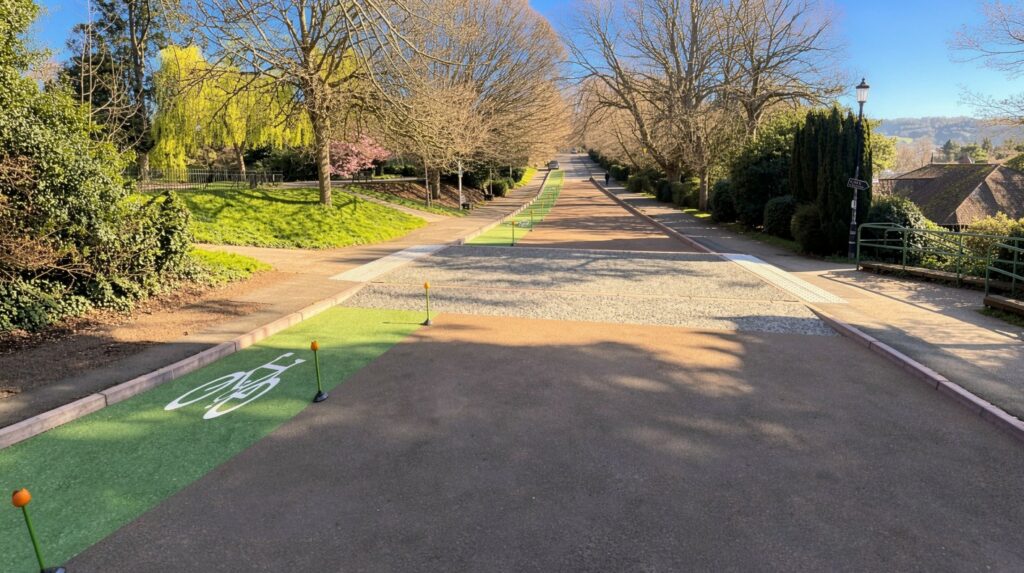
Concorde Way is a set of connected cycling and walking routes in north Bristol, going through Lockleaze and Ashley Downs. A stretch of the route between Constable Road and Bonnington Walk going through the Lockleaze Community Orchard was closed for a housing development project in April 2021 — originally supposed to last only six months.
The cycling campaign has now joined forces with other organisations such as Lockleaze Neighbourhood Trust, Bristol Walking Alliance, Sustrans, UWE Bristol and more to demand that the route be reopened by July this year.
Ian Pond, Chairperson of Bristol Cycling told road.cc: “Legal & General have recently informed us that they intend to keep the path closed til August 2025. It will have been closed for 3 years next week on 4th April — so that would mean the total closure would be four years and five months.
“Working with others, we have sent an open letter to L&G calling for a reopening this summer in line with the other closure at Ashley Down.”
> Council warned that removing key cycle lane would be “real PR risk” – but pressed ahead anyway
Besides the Concorde Way, the community orchard, which has also remained shut to the public these last three years, is also going to continue this way until November 2024, according to latest communications from Legal and General.
The campaign group has been working with Lockleaze Neighbourhood Trust over the last 15 months to try and make some progress to fasten the reopening but to no avail. Now, the coalition of organisations has demanded that the orchard reopen by 31 May 2024, and Concorde Way by 21 July 2024.

In the letter addressed to the CEO of Legal and General, Ian Pond said: “For every day of the closure, local residents have been prevented from enjoying the community orchard and traffic-free space.
“The many path users including walkers & cyclists in North Bristol, cycle commuters to/from Bristol city centre & its Northern Fringe campus & enterprise areas and pupils of schools in the locality have been required to follow the on-road diversion placing them at greater danger, compared to using the Concorde Way.”
He added: “As the clock ticks down to the 3rd anniversary of the closure now is the time for Legal & General to do the right thing for local residents and the wider Bristol & South Gloucestershire communities & employers by reopening the community orchard, the Concorde Way path and guaranteeing the long-term future of these important amenities.”
Concorde Way closures have thrown safe routes for cyclists into disarray for a while in Bristol. Another stretch of the popular cycleway was shut last year in March to make way for the construction of the new train station at Ashley Downs.
That closure was also supposed to last for a year, but the council announced last month that it will now be extended to 30 September 2024 or until the completion of the station works, whichever is earlier.
The diversions put in place for this route came under strong criticism from cyclists, with Bristol Mayor Marvin Rees promising a reassessment, after councillors and local campaigners pointed out that cyclists were diverted to a “risky” and “unsafe” main road, as well as forcing them to walk their bikes along a stretch of narrow pavement.
Found out today that the Concorde Way cycle lane closure is due to be extended until September of next year. Fortunately cyclists and pedestrians have this ‘excellent’ diversion route to rely on. Time to explore a contract for E-kayaks? ???♀️ https://t.co/lTiapZWSiB
— Cllr Emma Edwards (@bristol_pip) November 10, 2023
In November, the diversion was flooded, with Green councillor Emma Edwards saying: “Found out today that the Concorde Way cycle lane closure is due to be extended until September of next year. Fortunately, cyclists and pedestrians have this ‘excellent’ diversion route to rely on. Time to explore a contract for E-kayaks?”
She also pointed out that the route was a major cycling and walking route for pupils of Fairfield School. “We really need this route improving and the drainage sorting ASAP for those children’s’ safety,” she added.















54 thoughts on ““Enough is enough”: Campaigners call on housing developers to reopen community cycling path after a 6-month closure turns into 3 years”
Time to apply “Unlawful
Time to apply “Unlawful Obstruction of a Highway”, if it is a PROW.
Unfortunately it’s not on the
Unfortunately it’s not on the legal definitive map of PROWs (it should be) so the developer or whomever is getting away with it :-/
mattw wrote:
Well said
I wasnt sure if the picture
I wasnt sure if the picture of the of the tunnel was a picture of a local canal somewhere or not…
I mean a narrow boat could probably go through quite easily….
The underlying problem here
The underlying problem here is that organisations responsible for enforcing the law where big business is concerned have been nobbled, either by legal loopholes or by lack of funding. This is the legacy that Mrs Thatcher’s ideas have left us. There are now so many examples that I hope that the British electorate will finally wake up and demand that law enforcement and the watchdogs responsible for protecting us from the excesses of capitalism are properly funded and given the legal framework they need to do their job. Unfortunately my faith in the voters of this country has been sorely tested during my lifetime and has now almost comlpletely disappeared, thanks mainly to the underfunding of education and allowing the press to print what they like.
A change in expectations for
A change in expectations for developers is required. Fine they can close roads and paths if that makes building safer and cheaper, however they are responsible for the diversion route for the whole period of the closure. Closing this path in Bristol for 4 years has no consequence on the developer so of course they can just leave it shut. It’s just costing them some Heras fencing at the end.
This is it in a nutshell.
This is it in a nutshell.
I wouldn’t be surprised if the developer is hoping to renegotiate how many houses it can built or whether it can ditch or modify certain planning conditions to maximise their profits. They might even be hoping to suppress demand for the active travel route.
But, the main reason this sort of thing happens is because it’s convenient for developers to fence things off, and forget about it until it’s convenient for them. And Planning Authorities are too naive/under-resourced to have enfordeable policies that are actually enforced to prevent this sort of thing. The odds are the case officer who was dealing with this application has left to work at another council, and no-one will be assigned the case until something happens with it. Which could be pressure from a local campaign group and/or sympathetic councillor.
I hope they get a result. What a shame to have the route cut off for such a long period of time. The developers will presumably make noises about needing to keep out fly-tippers, and ordinarily that might fly, but after such a long period, they could invest that bit extra to open up a gap in the fencing which lets cyclists in, but not tipper lorries. They’ll just have to take their chances on anti-social motorbikes.
The whole sorry capitalist
The whole sorry capitalist caboodle starts with this kind of thing, passes by water bodies flooded with sewage, tears down every public service and the state itself and ends up with destroying the planet.
End capitalism now.
You should just make use of
You should just make use of the market and vote with your wallet for the kind of capitalism you want!
Many people are unhappy with the current state of affairs. Is it fair to say generally people either think less capitalism (more regulation) OR more capitalism (less regulation) will fix it?
Problems immediately appear with any “get rid of” proposal. First “nature abhors a vacuum” – unfortunately for anarchists. Assume then that “something” will replace it. Not only does a replacement system have to have the attributes you want (or lack those you don’t). It has to be self-organising eg. reinforce / propagate itself – which people often see as an anti-feature. Then … it also has to be *better* at doing that than the (previous capitalist) system!
Reminds me of the comment about democratic government being a flawed system and only better than all the other ones tried.
chrisonabike wrote:
The problem is that all political systems are flawed, because humans are flawed. But there has to be a better system than the current one, predicated on making the maximum profit for the smallest number of people regardless of the negative impact on the large majority of people.
MattieKempy wrote:
The problem is that all political systems are flawed, because humans are flawed. But there has to be a better system than the current one, predicated on making the maximum profit for the smallest number of people regardless of the negative impact on the large majority of people.— chrisonabike
That sounds good! But…
(Waaay off topic of cycle paths and cycling now)
When people say “the system” what level are they speaking about? I suspect often some system of policy is meant rather than a totally different thing. That is a wholly radical proposal because changes at a system level tend to involve things like decades of civil war, famines, mass migration – essentially societal collapse.
When people say “good” how, and for whom? Ultimately, for a system to continue, primarily it has to be good (overall) for the system (empirical version, mathematical version). Human systems are usually “good” (by some measure) for some of the people – or at least less bad than other systems for most of the people – but they *must* overall be good for themselves. Systems which don’t reinforce themselves will fall apart or otherwise be replaced with others.
Consider Cat-italism: I give all my money to the cats. I feel good and it’s popular with the cats. The happiness engendered keeps me doing so, but doesn’t otherwise reinforce the system because (without Instagram…) the cats don’t show their happiness by generating money. I run out of money, the cats can’t bail me out and when my family applies for guardianship the cats won’t be in court to save me.
Another common complaint groups / patterns of organisation is “they were great at the beginning!” But the original group members leave, or decide they don’t want to keep contributing as much, and other people maybe want to do things differently. Longer-term systems must be capable of working around this.
What’s the alternative?
What’s the alternative?
Not for profit companies?
https://www.bbc.com/news/uk-wales-66173170
Communism?
https://soviethistory.msu.edu/1985-2/desiccation-of-the-aral-sea/
Well, the £57bn that’s been
Well, the £57bn that’s been paid in dividends to the shareholders of the water companies could certainly have been spent on something rather more useful.
Welsh Water has no
Welsh Water has no shareholders.
Still pouring huge amounts of sewage into the rivers.
Terrible … but in that case
Terrible … but in that case still a better proposition than a company both polluting the water and paying dividends to shareholders, surely?
The money’s still going
The money’s still going somewhere.
If it’s just being siphoned off by overpaid management and staff then you’ve got all the negatives with even less accountability.
Rich_cb wrote:
The private ones don’t seem particularly accountable from an environmental perspective. Paying shareholders dividends is simply being accountable to them for giving a return on their money. That’s at best very loosely coupled to whether the company is doing other “good” things from an average individual’s perspective e.g. being good stewards of the environment or even presenting a good deal to the customers.
Say Dŵr Cymru Welsh Water were privatised tomorrow. How will that stop the pollution?
A particular issue with utilities like water of course is that “it’s not a free market” and we almost certainly don’t want that! It’s not usually practical to connect another company’s pipes to my house, bring the bathwater back on the bike or just go without.
The public ones, the issue is always keeping them efficient / effective. Since operating conditions are being set by government bodies (or monies provided) that’s politics! Of course that also applies somewhat to private utility companies – but of course usually they also have to keep finding additional money for shareholders.
Presumably you’d have to have an awful lot of overpaid management and staff to take up the slack represented by excess monies for dividends? Are private companies noted for paying their CEOs peanuts to keep them keen?
Discounting “change in the environment” (which is a factor) the existence of fairly longstanding private companies doing a poor environmental job suggests “less regulation” is not the answer. Of course that might not be “more regulation” but it certainly sounds like “more appropriate regulation”.
Water companies are an all
Water companies are an all round terrible idea. Monopolies are always bad for the customer.
If, big if, they were regulated properly then large fines would reduce profits which would lead to shareholder pressure on the board.
That mechanism is far from perfect but even that is entirely absent for Dwr Cymru.
Rich_cb wrote:
You’re not suggesting some kind of … nationalisation?
I think nationalisation would
I think nationalisation would be even worse.
The only advantage of privatisation is that you can compare performance between different companies and insist laggards improve.
Overall water supply is a very tricky thing to optimise.
On a tangent, the Romans used to make successful management of water supplies an important step in the advancement of their politicians. If you couldn’t run the water system well you’d likely never progress in public life.
Rich_cb wrote:
Without competition, the market will always fail. If I could choose Severn Trent from my taps this morning but Wessex for that after dinner wind down, and obv Thames to flush away that irritating floater, that would be great. But I can’t. It makes it worse that investors, using debt loading to increase their returns, only wish to provide a minimal service at maximum cost (looking at you, Macquarie). Not to mention the inefficiency of paying both the water company to run the business and the regulator to stand by whilst rivers are clogged with turds, and the problem of a revolving door between the two sides.
At least with publicly owned water utilities, there’s a possibility of some other combination of service and cost.
Water doesn’t lend itself
Water doesn’t lend itself well to competition.
Nationalisation will just lead to inefficiency and even worse underinvestment.
The best solution from a selection of not very good solutions is probably privatisation with far more robust regulation but there isn’t an easy answer.
“Water doesn’t lend itself
“Water doesn’t lend itself well to competition.
Nationalisation will just lead to inefficiency and even worse underinvestment.”
Would you mind explaining your thinking? It’s not at all obvious to me why nationalisation should lead to those things or what advantages paying private business to do the job might have.
john_smith wrote:
My thinking is that large organisations suffer from a lot of inefficiencies due to bureacracy. Traditionally, the thinking is that competition between organisations provides an incentive for the organisations to improve and get rid of any poorly performing departments. When there’s no competition, then there is no incentive except for internal competition between people which leads to the promotion of the most sociopathic individuals who are prepared to be the most ruthless and have no conscience or sense of social responsibility.
Also, when a monopoly is privatised, it appears that the main incentive is to funnel as much money as possible to shareholders by taking out debts. There’s also a big incentive to avoid complying with laws and to avoid investing money into the business as that’s money that could have gone to the shareholders.
Indeed. Also, as we have seen
Indeed. Also, as we have seen with the EU, the “large organisations suffer from bureaucracy” argument is flawed. Large organisations can be lean and efficient.
With a private business, if
With a private business, if it’s properly regulated, investment should continue throughout economic cycles as water is pretty much recession proof.
If nationalised politicians will raid water companies for revenue during recessions etc leading to underinvestment.
Monopolies are always bad for consumers regardless of who ultimately owns them. With water it’s trying to find the best bad option.
Have you ever considered that
Have you ever considered that you are probably one of the ‘shareholders’?
I dunno about that (and in
I dunno about that (and in the Welsh Water case as Rich_cb notes the holding company has no shareholders). But I’m definitely a customer. And if I went for a dip in a local stream the consequences might reinforce that the local public are *stakeholders*.
As noted for water companies customers can’t readily pick and choose. And currently if the company doesn’t invest in its infra or dumps sewage clearly that’s not resulting in sufficient financial sanction – which is the only language we shareholders understand!
Lo and behold, up sprouts
Lo and behold, up sprouts Rich_cb…
Just wondering what your
Just wondering what your proposed alternative to capitalism is?
Easy to spout meaningless slogans online, a bit harder to propose a meaningful alternative.
There are alternatives, but
There are alternatives, but as Corbyn found out, proposing them brings the entire force of the establishment down on you.
It was obviously an
It was obviously an establishment plot against Corbyn.
Strangely, that same establishment then brought down Truss.
I’m guessing the Deep State are just a bunch of centrist dads?
No, Truss brought down Truss.
No, Truss brought down Truss. Even by tory standards she was/is regarded as a swivel eyed loon.
That’s what the deep state
That’s what the deep state wants you to think anyway. Wake up, sheeple.
She had just won a leadership
She had just won a leadership election so there must have been some members of the Conservative party who thought she was worth a shot.
She was brought to heel by the bond markets ultimately.
Can’t simultaneously borrow billions for tax cuts and energy subsidies.
Since Truss, Starmer has had to massively reel in his spending plans too.
The bond market has awoken from its post 2008 torpor and is back to doing what it’s always done.
Rich_cb wrote:
I thought she was chosen because if people squinted, they thought they could see Thatcher*?
Presumably if it hadn’t been the bond markets it would have been the realisation that the lady was very much for turning – indeed the envy of Mr. Flip-flop on the other benches. (Apparently Thatcher was amenable to being persuaded one way or another *before* coming out on a particular issue and going deaf to contrary advice – as most enduring politicians must be).
* For some reason this is considered electoral gold. Indeed there have been some unlikely “tribute acts” based on those principles including a couple of women and even a man (Tony Blair).
Rich_cb wrote:
To be fair, I think Truss got voted in as the Tory members(!) didn’t want a non-white leader. She also made a lot of promises which appealed to them too, but we don’t know why the members(!) voted the way they did. It’s notable that Sunak was in the lead until it came down to a choice between Sunak and Truss which does imply to me that ethnicity became more important than competence.
https://www.bbc.co.uk/news/uk-politics-60037657
I think your own prejudices
I think your own prejudices may have clouded your interpretation of the result.
Zahawi and Braverman both endorsed Truss as did Mordaunt. It’s not surprising that a majority of their supporters followed suit.
Concluding that large numbers of Conservative party members are voting based on racist prejudice after a leadership contest that was incredibly diverse seems misguided.
Even more so when you consider that Braverman and Baddenoch are some of the most popular MPs with conservative members.
Rich_cb wrote:
It’s purely conjecture, but it’s notable how Sunak was the clear winner in all the ballots and then lost in the direct choice between the two.
Members and MPs have
Members and MPs have different priorities.
Conservative party members tend to be to the right of many of their MPs so it’s unsurprising that they opted for the right wing candidate.
The fact that Braverman and Baddenoch are membership favourites does pour some cold water on your conjecture.
In fact, based on that it would be more reasonable to assume they voted for Truss based on gender.
Not so long ago Humans
Not so long ago Humans discovered a large sack of used fivers under the bed (fossil fuels). They are now in the process of wasting it on shiny baubles for short term gain at the expense of their own medium term future (and that of much of the rest of Earth’s biomass). Unfortunately, this is regardless of politics, either democratic or demagogic.
Earth as a planet will be fine.
Confusing capital with income
Confusing capital with income indeed.
OTOH one might also ask how it could be different. Evolution lacks foresight and is notorious for favoring “good enough, right now” *. Where there is balance it seems it is dynamic rather than static (“punctuated equilibrium” is an observation where much depends on the “eye of the observer”). Things act to propagate themselves but that’s just “into the next round”.
Of course coalitions and conspiracies can arise but it’s rather difficult to set up “collective voluntary restraint”. At least for humans we tend to chafe at restrictions and are strongly attracted by shiny things (or greater social prestige).
* Despite that producing some amazing designs. Turns out of you throw an excess of fools at an open field of problems for long enough…
It’s a good test to see if
It’s a good test to see if intelligence (we know enough of the science) can overcome evolutionary instincts (irrational under current circumstances).
levestane wrote:
Hmm… I think I understand where you’re coming from there, and I also am sympathetic to more “long term, low resource” ideas. But … it’s a day of rabbit holes! A lot to unpack in that short sentence.
Fundamentally – you seem to be alluding to a disagreement between “mind and body” in some way – which is a very deep rabbit hole!
Attempting to manouver round that – evolutionary instincts vs. intelligence: absent a religious explanation both appear products of an evolutionary process and both “natural” (arguments still rage about ideas / cutural transmission) – they may differ but in the human case both “ideas” and “humans” currently require a human to continue! (We can store or transmit ideas via other media but after even a short period we can have great difficulty simply reading these messages, never mind getting the full “meanings” of them).
Without getting sci-fi and distopian, say you could de-couple “intelligence” from the “biological human” – would that “intelligence” be more or less interested in the long-term future? If it had a finite physical manifestation it might be no more interested in the longer term than the presumed more grubby “evolutionary instincts”.
It could be either way – perhaps humans would be no more relevant to it than e.g. brine shrimps are to us. OTOH although computer viruses can replicate themselves they ultimately (currently) rely on humans providing and maintaining computers for them to run on. So at least for now they also should “care” about having humans in the future. Or such an intellect might simply differ in detail about the timescale of future it was concerned about. Our pets, domesticated plants and cold viruses all in various ways are “interested” in a future which contains humans – but their timescales can be very different (as is their degree of dependence of course).
The time period we’re talking about is important. At a certain point this becomes rather abstract. How much should we weight the interest of our putative (children’s)^n children over that of those currently alive?
It’s almost certain in the future eventually there won’t be “humans” – if only because “evolution” likely changes us into something sufficiently different (in the way that we don’t tend to call humans chimps, or fish, or possibly “weird sponges“). Since evolution doesn’t necessarily have a preferred “direction” even if our direct “line” continues there’s no guarantee that “intelligence” is maintained in our descendants. Beyond that our location may be uninhabitable within a billion years, and even if we spread to further worlds space is apparently expanding and thermodynamics applies so eventually there may be no low-entropy regions to harness…
In the more immediate term – if we could navigate a more sustainable way forward – for how long and at what “developmental level”? Who gets to choose? How is that enforced?
Because “humans” there may not be a realistic “play” which leads us to e.g. a much reduced level of resource consumption. If that were so what benefit to continue to wear a hair shirt while Rome burns?
OR perhaps there is a way to do this but it requires some unpalatable social changes. Perhaps like North Korea – they’ve reduced the resource use of a large section of their population (in many cases lethally). Albeit that is not necessarily an overall reduction e.g. they’re stinting the populace to boost the military and benefit the elite…
Would we care to live in a long-term society which more resembles that of social insects? Or with an expansive system of “eco-religious taboos”?
Much as I generally enjoy
Much as I generally enjoy your posts, this is too longwinded, and doesn’t really improve on the initial argument.
The question is really simple, can our individual intelligence which, apparently in a majority is enough to make them comprehend the problem of climate catastrophe and biodiversity loss, and wish for changes apt to stop them, supersede our more socially oriented instincts of belonging to a group, and obtaining a more elevated status in that group by whichever means that group uses for that purpose at any given time, which by and large make us disregard, what we know about our current status symbols being unsustainable for the planet we live on.
No need to invoke the distant future when the actual problems will make life as we know it impossible on most of the planet in so short a timescale as a single digit number of generations.
And I’m a bit disappointed in the limited number of actual solutions you envisage, that don’t seem to expand a lot on what some of the more antagonistic posters on here are capable to imagine (or rather to dig up from the past).
I bored you, I bored myself!
I bored you, I bored myself!
Indeed an example of the problem? We’ll often splurge today when we can – and in a sense that *is* “life as we know it? At the same time we hope / expect to be here tomorrow so it’s of benefit to our future selves not to make a mess.
Practical solutions to pressing issues, I agree. And we know several *proved* ones like cycling – but there are a bunch of practical ways to “do more with less”.
https://en.m.wikipedia.org/wiki/John_Seymour_(author)
https://solar.lowtechmagazine.com/
And people have even had some thoughts on the “how” of that overall (couple of random examples):
https://en.m.wikipedia.org/wiki/Small_Is_Beautiful
https://longnow.org/
Given humans are rather social creatures I’d say its more a “group” or systems question than just an “individuals vs. society”. We are self-interested but humans seem to be – more or less – mainly concerned with other humans.
Just on “solutions” even the apparently simple “everyone benefits” open goal ones like providing for active travel are at best … very slow to “take”?
So … I think my ramble was tilting at a slightly different question. What does “sustainable” mean to relatively short-lived creatures, in shortish-duration social organisations? Indeed ones whose “life as we know it” has been changing at an accelerating rate?
Worth remembering that for millenia humans have had radical impacts on their environment. Albeit orders of magnitude less than now. And possibly for even longer although some early examples are now less certain eg.
https://www.nature.com/articles/s41467-018-07897-1
That question is not necessarily one that has an answer.
I don’t think they would have
I don’t think they would have got away with this if it was used by cars.
To me it looks like deliberate obstruction by L&G and also deliberate mis-leading of the planning authority. Admittedly, projects can go over expected delivery times but this is almost 8 times longer than they said. Either they were hopelessly incompetent or mischevious when they proposed it. Whatever the reason, they should be paying a severe penalty for the overrun and subsequent loss of amenity.
They could of course just be obstrucing it to play for time – “it’s not been used for so long that it’s normal not to be there so we can close it permanently and put the land to better (more houses and money for us) use.”
Who does the land belong to
Who does the land belong to though?
Interesting question, and as
Interesting question, and as they say ‘possession is 9/10ths of the law’. If they hold it in a particular state for long enough (ISTR 10 years) without any acion being taken then basically they can claim it as theirs.
This is definitely a case that the campaigners need to keep an eye on.
I wonder if the right to roam people have an interest too.
There’s a section of footpath near me on the Cleveland Way https://maps.app.goo.gl/TRwSXWRq5EfAutPq7 that’s been closed off since 2021, not scheduled to re-open until 2027 (maybe sooner if the housing estate is completed earlier). I don’t think it will ever re-open looking at the current layout of the site.
I’ll just drop this in here
I’ll just drop this in here for contrast:
https://www.bbc.co.uk/news/uk-scotland-glasgow-west-68631356
Brilliant illustration of the importance of non-motorised travel – and the impact you can have on a community for relatively little money compared with what is spent on roads.
Indeed and a thumbs-up. BUT
Indeed and a thumbs-up. BUT …
a) Of course it’s only needed because roads. This shouldn’t be seen as “what a great bonus”! It should be part of the fundamental requirements when building busy roads. (And Glasgow should recognise the need to reverse damage done by their experiment with urban freeways…) Especially around urban areas they may disconnect nearby places for active travel as much as they connect more distant places for drivers. Acceptable mitigation must be better than “a concrete trench in the sky every couple of miles”.
b) As “usual for UK” we have “just let them share the space”. It likely won’t be a problem – at least initially – but why can’t we understand that different modes work best when they have their own clearly marked space?
“……to try and make some
“……to try and make some progress to fasten the reopening……”
Fasten it to what?
Oh dear.
With the old route I hope
With the old route I hope they bigger it up also! Sadly they’ll probably do that but with a vowel change.
Pair of bolt cutters…
Pair of bolt cutters…