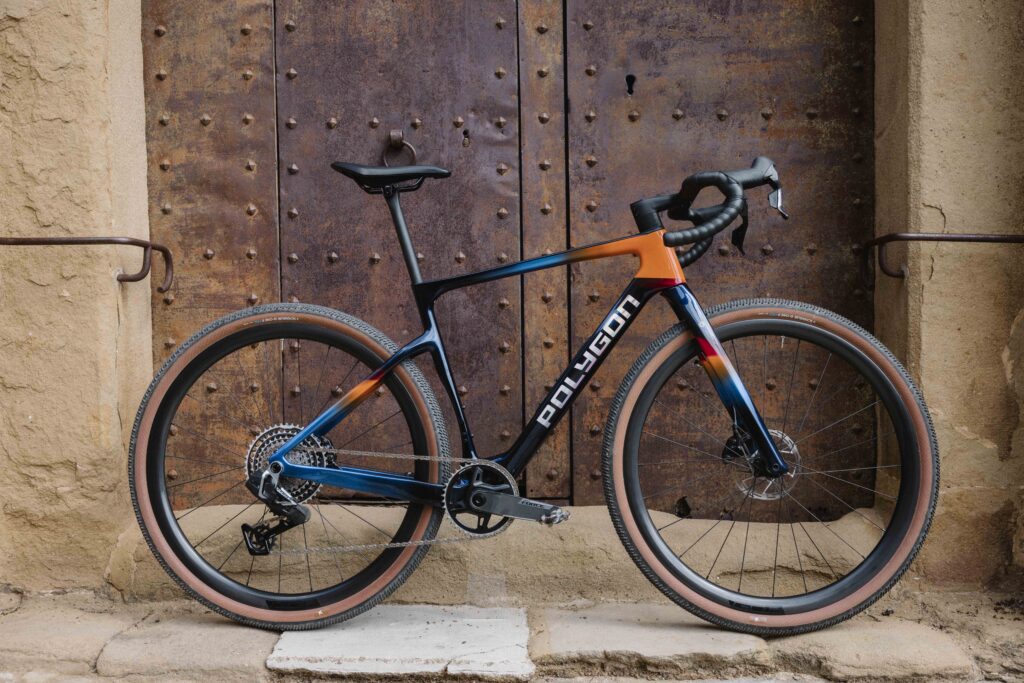
Stiff, light , good looking – and comfortable to ride, when the last incarnation of the Orca hit the streets back in 2006 I really liked it. This was one of the first bikes to demonstrate that the bike industry was really getting to grips with the possibilities carbon had to offer, and it sure was pretty too – which helps. So there’s a lot riding on the 2009 makeover. What’s different? Essentially the frame is lighter and stiffer. The dropouts, and headbadge (which also acts as a cable guide) are now made from magnesium which Orbea reckon makes for a sub-kilo frame in the mid-sizes, the previous incarnation that we rode had a frame weight bang on the 1Kg mark when we rode it back in ’06. The carbon weave has been tweaked too to add extra stiffness. All the test bikes were in stealth black – lacking the distinctive inset paint job that made the original Orca so attractive, – the Orca is available in a number of different colourways including a very striking red and the original black and ivory combo.
See more pics of the Orbea Orca
Eurobike rides: Orbea Orca
Add as a preferred source on Google
Help us to bring you the best cycling content
If you’ve enjoyed this article, then please consider subscribing to road.cc from as little as £2.49. Our mission is to bring you all the news that’s relevant to you as a cyclist, independent reviews, impartial buying advice and more. Your subscription will help us to do more.
No Comments
Read more...
Read more...
Read more...
Latest Comments
@kingleo Well gee thanks, I'm sure road.cc readers really needed your "knowledge" of "keep your hands on the brakes, ride at a suitable speed and watch out for people pulling out in front of you." You weren't "just" trying to do that, fatuous as it would be, your subsequent humblebrag that you rode in London for however long without crashing with a motorist was clearly meant to imply that those who do crash with motorists had only themselves to blame, as did your subsequent false statement that cyclists are to blame for 50% of "accidents". It betrays a strong whiff of victim blaming which I'm sorry to say has not been absent from your posts in the past either. That's fine, you're entitled to your opinion, but don't try and dress it up as "just passing on advice" because everyone can see it's much more than that.
@mitsky Clearly you missed an invitation to demonstrate your trials skills there!
Rendel: It's not a competition. I'm only trying to pass on some of my knowledge about how to cycle safely in cities.
I can only suggest everyone interested have a look at The Ranty Highwayman's blog (he's a civil engineer who now specialises in "sustainable mobility") where he has - with increasing weariness - covered this subject many times. And has pointed out the fact that for many years we have had exactly the same but where there is a *road* between the bus stop and the footway, eliciting very little "won't you think of the blind..." For those interested this topic has also been covered by Robert Weetman, Bicycle Dutch (who has articles on "Riding around the bus stop" and also "How hard is it to cross the cycle path?") etc.
Please can we have a similar study done for collisions involving drivers and disabled people, at all types of pedestrian crossings? A few years ago I asked the RNIB and/or NFB for stats on collisions involving visually impaired people and drivers/cyclists etc. To show that the major danger is likely to be from drivers, both in numbers of collisions and severity. They could not provide the stats.
@jaymack indeed, but in may people's calculations that cost is effectively ignored because "it's already paid / a given" or "we obviously have to have a car anyway". So once people have one we don't exactly forget that it costs money, but tend to look at the cost of e.g. a train ticket vs. the cost of fuel to drive somewhere and the latter very often looks a better prospect! (Even ignoring the other tradeoffs people may consider like "my own space" / "I can leave / return when I like" / "door to door" etc.)
Being perched on by overweight gulls fed on a diet of chips and ice cream?
@OnYerBike "Taking guesses as to what else might have caused that kind of damage…" I'm constantly seeing both cycle infra and nearby things like paving slabs, heavy-duty railings, lamp posts, concrete bollards etc. that have been bent or broken by those bloody cyclists...
@kingleo Another reason for not being content to say "take care, y'all" is that most people know (well ... "feel") that this is normal in the UK so it is yet another factor contributing to most people not wanting to cycle. And it's not the same as the case of e.g. crossing the road, where your safety as a pedestrian is more fully in your own hands (barring the drivers mounting the pavement, which alas does happen...) I assume you wouldn't echo the suggestion by the good public in some of the comments which seems to be that if cyclists want to remain uninjured they better stop (and possibly dismount) every time they reach a junction. Even if it's with a side street and it's their right of way. Could their be an alternative? Yes, and it's both simple and proven (see e.g. "continuous footway / cycleway"). But that requires both re-engineering our urban spaces and some degree of behaviour change from people driving. In this case it needs fewer people driving, probably via sending the through traffic somewhere else or otherwise reducing the demand for driving here. Having a busy A-road through a "place" like this is unlikely to lead to happy transport solutions. I guess sorting out (outer) London is very difficult though since it's a huge collection of urban centres which have organically grown together.