


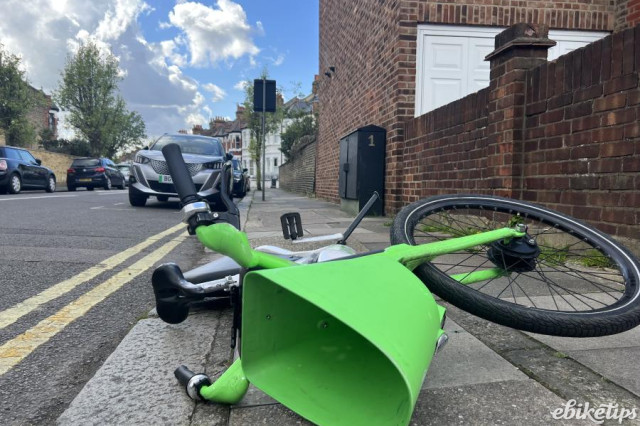

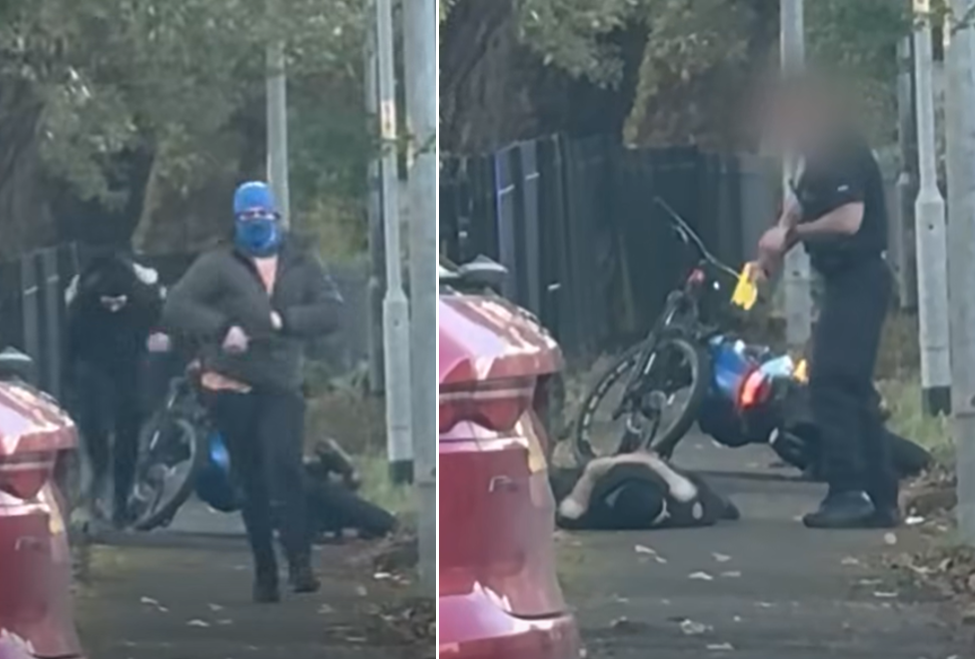
Lime has apologised and removed e-bikes from the London district of Penge after a visually impaired man claimed he was forced to take to a busy road to avoid e-bike clutter.
Jason Beal, who is blind, told The Standard that he was forced to wander into Kent House Road when his guide dog, Caine, refused to walk on a pavement blocked by e-bikes.
The issue is the latest in a series of problems Beal and his wife Jessica say they’ve faced in and around Penge.
“There have been a number of times the Lime bikes have been parked up or propped up against the tree or left over the pavement,” Jason told the Standard.
“Then I’ve got to stop, Kent House Road is quite a busy road. He (Caine) will refuse to go into a road at any time. So, I’ve got to make a decision to try to take him into the main road. That’s a very frightening experience for myself.
“Alternatively, there have been times when we have been walking up to the station and there have been loads of bikes parked up against where the tactile pavement is and I’ve had to go into the edge of the road there.”
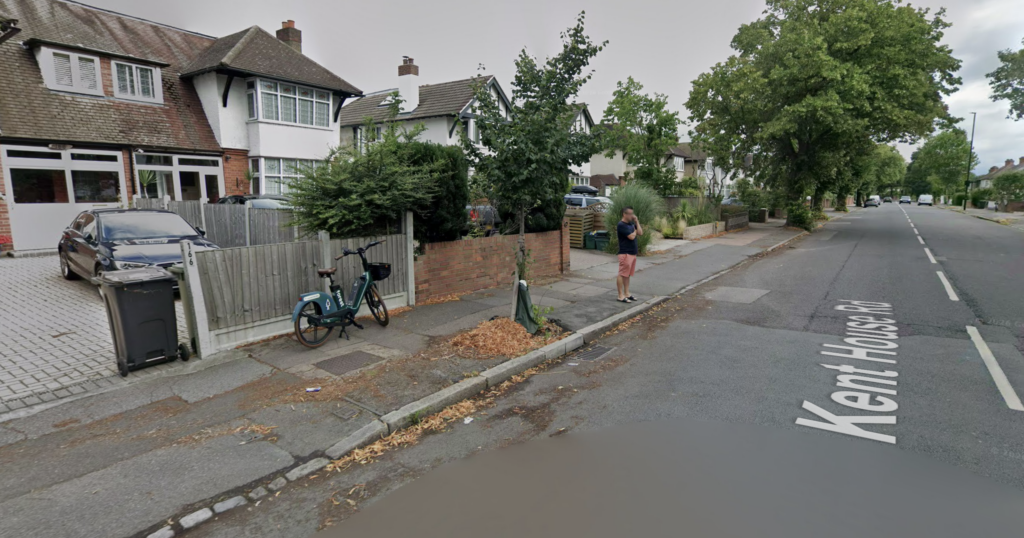
Jessica, who is also partially sighted, revealed that she faces problems due to e-bikes. “You never know when they are going to crop up and if you are going to hit one, or are they going to fall on you,” she said. “So, it’s quite scary just walking around.”
Beal, an assistive technology manager, and Jessica, who works as a marketing audience manager, took up the issue with their local MP, Liam Conlon, who intervened with Bromley Council and Lime.
“We cannot allow new barriers to be created for disabled residents who already face challenges getting around,” Conlon said. “As a disabled person myself, who was unable to walk for four years as a teenager, I understand these issues first-hand. It is something I take seriously, and something I will not accept.”

Here, the plot thickened when Bromley Council’s Executive Councillor Simon Fawthrop found that Lime was operating in the borough without formal consent. After the council threatened Lime with impoundment fees, the micromobility company swiftly banned hires throughout the borough.
“We would therefore like to apologise to Jessica and Jason for the issues they have faced due to rider parking in Penge,” Lime said in an apologetic letter to the Beals. “To address the specific issue in Penge…we have made a change to the Lime app to prevent Lime bikes from being used beyond the Lewisham boundary until we can agree an approach that supports the roll-out of an effective local scheme, with appropriate parking locations.”
Lime is now working with Bromley Council to roll out a scheme that supports ‘appropriate’ parking solutions and prevents blocked pavements.
“I’m delighted that Lime have announced they are withdrawing their bikes from Penge – and would like to thank them for their cooperation, and for their apology,” said Conlon.
Regular readers will know how much of an issue pavement parking is, with London’s borough councils and e-bike hire companies getting stuck in a quagmire of micromobility benefits, revenue streams, and the needs of pedestrians. The answer seems to be in creating more dedicated on-street parking bays for e-bikes.
Lambeth Council recently announced a scheme to turn car parking spaces into e-bike hire spots — but a restaurant owner objected when Camden Council did the same thing outside his upmarket eatery. Meanwhile, Westminster made on-street parking bays permanent following a trial period.










7 thoughts on “Lime disabled in London district after blind resident claimed pavement-blocking e-bikes ‘forced him onto busy road’”
Will the authorities of Penge do the same for drivers parking badly thus causing the same problem for disabled people?
I won’t hold my breath.
If “[t]he answer seems to be in creating more dedicated on-street parking bays”, I suspect they’ve already got that covered.
Shocked not shocked about the first part (although it may be that in places the (by)law is such that they don’t have to…)
I believe some LAs have said that they can’t stop the firms (Oxford IIRC), so the second is hopeful.
Of course as others note “if only this happened with cars” – quite right. But that doesn’t mean we should therefore tolerate other commercial interests grabbing public space for private profit.
Whilst I appreciate the idea behind Lime bikes/scooters and their ilk, the problem lies in that they can just be abandoned anywhere. If they required returning to a dedicated docking station before the ride was considered finished then that would cut down on this nonsense. Or even go a step further, it wont release your phone until its placed back in the docking station.
In theory them being “abandoned” is in part a benefit. The firm doesn’t have to truck so many of them around since many will be collected by users. (Eg. finding one and going to it, rather than the docking station).
How helpful to the users that is may be moot because of most dockless bike hire business models.
In practice I think the docking model is less bad. However if cycling is actually facilitated eventually most people have their own bike *. And tying any hire in with public transport hubs (like NL’s OV Fiets) then makes the most sense.
Overall I keep thinking about NotJustBikes comment that most public bike hire schemes are an attempt to make up for a failure to provide (good enough) street-level public transport.
* I think that’s the case even now in the UK? Certainly I notice far more bikes stored locally (balconies, corridors…) than would appear to be regularly (or ever) used.
The amount of times I’ve had to move an fing Lime scooter or bike off the path!
The problem is selfish idiots.
Return to rack is the only solution. Obviously they need 3x rack numbers compared to bikes.
Lime, I could have told you all if this at the outset, as could the majority of thinking humans.
I live on the Lewisham/Bromley border. This explains why we have suddenly got a slew of Lime bikes across our pavements. Riders find they can go no further and simply abandon them on the border.
Hence all this has done is move the problem and compounded it by concentrating it on the border rather than dispersed to the eventual destination. Riders and residents both lose. The border also runs through Kent House Road so the blind person will only have shifted the problem further up the road and probably made it even worse.
Bromley could have tried to mitigate the issue by providing (like surrounding boroughs) dedicated hire bike parking instead of shifting their problem out of borough.
We need to move to regulation that hire bikes can only be left in a designated area like TfL bikes. Their advantage is this needs only white paint not docking infrastructure. But, I guess, Lime wouldn’t like that.