


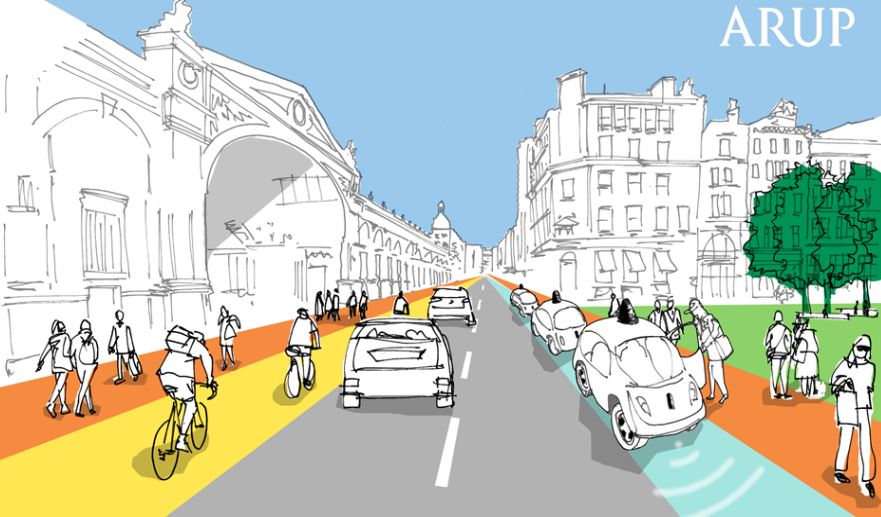

A flexible kerb space idea that would allow a road’s use to be altered over the course of a day has received £30,000 of funding and could receive a further £50,000 if it wins the National Infrastructure Commission’s Roads for the Future competition.
BikeBiz reports that design firm Arup’s ‘FlexKerbs’ would adjust throughout the day and week to ensure that space meets local demand.
The firm says: “Over the course of a day, for instance, a single FlexKerb segment can function as an autonomous vehicle rank at rush hour, a cycle path at lunchtime, a pedestrian plaza in the evening and a loading zone overnight.”
Some will point out that cycle paths frequently double up as loading zones even during the daytime, but this is presumably not what they meant. Nevertheless, some will no doubt harbour concerns that such an innovation might provide a means of watering down planned cycle infrastructure.
The idea is after all one of five shortlisted for the Roads for the Future competition which has asked entrants how they would get the UK road network ready for connected and autonomous vehicles (CAVs).
Arup now has three months to develop a feasibility study to demonstrate how FlexKerbs could benefit cities once CAVs have been introduced.
The firm plans to simulate the scheme on a typical London high street, designing a FlexKerb schedule for one weekday and one weekend day to show how flexible use of a busy street’s kerbside can enable safe and convenient CAV pick-up and drop-off whilst maintaining—or even enhancing—the urban environment for pedestrians, cyclists, and other transport users.

-300x199.jpg "“He wants bikes in traffic lanes. Give him what he wants”: Cyclists urged to “slow every street down to bicycle speed” and ride in middle of lane amid premier’s war on cycle paths + more on the live blog")







54 thoughts on “Flexible kerb space idea could result in pop-up cycle lanes”
I don’t get this fixation
I don’t get this fixation with driverless cars. What’s the advantage. It is still a car on the road doing a journey for a limited number of occupants, regardless of whether it has a driver or not.
PRSboy wrote:
I’ve gone on about it several times already, so should probably give it a reast. But I am entirely unconvinced they’ll ever work, or, if they do work, that they won’t do more harm than good.
Note that the uber one that killed a pedestrian recently turns out to have had its sensor sensitivity set too low, so thought the person it detected in the road wasn’t significant enough to stop for.
What if it turns out that’s an unavoidable trade-off ? If the choice turns out to be either stop for every plastic bag blowing across the street and so delay the paying customer, or occasionally drive into people? Which will the car-markers choose? And before answering, bear in mind how those car makers chose to deal with the trade off between higher (illegal) emissions poisoining the general public, and reducing the car’s performance and upsetting the car’s purchaser.
We need fewer cars being used less, not driverless ones.
FluffyKittenofTindalos wrote:
Asking “Which will the car-makers choose?” is the wrong question. The real question is “Which will we as a society in general choose?” The answer is even more worrying.
Bmblbzzz wrote:
In fairness, I imagine the scanners and sensors will get much better, together with improvements in AI. As an optimist I have the view that autonomous cars may get into less dangerous situations in the first place as they are not potentially operated by a moron.
The fact is that the current system of driver licensing is flawed, tolerating everyday incompetence as a trade off for general mobility. Similarly, the architects and users of the transport network tolerate injury and death as a trade off for convenience and cost.
FluffyKittenofTindalos wrote:
The robocars aren’t going to need to attain zero casualties. The robocars just need to persuade those in power they are less deadly than the incompetent humans driving death cages.
PRSboy wrote:
At the most basic level driverless cars will eliminate the need for on street parking, freeing up plenty of space for wider pavements and cycling infrastructure.
They will also hugely reduce the cost of taxi hire meaning that many people will simply opt out of private car ownership altogether.
This will again reduce the numbers of cars parked but will also reduce the overall number of journeys.
Put these words into a well
Put these words into a well known phrase: ‘idea’, ‘stupid’, ‘fucking’.
Could we just spend any
Could we just spend any investment on fixing the potholes in the normal dumb roads we already have.
“Over the course of a day,
“Over the course of a day, for instance, a single FlexKerb segment can function as an autonomous vehicle rank at rush hour, a cycle path at lunchtime, a pedestrian plaza in the evening and a loading zone overnight.”
So the only time it’s a cycle path is when no one else wants to use it (and probably few cyclists too), and since other users struggle to stay out of clearly marked permanent cycle paths the rest of the time it’s essentially useless.
Quote:
How? They still have to be somewhere. They’re either driving around, or parked. And driving around takes up more road space than parking…
This is only true if driverless cars result in there being far fewer cars in use than now, and it’s not obvious that that is the outcome. Car sharing schemes have failed to make any significant dent in car ownership, and assuming that autonomous vehicles will is not a “most basic level” step.
rkemb wrote:
How? They still have to be somewhere. They’re either driving around, or parked. And driving around takes up more road space than parking…
This is only true if driverless cars result in there being far fewer cars in use than now, and it’s not obvious that that is the outcome. Car sharing schemes have failed to make any significant dent in car ownership, and assuming that autonomous vehicles will is not a “most basic level” step.
yes, there’s some confusion here between driverless cars, and car-sharing. The ideal situation is to eliminate private car ownership and have a stock of shareable cars along the lines of Boris Bikes, Velib and so on – in fact Paris is introducing such a scheme at the moment I think.
When they are public transport they are essentially self-drive, or driverless, taxis and their use can be optimised so that the total number of cars is reduced. This will depend on having a staggered rush hour of course, as well as decentralised workplaces, as the people who want to drive in all at the same time means there would have to be enough cars to fill the demand. However, at the same time hopefully more people are using (driverless) mass transport such as buses.
It’s the sort of thing that needs government to bootstrap it with appropriate incentives and disincentives into a virtuous circle, for example by removing private parking from city centres except for, for example, blue badge holders, increasing congestion charges, and making shared cars cheap or free. Car-sharing schemes such as Zipcar are still run on a commercial basis rather than as a public service.
rkemb wrote:
On street parking won’t be needed as cars can simply go and park themselves elsewhere.
A car driving for 10 minutes to an off road parking facility uses up a piece of road for 10 minutes. A car parked on the road uses up a piece of road for hours/days/weeks until the car is driven next. As most cars are parked for 95% of the time the amount of street space freed up by that one change will be huge.
Driverless taxis will also massively reduce second car ownership, freeing up more space, and eventually, imho, virtually eradicate private car ownership.
Rich_cb wrote:
How? They still have to be somewhere. They’re either driving around, or parked. And driving around takes up more road space than parking…
This is only true if driverless cars result in there being far fewer cars in use than now, and it’s not obvious that that is the outcome. Car sharing schemes have failed to make any significant dent in car ownership, and assuming that autonomous vehicles will is not a “most basic level” step.
— Rich_cb On street parking won’t be needed as cars can simply go and park themselves elsewhere. A car driving for 10 minutes to an off road parking facility uses up a piece of road for 10 minutes. A car parked on the road uses up a piece of road for hours/days/weeks until the car is driven next. As most cars are parked for 95% of the time the amount of street space freed up by that one change will be huge. Driverless taxis will also massively reduce second car ownership, freeing up more space, and eventually, imho, virtually eradicate private car ownership.— rkemb
Where is all this extra off-road parking going to come from? Notwithstanding your figures have been plucked out of thin air.
don simon wrote:
What figures have been picked from thin air?
There is so much off road parking already available, driverless cars could also park more efficiently making better use of the existing space.
The growth of driverless taxis will also eliminate a lot of demand for parking at places of work etc freeing up more off road parking space.
Rich_cb wrote:
Where is all this extra off-road parking going to come from? Notwithstanding your figures have been plucked out of thin air.
— Rich_cb What figures have been picked from thin air? There is so much off road parking already available, driverless cars could also park more efficiently making better use of the existing space. The growth of driverless taxis will also eliminate a lot of demand for parking at places of work etc freeing up more off road parking space.— don simon
Picked from thin air are the 10 mins and 95%, unless you can provide supporting evidence that satisfies my scrutiny, then it’s pure speculation on your part.
You’ll have to be more specific on where this available parking spoace is too and the more efficient use of existing space.
Why would driverless taxis increas usage? Apart from not getting the less than casual racist commentry and crap driving, there is no evidence to show that people will decide to use driverless taxis in place of car ownership. That isn’t going to go away unless we have another way of demonstrating wealth/success.
don simon]
You’ll have to be more specific on where this available parking spoace is too and the more efficient use of existing space.
Why would driverless taxis increas usage? Apart from not getting the less than casual racist commentry and crap driving, there is no evidence to show that people will decide to use driverless taxis in place of car ownership. That isn’t going to go away unless we have another way of demonstrating wealth/success.— don simon</strong><br />[quote=don simon
The 10 mins is just an arbitrary number. The 95% figure is well known. Just Google it.
Car ownership is lower in London than the rest of the UK. London is far wealthier than the rest of the UK suggesting that tragically inadequate Londoners have found ways to compensate other than a big 4×4. It also suggests that reliable public transport reduces the demand for private car ownership.
Rich_cb wrote:
Picked from thin air are the 10 mins and 95%, unless you can provide supporting evidence that satisfies my scrutiny, then it’s pure speculation on your part.
You’ll have to be more specific on where this available parking spoace is too and the more efficient use of existing space.
Why would driverless taxis increas usage? Apart from not getting the less than casual racist commentry and crap driving, there is no evidence to show that people will decide to use driverless taxis in place of car ownership. That isn’t going to go away unless we have another way of demonstrating wealth/success.
— Rich_cb The 10 mins is just an arbitrary number. The 95% figure is well known. Just Google it. Car ownership is lower in London than the rest of the UK. London is far wealthier than the rest of the UK suggesting that tragically inadequate Londoners have found ways to compensate other than a big 4×4. It also suggests that reliable public transport reduces the demand for private car ownership.— don simon
So the figures were indeed plucked out of thin air.
Taxis are not public transport.
London, in so many ways is not representative of the rest of the UK, I also see the daily complaints of both the cost and running of the lauded London public transport system. Almost to the point that makes me think that people are forced to use it rather than choose and given an alternative, they would take it.
Public transport can work is large cities, and car usage can be reduced in large cities. Cycling can be made safer in large cities too, I’ve seen it, but I’ll let you come up with a solution instead of speculating.
What’s a big 4×4 got to do with anything?
don simon wrote:
Arbitrary figures are just that. I wouldn’t expect you to understand.
The 95% figure is well known.
Here’s a link, educate yourself: http://bfy.tw/IIDH
Taxis are often classified as public transport.
Everything is speculation when we’re discussing
possible future developments.
Rich_cb wrote:
Taxis are not public transport.
London, in so many ways is not representative of the rest of the UK, I also see the daily complaints of both the cost and running of the lauded London public transport system. Almost to the point that makes me think that people are forced to use it rather than choose and given an alternative, they would take it.
Public transport can work is large cities, and car usage can be reduced in large cities. Cycling can be made safer in large cities too, I’ve seen it, but I’ll let you come up with a solution instead of speculating.
What’s a big 4×4 got to do with anything?
— Rich_cb Arbitrary figures are just that. I wouldn’t expect you to understand. The 95% figure is well known. Here’s a link, educate yourself: http://bfy.tw/IIDH Taxis are often classified as public transport. Everything is speculation when we’re discussing possible future developments.— don simon
Can’t help yourself in debates, can you? The second you struggle to justify what you’ve said, it all gets personal and insulting, with a bit of condescension thrown in. You asked me why I called your figures as being plucked out of thin air, your response is that they are arbitary figures and decided to go on one of your typical battles.
You still haven’t told me why a 4×4 gets a special mention, I don’t expect you can. I do expect you to have the last word though.
Have a great bank holiday, perhaps you could buy yourself a bike and go for a ride. You might enjoy it.
don simon wrote:
You tried to be clever and failed.
The 10 mins is arbitrary, it could be 5, 15, 20 etc without changing the point. It therefore doesn’t need a reference.
All but the most obtuse would recognise that the 95% figure is the important one. That is based on widely known research and is similar in most western countries. Did you not follow the link provided?
You mentioned how people need a nice car to show wealth/success, that seems a bit pathetic. Hence the 4×4 mention. Touch a nerve?
Rich_cb wrote:
Can’t help yourself in debates, can you? The second you struggle to justify what you’ve said, it all gets personal and insulting, with a bit of condescension thrown in. You asked me why I called your figures as being plucked out of thin air, your response is that they are arbitary figures and decided to go on one of your typical battles.
You still haven’t told me why a 4×4 gets a special mention, I don’t expect you can. I do expect you to have the last word though.
Have a great bank holiday, perhaps you could buy yourself a bike and go for a ride. You might enjoy it.
— Rich_cb You tried to be clever and failed. The 10 mins is arbitrary, it could be 5, 15, 20 etc without changing the point. It therefore doesn’t need a reference. All but the most obtuse would recognise that the 95% figure is the important one. That is based on widely known research and is similar in most western countries. Did you not follow the link provided? You mentioned how people need a nice car to show wealth/success, that seems a bit pathetic. Hence the 4×4 mention. Touch a nerve?— don simon
Why? You’re irrational hatred of 4x4s without knowing anything about them is both interesting and odd at the same time. But hey…
don simon wrote:
I don’t hate 4x4s. I think people who drive cars larger than they need are incredibly selfish.
If they do so for vanity reasons they’re obviously quite inadequate people so maybe they deserve sympathy rather than scorn?
Rich_cb wrote:
Fantastic. So not only will we have congestion from driverless cars taking people (I use the plural hopefully) to work and dropping them off, we’ll now have the extra trips where the driverless cars go off and park themselves and return later in the day to pick up their owner, extending the rush hour.
It’s an interesting opinion but surely if this was to be so it’d already have happened with regular taxis. IMHO the only eradication that might happen is the eradication of taxi drivers, which some may argue has it’s merits.
You’ll also have huge amounts of additional road capacity freed up by the removal of parked cars from the roads plus more efficient use of road space and far more incentive to car share.
Taxis are currently too expensive to replace regular private car use, remove the driver and reduce the insurance premium and the cost will fall dramatically.
This will make private taxi hire economically competitive with regular car use and hence eliminate most private car ownership.
Once private ownership has ceased there will be further reductions in congestion as parking will happen far less frequently.
Rich_cb wrote:
Most roads where congestion is an issue are already no parking at any time or at peak times.
This capacity you are magically freeing up would be mostly residential roads, I don’t really want my road to be considered available capacity to reduce congestion on the main roads.
I reckon my car may well be parked 95% of the time but most of this is on my driveway and not an issue to anyone.
However, most commuters dream of driving for only 8.5 hours per week.
Not sure where you think these driverless cars will take themselves off to either. It’s a nice idea that they will go to be used by someone else but if there are enough to meet rush hour demand there woukd be a massive surplus the rest of the time so most would need somewhere to be parked or they would be endlessly circulating on the roads, making car travel even less efficient than it is now.
wycombewheeler wrote:
That’s not the case where I live, a lot of congestion and the ensuing pollution on residential streets.
There is already enough parking capacity for the rush hour cars. If they were driverless and not privately owned a large proportion of them could be assigned to another job immediately after rush hour. The number of parked cars would fall dramatically.
Most of us wouldn’t want our streets used for additional traffic but I certainly wouldn’t object to having a segregated cycle route on my street.
Rich_cb wrote:
How? They still have to be somewhere. They’re either driving around, or parked. And driving around takes up more road space than parking…
This is only true if driverless cars result in there being far fewer cars in use than now, and it’s not obvious that that is the outcome. Car sharing schemes have failed to make any significant dent in car ownership, and assuming that autonomous vehicles will is not a “most basic level” step.
— Rich_cb On street parking won’t be needed as cars can simply go and park themselves elsewhere. A car driving for 10 minutes to an off road parking facility uses up a piece of road for 10 minutes. A car parked on the road uses up a piece of road for hours/days/weeks until the car is driven next. As most cars are parked for 95% of the time the amount of street space freed up by that one change will be huge. Driverless taxis will also massively reduce second car ownership, freeing up more space, and eventually, imho, virtually eradicate private car ownership.— rkemb
Just running with this for the moment, because while I’m unconvinced any of this will ever happen, it’s interesting to try and imagine how it would work in an ideal case. No longer storing cars in throughfares would certainly be a huge improvement.
If you say 10 minutes, then, given current speeds are about 10mph on average in rush hour in inner London, that would imply you’d want large (multi-storey?) parking for these self-driving-taxis such that they are within two miles of any point where someone would want one,.
To be fair that’s actually not as mad as I first thought, as I think, if I have this right, it works out as very roughly one such depot per inner London borough. Which might actually be possible. Outside that area distances are greater but so are traffic speeds.
So the idea would be – summon one from the nearest depot to collect you, go to where you want to be, then it parks itself in the nearest depot to that?
One question is, they’d surely have to redistribute themselves back to the home depot, or else they’d end up in the wrong places…but I suppose that could be done outside the rush hours, as long as the depots are large enough not to run out during peak times (and that’s an issue I can’t work out – just how much capacity would be required in these multi-story carparks?).
But what I don’t get, is why, then, this doesn’t already happen with human-driven taxis? Why do those taxis instead wait on public streets or cruise around looking for custom? Why doesn’t Uber already work like that?
Your argument would be, I guess, then, that the labour cost of the human driver makes taxis too expensive to achieve the necessary critical mass?
I dunno… I’m not convinced that the things will work on a technical level (the actual driving part), nor that the people who currently choose to drive 1 mile to buy a paper (and a huge proportion of urban car trips are a mile or so) would rather wait 10 minutes for a self-driving taxi to turn up and take them there. In many cases they could walk there in hardly any more time than you are envisaging them waiting for a self-driving taxi. If they were that patient, would they really be driving to begin with?
FluffyKittenofTindalos wrote:
Uber sort of does work like that. A lot of drivers will simply log off and return home when work is scarce, once demand picks up more drivers make themselves available.
The situation I described where a privately owned car would drive to a depot and then return may never happen. We may just make the jump to driverless taxis abandoning private ownership all together.
If it does happen it will probably require some increase in off road parking capacity to be built but I imagine a lot of supermarkets etc would be happy to monetise their excess capacity overnight and at off peak times.
Privately owned driverless cars might have a waiting time as you described, this won’t suit many people which is part of the reason that I think we might jump straight to driverless taxis.
FluffyKittenofTindalos wrote:
One reason that this doesn’t happen now is the cost of existing multi-story inner-city car parks. It is too expensive for the taxis to wait in these locations. If the robocars have to use such premium secure space too I am not sure that they could ever be cheap as have been implied.
It’s not smart cars you need
It’s not smart cars you need (well, OK, they might be [i]part[/i] of the solution) but it needs to be done in conjunction with smarter roads, especially traffic light junctions. The number of times I’m driving along, traffic flowing nicely and then bang – on the brakes to a standstill at a junction where the lights are mindlessly cycling through in spite of there being nothing at all coming out of the other carriageway.
Driverless cars don’t fix that but smart lights that don’t change at set intervals regardless would do.
I’d be against the idea of “smart roadspace” based on the fact that the default setting will simply be “allow ALL the cars!”
That said, there’s some instances where vaguely similar schemes do work well, using 3 lanes. In the morning, the flow is 2 lanes into town, 1 lane out; in the evening, overhead lights change the flow to make the middle lane “outgoing” – 2 lanes out, one lane in. Works well – I used to use one in Cardiff pretty regularly.
Three lanes doing the work of four.
crazy-legs wrote:
As long as they are not the sort if smart lights that don’t detect bicycles. I feel I am old enough now not to need accompanying across a junction, so I don’t see why I should need to wait for a car to arrive to trigger the lights.
“Chairman of the National
“Chairman of the National Infrastructure Commission Sir John Armitt said he and the competition jury had found the quality of entries to the Roads for the Future competition “very impressive……”
I can’t help feeling that Sir John and the jury don’t ride bikes and travel exclusively by chauffer-driven cars as this idea is only impressive if you travel by car 100% of the time. I can’t say I’m getting warm waves of confidence about the National Infrastructure Commission, just get on with it an create the best value for money of any infrastructure by a million miles; a comprehensive cycle network. After they’ve done that they can look at the lower value options.
If drivers routinely abuse clearly marked facilities for cyclists and pedestrians, any ambiguity at all will merely encourage them. Giving the creators £30k for this is merely encouraging stupidity. I mean, I’m all for thinking outside the box, but this idea is outside the planet.
We’re doomed.
We’re doomed.
“The jury for the Roads for the Future competition are:
Bridget Rosewell, Commissioner (Jury Chair)
Sir John Armitt, Chairman, National Infrastructure Commission
Laura Shoaf, Managing Director, Transport for West Midlands
Julia King, Baroness Brown of Cambridge DBE, engineer and Deputy Chair, Committee on Climate Change
Professor Natasha Merat, Director, Transport System Hub, University of Leeds
Jim O’Sullivan, Chief Executive, Highways England
Chris Holmes, Senior Manager Research Team, Jaguar Land Rover”
Got you, it’s the size of the
Got you, it’s the size of the vehicle this time.
don simon wrote:
‘Twas ever thus.
Rich_cb wrote:
Got you, it’s the size of the vehicle this time.
— Rich_cb ‘Twas ever thus.— don simon
Except your contaminants rant.
Again, I trust that you live in a property of no more than 20m2, otherwise it’s pure selfishness. It’d be a litlle hypocritical if you live somewhere larger, wouldn’t it?
don simon wrote:
He probably doesn’t spend much time driving his house on the public road, so your riposte doesn’t really work. (Disclaimer – I don’t think his “size of vehicle” argument has much merit either)
don simon wrote:
Particulates.
A larger car will produce more particulate pollution than an equivalent smaller car.
You can’t offset particulates and they kill people.
Rich_cb wrote:
Except your contaminants rant.
Again, I trust that you live in a property of no more than 20m2, otherwise it’s pure selfishness. It’d be a litlle hypocritical if you live somewhere larger, wouldn’t it?
— Rich_cb Particulates. A larger car will produce more particulate pollution than an equivalent smaller car. You can’t offset particulates and they kill people.— don simon
If the automated car has the added journey over a driven car, of going 30 minutes after destination to park, then don’t those extra particulates kill people too?
ClubSmed wrote:
It would be a balance. Removing on street parking would improve traffic flow therefore reducing particulate pollution.
The additional space for walking/cycling would hopefully increase the modal share of active transport further decreasing particulate pollution.
Rich_cb wrote:
If the automated car has the added journey over a driven car, of going 30 minutes after destination to park, then don’t those extra particulates kill people too?
— Rich_cb It would be a balance. Removing on street parking would improve traffic flow therefore reducing particulate pollution. The additional space for walking/cycling would hopefully increase the modal share of active transport further decreasing particulate pollution.— ClubSmed
Is the space saved by eliminating on street parking going to be used for improved traffic flow at peak times or additional space for walking/cycling? If it is going to be for walking cycling then the traffic flow would not be increased, in fact it would be worse because of the extra journeys to park. If it is going to be for traffic flow then the extra traffic on the road would probably put people off cycling/walking.
ClubSmed wrote:
Does it have to be either/or?
Where a few parked cars cause pinch points then flow will be increased.
Where lots of cars are taking up an entire lanes worth of space the extra space could be given over to segregated infrastructure. This would help increase active travel and therefore reduce congestion/pollution.
Once private ownership reduces dramatically there will be no need for most cars to park for prolonged periods.
Rich_cb wrote:
Is the space saved by eliminating on street parking going to be used for improved traffic flow at peak times or additional space for walking/cycling? If it is going to be for walking cycling then the traffic flow would not be increased, in fact it would be worse because of the extra journeys to park. If it is going to be for traffic flow then the extra traffic on the road would probably put people off cycling/walking.
— Rich_cb Does it have to be either/or? Where a few parked cars cause pinch points then flow will be increased. Where lots of cars are taking up an entire lanes worth of space the extra space could be given over to segregated infrastructure. This would help increase active travel and therefore reduce congestion/pollution. Once private ownership reduces dramatically there will be no need for most cars to park for prolonged periods.— ClubSmed
unless the new space is going to be used for motor vehicles, bicycles and pedestrians then yes it does have to be either/or. You mention segregated infrastructure, does that not suggest either/or?
ClubSmed wrote:
I did not make myself very clear, apologies.
You would decide how to use the additional space based on what would bring the greatest benefit.
If there is a suitably long stretch of road freed up you can go for active travel infrastructure, if it’s just a few pinch points then leave the road as it is and get improved flow.
Rich_cb wrote:
Have you told the ambulance service that they’re watong their time? Or the fire service? Or those 4×4 driving mountain rescue twats? And as for those cunts and their air ambulances?!!!**!!@@????
The house is perfectly valid if he wants to judge people on the space they want/need.
don simon wrote:
You’ve misunderstood. Again.
If the car is larger than required it’s selfish.
If it’s necessary to have a larger car then it’s not selfish.
Rich_cb wrote:
Technically, it is selfish to have a vehicle larger than necessary.
However, that should apply to everyone who drives a multiple occupant vehicle when it is not at full capacity and that is not really feasible. Imagine a bus service that only starts the journey when it is full up? Or a commuter that has to buy a single-seat car just for commuting and drives their family around in a different car at the weekend?
If you extend the ‘selfish’ argument, then you could declare that everyone living in “Western” countries are incredibly selfish due to their general consumption habits. I don’t necessarily think that it’s wrong, but it’s not a sensible yardstick to compare people’s behaviours and requirements.
hawkinspeter wrote:
It depends how strict you want to be. If you have a need for a large car even if it’s not needed everyday then I think it’s fair enough to own one.
Once private car ownership ceases we’ll be able to order a car specific to our exact needs for each individual journey.
I do think we have an obligation to reduce our consumption as much as possible but that does obviously require a fair bit of effort so not everyone is enthusiastic about doing so.
Rich_cb wrote:
What have I missed in the offset argument? As pointed out most, if not all, vehicles are driven below full occupancy some of the time. Therefore, by your definition, selfishly. Some of these vehicles emit particulates, which contribute to illness and death, some vehicle owners can offset this negative aspect in a number of ways. Why is that so hard for you to get your head around?
I’ll repeat, that unless your life and lifestyle is beyond scutiny, you’re being hypocritical. Life isn’t as black and white as you seem to see it.
don simon wrote:
You can’t offset particulates.
If your car is larger than necessary then you’re emitting more particulates than necessary and causing more harm than necessary.
Why is that so hard for you to get your head around?
Rich_cb wrote:
I can’t make it any clearer for you. If you can’t see that you actually agree with me on this point, then there’s no helping you.
don simon wrote:
You’re back to that old trick again. You really are a joke.
Rich_cb wrote:
Is that the one where I say something that is demonstated to be true?
don simon wrote:
So much unnecessary aggression ruining what could have been an interesting discussion for others.