


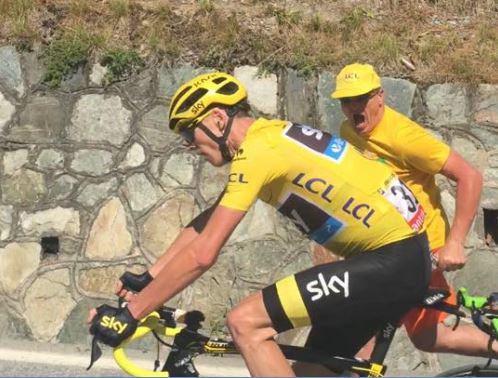

Chris Froome has denied as “completely untrue” a report in an Italian newspaper that he has done a deal over his adverse analytical finding for the anti-asthma drug salbutamol at last year’s Vuelta and has accepted a ban lasting between five and six months.
The 32-year-old, who won the Spanish Grand Tour after clinching his fourth Tour de France title last July, was discovered to have twice the permitted level of the drug in his urine following an anti-doping control after Stage 18 of the race.
Today, Milan-based newspaper the Corriere della Sera reported that the Team Sky rider would admit negligence on his part, apparently on the advice of his wife and manager, Michelle Froome
However, he took to Twitter to deny the newspaper’s claim, describing it as “completely untrue.”
I have seen the report in Corriere della Serra this morning – it’s completely untrue.
— Chris Froome (@chrisfroome) January 30, 2018
The Corriere della Sera put forward several reasons why Froome, who has vowed to provide an explanation to the authorities of how his urine came to have twice the legal concentration of salbutamol with a reading of 2,000 mg/ml, might be tempted to accept fault through a mediation process.
Those include the difficulty in persuading the UCI Anti-Doping Panel to accept whatever explanation he provides, reportedly including the argument that he was the victim of a kidney disfunction.
Moreover, the newspaper says that should he submit himself to laboratory tests in an effort to clear his name but the results fail to convince the authorities, he could face a ban of between 12 and 24 months.
For those reasons, the Corriere della Sera suggests that he would be prepared to forfeit his Vuelta title as well as the bronze medal he won in the time trial at the UCI Road World Championships in Bergen, Norway last September.
A suspension of up to six months, which would most likely be backdated to the date of the adverse analytical finding, 7 September 2017, would mean he was eligible to return to racing at latest around two months before the start of the Giro d’Italia in Jerusalem on 4 May.
However, the newspaper adds that a ban of that length would seem a light sanction, given that Italian rider Diego Ulissi, who in 2015 was banned for nine months after admitting negligence for having an excessive level of salbutamol in his urine – albeit a lower amount than Froome.










35 thoughts on ““Completely untrue” – Chris Froome dismisses report that he has accepted salbutamol ban”
So hammering out nearly 300km
So hammering out nearly 300km is his way of training and not getting something out of his system then. Allegedly spotted in sponsorship free kit on his bike too. What can that mean?
don simon wrote:
What can it mean, lots of things. Riders do get “neutral kit” from sponsors when testing out new designs or patterns so that people don’t know what it is they are wearing. They are also free to wear any sponsor free kit they feel like whenever they want, the only time they’ll be held to wearing kit is official photo’s, races and anytime the team stipulate that it must be done. During the off-season, many riders wear what they like, when they like. Especially if not training with the team, as you have to wash your own kit.
300km in training, that’s nothing really. Why just the other day, a bunch of guys who aren’t anywhere near top level did 240km in training on one ride.
I do wish that the process would speed up a bit, any other rider would have been sanctioned or let go by now. Just wait for the tours this year, maybe not the Giro as the Italians aren’t that back, But TdF, he’s going to get piss thrown at him all the time, inhalers chucked…etc.
don simon wrote:
It may have been him trying to see if he could hit similar readings and may explain why he’s doing it publicly…
alansmurphy wrote:
So hammering out nearly 300km is his way of training and not getting something out of his system then. Allegedly spotted in sponsorship free kit on his bike too. What can that mean?
— alansmurphy It may have been him trying to see if he could hit similar readings and may explain why he’s doing it publicly…— don simon
I must have missed the 271km stage.
My bad.
For the sake of the sport,
For the sake of the sport, just take the ban now.
The_Vermonter wrote:
Wouldn’t the sport be better if the number one GT rider was proven not to have cheated, also the correct outcome is better than a quick one.
heard it won’t be backdated
heard it won’t be backdated as he raced after finding out the finding and didn’t self suspend straight away. Or words to that effect.
You mean that possibility if
You mean that possibility if he had an organ problem that didn’t dissipate the Sal from the previous day (hence his very low test level the day before and poor performance) which meant he had a concentration level that was abnormal due to the abnormal functioning of the organ that processes that chemical.
Again, the most tested athlete in sport, on one day, knowing he’s under the spotlight every single day and will be tested every day in competition decides to ‘dope’ (which is the wrong term anyway), sorry but I just don’t buy it.
I can just imagine what Froome is thinking going by the judges/jurists/executioners/
Oh I’ll just have a fuck ton load of this so I can perform on this one day even though I know it gives me no advantage and that I know I’ll be tested and immediately found out then have my title stripped, name and family dragged through the media, possibly get banned, even taken to court for reparitions, have people finger pointing at me for the rest of my life and called a cheating cunt, sure, gimme some more of that shizzle!
BS
BehindTheBikesheds wrote:
Which is exactly whaty happened to Contador.
don simon wrote:
So you don’t understand the difference between Clen and Sal, so no, not exactly what happened with Clenbutarol Bertie.
BehindTheBikesheds wrote:
You obviously haven’t read your own post.
don simon wrote:
Have a read of this re contador
check12 wrote:
Just as a synopsis, that article demonstrates without any shadow of doubt that he was doping to enhance performance, does it?
I’m not going into the ins, outs and bullshittery, except top say:
“
You mean that possibility if he had
an organ problem that didn’t dissipate the Sal from the previous day (hence his very low test level the day before and poor performance) which meant he had a concentration level that was abnormal due to the abnormal functioning of the organ that processes that chemical.eaten a dodgy steak, knowing that Spanish farmers can be little rogues.Again, the most tested athlete in sport, on one day, knowing he’s under the spotlight every single day and will be tested every day in competition decides to ‘dope’ (which is the wrong term anyway), sorry but I just don’t buy it.
I can just imagine what
FroomeContadoriswas thinking going by the judges/jurists/executioners/Oh I’ll just have a fuck ton load of this
so I can performon this one daylovely tainted steak even though I know it gives me no advantage and that I know I’ll be tested and immediately found out then have my title stripped, name and family dragged through the media, possibly get banned, even taken to court for reparitions, have people finger pointing at me for the rest of my life and called a cheating cunt, sure, gimme some more of that shizzle!BS”
don simon wrote:
It’s not though is it. Contador had clenbuterol which he claimed was from contaminated beef, nothing to do with asthma.
The logic is a bit out in the
The logic is a bit out in the article. Froome isn’t too bothered about the Giro, the only reason to compete would be to hold all 3 at once. Losing the Vuelta to cycle the Giro makes no sense.
Like Bertie had to eat 40kg
Like Bertie had to eat 40kg if contaminated steak to get the reading he did, I’d like to understand how many puffs he had to take before he reached 2000 whatever’s. Or can it be taken another way? Basically, how did he physically do it?
kitkat wrote:
The limit is 800mg per 12hrs. Froome had double that amount. So 1600mg is 16 puffs of a 100mg blue inhaler per 12 hours. If you need 16 tokes per 12 hours, you’re not fit to be on a bike, you should be in bed, certainly not technically the fittest rider in the race i.e. race leader. It’s fishy as fuck.
Thelma Viaduct wrote:
An asthma suffer will along in a minute to tell you this is normal and they did this on an Evans sportive.
Thelma Viaduct wrote:
He didn’t have double the 800mg. He had a test which is an output suggesting the input may have been excessive.
It’s not that hard to understand.
kitkat wrote:
They are not allowed to take it any other way.
Or maybe the opposite; if I
Or maybe the opposite; if I get no relief after 4 puffs I’m getting worried. Normally (as a mild asthmatic) one puff (less than the recommended dose) will stop the slight tightness of a mild asthma attack in me.
If if it doesn’t work, I’m suffering a shortness of breath and I’m starting to get that tightness in the chest. The last thing I would be thinking of doing, let alone being able to do, is to ride my bike. Note I said ride my bike, not race it, certainly not at the limit of my ability; I’d be physically unable to get anywhere near it. And I’m a very mild asthmatic who has not been hospitalised with asthma for over 25 years…
So it does make me wonder just what the hell was he trying to achieve with so many puffs of a Salbutamol inhaler….as obviously it wasn’t working. Surely on medical grounds a nebuliser would be what was required(same drug in a much greater dose) which is what they would put you on if you turn up at A&E with mild asthma that was not responding to your inhaler.
I honestly want to believe he was just trying to deal with his asthma, as there is no performance enhancement in taking Salbutamol, but the question of continual consumption in an attempt to deal with it, which evidently wasn’t working(or was it as he managed to keep riding!), yet still being able to hang on on one of the toughest races in elite sport needs explaining in my opinion, to a mild asthmatic who wouldn’t be able to cycle to the hospital if I was experiencing asthma that did not respond to Salbutamol…
PP
Pilot Pete wrote:
How dare you question St Chris’s integrity! I want to believe in his innocence. I must believe in his innocence as he’s British and great and better than everyone else. Brits don’t cheat except that Linford Christie fella and maybe one or two footballers and a couple of rugby players. Especially British cyclists don’t cheat, Sir Brad wasn’t proven to be a cheat and Tom Simpson is a fucking hero! Sir Chris will be proven that nothing could be found to find him guilty as the dog ate his perscription, thusly allowing me to shout from the rooftops that he wasn’t found guilty due to lack of something or other, and that will be good enough for me. How dare you!
don simon wrote:
True
The 2 things with Tom should be separated as should the context. Laterly, I get that the same argument could be made with Lance “they were all doing it” but it’s the levels they went to, the deceit etc. Simpson was drinking brandy, was ill, was popping pills, at a time when menthol cigarettes and red wine were healthy; it was a lack of science that’s part of the sad story as opposed to using science and power to make fortunes.
I think Tom’s hero status is more born out of being the first to take on France, the English gent character, the ridiculous fight and desire in his performances, the success and in a large part the very public and saddening downfall. How many music stars gain hero status beyond their relative talent from departing early?
Curiously, on the Simpson ride up Ventoux in July, more foreign riders were partaking in the organised ride than British (from my straw poll of being passed). So maybe us Brits aren’t as tolerant as we think, defending our own. They loved him!
Good news.
Pilot Pete wrote:
Someone was bound to say this, so I’ll take one for the team.
Your experience of asthma is not the same as mine. Mine may not be the same as Chris F’s. I have ridden TT’s with what my dioctor defines as asthma symptoms, and been able to note the difference in performance. It’s a standard part of my warmup to do a quick check over myself and ask whether I need to use an inhaler. This season I may even use a peak flow meter to try and systematize that. I probably ahve to, because I don’t want to end up with an adverse analytical findign should UKAD decide to randomly pick me out to check if there’s any clenbuterol in the many pies I eat as part of my training routine.
Howver, given that there have been cases where an adverse finding has been explained away, and WADA have accepted that (do I have to mention Frankie Sheahan again) I’m well aware that there may be evidence that the average level within WADA limits is an unreliable measure….
It is fishy.
It is fishy.
But the doping thing just doesn’t add up to me. Froome knows what he’s allowed to take and he knows that he’ll be tested, and with salbutamol
there’s clearly no performance benefitno one who is legit, appears to know why or what benefit this may or may not have caused.Froome is also a physical freak, I very much doubt anyone can ‘actually know’ what happens to salbutamol in a body like Froomes, with any number of varying factors.. including ‘functional dehydration’ – http://road.cc/content/news/213549-team-sky-doctor-claims-functional-dehydration-could-make-riders-climb-more
My fag packet theory is that Froome takes salbutamol every day in large doses, not for his well documented asthma he suffers from, but for some weird asthma prevention technique for when he’s racing.. something to do with pushing the limits of the rules, I reckon he’s just doubled up or taken too much by accident.. it’d be easily done with the hecticness of a GT. He’s over the limit no doubt, but that doesn’t mean he’s automatically a doper. In fact hell, it doesn’t mean that the test conducted is actually any good full stop, as mentioned previously, the measure is an ‘output’ measurement based on what happens to a ‘normal human processes this asthma drug, not an ‘input’ measurement. Who’s to say he’s not taking intravenous salbutamol to cover up a much worse crime!
The latest WADA report was for 2015, it states, there were 244 Adverse Analytical Findings, of which 144 resulted in anti-doping rule violations (e.g. prosecuted), which leaves 100 athletes or 40% of athletes who have had their cases closed either for medical reasons or because no sanction was merited as they were exonerated or deemed to have committed no fault or negligence following a full disciplinary process.
So whilst this is usually takes place behind closed doors (rightly or wrongly) where 40% of findings are closed without sanction, why is the world not asking why this whole thing has been leaked and questioning who would want to leak this?
peted76 wrote:
Only someone who was naive to the point of idiocy or wholly ignorant of the past 30 years of doping scandals in cycling could say this and mean it.
If you ask me what “just doesn’t add up” is a palmares that goes from winning the Anatomic Jock Race in August 2009 to second in the 2011 Vuelta via ninth in the 2010 Tour de Haut Var. (No, I don’t buy the Bilharzia bullshit.)
surly_by_name wrote:
There is plenty that doesn’t add up… plenty.
That’s not to say there wasn’t funny business afoot, as clearly there was something going on. I can’t believe that Chris and sky would be so stupid to let Chris puff away to such am excessive extent as required.
Neither do I believe that Chris has a physiology that randomly changes how it metabolises salbutamol on a given day…
So was it a fuck up with a masking agent, or use of other medication that changed the way Chris processed salbutomol that day… or just a gross fuck up on the part of Sky… I don’t know, it doesn’t add up.
As for Froomes ability… You need talent, luck, and good contacts to turn pro. 15 years ago there were barely any UK pros. Not because we weren’t producing good athletes, but because we didn’t have the contacts and pathways for riders to follow.
Those UK pros that made it then were exceptional, they had to be as their talent had to compensate for lack of contacts.
That was British riders looking to get on the continent. How good then would a rider from Africa need to be to not only turn pro, but get a ride with one of the world’s best team’s with no obvious results?
Tonlool at Froomes early results and use this to gauge natural talent is being insultingly simplistic. Cycling management knows what talent looks like and Chris was snapped up despite him doing anything but fitting th e standard mould.
Quote:
Honestly, why don’t you learn about asthma first before judging … Its a bit like when non cyclists tell us cyclists how we should be riding our bikes.
Inhalers take seconds to work (if taken correctly) – and once the attack has been cleared, there are no other effects – you are ‘normal’ again, and good to go.
When I was at school, I was prescribed 2 puffs of a 400mg inhaler, every 4 hours… so that would have been upto 2400mg in a 12 hour period, just for a normal dosage. No, I was not winning any grand tours back then, but that medication allowed me to lead a normal life – something I could not do before inhalers were invented.
“2,000 mg/ml” !!!
“2,000 mg/ml” !!!
Surely nanograms not micrograms? ie. ng not mg. Typo in article?
Still, if each puff is 200mg into 5 litres of blood, that’s 50 puffs of an inhaler. Inhalers are usually 100 or 200mg per dose with 200 doses.The half life of salbutamol is 3.8-6 hours. ie. the amount still in the blood reduces to half in 3.8-6 hours. 80% ends up in urine.I would guess he’s going to argue some unique physiological condition whereby that amount of salbutamol builds up?
[include Standard I am not a chemist/physician disclaimer]
Edit: Just read the regulations.
800mg per 12 hours is the limit. ie. 4 puffs of a 200mg dose inhaler. That doesn’t seem like a lot.
That produces (on average) 1000 nanograms/ml concentration in the urine sample after WADA conducted tests on athletes. It’s not directly related to blood concentration. The 1000 limit is therefore more an indication that the 800mg was exceded rather than being proof.
Bit like the referendum, this
Bit like the referendum, this whole episode has been released to the public before there is sufficient information to make informed conclusions.
We are now forced to take an opinion that may or may not be proven wrong, or never proven.
For instance… the fall out from there being no sanction is untenable. It would make too many people question the integrity of the sport at an organisational level.
So there will be a sanction.
It doesn’t matter what evidence is provided, Froome can not be seen to get away with this. Which in turn will set a precedent for all future Salbutomal cases.
This would be sad, if under Sky’s scrutiny, genuine problems with the current salbutomal regulations were discovered.
As for Contador. I had no doubt in my mind that Bertie enjoyed the spoils of illicite performance enhancement. A proper old school chugger from the school of early noughties spanish origin.
That said, the clen case was a freaking joke. A tiny level of clen was found in his system on one day, nothing the day before, and reducing returns on subsequent days tests. All evidence pointed towards accidental ingestion… or an amazingly calculated dosing to suggest such as event.
The case should have been thrown out. It wasn’t. Why not? I believe there are two options;
1. he was such a known doper that the authorities went for the jugular on even the most minor infraction
2. because he raced through his investigation, a minor six month sanction as quite commonly used on similar accidental ingestion cases, could not , in all good grace be applied.
Its worth thinking about the two above when it comes to Froome.
Jimmy Ray Will wrote:
Precedent from this case? Google Frankie Sheahan – WADA sold the pass on precedent over ten years ago….
Jimmy Ray Will wrote:
But contadors actual ban was only 6 months in reality (because of the drawn out process/timing)even though he was stripped of the titles. So he’d managed to keep racing and importantly staying fit all that while which is a huge advantage compared to say someone getting a proper 2 year ban.
Chances are – seeing as Sky
Chances are – seeing as Sky has megamoney and access to medical resources beyond most teams – that Sky has found some evidence that megadosing does have a benefit.
It’s amazing how little research there is actually is into common medical conditions sometimes, it’s all driven with money as an end goal, rarely for research in itself. So maybe what’s out there suggests megadosing yields no benefits, and maybe Sky have been a bit more proactive with research into extreme athletes not normal people.
Surely ‘chances are’ + ‘maybe
Surely ‘chances are’ + ‘maybe’ on an internet forum are somewhat behind the medical expertise of the poor teams like Bahrain Merida and BMC.
Chances are maybe someone fucked up with a prescription drug…
alansmurphy wrote:
No it’s a conspiracy, somebody spiked his drugs!