


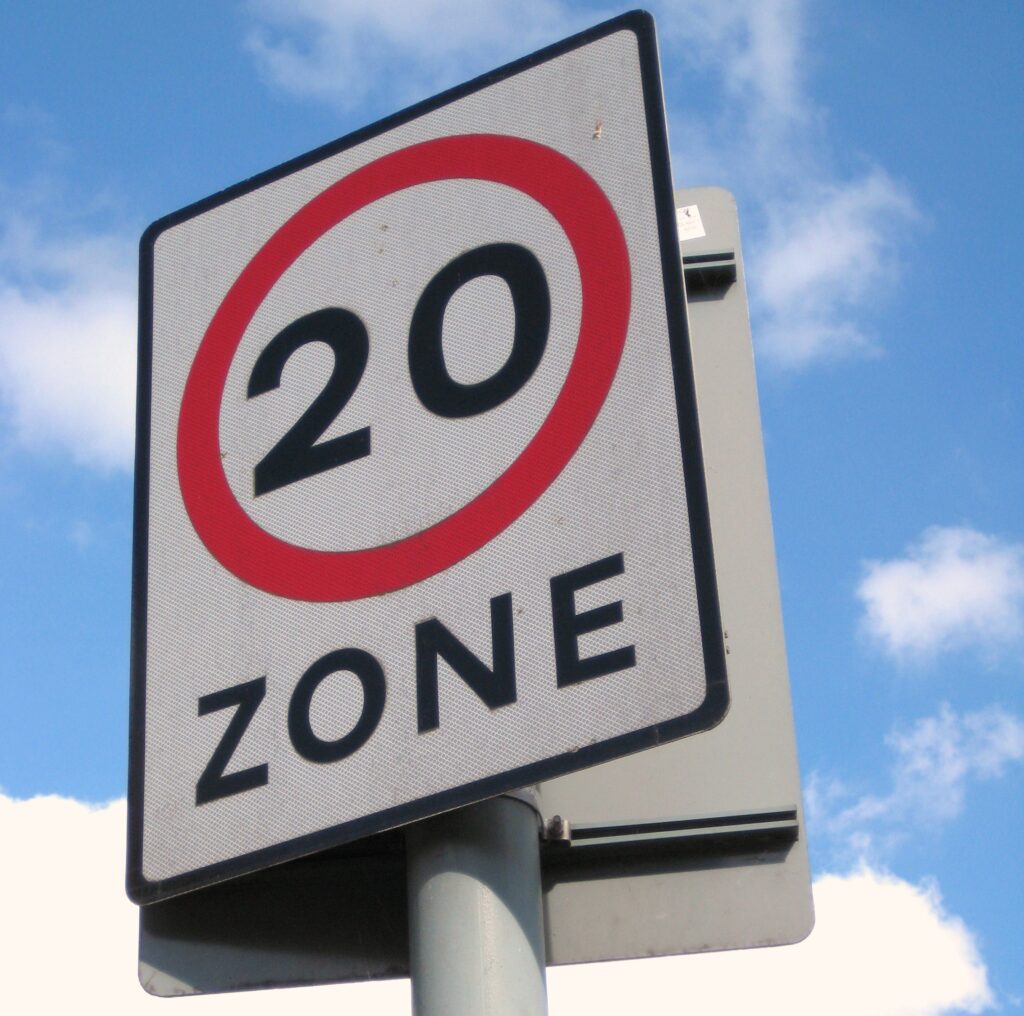

Not for profit organisation 20’s Plenty For Us has accused road safety charity IAM RoadSmart of attempting to ‘undermine’ 20mph speed limits. The campaign group has taken issue with IAM RoadSmart’s recent claim that “widespread confusion over 20mph may be undermining a more general trend to slow down.”
Responding to recent government speed compliance statistics which indicated that 81 per cent of car drivers exceeded the speed limit on 20mph roads, IAM RoadSmart’s director of policy and research, Neil Greig, said that there was a problem, “getting drivers to comply on the ever increasing number of roads in our towns and cities with a 20mph limit.”
IAM RoadSmart is against “blanket 20mph limits” and wholesale changes in the urban limit from 30mph to 20mph.
A policy document states its position as being that distributor roads should always remain as 30mph or above and that the key requirement of any 20mph zone must be that it is “self-enforcing” through signposting that makes sense or traffic calming features.
That document adds: “Research suggests that drivers use the clues from the environment around them to judge the correct speed. Where limits do not match the environment uncertainty and confusion are generated which can raise stress levels and provide an unwelcome distraction from safe driving and lead to a wider disrespect for limits.”
Rod King MBE, the founder and campaign director for 20’s Plenty for Us, took issue with IAM RoadSmart’s position.
“IAM RoadSmart would be more credible if they called on all speed limits to be obeyed rather than trying to undermine 20mph speed limits where people live, work, shop, play and learn. The call for default 20mph limits with exceptions is echoed by many health and road safety organisations, including WHO saying that 30kmh (20mph) is the right speed limit where vehicles conflict with pedestrians and cyclists.”
King also took aim at the government report, arguing that the 20mph roads included were not representative.
“The nine 20mph roads detailed in this report have very little in common with most residential and high street roads where communities set 20mph speed limits to make them safer and more comfortable.
“Even then, this report shows that compliance on these nine roads is improving. IAM RoadSmart keep complaining about “blanket 20mph limits” yet most authorities are using discretion to exclude such roads as this report references or add the appropriate engineering or enforcement to gain compliance.”







37 thoughts on “Campaigners say IAM RoadSmart is trying to ‘undermine’ 20mph speed limits”
I think that Mr King may have
I think that Mr King may have hit the nail on the head, there; IAM Roadsafe rather sounds like apologists for the status quo (but I’m sure some of their best friends are cyclists, or something…)
So according to this bunch of
So according to this bunch of apologists for killers, it’s the business of drivers to judge the “correct speed”, rather than actually to obey the law.I wonder if they’d be equally happy to allow burglars to decide what is the correct number of houses to burgle?
oldstrath wrote:
Unfortunately it is often down to the motorist to judge the correct speed. No reminders are required for 20mph zones. The signs on the entry to a 20mph zone are often in the junction where the motorist has a lot of other information to take in. Even in zones where reminder signs are required (e.g. 40, 50 mph zones), they are often obscured, faded or missing (maybe were never there to start with). Simple solution would be to make 20 the default. Obviously, the best 20 zones have the speed limit painted on the road at regular intervals.
[rant]My personal opinion is that most roads should have a 20 limit. The average speed of a motor vehicle in a town generally less than that, it would mostly just reduce the amount of time motorists spend waiting at trafic lights and junctions. Building cycle lanes and shared use paths everywhere is not feasible, and we have a hard enough time getting them built where it is feasible. Yes we should have 8-80 cycle infrastructure, but the truth is we do – it is called the road, and it is where all cyclists are generally required to cycle, by law.
I don’t think that putting in obstacles is the correct answer, as things such as speed bumps generally have much more effect on cyclists than they have on motor vehicles. Motorists will often speed up to thirty, then slow to ten for the bump and then speed up to thirty again. Motorists should learn to use second gear – obviously tricky if you are in an automatic that has no manual override, but these are quite rare these days.
At present, I find that when I cycle on the road, the speed limit is me (that is when I’m not the only thing moving, as often seems to be the case). The roads where I live generally not wide enough for a car to pass a cyclist without using the oncoming lane, unless they are cycling in the gutter – and the traffic levels often preclude overtaking using the oncoming lane. If we ever get to the levels of cycling that we as a nation require, then 30 mph will become largely unchievable in most towns and cities*, except for cyclists and motorcyclists (who can share lanes more easily), and at very quite times of the night/early morning. So why not just bite the bullet and introduce 20 limits now?
* heck, 30 mph is rarely achievable at the moment, at least, not for very long[/rant]
I’m surprised to find I think
I’m surprised to find I think the IAM have a partial point, at least with that ‘self-enforcing’ bit.
Road design that intrinsicly makes high-speeds difficult or hard to attain is surely preferable to just relying on signs? Things like getting rid of stupid motorway-slip-road-style junctions in favour of more right-angled turns might help. I’m sure there are other things that can be done that don’t rely on concious obedience to signs.
At the same time, a bit of enforcement _might_ manage to establish a social norm of lower speeds in cities, which seems to be 20isplenty’s position. Not really sure myself.
Memo for IAM Roadsmart. I
Memo for IAM Roadsmart. I don’t know what research you’re looking at but maybe a quick peep at the KSI stats might help. Drivers do not use clues from the environment to judge the correct speed. They use clues from the environment to judge what speed they think they can get away with. The number of fatalities and serious injuries resulting from excessive speed would seem to hint that maybe their judgement isn’t 100% sound.
It been proven time and time
It been proven time and time again people drive to the road condition not the posted speed.The only way to slow people down is to slow the road
I’m a bit torn on this. On
I’m a bit torn on this. On the one hand the residential area I live in has a 20 limit. I agree. But the main road between Hammersmith and shepherds Bush in London had just sprouted 20 signs. It is a main road. Also 20 puts cars and cyclists in more conflict sometimes. When the 20 limit was introduced in Richmond park it made the cars hold up the cyclists which had led to lots of dodgy cyclist overtaking.
20 never feels right in a car too. It seems somewhere between 1st and 2nd gear.
Speed limits won’t work. Most
Speed limits won’t work. Most accidents involve nobs that aren’t obeying road rules anyway. They may be stupid, drunk, drugged or entitled 3rd world dicks in a super car bought by daddy.
Start by limiting cars for drivers under 35 to a power-to-weight ratio of say 60kw/tonne.
Reduce vehicle max width. Narrow cars mean more side space on narrow roads.
Ban all safety equipment from cars – no airbags, seatbelts crumple zones etc. Replace with a 12 inch spike sticking out of the centre of the steering wheel.
Cozz wrote:
I think you could be on to something here with steering wheel spike. It would be far more efficient at preventing falling asleep at the wheel. I would imagine mildly punctured councillors might also look to repair potholes a lot sooner. However, you just know you’ll find spike-mounted phone holders on Amazon within days.
I agree with the IAM I often
I agree with the IAM I often drive at less than 30 through estates etc where appropriate but do also sometimes exceed limits on wide clear roads, there are few 20 limits near me though. Constantly looking for signs must take your attention from the road.
ChasP wrote:
Aren’t you meant to be constantly looking for hazards though ? Kids running out ? Pedestrians on the pavement ? Maybe driving isn’t for you after all ?
ChasP wrote:
Most twenty limits are twenty zones, and are only required to have signs on the entry point. The newer ones often have the speed limit painted on the road, which is surely cheaper and more effective than putting signs up.
Lots of 20s in Bristol even
Lots of 20s in Bristol even on the main commuting routes where children don’t play in the middle of the road, the original reason for their introduction and widely ignored.
. The safest speed is that at which 85% of motorists would use if there were no speed limits. Go up or down from that and you increase the accident rate, so no doubt some of the 20 limits will increase accident rates.
. But Hey, never mind the facts just use emotions.
In Avon and Somerset the accident rates dropped by 25% when the speed cameras were switched off, and what did our local councillors vote for? Yes you have guessed correctly, switch them back on and of course introduce advertising signs on roundabouts, the most dangerous places for cyclists.
. When you look at the siting of some of the speed cameras it is obvious they are there to get funds, e.g, On a dual carriageway with massive central barrier, with separate pedestrian paths and no crossings or traffic lights near, and no accident record at that location. They only catch the non locals, the locals slow down pass the camera and speed up again.
. I much prefer a car overtaking me and giving me plenty of room even if it means exceeding the speed limits, it’s the ones that creep by with inches to spare that worry me.
. If they really wanted to reduce the accident rates at those spots they need to make sure the drivers know there is a camera, so they can slow down. At one time they were painted yellow and black but I guess the cash declined so now they are just yellow and don’t particularly stand out. It’s no good fining someone after an accident where personal injury is involved, they need to stop the injuries in the first place, but that would need some money spent on road engineering effort to solve the problems.
End of Rant
The safest speed is that at
I’m not sure how you’d acquire evidence for such a claim, but is there any? You also seem to ignore the point that if cars were all restricted to 10 mph, although the impatients might make more incidents, the consequences of these would be much less severe.
oldstrath wrote:
I’m not sure how you’d acquire evidence for such a claim, but is there any? You also seem to ignore the point that if cars were all restricted to 10 mph, although the impatients might make more incidents, the consequences of these would be much less severe.— OldMixte
https://en.wikipedia.org/wiki/Speed_limit
OldMixte wrote:
Did you forget to include the rest of your post where you actually addressed the point?
OldMixte wrote:
I’m not sure how you’d acquire evidence for such a claim, but is there any? You also seem to ignore the point that if cars were all restricted to 10 mph, although the impatients might make more incidents, the consequences of these would be much less severe.
— oldstrath https://en.wikipedia.org/wiki/Speed_limit— OldMixte
A site which offers no evidence I could see. The 85% rule appears to be based on the bizarre assumption that most motorists are “reasonable”, completely ignoring the impact on non motorists.
OldMixte wrote:
The problem with this theory (which, though people keep citing it, is not really evidence-based, as far as I can tell it’s just a rule-of-thumb invented from nothing at all a long time ago by US road-planners) is that it leaves the judgement about speed entirely to motorists.
85% of motorists will choose a speed based on an instinctive balance between convenience and their own safety. The safety of those outside the vehicle does not get given the same weight in this judgement. That is a bit of a problem.
Furthermore, in relation to urban roads (rather than motorways) you can’t just look at the accident rate, you have to look at the effect on suppressing other travel modes and on the quality of life of the locals.
OldMixte wrote:
A couple of weeks ago, at about 9pm, I was driving around a blind bend on a road off a sort of roundabout (more kind of oval shaped) where the speed limit changes changes from 40 to 30. It is a main road, the sort of road where “children don’t play in the middle of the road”. There was 2x two yearold girls, in the middle of the of the road, completely unsupervised. It is a bend where I often see people travelling at speeds which completely impair their ability to stop for anything unexpected. I’m pretty confident that more than 15% motorists would have painted the road with those two girls.
It’s not about children
It’s not about children playing in the road, it’s about where childeren or anyone else might be. who don’t want to be next to where drivers get to decide what could be a “relevant” speed.
It’s about turning our roads back into streets, pleasent places to be, not just drive through. I’m into a great deal more filtered pemability, stopping rat runs and their impatient motorists.
I was listening to Jeremy Vine the other day, and wanted to be more shocked by the number of drivers who lack so much skill and ability, that they cannot control their vehicles in a legally acceptable and defined manner.
And most of all it’s about saving and not destroying lives.
ktache wrote:
I can’t believe how many people are quite happy to anounce that they are unable to drive at 20mph without keeping a constant watch on the speedo (so they won’t see the kiddiewinks run out and when they kill one, it won’t be their fault it will be the fault of the evil council, so there) and having previously expressed no interest in green issues suddenly become an eco-warrior moaning about the extra emissions & pollution caused by having to do 20 & not a smooth steady 55mph half a mile down the road to the local shop.
tarquin_foxglove wrote:
I’ve seen the same rubbish trotted out repeatedly for 30 and 40 mph limits.
However, they manage just fine to keep a lid on their speed if they think a Gatso or mobile speed camera is nearby. Arseholes.
Simon E wrote:
I’ve seen the same rubbish trotted out repeatedly for 30 and 40 mph limits.
However, they manage just fine to keep a lid on their speed if they think a Gatso or mobile speed camera is nearby. Arseholes.— tarquin_foxglove
My car in 4th, does 25 mph without touching the accelerator, the slightest touch can send me over the 30. If you were to check the speeds in 20mph areas, judging by my observations less than 1% obey the limits including the police. The defence against hitting a pedestrian was that I was checking my speed. It takes around 2 seconds to do that and a lot can happen in those 2 seconds, like a child running out into the road.
By the way I am not against sensible speed limits.
OldMixte wrote:
Why is it everyone else’s problem that you have a crap car?
OldMixte wrote:
Hand in your licence. Why would it take 2 seconds to check your speed ? You’re not fit to be on the roads.
OldMixte wrote:
Yes, that is why learner drivers are taught to use third gear in 30 mph zones. This has been the advice for a long time, 4th gear for cruising in a 30 zone hasn’t been recommended for many years. In a 20 zone you should be in 2nd gear. As the name suggest, there are gears other than 4th gear, even most automatic cars come with a manual selector nowadays.
Surely it doesn’t take you 2 seconds to glance at the speedometer? Is it in roman numerals or something or do you just need better glasses?
Maintaining a speed of 20mph, like tying your shoe laces, and wiping your own bottom, gets a lot easier practice. If you have difficulty with it, you should practice it more often or return your driving license.
OldMixte wrote:
I’ve seen the same rubbish trotted out repeatedly for 30 and 40 mph limits.
However, they manage just fine to keep a lid on their speed if they think a Gatso or mobile speed camera is nearby. Arseholes.
— Simon E My car in 4th, does 25 mph without touching the accelerator, the slightest touch can send me over the 30. If you were to check the speeds in 20mph areas, judging by my observations less than 1% obey the limits including the police. The defence against hitting a pedestrian was that I was checking my speed. It takes around 2 seconds to do that and a lot can happen in those 2 seconds, like a child running out into the road. By the way I am not against sensible speed limits.— tarquin_foxglove
Use 3rd then.
Bigfoz wrote:
This.
OldMixte wrote:
I’ve seen the same rubbish trotted out repeatedly for 30 and 40 mph limits.
However, they manage just fine to keep a lid on their speed if they think a Gatso or mobile speed camera is nearby. Arseholes.
— Simon E My car in 4th, does 25 mph without touching the accelerator, the slightest touch can send me over the 30. If you were to check the speeds in 20mph areas, judging by my observations less than 1% obey the limits including the police. The defence against hitting a pedestrian was that I was checking my speed. It takes around 2 seconds to do that and a lot can happen in those 2 seconds, like a child running out into the road. By the way I am not against sensible speed limits.— tarquin_foxglove
That is a *very* long 4th gear. My mini will happily chunter along at 20mph in 5th, although, to be fair, it’s only just above idle; it’s comfortable in 4th at 20 and will accelerate reasonably well if asked to. However, it also appears to have a facility that maybe your car is lacking: a “gearstick” and “clutch” that allow me to the change the gears in the transmission to suit the speed at which I’m driving. Perhaps your car predates that invention?
It absolutely should not take 2 seconds to check your speedometer. If it does, may I suggest that you simply drive slightly more cautiously – if you’re well within the speed limit, you won’t need to check that often. Also, at 20mph, you won’t travel as far in the time it does take you to check, plus you’re *much* less likely to kill or main anyone that you do mow down while peering in wonderment at your dashboard.
OldMixte wrote:
A serious suggestion: voluntarily return your driving license and sell your car. Based on your comments I suspect you are not fit to drive a motorised vehicle.
Simon E wrote:
Honestly, this is a suggestion that should be taken more seriously. The debate always seems to be framed in terms of convenience or safety of motorists – or occasionally in terms of how to keep other road users separated from the dangers presented by motorists. There is rarely a suggestion (outside of cycling fora) that motorists should have to adhere to higher standards of competence in order to limit their shocking toll of death and serious injury. Wouldn’t it be wonderful if the IAM started suggesting that motorists should be properly trained in how and why to observe 20mph speed limits and have their license to drive revoked if they are not able to display that competence?
Just how “advanced” can a motorist claim to be if they are unable to:
– operate a gearbox?
– observe signs?
– operate within a clearly marked speed limit?
If aircraft pilots or train drivers were killing at least 1800 people every year, without fail, and maiming over 20000 more, would we be handing out points and fines and letting them continue to take the controls, whinging about how the signs might be inconsistent, or would we be sacking them and finding people better at the job?
ktache wrote:
Totally agree, but the way that it is currently implemented is dumb. I have to say that I routinely don’t stick to the 20 limit, the ones I drive on are exactly the same street as before (major through route with high vehicle counts) just with a 20 badge on not a 30. I would welcome measures to change the street to slow me down and reduce traffic volumes. In addition the police are specifically briefed not to enforce 20 (why?)….
Thinking further on this I’m in an interesting situation at the moment where I need to drive to get to the hospital regularly and I simply couldn’t do it by bike (too far) and it would be very inefficient to my employer (think loosing 3/4 of a day rather than 2 hours) for me to go by PT. However for most things I can’t walk very far but I can ride a bike so the bike has actually turned into disability aid for the 0-2 mile trips. I’m covering two of the classic anti bikes arguments at once, namely “because I NEED to drive” and that “bikes don’t help the disabled”.
Couldn’t you use a lower gear
Couldn’t you use a lower gear?
Most 20 mph zones that I know
Most 20 mph zones that I know have some traffic calming measures such as speed bumps, so there is no excuse for not knowing the limit.
What the IAM tend to forget
What the IAM tend to forget is that the rules are made to inform the average motorist who has probably taken no further interest in being trained to be a better driver since they passed their driving test.
Personally I have no difficulty in driving at 20mph even when there is a higher speed limit, but then again I have passed IAM qualifications as a motorcyclist and through work. 20mph limits, where appropriate, are an important step towards reclaiming the urban environment from the motor car, making it a; safer, quiter, cleaner and more pleasant place to be for everyone.
We have 20 limits near us, on
We have 20 limits near us, on a 30 limit road. They operate at school arrival and kick out times, and are accompanied by some flashing lights / warning signs – i.e. 20 when lights are flashing. I’m very in favour of them.
Does any road need to be a blanket 20? Not sure. I guess in overcrowded urban areas, yes, but in small rural towns where the road can go 10 minutes at a time without any cars (like where we are), would the 30/20 when required system actually be better? Would more motorists toe the line simply because they understand the rationale better?
The IAM have a sort of point
The IAM have a sort of point in saying that motorists judge an appropriate speed from the environment. I think what actually happens is we take our speed cues from the other motorists on the road at that time.
The article doesn’t (or maybe the IAM didn’t) explain just what this “confusion” over 20mph speed limits is. If it’s that people don’t know whether a particular road has a 20 or 30 mph limit (or maybe even 40) then, aside from the obvious factors of a) paying attention to road signs, and b) erring on the side of caution, it’s not a big deal. If you choose 20 and the limit is 30, wowee, you’ve taken 30 seconds longer. If you choose 30 and the limit’s 20, well the figure of 80% drivers ignoring 20 limits is probably correct, so again, normal for drivers. Next time, pay more attention.
Oh, and if we were all really that good at judging appropriate speeds by environmental clues, we wouldn’t need speed limits at all. This was the case in UK from 1930 to 34. Didn’t last long cos crashes shot up. Also the case in Third Reich Germany, same result but (surprise!) they didn’t alter the law.