


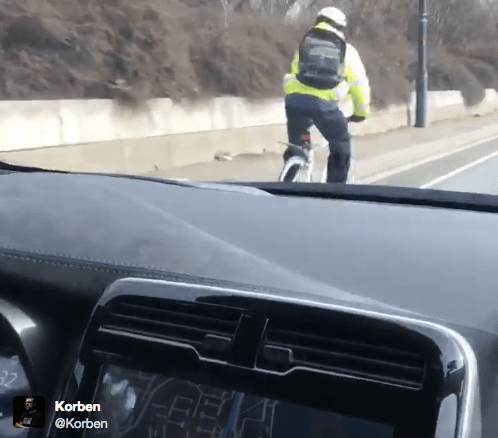

A journalist from France has caught on camera the moment a Nissan driverless car passes a cyclist without leaving enough space.
Petite vidéo de la conduite autonome. #electrytheworld J’en ai mis une autre sur Instagram. C’était topissime. pic.twitter.com/1xJI0g40jd
— Korben (@Korben) March 4, 2017
The video, shot in London as Nissan showcased its driverless progress, shows how the car’s console registers the cyclist, but then fails to move over to give him space.
Tetsuya Iijima, global head of autonomous drive development at Nissan, is behind the wheel, but fails to over-ride the car and move out either, the video, spotted by BikeBiz, shows.
One of the French journalists in the car can be heard saying: ”I was a little scared for him” in French.
Last year we reported how Adrian Lord, of the transport consultancy Phil Jones Associates, fears that once technology that prevents pedestrians and cyclists from being hit by vehicles makes it to our roads, it opens the door for vulnerable road users to take advantage of the impossibility of being injured.
He said: “Once people realise that an autonomous vehicle will stop [automatically], will pedestrians and cyclists deliberately take advantage and step out or cycle in front of them?
“If that’s the case, how long would such a vehicle take to drive down Oxford Street or any other busy urban high street?”
Meanwhile professor of transport engineering at the University of the West of England, John Parkin, told the Financial Times (link is external) that much of the infrastructure that’s being implemented to keep bikes and cars apart in inner-city environments, will be made redundant by autonomous technology reaching maturity.
“When fewer cars are driven by humans, in cities at least,” the professor said. “There would be less need to segregate cyclists from traffic. This would allow roads to be designed as more open, shared spaces.”







47 thoughts on “Video: Nissan driverless car in cyclist close pass”
People are obsessed by the
People are obsessed by the idea that cyclists and pedestrians will ‘take advantage of driverless cars’. it sounds like there judging cyclists and pedestrians the same the same way motorist currently act towards vulnerable road users ‘it’s ok their get out of my way or their be dead’. The difference is that people in driverless cars aren’t going to have there lives put in danger by the actions of a cyclists or a pedestrian on a daily basis, there just going to have a slower journey, oh the humanity.
Aren’t they going to predestriase oxford street anyway. So yeah it going to take a very long time to driver down there.
the thought of these
the thought of these simpering geeks faffing about with this nonsense anywhere on public roads beggars belief
Quote:
Sounds like a plan for far more civilised cities to me.
My mate was victim of a close
My mate was victim of a close pass by a Tesla the other day. When confronting him, the driver’s response was ‘sorry mate, it was on autopilot’.
Le singe est dans l’arbre.
Le singe est dans l’arbre.
Leviathan wrote:
le singe est au volant
The difference is that the
The difference is that the autonomous driving algorithm has the potential to gather data and effectively learn from every single scenario. More importantly it has the capacity to share those learnings with all vehicles using the same algorithm.
Having experienced no fewer than 3 dangerous passes on the club ride this morning, I’d far sooner take my chances with software being in control.
Mungecrundle wrote:
By the sounds of it they’re learning to be more like real human drivers! Next thing they’ll be bleating on about road tax in electronic voices.
Seriously though, do these algorithms contain strict red lines on adhering to safe distance minimums, or is there some allowance for taking reasonable (clearly not in this case) risks if it decides it’s safe to do so? Hope it’s not the latter…
Mungecrundle wrote:
How many crashes has Airbus had due to automation? And that’s without the complexities of being on a road in heavy traffic.
As a software engineer, I don’t see self-driving cars being a thing anytime soon. At least not safe ones, or ones that don’t require a lot of human intervention. Worse, this is just going to lead to drivers that will be incapable on the occasion where the self-driving doesn’t work.
velo-nh wrote:
How many crashes has Airbus had due to automation? And that’s without the complexities of being on a road in heavy traffic.
As a software engineer, I don’t see self-driving cars being a thing anytime soon. At least not safe ones, or ones that don’t require a lot of human intervention. Worse, this is just going to lead to drivers that will be incapable on the occasion where the self-driving doesn’t work. — Mungecrundle
Please tell us, Velo, just how many crashes have Airbus had due to automation? And for the same period how many more crashes due to human error?
I’ve just gone through this list of A320 incidents and found only one incident where the autopilot was mentioned, and several where the cause was attributed to human actions:
https://en.wikipedia.org/wiki/Accidents_and_incidents_involving_the_Airbus_A320_family
Automation
vs. Human
Maybe this last one is unfair… or maybe not. Outside of science fiction (at least as yet), computers aren’t prone to emotional instability and even then I’m willing to take my chances with Marvin the paranoid android from H2G2 instead of some of the psychos out there behind a wheel currently – HAL9000 on the other hand …
CygnusX1 wrote:
Don’t come at me with facts, this is the internet! 3.0 (post fact version)
barbarus wrote:
I thought the argument that’s been made is that excessive automation ‘de-skills’ the pilots so when they _do_ need to take over, they can’t cope and screw things up? So it’s not that the autopilot makes the error, it’s that it leaves human pilots more prone to do so than they used to be.
It seems to be one of those plausible-but-debatable thesis that some expert argues for, and which journalists who aren’t-as-clever-as-they-think-they-are, then keep excitedly telling us all about as if we hadn’t heard it already.
Might be true, might not, dunno, but seems relevant to self-driving-cars, given that the people using them will probably be drunk or asleep or watching movies when they are suddenly called on to intervene.
Point being I don’t think one can put much trust in self-driving cars that require the human being able to ‘take over’ when things get tricky. They are going to have to be able to cope on their own.
FluffyKittenofTindalos wrote:
Absolutely. Who wants a driverless car that you still have to be ready to drive at a moment’s notice? I want it to drive me home from the pub and then go and pick someone else up, like a taxi without the bad tempered driver.
The big advantage that cars have over aeroplanes though is that when they stop, they just sit there rather than plummeting out of the sky. So car autopilots can just slow and stop (hopefully safely*) if they can’t work out what to do, no driver intervention required. In a plane, the pilot HAS to take over or everyone dies.
* There are some situations where there’s going to be a crash no matter whether the driver’s human or cyborg.
CygnusX1 wrote:
Air France 296, June 1988. Controversial, but the plane delayed the pilot’s command to throttle up before hitting the trees.
Air France 447, May 2009. Mixed blame with the pilots not knowing how to react to the automated systems disengaging.
Air Asia 8501 (Qz8501), Dec 2014. Blamed on over-reliance on automation leading to an inability to control the aircraft without it.
Indian Airlines 605, Feb 1990. Controversial, some parties claim the crash was caused by throttle behavior that downed Air France 296.
I could go on, but I think you get the idea. Yes, the automation didn’t intentionally down the plane, but the automation mixed with human pilot interaction has led to disasters. “Self driving” cars will still have humans and I presume the cars will still have manual control for some time, probably past our lifetimes. The video in this article shows the degredation of skills, the idiot “driver” didn’t take control when the vehicle came too close to the cyclist. That type of over-dependence is what made me think of the airlines.
velo-nh wrote:
That’s why most manufacturers are now looking at going straight to SAE Level 4 – full autonomy, with no driver intervention.
Good article on what the levels are and current state of development (and its where I’ve lifted the quote above from):
http://www.techrepublic.com/article/autonomous-driving-levels-0-to-5-understanding-the-differences/
velo-nh wrote:
Please stop highlighting plane crashes.
J90 wrote:
Nervous flyer?
velo-nh wrote:
How many crashes has Airbus had due to automation? And that’s without the complexities of being on a road in heavy traffic.
As a software engineer, I don’t see self-driving cars being a thing anytime soon. At least not safe ones, or ones that don’t require a lot of human intervention. Worse, this is just going to lead to drivers that will be incapable on the occasion where the self-driving doesn’t work. — Mungecrundle
Sounds great – are all cars on the road going to be separated by 90 second gaps? with assistant drivers? and traffic controllers in constant contact with drivers?
If the cyclist in question had swerved and been hit, who would be held responsible and taken to court? the driver or the computer programming team?
And if engineers are screening the results – I hope the team includes a few pedestrians, cyclists, mothers with young children, disabled pensioners. I rather suspect most highly paid engineers and computer programmers may not have the best interests of other road users in mind.
I hate geeks and their
I hate geeks and their robotic fantasies.
Ramuz wrote:
And yet your entire world is stuffed full of robotic devices and computer controlled systems that you probably take for granted or are just unaware of.
Nobody seems to have a problem in buying a car that has essentially been built by robots but autonomous operation of those same machines seem to strike at the heart of the male ego in particular.
Ramuz wrote:
He says on the internet….
Ramuz wrote:
I probably _am_ a geek, but I still half-agree.
Techno-evangelists get on my nerves a bit. Socio-political problems require socio-political solutions. Technology changes problems but doesn’t necessarily solve them.
Ramuz wrote:
You’d better go and live in cave, since all the technology you use and rely on every day is design and developed by ‘geeks’.
I agree with Mungecrundle,
I agree with Mungecrundle, this is obviously far from ideal but once the engineers are.aware.of the issue and fix it all autonomous Nissan will pass safely.
Given that this trial has only just started it’s not surprising that there are a few teething difficulties.
Nissan hope to have this perfected by 2020 so hopefully the days of close passes are very much numbered.
“I agree with Mungecrundle,
“I agree with Mungecrundle, this is obviously far from ideal but once the engineers are.aware.of the issue and fix it all autonomous Nissan will pass safely.”
That presupposes Nissan engineers recognise it. The engineer at the wheel could have taken over and steered the car around, but chose not to. So I don’t see him seeing anything wrong with the car’s behaviour that needed correction…
Bigfoz wrote:
The engineer in the car might have missed it but there will be a whole army of them poring over the data from every journey.
The fact that most newspapers have sent reporters for a ride around London in the new Leafs suggest a huge PR exercise is also underway. Negative coverage will be monitored very closely.
I very much doubt this will remain an issue for long.
Rich_cb wrote:
On one tv news item there was another example where the car aproached what I think was a narrow pavement/street sweeper vehicle (travelling, not sweeping) and the driver had to intervene and made some comment. A little worrying he didn’t intervene in the cycling case, but yeah, I’d expect a whole lot of engineers will be looking at driving data.
But the truth is that robots
But the truth is that robots will soon be impregnating your wife. Sex and procuration will be done artificially.
Ramuz wrote:
And not before time, if I may say so. When I reached the age where my sex drive throttled back it was like being unchained from a maniac.*
*I stole that but it is so accurate.
Not if I hide the batteries.
Not if I hide the batteries.
Bit too much chuckling going
Bit too much chuckling going on for my liking 🙁
Podc wrote:
Agreed… obviously non-cyclists.
However, this is a blip soon to be a non-story. In 10 years these cars will be the norm and I’m happy to predict, close and punishment passes will be long forgotten. (Except for those that have not gone full auto yet)
Podc wrote:
Yeah….Fuckin hilarious when that happens
Don’t know what the hubbub is
Don’t know what the hubbub is about, Nissan got this one spot on, no? The computer is adapted perfectly to the UK style of driving, all working as intended.
Looks like the Nissan
Looks like the Nissan software engineers have faithfully replicated the programming found in many human drivers’ heads:
[font=Courier New]if (cyclist.inBikeLane == true) {
passingDistanceMeters = 0;
} else {
passingDistanceMeters = 1;
}[/font]
handlebarcam wrote:
[font=Courier New]if (cyclist.inBikeLane == true) {
passingDistanceMeters = 0;
} else {
passingDistanceMeters = 1;
}[/font]— handlebarcamIf only drivers did think in C!
arowland wrote:
I think that’s Javascript. In which case, we’re all dead.
Matt_S wrote:
[Engage geek mode]
Its definitely not C — there’s an object.attribute reference in the test condition, could possibly a C++ code fragment but Java or JavaScript more likely
[Engage cynic mode]
Treating humans on bikes as an object is about right, but there’s a bug – the program should read as follows if replicating human driver logic:
} else {
passingDistanceMeters = 0.5;
[Disengage cynic mode]
(Can’t disengage geek mode unfortunaley!)
“… how long would such a
Private motor vehicles should not be allowed on “Oxford Street or any other busy urban high street”. Problem solved.
Considering that this took place in London will the Met accept this as video evidence of (at the very least) careless driving by Tetsuya Iijima?
No offense Professor John
No offense Professor John Parkin, but this: “There would be less need to segregate cyclists from traffic. This would allow roads to be designed as more open, shared spaces.”
Is complete bo11ocks! Roads ARE open shared spaces, which are dominated by bullying self entitled people driving cars. When the robots are driving we aren’t suddenly going to be able to have picnics on them and I seriously doubt people will be any keener to cycle/walk in close proximity robots at high speed than they are being close to traffic at the moment.
Robots in factories have protective guards around them and they still go wrong (e.g. the robot that killed a worker in a VW factory recently), why would we risk asses them differently when they are loose on the highway.
Stick to the numbers John, or become a humanity professor where ideas and unsubstantiated opinions are welcome…
If I understood the displays
If I understood the displays correctly, the car was only doing 32-37 km/h, so perhaps the pass wasn’t as frightening as all that. But is should still leave min 1.5m in case of the cyclist needing to swerve.
There’s another video I’ve
There’s another video I’ve seen where the car doesn’t recognise a street sweeper in the lane ahead and the driver has to take control to prevent a crash.
There’s also this gem with a
There’s also this gem with a Tesla supposedly on autopilot that nails a construction barrier.
https://www.youtube.com/watch?v=fQxIhMBKblY
Just as with this article’s video, what the hell was the “driver” doing?
I assume driverless cars will
I assume driverless cars will stop to avoid collision with a person, or anything bigger than the car/or truck being driven – e.g. elephant, cow, donkey but what about smaller things? goat, large dog, medium size dog, small dog, cat, bird, mouse, frog – where is the cutoff point? How about a young toddler, say 18 months – about as big as a mid-sized dog – or if she trips over maybe a small dog or large cat. How about kangaroos – a driver has a chance to see them coming from the side before they cross – maybe there will be predictive course analysis built in – I wouldn’t bet on it since they have trouble doing this even for planes and ships.
Another point – who gets to face court if the automated car does something wrong – The computer programmer? the car manufacturer? or the driver who has to stay alert all the time with his hands on the controls and might as well be driving anyway.
Pasley69 wrote:
who faces court if your tumble dryer bursts into flames and burns down a block of flats?
Driverless cars won’t have steering wheels etc., that’s the point of them. Everyone in the car will be a passenger.
as for things coming from the side, maybe the designers have thought of that, and will put sensors there. Jeez. The driver has two eyes at best, two ears and one brain which are collectively dealing with a whole lot more than just driving. Driverless cars don’t need these limitations, and only have to think about driving, not hitting stuff, and getting out of the way of kangaroos. The reason planes and ships have problems with this is the dearth of Australian megafauna at sea and in the sky; Oxford Street is obviously different, there are unpredictable Antipodeans bouncing about all over the bloody place.
They will also be recording everything all the time for use in evidence. A law will be made to make it illegal deliberately to obstruct the highway, if such a law doesn’t already exist, and the car will have you bang to rights.
An opportunity for a test
An opportunity for a test case here perhaps – if the cyclist decides to report the close pass, who will be prosecuted – Nissan, or the person in the driving seat who did not take control?
RMurphy195 wrote:
Surely that’s a trick question… the answer to the question “who will be prosecuted?” is almost bound to be “no-one”!