


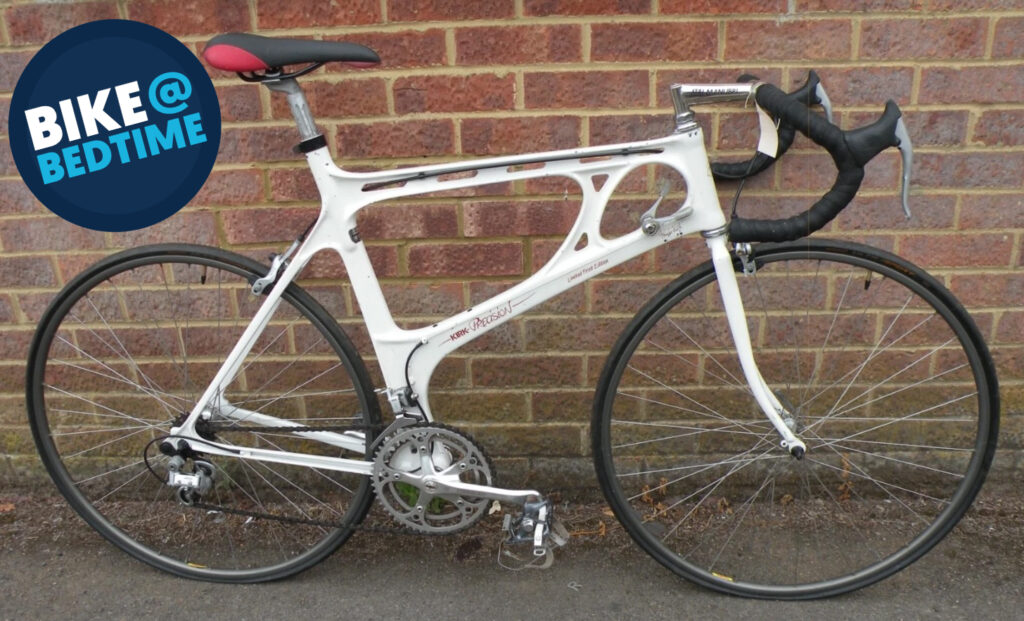

“Only one and a half cubic metres of seawater is needed to provide enough magnesium for one Kirk frame.” That was the claim made by Britain’s Kirk brand back in the 1980s and 90s.
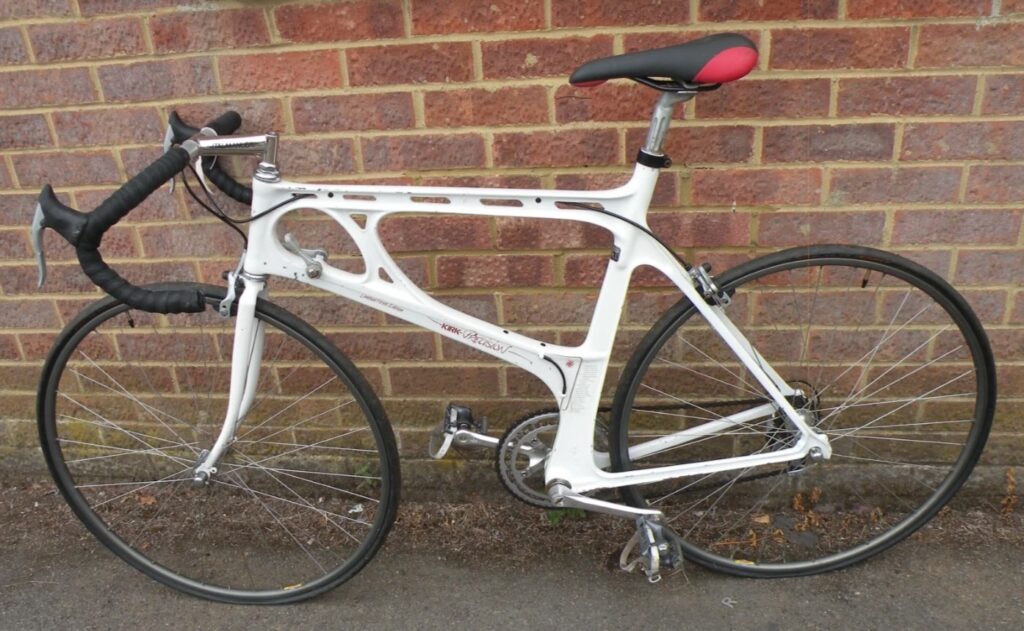
Kirk Precision bikes are some of the most distinctive ever, thanks to their die-cast magnesium alloy frames, and we just spotted this one for sale on eBay, so let’s look back at this unique British design.
Kirk Precision was the creation of Frank Kirk, an engineer with great experience in the automobile and aerospace industries.
An early Kirk catalogue said. “Frank Kirk saw the possibilities of using recent advances in magnesium casting technology to overcome the problems encountered by the bicycle manufacturing industry in trying to economically mass-produce a precision-built, lightweight frame.
“Designed with the aid of a very sophisticated computer, the Kirk Precision gives the rider a highly responsive, comfortable ride – and Kirk’s unique bicycle manufacturing process gives the frame great strength and torsional stiffness as well as a consistent accuracy of alignment to a tolerance unachievable in a conventional high volume production cycle frame – giving inspiration to the name.”
At a time when most bikes were made from steel or aluminium, why choose magnesium?
“Magnesium is the lightest structural material known to man, and the astonishing fact is that we are literally surrounded by the substance – 2% of the Earth’s crust is magnesium – with incredibly vast quantities in our seas,” said Kirk.
“Just one cubic metre of seawater contains 1.3kg of magnesium – and although the present global usage of magnesium is approximately a quarter of a million tonnes per year, our resources are so vast that even if we used four times that amount for a million years, we would only use up 0.01% of all the magnesium in our oceans. It is also easily recycled, making it virtually inexhaustible. Magnesium is used for manufacture of components where weight and strength characteristics are of paramount importance – especially in the aerospace and automobile industries.”
Kirk certainly talked the talk back then, and was very keen to highlight that its frames were “designed with the aid of a very sophisticated computer which produced mathematical models to analyse the criteria of production, stress, ride performance and styling to match the most sophisticated conventionally built frame”.
It said, “The consistent accuracy of the frame creates perfect alignment of the wheels, producing a bicycle with true running and cornering characteristics and allows unique features to be incorporated into the design – such as drop-out back wheels. Due to the low specific weight and other properties of magnesium, it has been possible to design a frame comparable with a lightweight racer but with very much higher durability, strength and torsional stiffness. Longevity has been proven on test rigs simulating full power loadings of 250Ibs at the pedals for the equivalent of over 100,000 miles, representing approximately a quarter of a million miles of normal road use. After this arduous test, the frame’s performance was unchanged.”
Kirk claimed that its frames were stiff, highly responsive, and comfortable, even in the most challenging conditions. Plus, the manufacturing process meant that the frames could be made lightning fast. Kirk said that later versions of its frames were die-cast in 40 milliseconds at 650°C under 650 tonnes of pressure.
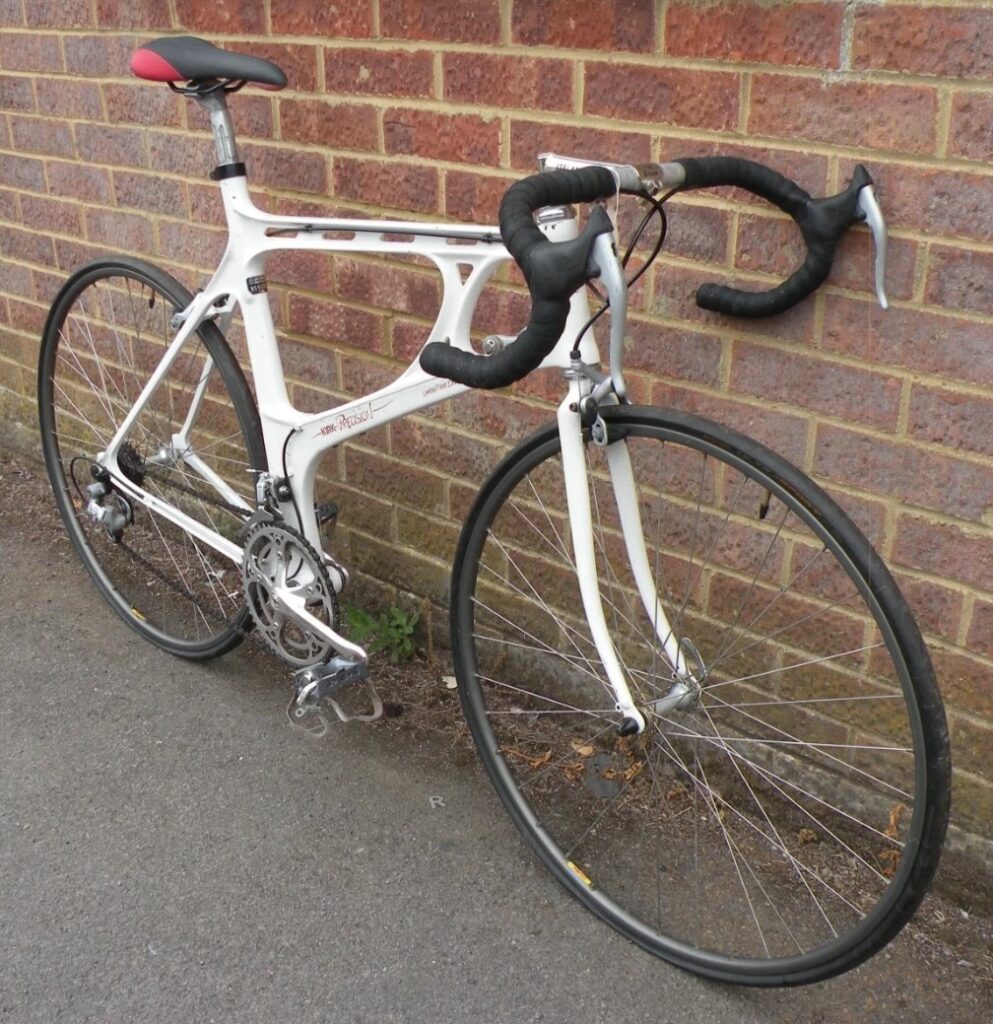
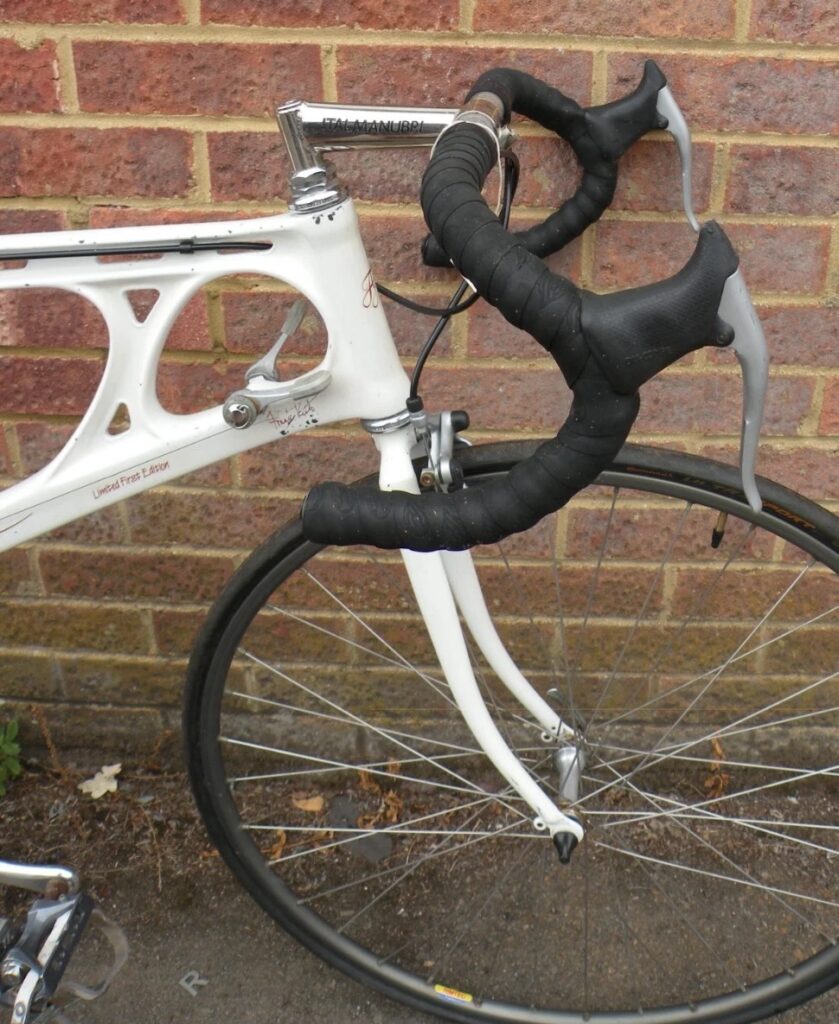
The fact that the frames comprised I beams rather than tubes gave them a distinctive look – the I beam top tube provided a convenient recess for the rear brake cable while the rear derailleur cable ran in the hollow of the chainstay – and Kirk bikes were raced by Phil Anderson and the Dutch TVM team in the world’s biggest races, including the Tour de France. Mountain bikes were included in the range too.
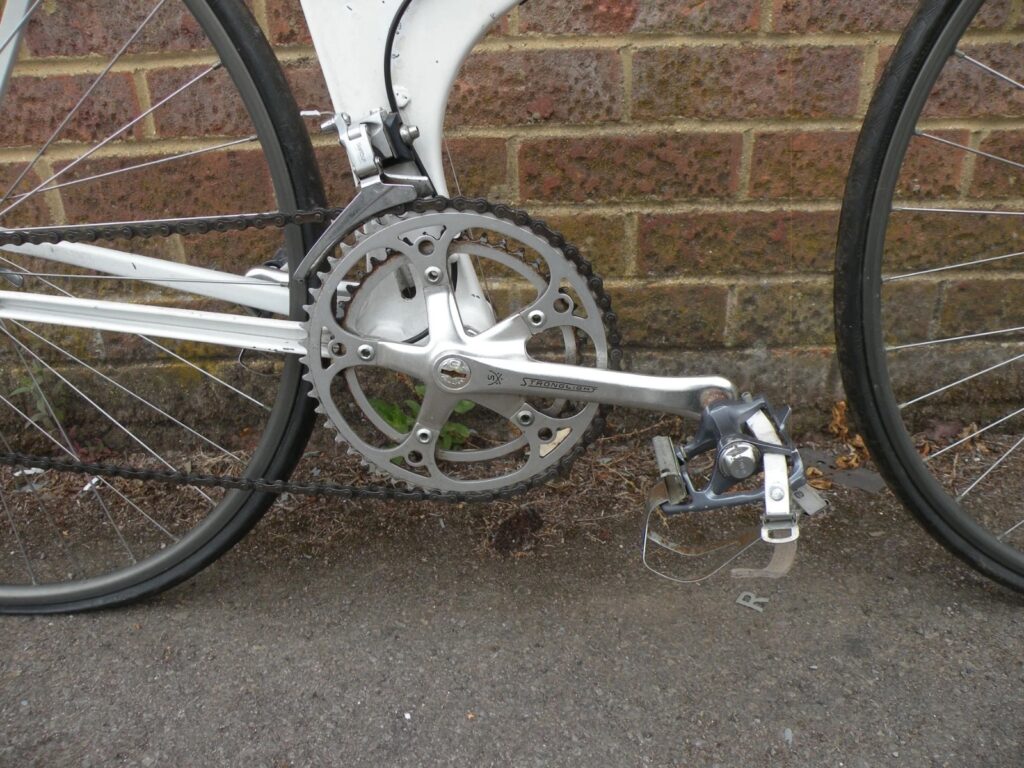
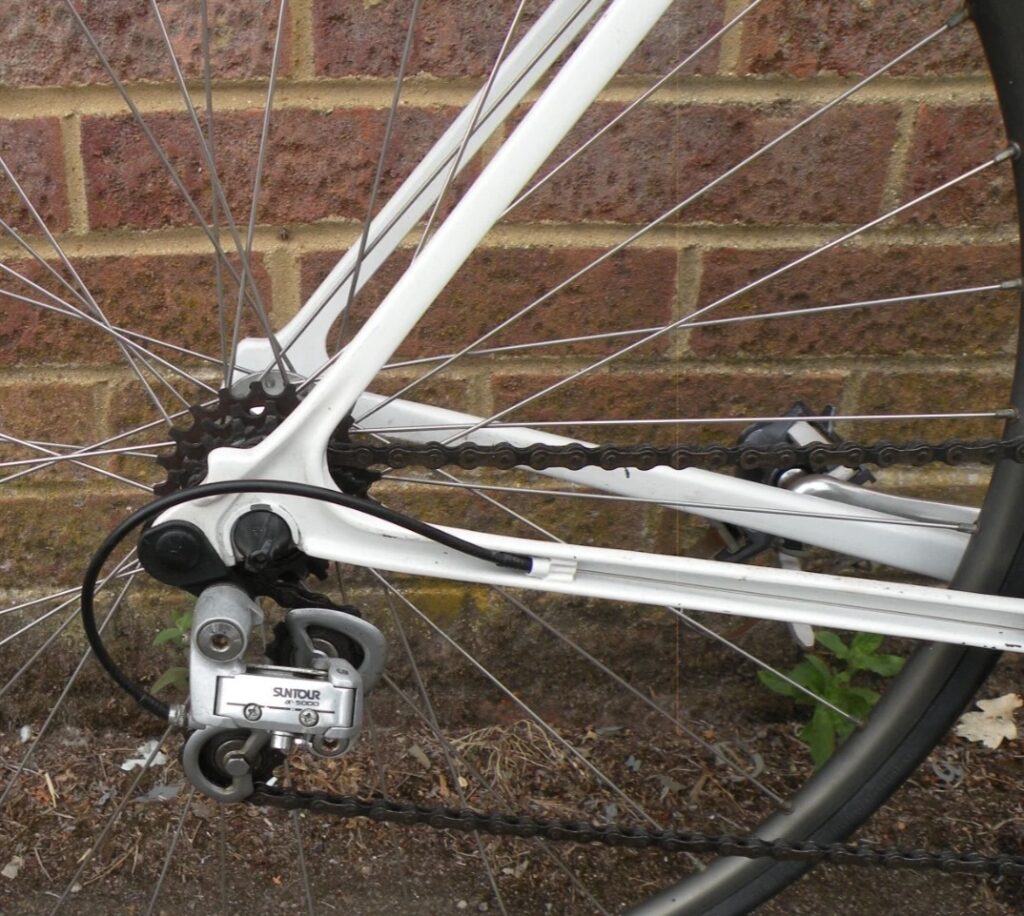
Alas, despite all the Kirk hype, there were reliability issues, and manufacturing ended in 1992. The bikes still have a loyal band of followers, though, and they come up for sale from time to time. You can buy this one from 1987 for £745 on eBay from Golden Age Cycles. SunTour down tube shifters, 2x 6-speed drivetrain, Dia-Compe Edge rim brakes… you’ll never be stuck for conversation at your mid-ride coffee stop.
See this Kirk Precision on eBay.
We caught up with Kirk Precision owner Graham Brodie to ask about the experience of owning one of these bikes. Here’s what he told us…

“As an avid bicycle collector, always on the lookout for things classic or quirky, I remembered the introduction of these things in the 80s, with the revolutionary idea that you could knock out a bike frame in 15 seconds with injection moulding of magnesium alloy. I recall Phil Anderson riding one in the Tour, and just as quickly as they arrived, they disappeared.
“The frames are heavy, and I think also prone to cracks, but as I wandered around the various stands in the 2016 Eroica Brittania, I spotted a very clean white Kirk Precision Limited First Edition on the Re-Cycle (bikes to Africa) stand. I drooled for a while, but they wanted a grand for it and I had set myself a limit of £250 to spend, so I talked myself out of the idea.
“The beer tent was very close by, and a little while later, after the effect of some quite strong local elderflower cider, I somehow wandered back to the stand, only to find they accepted credit cards, so I became the owner of a Kirk Precision, and hopefully a few bikes were funded for the charity.
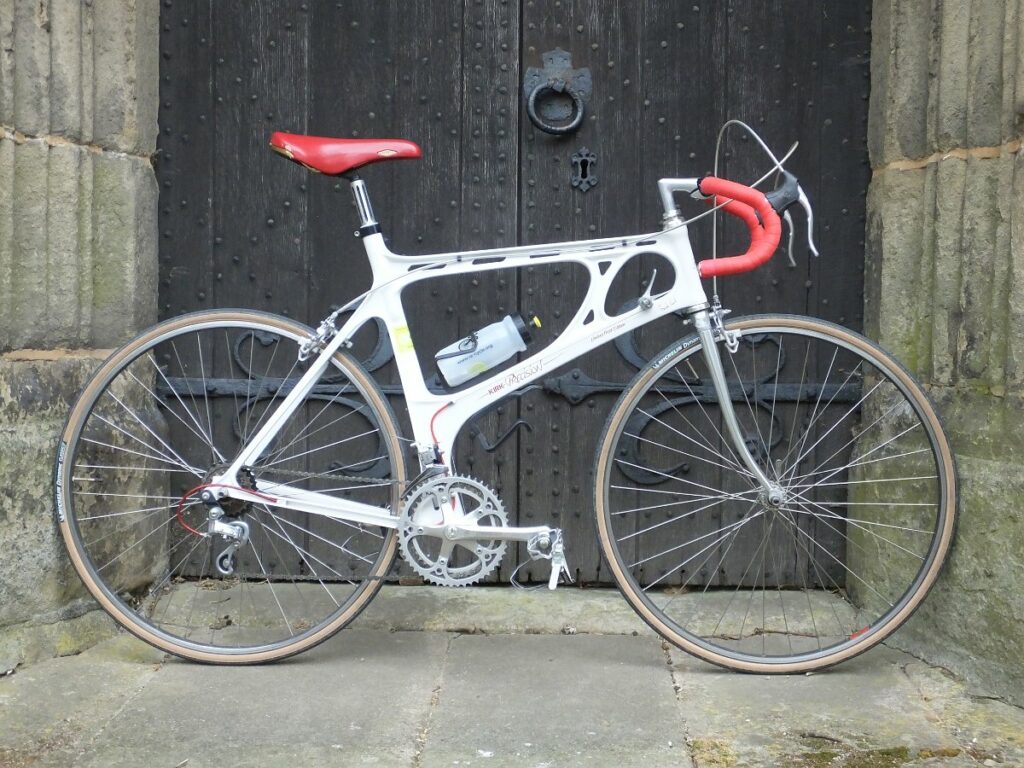
“Having bought it, I thought I’d better ride it, so my beloved vintage Carlton, which I’d taken up to do the ride, had its pedals taken off and transferred to the Kirk, which I rode on the 60-mile Eroica route. It rode a lot better than I thought it would – certainly not as responsive as a tubular steel frame, but I didn’t get rattled to pieces on the trails, it felt secure on descents, and climbed reasonably well despite its heavier weight.
“Since then, I’ve put a few other bits on it. The SunTour gears that many were supplied with are excellent and stay serviceable for decades.
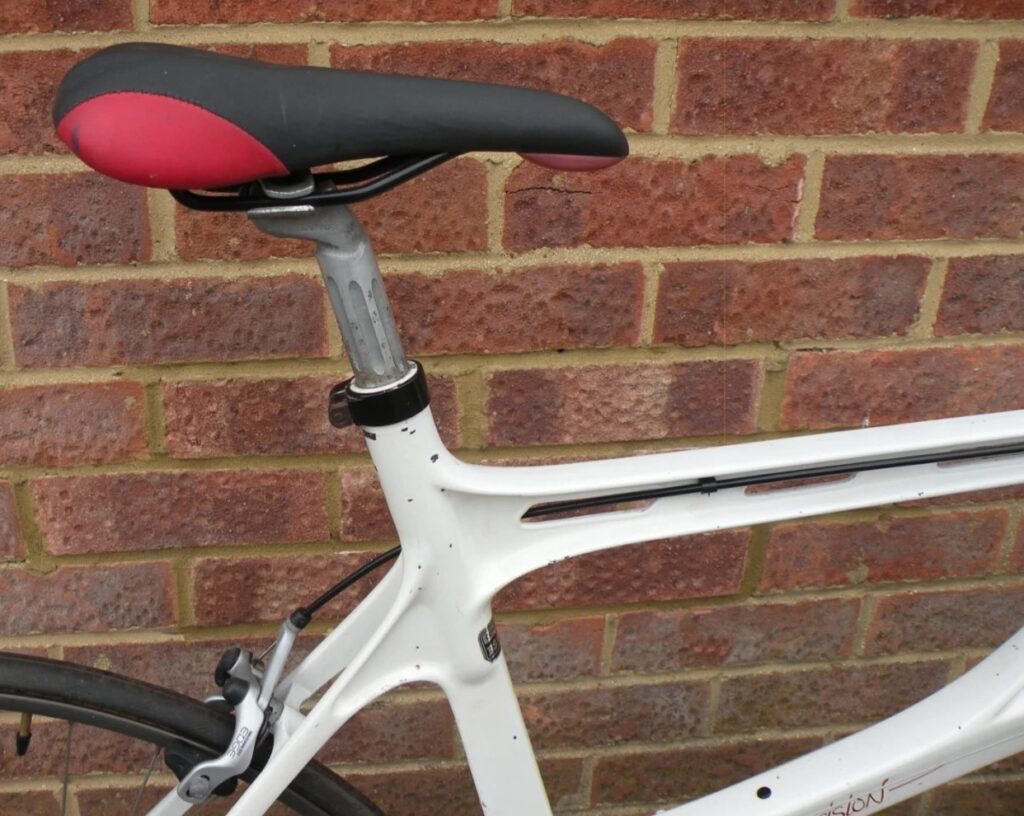
“I put a slightly blingier SR chainset on it with drilled rings, and some red anodised Wienmann brakes. Its longest ride was a local 100km Audax, the only issue being the saddle. Although it looks nice, my bum doesn’t like Rolls saddles.
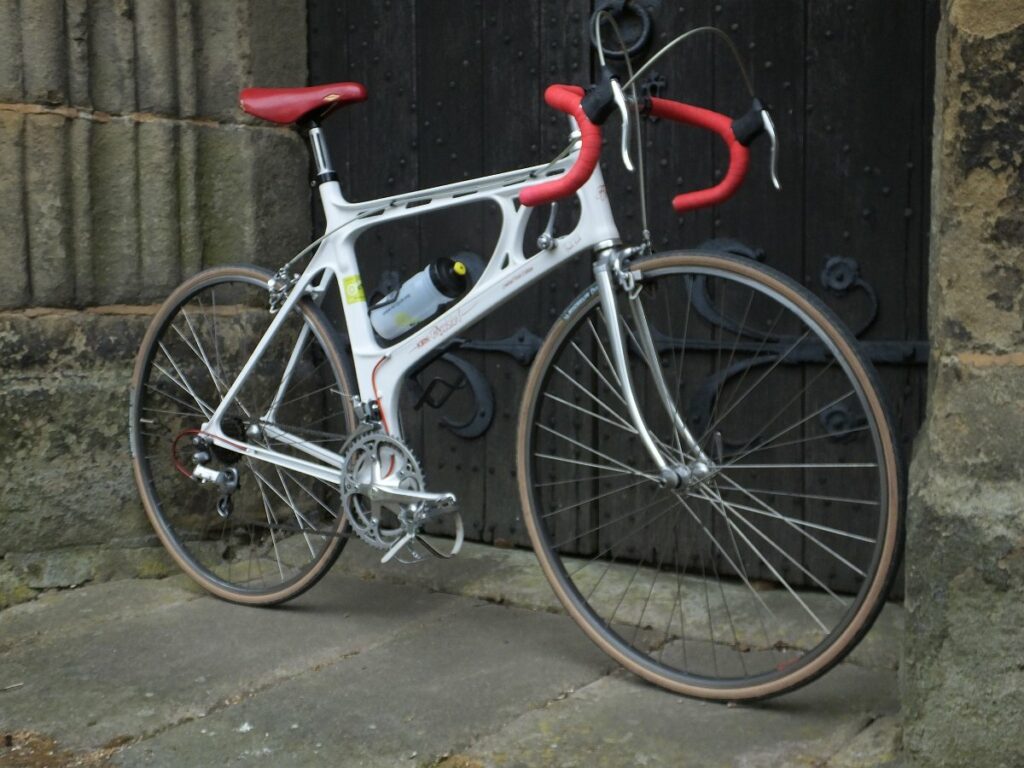
“It’s a fun bike to own. There are a few about at the moment and the market is flat so it’s a good time for buyers of vintage bikes. They are highly customisable as they were often supplied with different components – typically SunTour/Dia-Compe, so you could put on whatever works for your taste. With no lugwork, even a tatty Kirk would powder coat easily.
“If you see one with a fork painted the same colour as the frame, then it’s likely to be the original Vitus fork, renowned for being a bit weak and wobbly, so worth changing for something better. The rear hanger is quite specific, so make sure it isn’t damaged. This bike will still turn heads at the club ride cafe stop, or the town centre bike rack.
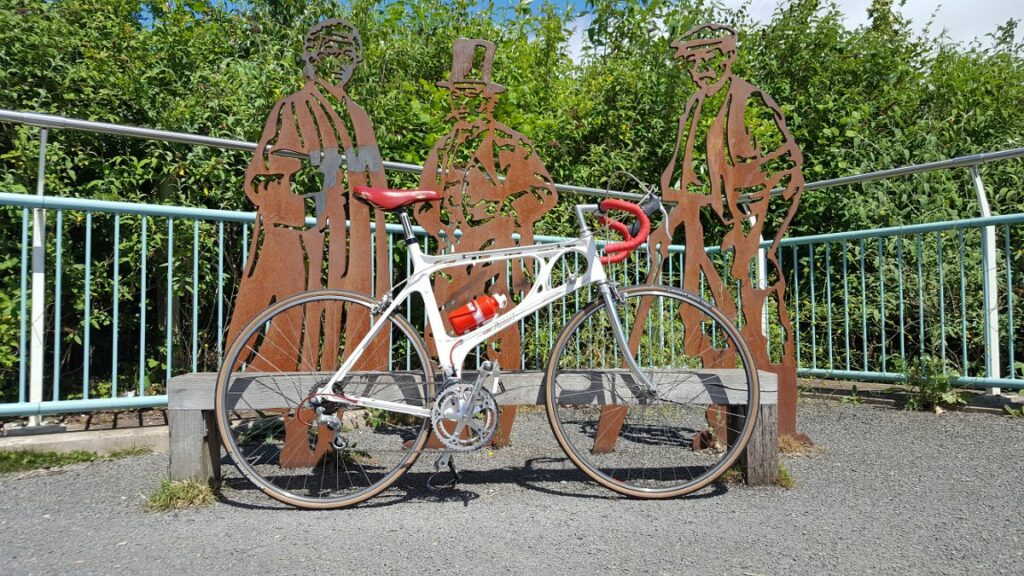
“Rumours that a Kirk Precision shouldn’t be taken near salt water [due to the magnesium], or that they can explode and catch fire in a crash are, I believe, just that. Nobody’s actually reported or seen this happen. Magnesium is a very flammable material, but you’d have to get it hot to get it going.”










8 thoughts on “Die-cast in seconds: check out the magnesium Kirk Precision”
There’s one on eBay right now
There’s one on eBay right now for £745, anyone tempted? 😅I’d probably commit sacrilege and put a wheeltop wireless groupset on it like my Triban 3 has 🙈
Boopop wrote:
Yeah, that would be the one pictured above, and linked to several times.
Cool. I knew about the MTB –
Cool. I knew about the MTB – criticised for being to flexible.
There is no chance of it catching fire, it’s a magnesium alloy and non explodey.
Brilliant anecdote — Graham
Brilliant anecdote — Graham Brodie vs cider.
2.4 kilograms – oooh a bit
2.4 kilograms – oooh a bit weighty..
I remember being highly
I remember being highly impressed by the design of the MTB when it came out. Magnesium alloys are very light and I’ve a set of Welgo magnesium pedals on my racing BMX that weigh very little indeed. Magnesium alloys can be subject to corrosion though and I remember this being an issue with magnesium rims and wheels used in motorcycling and racing cars. I’d be curious how the frames behave over time.
I owned one of the Kirk MTBs
I owned one of the Kirk MTBs with a magnesium frame and magura hydraulic rim brakes.
The brakes were very powerful and care was needed when using them.
The frame eventually cracked near the bottom bracket and that was the end of it.
Great bike while it lasted.
The shop I worked in in the
The shop I worked in in the late 80s stopped stocking them after warranty claims for cracked bottom brackets.