


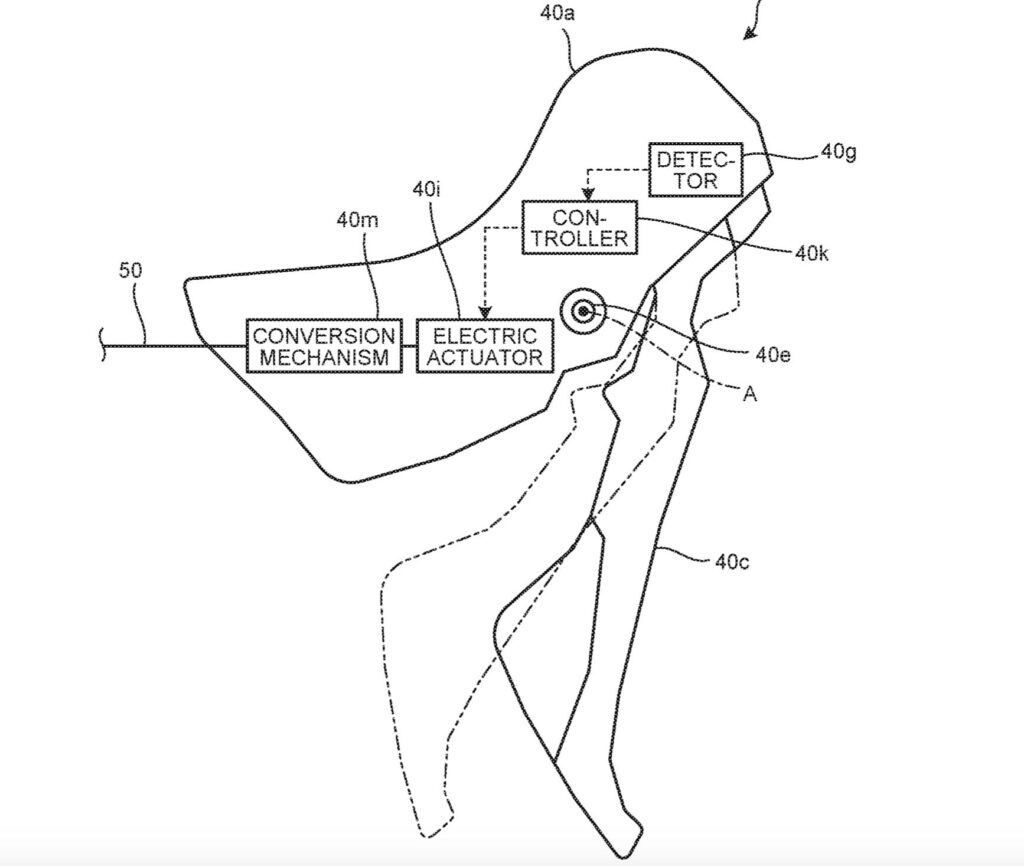

Shimano has patented a new system that uses electric power to operate hydraulic brakes, raising the possibility of this technology could be used on bikes that we all use in the future.
According to US Patent 11,007,987, dated 18 May 2021 – spotted by wheelbased.com and subsequently reported by BikeRadar – Shimano’s objective is “to provide a brake operating apparatus and a brake system that are capable of driving an existing brake apparatus by electric power”.
In short, when you pull the brake lever, a displacement sensor – such as a Hall element or the magnetic reed of a reed switch – detects that it has been moved and a strain gauge – which could be a piezoelectric element or magnetostrictive sensor – in a detector measures the force applied.
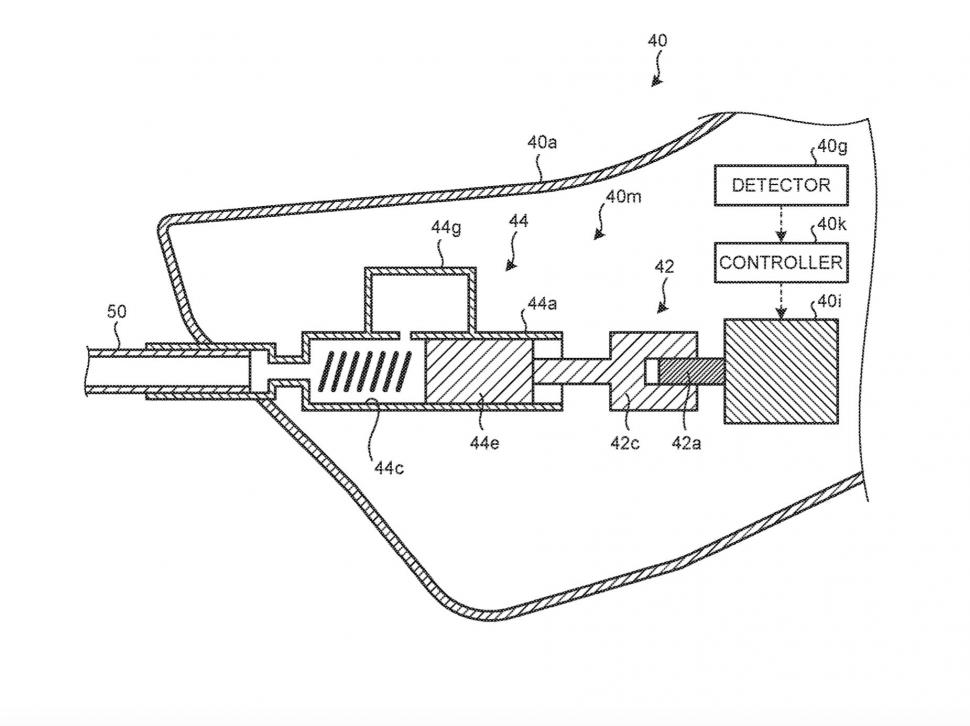
The lever “can provide the user with an operational feeling similar to that of a brake operating apparatus configured to drive the brake apparatus by human power”, says Shimano.
The detector converts the force into an electric signal which is sent to the brake controller, which is hardware that executes a software program.
“The electronic controller is a microcomputer that includes one or more processors and one or more computer storage devices (i.e. computer memory devices),” says Shimano. “The electronic controller is formed of one or more semiconductor chips that are mounted on a printed circuit board.”
The system includes a mechanism that “converts the power of the electric actuator into a driving force for the brake apparatus”. In short, it leads to movement of a piston inside a ‘cylinder bore’ that acts upon hydraulic oil to operates the braking. You have a hydraulic reservoir in the lever body
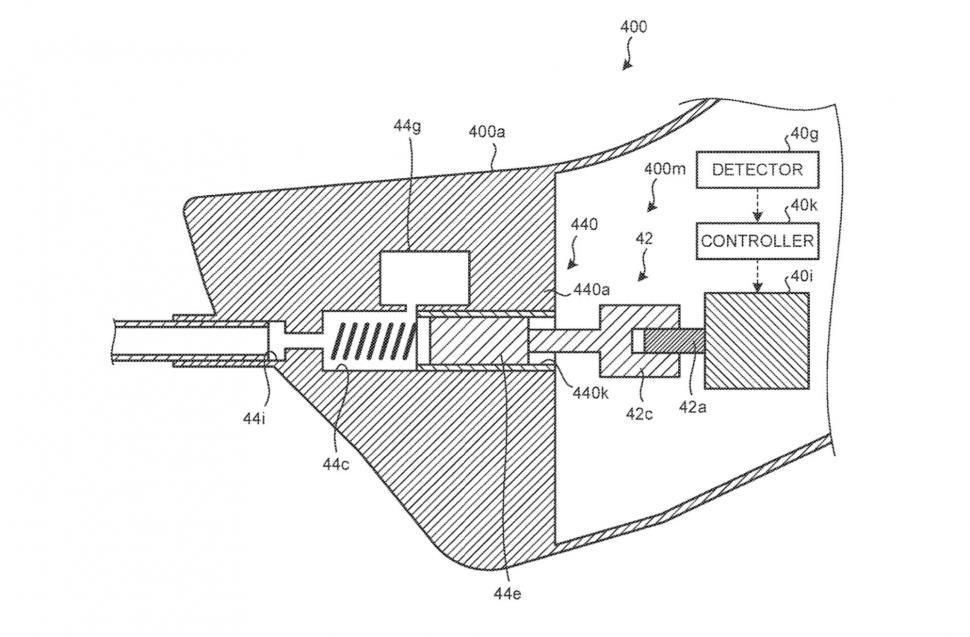
But why would you bother? All of this clever stuff happens up at the lever. Rather than the pulling of the lever acting directly on the hydraulic system, Shimano’s design sticks an electronic connection in the middle. If you’re going to the trouble of electrically operating a hydraulic braking system, the obvious question is: why not convert the electric power into “a driving force for the brake apparatus” somewhere else entirely – there are plenty of hollow elements in a bike – and save space at the lever?
Maybe Shimano feels that there’s no benefit in reducing the size of levers below what’s possible here and that this location is as good as any. Or perhaps it feels that its patent would cover alternative locations.
Of course, the fact that the patent exists doesn’t necessarily mean that we’re going to see Shimano unleash this design on the world any time soon… or at all. Shimano applies for and is granted loads of patents every year. Many come to fruition, many don’t. If you weigh up the potential benefit against the addition of complexity here, this one doesn’t strike us as particularly likely in the foreseeable future… but we could be wrong. As usual with patent, we’ll just have to wait and see.


-300x199.jpg "“He wants bikes in traffic lanes. Give him what he wants”: Cyclists urged to “slow every street down to bicycle speed” and ride in middle of lane amid premier’s war on cycle paths + more on the live blog")













22 thoughts on “Shimano patents electronic brake system”
As your final paragraph says,
As your final paragraph says, this looks to be more about securing patent and IP rights than something to be produced to this design.
Other questions that come to mind are how will they create resistance and feedback in the lever so a rider can feel their braking and will the brakes, or front brake at least, have ABS.
The feedback can be
The feedback can be replicated with springs / or some dummy gas/hydralic valve.
My first thought was it was wifi that might run on the same principle of my doobell where it is wireless but doens’t rely on batteries in the bell itself as the button presses generate the power for the signal. However the base units (brakes) do need ext power whilst waiting to recieve the signal.
Potentially they can do force
Potentially they can do force feedback with low power requirements. Like the rumble packs on old console controllers
Commercial airliners have fly
Commercial airliners have fly-by-wire control systems that have artificial feel systems replicating the aerodynamic control forces at the control column, which conventionally was attached by cables and pulleys to the control surfaces, but often now is just a switch generating electrical signals sent to the control surface actuators.
So definitely possible, it’s just a matter of how complex and how heavy it would be and if that is worthwhile…
IP Farming is a big part of
IP Farming is a big part of Shimano’s business. It’s why there are so few competitors in the bike drive-chain market. Shimano have patented almost all the essential parts (which is why Sram and Campag use such different mechanisms) and refuse to license them. In about 15 years we’ll see some decent, cheap bike parts because the current round of 105/Dura Ace level patents will age-out, and lets be honest, there’s not much that could be better with the R7000 105.
fwhite181 wrote:
An interesting proposition. Do you have any details?
I’m impressed if anyone is currently able to patent-farm an invention with over a century of prior art.
I’m pretty sure roller chains are now ubiquitous enough that there are few brands out there because even a cheap, unbranded chain is trustworthy enough for most purposes. Has there been a truly patent-worthy advance in decades? Or just marketing-worthy weak patents?
If I’m wrong, please give us some evidence, because it’d be really interesting (to me, not normal people, etc).
I’m a patent examiner… I
I’m a patent examiner… I spend all day trawling these things. I’m a bike nut so I’ve hunted a few of the more irritating examples: Shimano trad mechanical (of the current generation) EP2546128B1 – Bicycle shift operating device – Google Patents 2011) or Di2 (US9682744B2 – Bicycle shifting control apparatus – Google Patents), Shadow Derailleur (US8882618B2 – Rear derailleur – Google Patents)
Sram are at it too…have you seen SRAM’s power link (US20070197333A1 – Closing Link For A Bicycle Chain – Google Patents) or narrow-wide (US20130139642A1 – Chainring – Google Patents).. The flat-top chain, that’s patented (can’t find the number, I didn’t note it down!)
The reason the minor players aren’t just making Shimano 105 for £250 (which it could realistically be made for given the materials involved) is that it’s entirely patented..
Unfortunately, very little
Unfortunately, most of the critical improvements have only been made in the last 15 years or so. It wasn’t really until the 5700/5800 generations of Shimano group sets that shifting in mid-level groupsets got to the point that most reasonably fit club-riders wouldn’t really ask for more performance. But that generation were all patented in about 2010, so now it won’t be until 2030 that other players can use the basic apparatus without substantial modifications.
Exactly that. It’s a business
Exactly that. It’s a business move not a plan to sell this any time soon or maybe even ever. I wish Road CC would get that and stop publishing story after story about Shimano patents.
Do you need feedback in
Do you need feedback in brakes? I’m not sure how much is in my fingers, and how much is in the feel of the bike.
Dave Dave wrote:
I’m pretty sure that you do need feedback at the lever, because that’s the most directly sensed point. If you had really smooth brakes and no feedback, it would take you too long to process whether enough speed had been lost, and sensing current deceleration isn’t easy if reliant on things like increased hand pressure as your weight shifts forward.
This (for me, anyway) is a part of switching between rim braked and disc braked bikes – the feel at the lever is quite different and that’s what my brain naturally focuses on to start with.
On my cantilever braked bike, most of the feedback came from the epic fork judder before I switched to a hanger on the crown…
So let me get this right –
So let me get this right – they have replaced the brake wire with….a brake wire. Its also not clear what the failsafe mode is here.
Now if it was wireless AND failsafe – that would be worth patenting.
not sure how you can have
not sure how you can have fail safe in this instance. Safe is just the right amount of braking modulation.
In this instance, failsafe
In this instance, failsafe probably means if the electrics fail, further force or movement of the brake lever will mechanically move the hydraulics. So you always have braking available. As mentioned by Duncanap above, ABS brakes would be brilliant if possible.
I’d have thought in this
I’d have thought in this context fail-safe means to apply the brakes progressively if signal is lost. Fail-safe may not be the right standard to use. Ask a safety engineer, this is a highly specialist subject 🙂
Could it be a means to
Could it be a means to introducing anti-lock brakes? ABS technology on motorbikes is pretty incredible now, BMW claim you can slam on your front brake on full lean and their system (made in collaboration with Bosch) will deal with it.
Then they would need a sensor at the wheel checking for under rotation, and a brain to allow more of less braking pressure through the actuator.
Bosch do make ABS for ebikes
Bosch do make ABS for ebikes and I’ve seen another system for ebikes but can’t remember the manufacturer.
Here’s a link to the Bosch system. Looks a bulky for road bikes at the moment.
https://www.bosch-ebike.com/en/products/abs/
Yup. This thing screams
Yup. This thing screams “pathway to antilock brakes” to me.
Brilliant if your battery
Brilliant if your battery dies on top of the Galibier, as long as you didn’t start the descent yet.
I expect this patent is just safeguarding for an electric bike future where bicycles merge with motorcycles and need ECUs, IMUs and all the other shit unnecessary for riding a traditional bicycle
“Safeguarding for an electric
“Safeguarding for an electric bike future” +1
The only practical
The only practical implementation I can think of is TT bikes.
If the brakes were replaced with very small buttons on the TT bars that in turn activated a hydraulic system located within the frame you’d possibly save a bit of drag and allow a more aero position to be maintained for longer.
I can’t see the savings being very big though. Marginal gains and all that.
Alternatively it could automatically select the braking for you so you’d just yank on the levers and it would choose how much power to send to the front and rear brake based on the force you applied. Could then get an app alert if your brakes needed servicing too.
Given how often I’ve seen Di2 and etap fail at cycling races I’m not sure I’d trust it anytime soon though!
This looks like the basis for
This looks like the basis for a power-brake – like in motor vehicles, where the brake would not fail (entirely) even if the servo fails. The actuator(?), item 40i, would just need to be installed in a floating way, so that it could be pushed to the left by the break lever, to provide a fail-save, non-power backup.
Advantages could be much lower lever forces, or, with the same force levels, a much increased travel of the pistons – solving the issue of rubbing brake pads (as experienced by a certain C. Froome). Such a power brake could also implement an anti locking system.
Ideally, the power brake would be used in an electric bicycle – with ample of (electric) power available, with often less skilled riders, and a frequent need for every day use – even on bad and slippery roads.
Let’s hope Shimano turns this idea into a product!