



The UCI’s plan to test out controversial new rules on gear restrictions at next week’s Tour of Guangxi in China appears to be in jeopardy, after SRAM’s legal challenge against the “fundamentally unfair” policy was upheld by the Belgian Competition Authority, who have ordered cycling’s governing body to suspend the proposed trial with immediate effect.
The UCI, however, has hit back at the ruling, noting its “surprise at the intervention of a competition authority on a subject desired by all stakeholders of cycling” and claiming that rider safety “does not appear to be a shared objective”.
Last month, we reported that SRAM had launched legal proceedings against the UCI over the governing body’s proposed gear restriction regulations, which the component manufacturer argued violates EU competition law and will unfairly impact and penalise the brand’s riders and teams, without increasing safety during races.
As part of a raft of controversial safety regulations announced earlier this year, the UCI planned to trial its new maximum gearing rule at the final WorldTour event of the season, the Tour of Guangxi in China, which starts on 14 October, as part of its attempts to limit top speeds and reduce danger in the peloton.
This new rule, a variation on the old junior gears system, marks the first technical gear limitation in modern professional cycling and will cap the distance covered per pedal revolution to 10.46 meters – effectively limiting riders to a maximum gear ratio of 54×11 on 700c wheels.
> UCI to trial maximum gearing rule — but will it really make racing safer?
Though we’ve seen many riders mix and match larger chainrings from other brands on their bikes in recent years, Shimano, Campagnolo, and FSA now all have maximum gear ratios of 54×11, meaning they will be largely unaffected by the rule.
However, the trial system will significantly impact SRAM-sponsored teams, whose riders use a 10-tooth smallest cog on the rear cassette. Under the new 10.46 metre cap, any combination exceeding 54×11 is now prohibited.
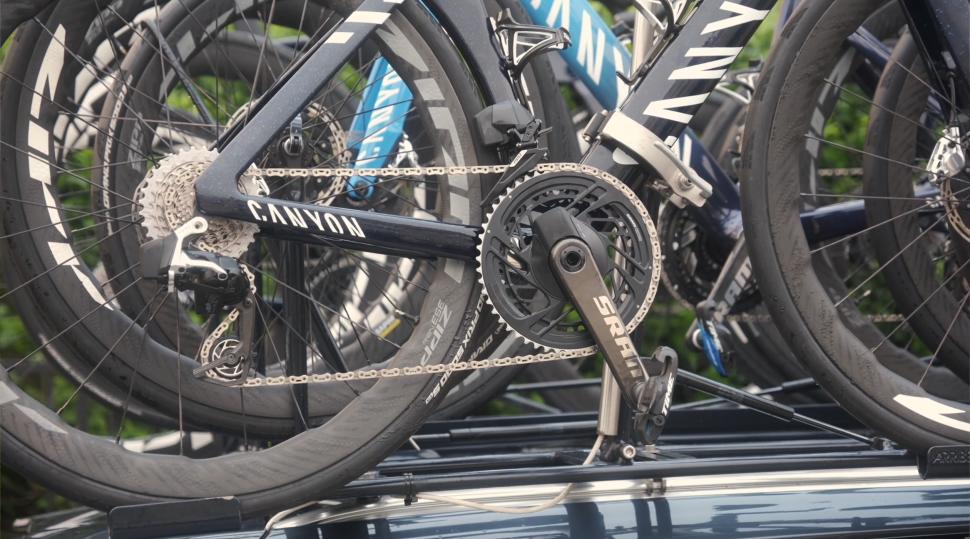
This means SRAM riders using a 10-tooth cog will be limited to a maximum 49-tooth chainring, ruling out the 50T and 54T setups that are common in the pro peloton, and the 54×10 configuration favoured by many of SRAM’s professional teams.
In its complaint to the Belgian Competition Authority (BCA), SRAM argued that the proposed protocol was adopted by the UCI without consultation, transparency, or any safety justification, disadvantages SRAM-equipped riders in races, and distorts the drivetrain market, violating EU competition law.
In a statement issued on Thursday evening, the BCA announced that it has “decided to impose interim measures aimed at suspending the technical standard adopted by the International Cycling Union (UCI) limiting the maximum gear ratio allowed in professional road cycling events to a transmission ratio of 54×11.”
“The BCA recognises the legitimacy and importance for a sports regulator such as the UCI to ensure the safety of athletes,” the authority said.
“However, the procedures for determining technical standards enacted for this purpose, as well as the related tests, must meet essential conditions of proportionality, objectivity, transparency and non-discrimination in view of the economic consequences of these standards. They cannot result in an undue restriction of competition between sports equipment suppliers.
“The BCA considers prima facie that the Maximum Gear Ratio Standard and the procedures governing its adoption by the UCI do not meet the required conditions of objectivity and transparency. The standard further generates disproportionate negative effects on a sports equipment supplier, namely SRAM.”

The statement continued: “SRAM is one of the two main suppliers of transmission systems for road bikes used by professional riders and the only one that does not currently have a product meeting the requirements of the Maximum Gear Ratio Standard.
“The standard, adopted under disputable conditions, is likely to cause harm to SRAM that is serious and difficult to repair, thereby justifying its suspension. The harm also extends to professional cycling teams equipped with SRAM transmission systems.”
Noting the “urgency of adopting interim measures”, with the Tour of Guangxi set to start on Tuesday, the BCA said it has ordered the UCI “to suspend immediately, and no later than 13 October, the implementation of the Maximum Gear Ratio Standard”.
> UCI “puzzled” by SRAM’s restricted gearing legal fight
Following the BCA’s ruling, the UCI issued its own statement to confirm that it will appeal the ruling, while hitting back at the competition authority and noting its “surprise” at the intervention (and, rather bizarrely, the international character of the complaint), while also criticising SRAM and accusing it of failing to prioritise rider safety.
“As a result of the provisional measures imposed by the BCA, the test planned for the Tour of Guangxi will not take place and the Test Protocol is currently suspended,” the UCI said.
“The UCI expresses its surprise at the intervention of a competition authority on a subject desired by all stakeholders of cycling, the scope of which was limited to analysing the effects that limiting gear ratios may have on riders’ speed and therefore on safety, especially considering that the decision is issued by a Belgian authority responding to a complaint from a US company against a Swiss sports association regarding a test to be carried out on Chinese territory.
“The UCI deeply regrets that riders’ safety does not appear to be a shared objective with those who challenged the implementation of the Maximum Gearing Test Protocol before the said Authority. However, the UCI will continue to act in the interests of the safety of riders, other members of the peloton and spectators.
“The UCI announces that it will appeal the above-mentioned decision. Changes may also be made to the Testing Protocol to allow for the implementation of the tests desired by all stakeholders in professional road cycling.”
However, the UCI’s insistence that it is putting the safety of the peloton first was almost immediately ridiculed by EF Education-EasyPost Jonathan Vaughters, an outspoken critic of the governing body’s recent safety regulations, including its ill-fated decision to trial GPS trackers at the women’s Tour of Romandie in August.
“Perhaps things like making sure parked (and still moving) vehicles are not on the race course, blind corners with rock piles in the apex are not on race courses, and motorcycles aren’t part of the peloton take precedence over gear restrictions, sock lengths, and handlebar width?” the American posted on social media.
Of course, Vaughters and SRAM aren’t the only ones to criticise the UCI’s proposed maximum gearing policy.
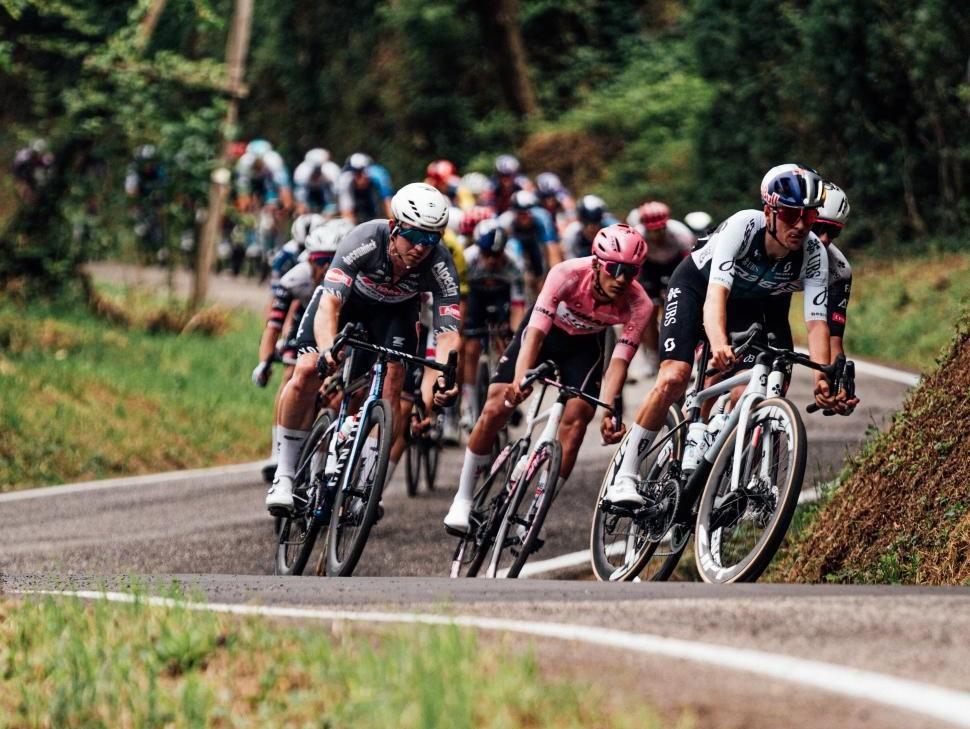
In August, Tom Pidcock claimed that limiting gears would only make the sport more dangerous by crowding the road on descents, while Dan Bigham claimed at the Tour de France that “restricting gear ratios simply distracts from making meaningful changes to rider safety”.
“From my analysis, for reducing ratios to have an impact, we need to presume professionals would adhere to unrealistic cadence limits that aren’t supported by the literature,” the British aerodynamics expert, who now works for SRAM-equipped Red Bull-Bora-Hansgrohe, said in July.
“It’ll impact on as little as 0.01 per cent of a race and will arguably reduce speeds by no more than 0.5kph. All of this to change entire groupset design? It really doesn’t seem effective to me.”


















15 thoughts on “SRAM wins legal challenge to suspend “harmful” gear restriction trial – but UCI hits back by claiming “riders’ safety does not appear to be a shared objective””
I am not convinced the Watt
I am not convinced the Watt savings of modern race bikes are the prime cause of increased risks to the competitors. I suspect it is more to do with racing tactics causing bunching and I wonder if having an earpiece in one ear is affecting the senses and reactions of riders.
Going back 20 years, I don’t recall watching many sprint stages ending where 4 or 5 GC teams were on the front of the peleton. And again, it used to be GC contenders who would position themselves in advance of a climb etc., now it is whole teams vying for the best position.
UCI’s
ministry of truth…is an… interesting characterisation, given that one of said stakeholders just sued to prevent it (never mind any others who’ve spoken against it).
To defend the UCI (*holds
To defend the UCI (*holds nose*), it’s poorly expressed but I think they’re talking about making pro racing safer in general rather than this specific measure.
Yes but as usual the UCI are
Yes but as usual the UCI are only talking about making pro racing safer instead of doing something that might actually have that effect.
This is just daft. Are we
This is just daft. Are we really meant to believe SRAM can not produce a cassette with an 11T smallest sprocket, when they currently produce one with 10T?
Presumably that then puts
Presumably that then puts SRAM a very marginal disadvantage compared to the equivalent Shimano and hence not wanting to do it? I might be misremembering I thought there was already a 11t lowest cassette in the AXS compatible range too.
How exactly does it
How exactly does it disadvantage SRAM, if SRAM teams have to run 54×11 as the maximum gear ratio, just like the other teams?
Because SRAM design their
Because SRAM design their road cassettes and chainrings around a 10t smallest cog. 50/10 exceeds the UCI’s proposed max of 54/11, so they would either have to stop producing cassettes with 10t cogs or produce a 49t chainring, all of which has cost implications for retooling and/or affects the marketing usp of their road cassette and chainring combos. Also 49/10 is 0.01 smaller than 50/11, so arguably even to do so would put their riders at slight disadvantage. In competition, even the slightest margin counts. Noone wants to give anything away.
Paul J wrote:
The highest gear allowed would be 54 x 11 i.e. a ratio of 4.9.
AIUI, SRAM supply a 50T or a 48T chainring combined with a 10T smallest sprocket. So they could comply with the rules by making a 49T chainring.
Other manufacturers don’t have to do anything, so SRAM is being disadvantaged. Whether that’s a significant disadvantage, I couldn’t really say. Is it really that hard to make a 49T chainring?
SRAM currently make an 11T 12
SRAM currently make an 11T 12-speed cassette, the CS-PG-1231-D1. Granted, that’s a PG freehub “driver”, not the XD on their latest stuff, but most wheel hubs you can swap around the freehub.
A lot of the issue here is that SRAM _love_ changing their standards every few years and making stuff incompatible. Even so, we’re talking swapping the freehub and cassette in most cases and worst case swapping a rear wheel. SRAM clearly _have the tooling_ to make 11T 12-speed cassettes.
Are the UCI now to be strait-jacketed in how they regulate racing technical rules, cause the manufacturers like to change their standards regularly to lock customers on to their upgrade treadmills?
They can, but they don’t want
They can, but they don’t want to as it makes their XD freehub pointless. They can also just give the teams a smaller chainring, which they used to insist was no different thanks to their 10t cassette, but the riders didn’t like it so they rereleased Standard chainsets. One big driver for SRAM 10t and smaller chainsets was their struggles with front derailers, smaller chainsets means they can reduce the to a more managable jump to 13 rather than the 16 drop of traditional standards, they’ve pumped tons of resourcea into their XD 10 tooth sytem hence the reluctance to undo it all
Interesting stance by the UCI
Interesting stance by the UCI. Regulators tend to react quite badly to being told they dont have any juristiction.
“Shimano, Campagnolo, and FSA
“Shimano, Campagnolo, and FSA now all have maximum gear ratios of 54×11”
Campagnolo has a maximum on 54×10, but crucially they offer both a 10t and an 11t cassette while SRAM do not currently
The SRAM point of view is
The SRAM point of view is actually being overlooked by some, for them this in not about whether or not they could produce an 11 tooth top sprocket or a 49t chainring it is about losing a USP and so potentially losing sales, and in this economical day and age why should they take that hit? I think also someone needs to listen to the riders whether they are SRAM equipped or not, if lower gearing results in closer bunching on descents one riders mistake will have greater consequences. The thing is the UCI want to be seen to be doing something aimed at rider safety, this is all about appearances. As Jonathan Vaughters says what they ought to be looking at is better course supervision and I think supply of special barriers for the outside of corners in the last 5 kilometres of UCI ranked races, think along the lines of tech pro for F1, but adapted for cycling so that riders who crash don’t have their races or indeed careers ended by serious injury and spectators are not hurt. The problem for the UCI is that all requires physical and monetary investment. I think they are more worried about their stakeholders dividends than they are about rider safety, if you want to talk about stakeholders.
It would be daft if UCI
It would be daft if UCI technical regulations have to be hamstrung by the marketing departments of the groupset and frame makers, and their intense need to keep changing standards every few years, to ensure that when people want to change things on their bike they have to buy most of a new bike, if not a new bike.